


 |
市場調查報告書
商品編碼
2125548
馬來西亞電信行動網路業者:市場佔有率分析、產業趨勢與統計及成長預測(2026-2031 年)Malaysia Telecom MNO - Market Share Analysis, Industry Trends & Statistics, Growth Forecasts (2026 - 2031) |
||||||

※ 本網頁內容可能與最新版本有所差異。詳細情況請與我們聯繫。
根據 Mordor Intelligence 的數據,馬來西亞電信行動網路營運商 (MNO) 市場在 2025 年的價值為 70.2 億美元,預計到 2031 年將從 2026 年的 72.3 億美元成長到 83.6 億美元,在預測期(2026-2031 年)內的複合成長率為 2.9%。
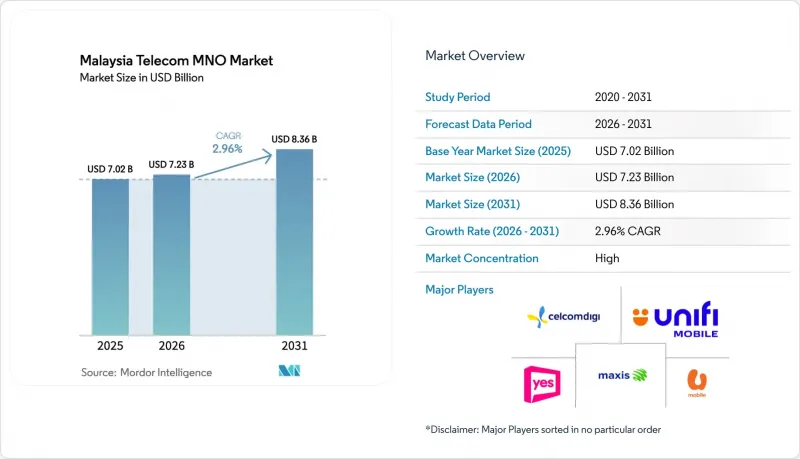
本報告按服務類型(語音服務、數據和網際網路服務、通訊服務、物聯網和機器對機器服務、OTT和付費電視服務等)和最終用戶(企業和消費者)進行分類。市場預測以價值(美元)和數量(用戶數)為單位呈現。
馬來西亞電信網路營運商 (MNO) 市場的趨勢和見解。
基於JENDELA和雙網模式擴展5G覆蓋範圍
從單一發網路向競爭性雙網路結構的轉變將徹底改變所有電信業者的基礎設施經濟格局。馬來西亞國家數位公司(Digital Nasional Berhad)的目標是到2024年12月覆蓋80.2%的人口,而U Mobile建造第二個全國性網路的計畫將提供冗餘,從而降低批發價格並提升服務品質。 U Mobile與中國移動國際合作,承諾在18個月內安裝5000至7000個5G基地台。這項雄心勃勃的計畫旨在加速5G部署,同時緩解人們對壟斷瓶頸的傳統擔憂。這種雙網路部署也將釋放頻段用於民用5G切片,從而支援在工業領域部署對延遲敏感的應用,例如機器視覺檢測和自動物料搬運。擺脫單一供應商的限制,將使參與企業的馬來西亞行動網路營運商(MNO)有更大的空間在差異化的5G費率方案和服務等級協定(SLA)方面進行創新,而不是僅僅依賴價格競爭。
人均行動數據消費量增加,ARPU值上升
在4K影片串流、雲端遊戲和人工智慧行動應用的推動下,預計每月數據使用量將從2024年的21.6GB激增至2029年的51.9GB。為了因應這一成長,營運商正逐步淘汰限速的「無限流量」套餐,轉而推出速度不限的5G套餐。以Astro與Netflix和Disney+Hotstar的捆綁套餐為例,OTT(網路電視)合作正在建立一個極具吸引力的內容生態系統,有助於提高客戶留存率並降低客戶解約率。然而,營運商正在尋求一種微妙的平衡。目前所有業者普遍提供的50馬幣以下的「無限流量」套餐,如果無法妥善實施基於速度的差異化策略,則可能削弱ARPU(每位用戶平均收入)的潛在成長。成功的關鍵在於引導用戶選擇高速套餐,同時將邊緣網路遊戲和超高清體育賽事串流等專屬服務功能限制在價格較高的套餐中。
無限流量套餐的激烈競爭給利潤率帶來了壓力。
50馬幣以下的無限流量套餐價格已跌至谷底,盈利受到嚴重擠壓,而此時5G基礎設施投資正處於高峰期。 U Mobile僅限週末使用的5G預付套餐(25馬幣)和CelcomDigi同價位的3Mbps套餐迫使所有營運商紛紛效仿。由於無限流量已包含在基礎價格中,基於速度的額外收費變得毫無意義,因此利潤率面臨巨大壓力。雖然在流量使用量達到約200GB後實施的公平使用限速有助於緩解網路堵塞,但用戶越來越將限速視為“違約”,這可能導致用戶流失和社群媒體上的批評。為了恢復盈利,營運商目前正將重心轉向需求彈性低、支付意願高的企業合約、內容捆綁銷售以及金融科技相關業務。
細分市場分析
至2025年,數據和網路服務將佔馬來西亞行動網路營運商(MNO)市場佔有率的53.62%,預計到2031年將以2.99%的複合年成長率持續成長。超高清串流媒體、整合通訊和雲端遊戲帶來的流量成長,迫使營運商擴展回程傳輸並部署營運商級邊緣節點。語音服務將繼續佔馬來西亞MNO市場佔有率的19.18%,這得益於漫遊需求的復甦和企業統一通訊套餐的普及,但其複合年成長率將低於數據主導行業,為2.70%。通訊、附加價值服務和批發傳輸總合佔總收入的16.04%,並以2.98%的速度成長,這主要得益於超大規模資料中心營運商不斷成長的頻寬需求。
儘管物聯網 (IoT) 和機器對機器 (M2M) 業務僅佔總收入的 5.05%,但其複合年成長率 (CAGR) 高達 3.11%,這主要得益於 JENDELA 走廊內的工業 4.0藍圖和智慧城市試點計畫。隨著製造現場主管轉向利用高密度感測器網路的預測維修系統,馬來西亞電信網路營運商 (MNO) 市場的物聯網模組市場規模預計將會擴大。 OTT 和付費電視服務佔總營收的 6.11%,並維持著 3.05% 的成長動能。 Astro 與 Netflix 和 Disney+Hotstar 的直接收費夥伴關係表明,網路營運商可以透過內容聚合來提高每位用戶平均收入 (ARPU)。
其他好處:
- Excel格式的市場預測(ME)表
- 3個月的分析師支持
目錄
第1章:引言
- 研究假設和市場定義
- 調查範圍
第2章:調查方法
第3章執行摘要
第4章 市場狀況
- 市場概覽
- 監理與政策框架
- 頻段狀況和競爭對手擁有情形
- 通訊業生態系統
- 宏觀經濟與外在因素
- 波特五力分析
- 主要行動網路營運商 (MNO) 的關鍵績效指標 (KPI) (2020-2025)
- 行動用戶數量和普及率
- 行動網路使用者數量和普及率
- 按接入技術分類的SIM卡合約數量和滲透率
- 蜂巢式物聯網/機器對機器連接數
- 寬頻連線數(移動和固定)
- ARPU(每位用戶平均收入)
- 每用戶平均數據使用量(GB/月)
- 市場促進因素
- 利用 JENDELA 和雙網路模式擴展 5G 覆蓋範圍
- 人均行動數據使用量增加,ARPU值上升
- 政府主導的光纖部署計畫(NFCP、JENDELA)
- 製造業叢集對專用5G和物聯網解決方案的需求
- 電信業者(Telco)和OTT服務供應商的內容商品搭售正在促進付費電視和資料通訊的提升銷售。
- 針對遊客和新居民使用 eSIM 卡的計劃正在促進預付收入的成長。
- 市場限制因素
- 無限資料方案的激烈價格競爭給利潤率帶來了壓力。
- 高頻使用費和普遍服務義務附加費給現金流帶來了壓力。
- 克蘭谷以外的光纖回程傳輸瓶頸
- 圍繞DNB股份出售的政策不確定性
- 技術展望
- 電信業關鍵經營模式分析
- 定價模型和定價分析
第5章 市場規模與成長預測
- 整個通訊業的收入和每用戶平均收入
- 服務類型
- 語音服務
- 數據和網際網路服務
- 通訊服務
- 物聯網和機器對機器服務
- OTT和付費電視服務
- 其他服務(附加價值服務、漫遊和國際服務、企業和批發服務等)
- 最終用戶
- 公司
- 消費者
第6章 競爭情勢
- 市場集中度
- 主要供應商的策略性舉措和投資(2023-2025 年)
- 2024年行動通訊業者(MNO)市佔率分析
- Product Benchmarking Analysis for mobile network services
- MNO snapshot(subscribers, churn rate, ARPU, etc.)
- 行動通訊業者(MNO)公司簡介*
- CelcomDigi
- Maxis
- U Mobile
- Yes(YTL Communications)
- Unifi Mobile(Telekom Malaysia)
第7章 市場機會與未來展望
According to Mordor Intelligence, the Malaysia telecom MNO market size was valued at USD 7.02 billion in 2025 and estimated to grow from USD 7.23 billion in 2026 to reach USD 8.36 billion by 2031, at a CAGR of 2.96% during the forecast period (2026-2031).
This report is Segmented by Service Type (Voice Services, Data and Internet Services, Messaging Services, Iot and M2M Services, OTT and PayTV Services, and More), and End User (Enterprises, and Consumers). The Market Forecasts are Provided in Terms of Value (USD) and Volume (Subscribers).
Malaysia Telecom MNO Market Trends and Insights
5G Coverage Expansion Under JENDELA & Dual-Network Model
The leap from a single wholesale network to a competitive dual-network structure rewrites infrastructure economics for every carrier. Digital Nasional Berhad achieved 80.2% population coverage by December 2024, and U Mobile's mandate to erect a second nationwide grid introduces redundancy that should narrow wholesale fees and improve quality of service. U Mobile pledges 5,000-7,000 5G sites within 18 months in partnership with China Mobile International, an aggressive schedule that accelerates adoption while mitigating the prior fear of a bottlenecked monopoly. The dual-track rollout also unlocks spectrum for private 5G slices, positioning industrial zones for latency-sensitive applications such as machine-vision inspection and autonomous material handling. By removing single-supplier constraints, Malaysia telecom MNO market participants gain room to innovate on differentiated 5G tariffs and service-level agreements rather than competing solely on price.
Rising Per-Capita Mobile Data Consumption & ARPU Uplift
Monthly data usage is projected to jump from 21.6 GB in 2024 to 51.9 GB by 2029, propelled by 4K video streaming, cloud gaming, and AI-enhanced mobile apps. To capture this surge, carriers are phasing out throttled "unlimited" offers in favor of tiered 5G packages that monetize uncapped speeds. OTT alliances, typified by Astro's bundle with Netflix and Disney+Hotstar, deliver sticky content ecosystems that lengthen tenure and combat churn. Operators nevertheless navigate a delicate balance; unlimited data plans below RM 50, now common across all networks, threaten to dilute potential ARPU gains if speed-based differentiation is poorly executed. Success hinges on migrating subscribers to premium speed tiers while reserving exclusive service features-such as edge-hosted gaming or UHD sports streams-for higher-priced plans.
Aggressive Unlimited-Data Price Wars Compressing Margins
Unlimited plans under RM 50 have set a low watermark that squeezes profitability just as 5G capex peaks. U Mobile's prepaid offer with 5G-enabled weekends at RM 25 and CelcomDigi's 3 Mbps plan at the same price have forced every carrier to replicate similar promotions. The resulting margin squeeze is stark: speed-based premiums vanish when baseline tariffs include uncapped data. Fair-usage throttling helps to limit network congestion after roughly 200 GB of use, yet customers increasingly view speed reductions as broken promises, risking churn and social-media backlash. To restore economics, operators now pivot toward enterprise contracts, content bundling and fintech adjacencies where elasticity is lower and willingness to pay is higher.
Other drivers and restraints analyzed in the detailed report include:
- Government-Backed Fiber Rollout Programs (NFCP, JENDELA)
- Manufacturing Clusters' Demand for Private 5G & IoT Solutions
- High Spectrum Fees & USO Levies Straining Cash Flow
For complete list of drivers and restraints, kindly check the Table Of Contents.
Segment Analysis
Data and internet services captured 53.62% of Malaysia telecom MNO market share in 2025, running ahead at a 2.99% CAGR through 2031. Growing traffic from UHD streaming, Gen-AI smartphones, and cloud gaming drives operators to upscale backhaul and deploy carrier-grade edge nodes. Voice remains a 19.18% slice of Malaysia telecom MNO market size, cushioned by roaming recovery and unified-communications bundles sold into enterprise accounts, yet its 2.70% CAGR lags data-led verticals. Messaging, value-added services, and wholesale transit combine for 16.04% of revenue and post a 2.98% growth clip, buoyed by rising demand for bandwidth from hyperscale datacenter operators.
IoT & M2M stands at only 5.05% of total receipts but records the highest 3.11% CAGR, propelled by Industry 4.0 roadmaps and smart-city pilots within JENDELA corridors. The Malaysia telecom MNO market size for IoT modules is forecast to expand as manufacturing supervisors switch to predictive maintenance systems that rely on high-density sensor grids. OTT and Pay-TV services contribute 6.11% of revenue on a 3.05% trajectory; Astro's direct billing partnerships with Netflix and Disney+Hotstar illustrate how carriers secure incremental ARPU via content aggregation.
Complete Report Scope:
- Overall Telecom Revenue and ARPU
- Service Type
- Voice Services
- Data and Internet Services
- Messaging Services
- IoT and M2M Services
- OTT and PayTV Services
- Other Services (VAS, Roaming & International Services, Enterprise & Wholesale Services, etc.)
- End-user
- Enterprises
- Consumer
List of Companies Covered in this Report:
- CelcomDigi
- Maxis
- U Mobile
- Yes (YTL Communications)
- Unifi Mobile (Telekom Malaysia)
Additional Benefits:
- The market estimate (ME) sheet in Excel format
- 3 months of analyst support
TABLE OF CONTENTS
1 INTRODUCTION
- 1.1 Study Assumptions and Market Definition
- 1.2 Scope of the Study
2 RESEARCH METHODOLOGY
3 EXECUTIVE SUMMARY
4 MARKET LANDSCAPE
- 4.1 Market Overview
- 4.2 Regulatory and Policy Framework
- 4.3 Spectrum Landscape & Competitive Holdings
- 4.4 Telecom Industry Ecosystem
- 4.5 Macroeconomic & External Drivers
- 4.6 Porter's Five Forces Analysis
- 4.6.1 Competitive Rivalry
- 4.6.2 Threat of New Entrants
- 4.6.3 Bargaining Power of Suppliers
- 4.6.4 Bargaining Power of Buyers
- 4.6.5 Threat of Substitutes
- 4.7 Key MNO KPIs (2020-2025)
- 4.7.1 Unique Mobile Subscribers & Penetration Rate
- 4.7.2 Mobile Internet Users & Penetration Rate
- 4.7.3 SIM Connections by Access Technology & Penetration
- 4.7.4 Cellular IoT / M2M Connections
- 4.7.5 Broadband Connections (Mobile & Fixed)
- 4.7.6 ARPU (Average Revenue Per User)
- 4.7.7 Average Data Usage per Subscription (GB/month)
- 4.8 Market Drivers
- 4.8.1 5G coverage expansion under JENDELA & dual-network model
- 4.8.2 Rising per-capita mobile data consumption & ARPU uplift
- 4.8.3 Government-backed fibre rollout programmes (NFCP, JENDELA)
- 4.8.4 Manufacturing clusters' demand for private 5G & IoT solutions
- 4.8.5 Telco-OTT content bundling boosting Pay-TV & data upsell
- 4.8.6 e-SIM tourist & migrant plans adding incremental prepaid revenue
- 4.9 Market Restraints
- 4.9.1 Aggressive unlimited-data price wars compressing margins
- 4.9.2 High spectrum fees & USO levies straining cash flow
- 4.9.3 Fibre backhaul bottlenecks outside Klang Valley
- 4.9.4 Policy uncertainty over DNB stake divestment
- 4.10 Technological Outlook
- 4.11 Analysis of key business models in Telecom Sector
- 4.12 Analysis of Pricing Models and Pricing
5 MARKET SIZE & GROWTH FORECASTS (VALUE)
- 5.1 Overall Telecom Revenue and ARPU
- 5.2 Service Type
- 5.2.1 Voice Services
- 5.2.2 Data and Internet Services
- 5.2.3 Messaging Services
- 5.2.4 IoT and M2M Services
- 5.2.5 OTT and PayTV Services
- 5.2.6 Other Services (VAS, Roaming & International Services, Enterprise & Wholesale Services, etc.)
- 5.3 End-user
- 5.3.1 Enterprises
- 5.3.2 Consumer
6 COMPETITIVE LANDSCAPE
- 6.1 Market Concentration
- 6.2 Strategic Moves and Investments by key vendors, 2023-2025
- 6.3 Market share analysis for MNOs, 2024
- 6.4 Product Benchmarking Analysis for mobile network services
- 6.5 MNO snapshot (subscribers, churn rate, ARPU, etc.)
- 6.6 Company Profiles* of MNOs (Includes Business Overview | Service Portfolio | Financials | Business Strategy and Recent Developments | SWOT Analysis)
- 6.6.1 CelcomDigi
- 6.6.2 Maxis
- 6.6.3 U Mobile
- 6.6.4 Yes (YTL Communications)
- 6.6.5 Unifi Mobile (Telekom Malaysia)
7 MARKET OPPORTUNITIES & FUTURE OUTLOOK
- 7.1 White-space & Unmet-Need Assessment

 中國行動網路業者(MNO):市佔率分析、產業趨勢與統計及成長預測(2026-2031)東協行動虛擬網路營運商:市場佔有率分析、產業趨勢與統計及成長預測(2026-2031)西班牙電信行動網路業者:市場佔有率分析、產業趨勢與統計、成長預測(2026-2031)中東和非洲電信營運商(MNO):市場佔有率分析、行業趨勢和統計數據以及成長預測(2026-2031 年)印度電信行動網路業者:市場佔有率分析、產業趨勢與統計及成長預測(2026-2031 年)德國電信行動網路業者:市場佔有率分析、產業趨勢與統計及成長預測(2026-2031 年)日本行動網路業者(MNO):市佔率分析、產業趨勢與統計及成長預測(2026-2031)法國電信行動網路業者:市場佔有率分析、產業趨勢與統計及成長預測(2026-2031 年)美國行動網路營運商(MNO):市場佔有率分析、產業趨勢與統計數據、成長預測(2026-2031 年)義大利行動網路營運商(MNO):市場佔有率分析、產業趨勢和統計數據以及成長預測(2026-2031 年)