


 |
市場調查報告書
商品編碼
2125528
義大利行動網路營運商(MNO):市場佔有率分析、產業趨勢和統計數據以及成長預測(2026-2031 年)Italy Telecom MNO - Market Share Analysis, Industry Trends & Statistics, Growth Forecasts (2026 - 2031) |
||||||

※ 本網頁內容可能與最新版本有所差異。詳細情況請與我們聯繫。
據 Mordor Intelligence 稱,義大利電信行動網路營運商 (MNO) 市場預計到 2026 年價值將達到 192.7 億美元,高於 2025 年的 186.4 億美元,預計到 2031 年將達到 227.7 億美元,2026 年至 2031 年的複合年成長率為 2031 年。
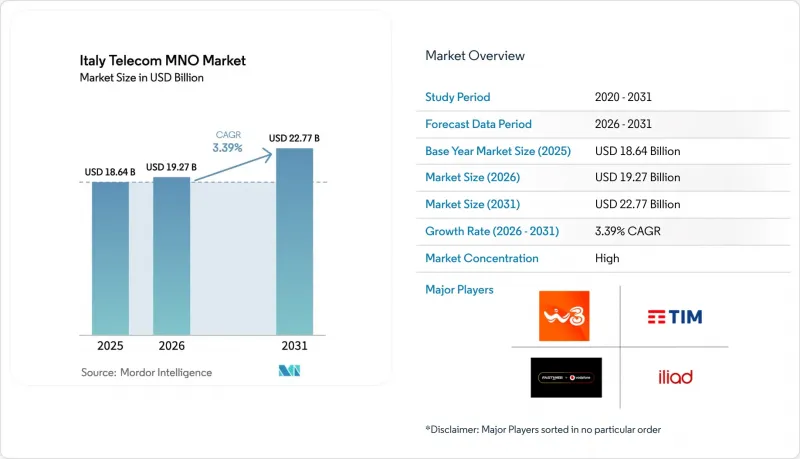
本報告按服務類型(語音服務、數據和網際網路服務、通訊服務、物聯網和機器對機器(M2M)服務、OTT和付費電視服務以及其他服務)和最終用戶(企業和一般消費者)進行分類。市場預測以價值(美元)和規模(用戶數量)為單位呈現。
義大利電信行動網路營運商市場的趨勢與洞察
5G用戶增加
義大利的5G人口覆蓋率已超過90%,是歐盟次世代接取的先驅之一。義大利電信(TIM)計畫在2026年將室外5G覆蓋率提升至95%,與4G相比,每GB成本最多可降低50%。國家復甦與韌性計畫(NRRP)提供的20.2億歐元(約23.3億美元)資金已津貼21900個基地台的回程傳輸光纖,填補了預計無法實現商業性盈利地區的網路空白。工廠和港口正在部署專用5G網路,這將帶來數據使用的成長和業務收益的提升。因此,隨著5G的進一步部署,義大利的行動網路營運商(MNO)市場預計將保持高速成長。
支援 ARPU 的整合套餐
將固定寬頻、行動服務和內容捆綁在一起,能夠提高客戶留存率並支撐平均收入水平,尤其是在經濟繁榮的北部地區。 Fastweb 與 Vodafone 的合作將使全國範圍內的整合提案得以實現,預計這將降低解約率並促進交叉銷售。電信業者正利用其光纖網路來提升銷售高階行動資料方案的銷量,並緩解價格侵蝕。米蘭的早期成功案例表明,聯合推廣光纖和 5G 可以將多平台訂閱用戶比例提高 10 個百分點。這些趨勢為義大利行動網路營運商 (MNO) 市場奠定了以價值而非數量為導向的基礎。
行動網路營運商(MNO)之間日益激烈的價格競爭給利潤率帶來了壓力。
自 Iliad 於 2018 年進入市場以來,激烈的價格競爭導致行動用戶平均收入 (ARPU) 下降,解約率上升。儘管行業重組正在緩解直接折扣競爭,但入門級套餐,尤其是預付套餐,仍然保持著激進的定價策略。業者正透過內容捆綁包和分級速度費率方案等提升銷售策略來應對。因此,在價格達到平衡之前,由於短期盈利壓力,義大利行動網路營運商 (MNO) 市場的複合年成長率 (CAGR) 將下降近 1 個百分點。
細分市場分析
數據和網路服務是最大的收入來源,預計到2025年將佔義大利電信行動網路營運商(MNO)市場佔有率的42.65%。物聯網(IoT)和機器對機器(M2M)解決方案雖然絕對規模仍然相對小規模,但在工業自動化和智慧城市專案的推動下,其複合年成長率(CAGR)最高,達到3.46%。隨著串流媒體、雲端遊戲和遠端辦公等方式導致流量消耗不斷成長,義大利電信營運商(MNO)以數據為中心的服務市場規模預計將穩步擴大。語音通話和簡訊使用量的下降持續釋放網路容量,因此可以推出更全面的數據套餐,但OTT通訊服務正對傳統收入來源構成越來越大的壓力。營運商正透過基於速度和與Netflix、亞馬遜和DAZN等內容合作夥伴的5G套餐,將不斷成長的流量變現,從而提昇平均使用量。固定行動融合,結合光纖回程傳輸和5G頻段,進一步鞏固了數據領域的領先地位,並確保了跨裝置的流暢用戶體驗。
隨著 WhatsApp、Telegram 等應用程式以極低的額外成本滿足了大多數消費者的需求,通訊和傳統語音通訊的收入正在穩步下降。儘管如此,電信業者仍在利用進階通訊服務(RCS) 和 5G 獨立組網 (SA) 的功能,部署低延遲的企業級 VoNR(新空口語音)和關鍵任務型一鍵通話) 服務。隨著物聯網 (IoT) 的擴展,義大利行動網路營運商 (MNO) 市場預計將在物流、智慧農業和公共產業等領域獲得成長動力。在這些領域,廣域 NB-IoT 覆蓋將提供經濟高效且節能的連接。總體而言,基於數據生態系統的服務多元化將抵消傳統收入來源的下降,從而確保均衡的成長結構。
其他好處:
- Excel格式的市場預測(ME)表
- 3個月的分析師支持
目錄
第1章:引言
- 研究假設和市場定義
- 調查範圍
第2章:調查方法
第3章執行摘要
第4章 市場狀況
- 市場概覽
- 監理與政策框架
- 頻譜的發展趨勢和競爭對手的擁有情形
- 通訊業生態系統
- 宏觀經濟與外在因素
- 波特五力分析
- 主要行動網路營運商 (MNO) 的關鍵績效指標 (KPI) (2020-2025)
- 行動用戶數量和普及率
- 行動網路使用者數量和普及率
- 按接入技術分類的SIM卡合約數量和滲透率
- 蜂巢式物聯網/機器對機器連接數
- 寬頻連線數(移動和固定)
- ARPU(每位用戶平均收入)
- 每用戶平均數據使用量(GB/月)
- 市場促進因素
- 5G用戶數增加
- 支援 ARPU 的融合套餐
- 義大利政府將資助建置1Gbps光纖到府網路。
- 企業對物聯網連結的需求日益成長
- OTT影片的激增正在推高數據使用量。
- 透過鐵塔共享/網路即服務降低資本投資
- 市場限制因素
- 行動網路業者(MNO)之間激烈的價格競爭給利潤率帶來了壓力。
- 監管機構降低行動電話終止費用
- 南部農村地區光纖電纜部署延誤
- 高昂的網路能源成本與環境目標之間的衝突
- 技術展望
- 通訊業關鍵經營模式分析
- 定價模型和定價分析
第5章 市場規模與成長預測
- 整個通訊業的收入和每用戶平均收入
- 服務類型
- 語音服務
- 數據和網際網路服務
- 通訊服務
- 物聯網和機器對機器服務
- OTT和付費電視服務
- 其他服務(附加價值服務、漫遊和國際服務、企業和批發服務等)
- 最終用戶
- 公司
- 消費者
第6章 競爭情勢
- 市場集中度
- 主要供應商的策略性舉措與投資,2023-2025 年
- 2024年行動通訊業者(MNO)市佔率分析
- MNO snapshot(subscribers, churn rate, ARPU, etc.)
- 行動通訊業者(MNO)公司簡介*
- Telecom Italia(TIM)
- WindTre
- Iliad Italia
- Fastweb+Vodafone
第7章 市場機會與未來展望
According to Mordor Intelligence, Italy telecom MNO market size in 2026 is estimated at USD 19.27 billion, growing from 2025 value of USD 18.64 billion with 2031 projections showing USD 22.77 billion, growing at 3.39% CAGR over 2026-2031.
This report is Segmented by Service Type (Voice Services, Data and Internet Services, Messaging Services, Iot and M2M Services, OTT and PayTV Services, and Other Services), and End User (Enterprises, Consumer). The Market Forecasts are Provided in Terms of Value (USD) and Volume (Subscribers).
Italy Telecom MNO Market Trends and Insights
Increasing 5G Subscriber Uptake
5G population coverage already exceeds 90%, placing Italy among the EU front-runners for next-generation access. TIM plans to raise outdoor 5G coverage to 95% by 2026, cutting cost per gigabyte by up to 50% compared with 4G operations. National Recovery and Resilience Plan (NRRP) funds worth EUR 2.02 billion (USD 2.33 billion) subsidize backhaul fiber to 21,900 radio sites, closing gaps where commercial returns are weak. Private 5G networks are gaining traction in factories and ports, raising data intensity and service revenues. Wider 5G adoption will therefore keep the Italy Telecom MNO market on a higher growth slope.
Convergent Bundles Sustaining ARPU
Bundling fixed broadband, mobile service, and content is lifting customer stickiness and supporting average revenue levels, particularly in affluent northern provinces. The Fastweb-Vodafone tie-up promises nationwide, converged propositions that reduce churn and spur cross-sell uptake. Operators leverage fiber footprints to upsell premium mobile data plans, limiting tariff erosion. Early success stories in Milan show a 10 percentage-point uplift in multi-play take-up when fiber and 5G are jointly promoted. Such dynamics keep the Italy Telecom MNO market on a value rather than volume footing.
Intense MNO Price Wars Compressing Margins
Fierce tariff battles since Iliad's 2018 arrival sliced mobile ARPU and pushed churn upward. Although consolidation is reducing head-to-head discounts, entry-level offers remain aggressive, especially in prepaid segments. Operators respond with upsell tactics such as content bundles and speed tiers. Near-term profitability pressure, therefore, reduces the Italy Telecom MNO market CAGR by almost one percentage point until price equilibrium is reached.
Other drivers and restraints analyzed in the detailed report include:
- Govt. Italia a 1 Gbps FTTH Funding
- Rising Enterprise IoT Connectivity Demand
- High Network Energy Costs vs. Green Targets
For complete list of drivers and restraints, kindly check the Table Of Contents.
Segment Analysis
Data and Internet services represented the largest revenue slice, capturing 42.65% of Italy Telecom MNO market share in 2025. IoT and M2M solutions, while still small in absolute terms, deliver the highest 3.46% CAGR, underpinned by industrial automation and smart-city projects. The Italy Telecom MNO market size for data-centric services will expand steadily as streaming, cloud gaming, and remote work heighten gigabyte consumption. Declining voice and SMS uptake continues to free network capacity for richer data packages, while OTT messaging tightens pressure on legacy revenues. Operators monetize traffic growth through speed-tiered 5G plans and content tie-ups with Netflix, Amazon, and DAZN, strengthening average spending levels. Fixed-mobile convergence further cements data dominance by marrying fiber backhaul with 5G spectrum, ensuring robust user experience across devices.
Messaging and traditional voice revenues keep sliding because WhatsApp, Telegram, and similar applications meet most consumer needs at negligible incremental cost. Nonetheless, operators are leveraging rich communication services (RCS) and 5G standalone capabilities to introduce low-latency enterprise voice over New Radio (VoNR) and mission-critical push-to-talk. The Italy Telecom MNO market size, aligned with IoT gains, is expected to experience momentum in sectors such as logistics, smart agriculture, and utilities, where wide-area NB-IoT coverage provides economical and battery-efficient connectivity. Overall, service diversification based on data ecosystems will outweigh the contraction of legacy revenue lines and secure a balanced growth mix.
Complete Report Scope:
- Overall Telecom Revenue and ARPU
- Service Type
- Voice Services
- Data and Internet Services
- Messaging Services
- IoT and M2M Services
- OTT and PayTV Services
- Other Services (VAS, Roaming And International Services, Enterprise And Wholesale Services, etc.)
- End-user
- Enterprises
- Consumer
List of Companies Covered in this Report:
- Telecom Italia (TIM)
- WindTre
- Iliad Italia
- Fastweb + Vodafone
Additional Benefits:
- The market estimate (ME) sheet in Excel format
- 3 months of analyst support
TABLE OF CONTENTS
1 INTRODUCTION
- 1.1 Study Assumptions and Market Definition
- 1.2 Scope of the Study
2 RESEARCH METHODOLOGY
3 EXECUTIVE SUMMARY
4 Market Landscape
- 4.1 Market Overview
- 4.2 Regulatory And Policy Framework
- 4.3 Spectrum Landscape And Competitive Holdings
- 4.4 Telecom Industry Ecosystem
- 4.5 Macroeconomic And External Drivers
- 4.6 Porter's Five Forces Analysis
- 4.6.1 Competitive Rivalry
- 4.6.2 Threat of New Entrants
- 4.6.3 Bargaining Power of Suppliers
- 4.6.4 Bargaining Power of Buyers
- 4.6.5 Threat of Substitutes
- 4.7 Key MNO KPIs (2020-2025)
- 4.7.1 Unique Mobile Subscribers And Penetration Rate
- 4.7.2 Mobile Internet Users And Penetration Rate
- 4.7.3 SIM Connections by Access Technology And Penetration
- 4.7.4 Cellular IoT / M2M Connections
- 4.7.5 Broadband Connections (Mobile And Fixed)
- 4.7.6 ARPU (Average Revenue Per User)
- 4.7.7 Average Data Usage per Subscription (GB/month)
- 4.8 Market Drivers
- 4.8.1 Increasing 5G subscriber uptake
- 4.8.2 Convergent bundles sustaining ARPU
- 4.8.3 Govt. Italia a 1 Gbps-FTTH funding
- 4.8.4 Rising enterprise IoT connectivity demand
- 4.8.5 Surge in OTT video boosting data usage
- 4.8.6 Tower-sharing / NaaS lowering capex (under-the-radar)
- 4.9 Market Restraints
- 4.9.1 Intense MNO price wars compressing margins
- 4.9.2 Regulatory cuts to mobile termination rates
- 4.9.3 Rural South fiber take-up lag (under-the-radar)
- 4.9.4 High network energy costs vs. green targets (under-the-radar)
- 4.10 Technological Outlook
- 4.11 Analysis of key business models in Telecom
- 4.12 Analysis of Pricing Models and Pricing
5 MARKET SIZE AND GROWTH FORECASTS (VALUE)
- 5.1 Overall Telecom Revenue and ARPU
- 5.2 Service Type
- 5.2.1 Voice Services
- 5.2.2 Data and Internet Services
- 5.2.3 Messaging Services
- 5.2.4 IoT and M2M Services
- 5.2.5 OTT and PayTV Services
- 5.2.6 Other Services (VAS, Roaming And International Services, Enterprise And Wholesale Services, etc.)
- 5.3 End-user
- 5.3.1 Enterprises
- 5.3.2 Consumer
6 COMPETITIVE LANDSCAPE
- 6.1 Market Concentration
- 6.2 Strategic Moves and Investments by key vendors, 2023-2025
- 6.3 Market share analysis for MNOs, 2024
- 6.4 MNO snapshot (subscribers, churn rate, ARPU, etc.)
- 6.5 Company Profiles* of MNOs (Includes Business Overview | Service Portfolio | Financials | Business Strategy and Recent Developments | SWOT Analysis)
- 6.5.1 Telecom Italia (TIM)
- 6.5.2 WindTre
- 6.5.3 Iliad Italia
- 6.5.4 Fastweb + Vodafone
7 MARKET OPPORTUNITIES AND FUTURE OUTLOOK
- 7.1 White-space And Unmet-Need Assessment

 中國行動網路業者(MNO):市佔率分析、產業趨勢與統計及成長預測(2026-2031)東協行動虛擬網路營運商:市場佔有率分析、產業趨勢與統計及成長預測(2026-2031)西班牙電信行動網路業者:市場佔有率分析、產業趨勢與統計、成長預測(2026-2031)馬來西亞電信行動網路業者:市場佔有率分析、產業趨勢與統計及成長預測(2026-2031 年)中東和非洲電信營運商(MNO):市場佔有率分析、行業趨勢和統計數據以及成長預測(2026-2031 年)印度電信行動網路業者:市場佔有率分析、產業趨勢與統計及成長預測(2026-2031 年)德國電信行動網路業者:市場佔有率分析、產業趨勢與統計及成長預測(2026-2031 年)日本行動網路業者(MNO):市佔率分析、產業趨勢與統計及成長預測(2026-2031)法國電信行動網路業者:市場佔有率分析、產業趨勢與統計及成長預測(2026-2031 年)美國行動網路營運商(MNO):市場佔有率分析、產業趨勢與統計數據、成長預測(2026-2031 年)