


 |
市場調查報告書
商品編碼
2125585
西班牙電信行動網路業者:市場佔有率分析、產業趨勢與統計、成長預測(2026-2031)Spain Telecom MNO - Market Share Analysis, Industry Trends & Statistics, Growth Forecasts (2026 - 2031) |
||||||

※ 本網頁內容可能與最新版本有所差異。詳細情況請與我們聯繫。
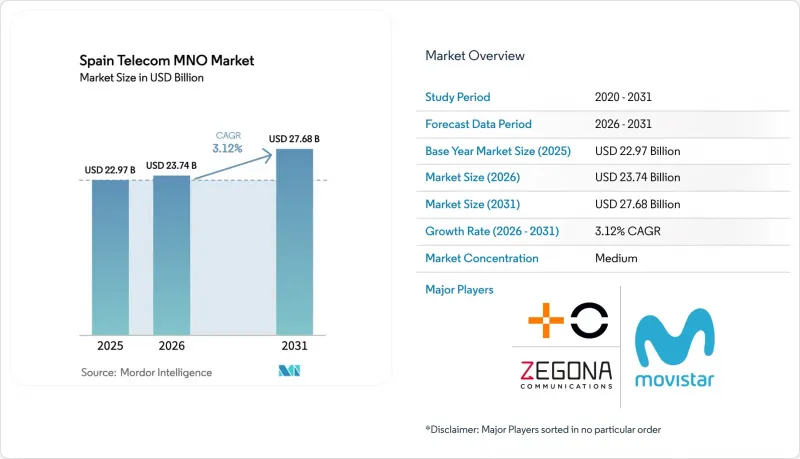
據 Mordor Intelligence 稱,西班牙電信行動網路營運商 (MNO) 市場在 2025 年的價值為 229.7 億美元,預計到 2031 年將從 2026 年的 237.4 億美元成長至 276.8 億美元,在預測期(2026-2031 年成長率 3.12%)為 3.26-2031 年的複合年成長率。
本報告按服務類型(語音服務、數據和網際網路服務、即時通訊服務、物聯網和機器對機器服務、OTT和付費電視服務等)、最終用戶(企業、消費者)以及地區進行細分。市場預測以美元計價。
西班牙電信行動網路營運商市場的趨勢與洞察
擴大 5G 獨立組網系統的覆蓋範圍並重新分配頻率。
西班牙電信業者目前已將8.3%的5G基地台部署在獨立組網模式下,遠高於3%的歐洲平均水準。西班牙電信(Telefónica)透過重新分配先前用於3G流量的2.1 GHz頻段,提升了馬德里和巴塞隆納的網路容量,並預計到2025年頻率利用率將提高22%。 MasOrange運作了「5G-Advanced」層,整合了700 MHz、3.5 GHz和26 GHz頻段,測試速度超過3 Gbps。企業對這種架構青睞有加,因為網路切片和邊緣節點能夠確保機器人和AR維護工具的延遲低於10毫秒。西班牙國家市場與通訊委員會(CNMC)決定將3.5 GHz頻段的許可證免費延長至2040年,這為工業走廊進一步增加基地台密度提供了資金保障。
無限流量套餐推動行動數據消耗量增加
目前,西班牙68%的後付費用戶都使用無限費率方案,預計到2025年,平均每月流量使用量將達到18.4GB。 DIGI推出的10歐元費率方案迫使現有業者展開價格戰,儘管流量激增,但每位用戶平均收入(ARPU)卻降至6.95歐元(約8.20美元)。沃達豐的網路數據顯示,影片串流佔行動流量的62%,但在包月套餐下,視訊串流媒體並未帶來額外收入。西班牙電信(Telefónica)報告稱,流量使用量排名前10%的用戶每月消耗47GB流量,但他們的收入貢獻僅為6.95歐元(約8.20美元),導致毛利率壓縮至38%。為了因應這一局面,電信業者正致力於推出光纖和行動套餐捆綁銷售,並向提升銷售每月價格約50歐元(約59美元)的高階5G套餐,以期恢復盈利能力。
行動用戶基數飽和限制了內部成長。
預計到2025年,行動普及率將達到122%,屆時將有5730萬張活躍SIM卡服務於4,700萬居住者,這意味著用戶數量成長空間有限。 2025年行動用戶淨成長率預計僅0.3%,與疫情前超過2%的年增率形成鮮明對比。目前,用戶成長主要由多SIM卡設備和物聯網連接驅動,而非新增個人用戶。儘管西班牙電信(Telefónica)已轉向整合套餐,但其個人用戶平均收入(ARPU)已年減了4.2%。這種成長停滯迫使營運商透過獲取高價值的企業合約來彌補個人用戶成長的不足。
細分市場分析
到2025年,數據和網路服務將佔西班牙電信行動網路營運商(MNO)市場收入的51.17%,顯著超過語音和通訊收入的總和。這一領域受益於影片串流使用量的增加以及5G帶來的數據容量提升,但包月無限流量套餐限制了其收入的進一步成長。儘管物聯網(IoT)和機器對機器(M2M)服務在西班牙電信MNO市場規模中所佔佔有率較小,但由於監管要求強制連接電錶、車輛和農業感測器,預計其複合年成長率(CAGR)將達到3.27%,在所有類別中最高。
隨著OTT應用取代電路交換流量,語音和通訊收入持續萎縮,而OTT和付費電視透過配套服務貢獻了約8%的市場構成比,這些捆綁服務有助於降低客戶流失率。預計漫遊業務將在2025年恢復到接近疫情前的水平,從而支撐「其他服務」收入,該收入在西班牙旅遊區的電信行動網路營運商(MNO)市場佔有率中仍然佔據重要地位。長期成長潛力在於該平台大規模管理設備群的能力,而Telefónica Tech的高利潤物聯網收入已經體現了這項能力。
其他好處:
- Excel格式的市場預測(ME)表
- 3個月的分析師支持
目錄
第1章:引言
- 市場分析與定義的前提條件
- 分析範圍
第2章 分析方法
第3章執行摘要
第4章 市場狀況
- 市場概覽
- 監理與政策框架
- 頻段狀況和競爭對手擁有情形
- 通訊業生態系統
- 宏觀經濟與外在因素
- 波特五力分析
- 主要行動網路營運商的關鍵績效指標(KPI)(2020-2025 年)
- 行動用戶數量和普及率
- 行動網路使用者數量和普及率
- SIM卡用戶數量及普及率:依接取技術分類
- 蜂巢式物聯網/M2M連接數
- 寬頻連線數(移動和固定)
- ARPU(每位用戶平均收入)
- 用戶平均每月數據使用量(GB/月)
- 市場促進因素
- 5G獨立組網服務區域擴展與頻率重新分配
- 無限流量套餐推動行動數據使用量成長
- 光纖到府 (FttH) 的廣泛應用正在推動整合配套服務的實現。
- 能源、交通和農業領域的企業物聯網採用現狀
- 汽車和港口產業對工業專用5G園區網路的需求
- 引進中立主機型室內DAS帶來的頻譜租賃收入。
- 市場限制因素
- 行動電話用戶數量飽和限制了內生成長。
- 低價品牌帶來的價格競爭和對每位用戶的平均收入(ARPU)壓力
- 過去頻率使用費相關的不透明訴訟正在延緩投資。
- 電力價格波動推高了電網營運成本。
- 技術展望
- 電信業關鍵經營模式分析
- 定價模型和定價分析
第5章:預測市場規模與成長率
- 整個通訊業的收入和每用戶平均收入
- 按服務類型
- 語音服務
- 數據網際網路服務
- 通訊服務
- 物聯網/機器對機器服務
- OTT(非櫃檯)和付費電視服務
- 其他服務(附加價值服務、漫遊和國際服務、企業/批發服務)
- 最終用戶
- 公司
- 消費者
第6章 競爭情勢
- 市場集中度
- 策略性舉措與投資:依主要供應商分類(2023-2025 年)
- 行動網路營運商市場佔有率分析(2025 年)
- 行動通訊服務產品基準分析
- 行動網路營運商概覽(用戶數、用戶客戶流失率、每位用戶平均收入)
- 行動網路營運商公司簡介
- Telefonica Spain(Movistar)
- MASORANGE, SL
- Zegona Communications(Vodafone Spain)
第7章 市場機會與未來展望
According to Mordor Intelligence, the Spain telecom MNO market size was valued at USD 22.97 billion in 2025 and is estimated to grow from USD 23.74 billion in 2026 to reach USD 27.68 billion by 2031, at a CAGR of 3.12% during the forecast period (2026-2031).
This report is Segmented by Service Type (Voice Services, Data and Internet Services, Messaging Services, Iot and M2M Services, OTT and PayTV Services, and More), End-User (Enterprises, and Consumer), and Geography. The Market Forecasts are Provided in Terms of Value (USD).
Spain Telecom MNO Market Trends and Insights
5G Standalone Coverage Expansion and Spectrum Refarming
Spain's operators already run 8.3% of national 5G sites in standalone mode, far above the sub-3% European average. Telefonica improved capacity in Madrid and Barcelona by refarming 2.1 GHz spectrum that previously carried 3G traffic, raising spectral efficiency by 22% during 2025. MasOrange switched on a 5G-Advanced layer that aggregates 700 MHz, 3.5 GHz, and 26 GHz bands, delivering trial speeds above 3 Gbps. Enterprises value the architecture because network slicing and edge nodes guarantee sub-10 millisecond latency for robotics and AR maintenance tools. The CNMC decision to extend 3.5 GHz licences to 2040 at no extra cost freed capital for further densification in industrial corridors.
Rising Mobile-Data Consumption Driven by Unlimited Plans
Unlimited tariffs now cover 68% of Spanish post-paid lines, lifting average monthly data use to 18.4 GB in 2025. DIGI's EUR 10 offer forced incumbents to match prices, so ARPU slid to EUR 6.95 (USD 8.20) even as traffic soared. Vodafone's network shows that video streaming represents 62% of mobile load yet adds no incremental revenue under flat-fee plans. Telefonica reported that top-decile users consumed 47 GB each month while contributing barely EUR 6.95 (USD 8.20) in revenue, compressing gross margins to 38%. Operators respond by upselling fiber-mobile bundles and premium 5G tiers priced near EUR 50 (USD 59) per month to restore profitability.
Saturated Mobile Subscriber Base Limiting Organic Growth
Mobile penetration climbed to 122% in 2025 with 57.3 million active SIMs serving 47 million residents, leaving scant room for further line additions. Net new mobile subscriptions rose only 0.3% in 2025 compared with more than 2% annual growth before the pandemic. Incremental gains now stem mainly from multi-SIM devices and IoT links rather than new human users. Telefonica's consumer ARPU fell 4.2% year-over-year despite migration efforts toward converged packages. The growth ceiling forces carriers to chase higher-value enterprise contracts to offset flat consumer volumes.
Other drivers and restraints analyzed in the detailed report include:
- Fiber-to-the-Home Diffusion Enabling Converged Bundles
- Enterprise IoT Uptake in Energy, Transport, and Agriculture
- ARPU Compression Due to Price Wars and Low-Cost Brands
For complete list of drivers and restraints, kindly check the Table Of Contents.
Segment Analysis
Data and Internet Services held 51.17% of Spain Telecom MNO market revenue in 2025, far surpassing voice and messaging combined. The segment benefits from heavy video-streaming consumption and from 5G's capacity uplift, yet flat-fee unlimited plans mute incremental monetization. IoT and M2M Services accounted for a smaller slice of Spain Telecom MNO market size but are projected to expand at a 3.27% CAGR, the fastest across all categories, as regulatory mandates embed connectivity into meters, vehicles, and agricultural sensors.
Voice and Messaging revenues continue to contract as over-the-top apps displace circuit-switched traffic, while OTT and PayTV add roughly 8% to the overall mix through churn-reducing bundles. Roaming almost returned to pre-pandemic levels in 2025, aiding the "other services" pool that still contributes meaningfully to Spain Telecom MNO market share in tourist districts. Long-term upside resides in platforms capable of managing device fleets at scale, a capability already reflected in Telefonica Tech's high-margin IoT earnings.
Complete Report Scope:
- Overall Telecom Revenue and ARPU
- Service Type
- Voice Services
- Data and Internet Services
- Messaging Services
- IoT and M2M Services
- OTT and PayTV Services
- Other Services (VAS, Roaming and International Services, Enterprise and Wholesale Services)
- End-User
- Enterprises
- Consumer
List of Companies Covered in this Report:
- Telefonica Spain (Movistar)
- MASORANGE, S.L.
- Zegona Communications (Vodafone Spain)
Additional Benefits:
- The market estimate (ME) sheet in Excel format
- 3 months of analyst support
TABLE OF CONTENTS
1 INTRODUCTION
- 1.1 Study Assumptions and Market Definition
- 1.2 Scope of the Study
2 RESEARCH METHODOLOGY
3 EXECUTIVE SUMMARY
4 MARKET LANDSCAPE
- 4.1 Market Overview
- 4.2 Regulatory and Policy Framework
- 4.3 Spectrum Landscape and Competitive Holdings
- 4.4 Telecom Industry Ecosystem
- 4.5 Macroeconomic and External Drivers
- 4.6 Porter's Five Forces Analysis
- 4.6.1 Competitive Rivalry
- 4.6.2 Threat of New Entrants
- 4.6.3 Bargaining Power of Suppliers
- 4.6.4 Bargaining Power of Buyers
- 4.6.5 Threat of Substitutes
- 4.7 Key MNO KPIs (2020-2025)
- 4.7.1 Unique Mobile Subscribers and Penetration Rate
- 4.7.2 Mobile Internet Users and Penetration Rate
- 4.7.3 SIM Connections by Access Technology and Penetration
- 4.7.4 Cellular IoT and M2M Connections
- 4.7.5 Broadband Connections (Mobile and Fixed)
- 4.7.6 ARPU (Average Revenue Per User)
- 4.7.7 Average Data Usage per Subscription (GB/month)
- 4.8 Market Drivers
- 4.8.1 5G Standalone Coverage Expansion and Spectrum Refarming
- 4.8.2 Rising Mobile-Data Consumption Driven by Unlimited Plans
- 4.8.3 Fiber-to-the-Home Diffusion Enabling Converged Bundles
- 4.8.4 Enterprise IoT Uptake in Energy, Transport, and Agriculture
- 4.8.5 Industrial Private 5G Campus Network Demand from Automotive and Ports
- 4.8.6 Spectrum Lease Revenue from Neutral-Host Indoor DAS Deployments
- 4.9 Market Restraints
- 4.9.1 Saturated Mobile Subscriber Base Limiting Organic Growth
- 4.9.2 ARPU Compression Due to Price Wars and Low-Cost Brands
- 4.9.3 Uncertain Litigation Over Historical Spectrum Fees Delaying Investment
- 4.9.4 Volatile Electricity Prices Increasing Network OPEX
- 4.10 Technological Outlook
- 4.11 Analysis of Key Business Models in Telecom Sector
- 4.12 Analysis of Pricing Models and Pricing
5 MARKET SIZE AND GROWTH FORECASTS (VALUE)
- 5.1 Overall Telecom Revenue and ARPU
- 5.2 Service Type
- 5.2.1 Voice Services
- 5.2.2 Data and Internet Services
- 5.2.3 Messaging Services
- 5.2.4 IoT and M2M Services
- 5.2.5 OTT and PayTV Services
- 5.2.6 Other Services (VAS, Roaming and International Services, Enterprise and Wholesale Services)
- 5.3 End-User
- 5.3.1 Enterprises
- 5.3.2 Consumer
6 COMPETITIVE LANDSCAPE
- 6.1 Market Concentration
- 6.2 Strategic Moves and Investments by Key Vendors, 2023-2025
- 6.3 Market Share Analysis for MNOs, 2025
- 6.4 Product Benchmarking Analysis for Mobile Network Services
- 6.5 MNO Snapshot (Subscribers, Churn Rate, ARPU)
- 6.6 Company Profiles of MNOs (Includes Business Overview, Service Portfolio, Financials, Business Strategy and Recent Development, SWOT Analysis)
- 6.6.1 Telefonica Spain (Movistar)
- 6.6.2 MASORANGE, S.L.
- 6.6.3 Zegona Communications (Vodafone Spain)
7 MARKET OPPORTUNITIES AND FUTURE OUTLOOK
- 7.1 White-Space and Unmet-Need Assessment

 中國行動網路業者(MNO):市佔率分析、產業趨勢與統計及成長預測(2026-2031)東協行動虛擬網路營運商:市場佔有率分析、產業趨勢與統計及成長預測(2026-2031)馬來西亞電信行動網路業者:市場佔有率分析、產業趨勢與統計及成長預測(2026-2031 年)中東和非洲電信營運商(MNO):市場佔有率分析、行業趨勢和統計數據以及成長預測(2026-2031 年)印度電信行動網路業者:市場佔有率分析、產業趨勢與統計及成長預測(2026-2031 年)德國電信行動網路業者:市場佔有率分析、產業趨勢與統計及成長預測(2026-2031 年)日本行動網路業者(MNO):市佔率分析、產業趨勢與統計及成長預測(2026-2031)法國電信行動網路業者:市場佔有率分析、產業趨勢與統計及成長預測(2026-2031 年)美國行動網路營運商(MNO):市場佔有率分析、產業趨勢與統計數據、成長預測(2026-2031 年)義大利行動網路營運商(MNO):市場佔有率分析、產業趨勢和統計數據以及成長預測(2026-2031 年)