


 |
市場調查報告書
商品編碼
2125468
中東和非洲電信營運商(MNO):市場佔有率分析、行業趨勢和統計數據以及成長預測(2026-2031 年)Middle East And Africa Telecom MNO - Market Share Analysis, Industry Trends & Statistics, Growth Forecasts (2026 - 2031) |
||||||

※ 本網頁內容可能與最新版本有所差異。詳細情況請與我們聯繫。
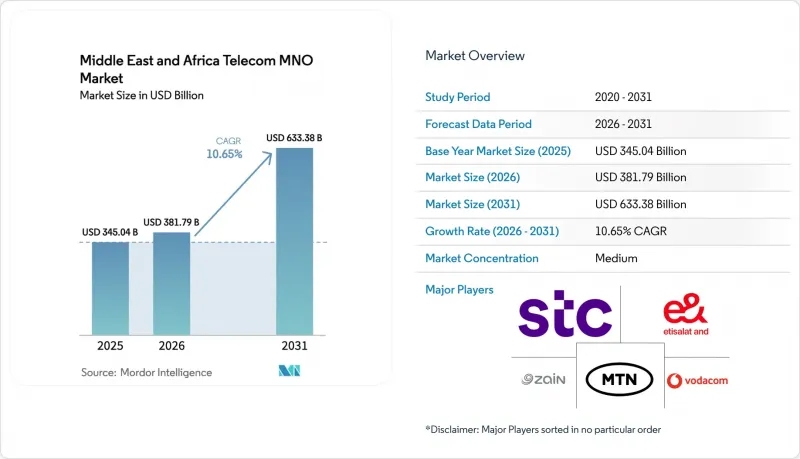
據 Mordor Intelligence 稱,中東和非洲地區行動網路營運商 (MNO) 的市場規模預計在 2026 年達到 3,817.9 億美元,高於 2025 年的 3,450.4 億美元,預計到 2031 年將達到 6,333.8 億美元。
預計 2026 年至 2031 年的複合年成長率為 10.65%。
本報告按服務類型(語音服務、數據和網際網路服務、即時通訊服務、物聯網和機器對機器通訊服務、OTT和付費電視服務以及其他服務)、最終用戶(企業、一般消費者)和地區進行細分。市場預測以價值(美元)和規模(用戶數量)表示。
中東和非洲電信網路營運商 (MNO) 市場的趨勢和洞察
影片類應用的興起導致行動數據流量爆炸性成長
隨著用戶從語音通話和簡訊轉向高清串流媒體,影片觀看正在重塑營運商的收入結構。海灣國家的簡訊收入從2013年的43億美元下降到預計2018年的32億美元,而同期行動資料通訊卻增加了180%。營運商正透過增加5G小型基地台的密度來應對這一變化,預計到2030年,中東和北非地區的小型基地台市場規模將達到4.1254億美元,複合年成長率(CAGR)為40.9%。每月費用約為70美元的固定無線接入(FWA)合約無需鋪設新的光纖即可實現家庭串流媒體流量的盈利。網路負責人目前正在權衡升級到大規模MIMO的成本與願意為Gigabit付費的高階用戶日益成長的需求。預計到 2030 年,撒哈拉以南非洲地區每用戶每月的數據使用量將成長三倍,達到 14 GB,因此需要同時投資於頻段和回程傳輸。
由於頻譜競標的支持,4G 和 5G 的部署正在加速。
海灣國家和北非的監管機構目前優先考慮覆蓋目標而非基於競標的收入。沙烏地阿拉伯的《2025-2027年頻率展望》為非地面電波網路和固定無線存取(FWA)預留了新的頻段,並透過簡化的許可製度顯著縮短了營運商的上市時間。同樣,南非的《2025年國家無線電頻率規劃(草案)》也為專用私有網路預留了頻段,以促進工業5G的發展。阿拉伯聯合大公國目前已運作7000個5G基地台,並制定了到2025年建造500個園區專用網路的政策。在巴林、約旦、科威特和沙烏地阿拉伯,2G和3G的同步淘汰釋放了低頻寬,用於5G,進一步提高了頻率利用效率。由於這些努力,農村地區的寬頻部署正在加速,每位元傳輸成本正在下降,這對於維持中東和非洲電信網路營運商 (MNO) 市場的利潤基礎至關重要。
激烈的競爭和SIM卡註冊量正在抑制ARPU值。
在肯亞和加納等市場,由於新加入經營者,價格競爭日益激烈;同時,生物識別SIM卡註冊也導致合規成本不斷攀升。通貨膨脹進一步削弱了消費者的購買力,令其承受更大壓力;而監管機構則為保護家庭利益,限制了價格上漲。電信業者正透過內容捆綁和會員應用等方式應對,但法規環境的分散導致執行力度不一致,限制了中東和非洲電信網路營運商(MNO)市場的獲利能力。
細分市場分析
到2025年,數據和網路套餐將佔總收入的39.35%,成為中東和非洲行動網路營運商(MNO)最大的收入來源。物聯網/機器對機器(IoT/M2M)尤其突出,預計到2031年,其在中東和非洲MNO市場規模中的複合年成長率將達到10.74%。由於OTT平台對用戶的競爭,語音通話和通訊的合計佔有率預計將降至25%以下。為此,營運商正努力透過對影片服務實施零費率以及與付費電視捆綁銷售來維持用戶留存率。邊緣運算節點和API的商業化正成為補充資料方案的新興收入來源。
在整個預測期內,「應用即服務」(Apps-as-a-Service)模式將依賴5G獨立網路核心網,率先在遊戲和遠端醫療領域實現低延遲應用。漫遊和批發流量曾易受經濟波動影響,但隨著非洲內部貿易的成長,這些流量將趨於穩定。儘管平均數據費用將持續下降,但高彈性需求將抵消此影響,從而支撐中東和非洲行動網路營運商(MNO)市場規模的持續成長。
其他好處:
- Excel格式的市場預測(ME)表
- 3個月的分析師支持
目錄
第1章:引言
- 研究假設和市場定義
- 調查範圍
第2章:調查方法
第3章執行摘要
第4章 市場狀況
- 市場概覽
- 監理與政策框架
- 頻段狀況和競爭對手擁有情形
- 通訊業生態系統
- 宏觀經濟與外在因素
- 波特五力分析
- 主要行動網路營運商 (MNO) 的關鍵績效指標 (KPI) (2020-2025)
- 行動用戶數量和普及率
- 行動網路使用者數量和普及率
- 按接入技術分類的SIM卡合約數量和滲透率
- 蜂巢式物聯網/機器對機器連接數
- 寬頻連線數(移動和固定)
- ARPU(每位用戶平均收入)
- 每用戶平均數據使用量(GB/月)
- 市場促進因素
- 影片類應用的興起導致行動數據流量爆炸性成長
- 頻段競標促進了 4G 和 5G 的部署。
- 企業數位轉型正在推動對物聯網/機器對機器連接的需求。
- 撒哈拉以南非洲地區由青年主導的智慧型手機普及
- 行動支付的跨境互通性正在提升每位用戶平均收入 (ARPU)。
- 面向大型企劃和智慧城市的專用 5G 網路切片
- 市場限制因素
- 激烈的競爭和 SIM 卡註冊限制導致 ARPU(每位用戶平均收入)下降。
- 地緣政治不穩定正在延緩基礎建設投資。
- LEO衛星寬頻正在成為農村地區的替代方案。
- 非洲內陸國家光纖回程傳輸短缺
- 技術展望
- 電信業關鍵經營模式分析
- 定價模型和定價分析
第5章 市場規模與成長預測
- 整個通訊業的收入和每用戶平均收入
- 按服務類型
- 語音服務
- 數據和網際網路服務
- 通訊服務
- 物聯網和機器對機器服務
- OTT和付費電視服務
- 其他服務(附加價值服務、漫遊服務、企業及批發服務等)
- 最終用戶
- 公司
- 消費者
- 地區
- 中東
- 沙烏地阿拉伯
- 阿拉伯聯合大公國
- 其他中東國家(卡達、科威特、巴林、阿曼、約旦、伊拉克、黎巴嫩、以色列等)
- 非洲
- 南非
- 奈及利亞
- 非洲其他地區(埃及、摩洛哥、阿爾及利亞、突尼西亞、迦納、坦尚尼亞、塞內加爾、衣索比亞、烏干達、肯亞等)
- 中東
第6章 競爭情勢
- 市場集中度
- 主要供應商的策略趨勢與投資,2023-2025 年
- 2024年行動通訊業者(MNO)市佔率分析
- 行動網路服務的產品基準分析
- 行動網路營運商概覽(用戶數量、解約率、ARPU 等)
- 行動通訊業者(MNO)公司簡介
- e&(Etisalat Group)
- STC Group
- Ooredoo Group
- Zain Group
- MTN Group
- Vodacom Group
- Orange Middle East and Africa
- Airtel Africa
- Safaricom PLC
- Maroc Telecom SA
- Telecom Egypt(WE)
- Globacom Limited(Glo Mobile)
- 9mobile(EMTS)
- Telkom SA SOC Limited
- Cell C
- Omantel
- Batelco(Beyon Group)
- du(EITC)
- Sudan Telecom Group Limited(Sudatel)
- Ethio Telecom
- AXIAN Telecom
- Econet Wireless Zimbabwe
- MTC Namibia
第7章 市場機會與未來展望
According to Mordor Intelligence, Middle East and Africa telecom MNO market size in 2026 is estimated at USD 381.79 billion, growing from 2025 value of USD 345.04 billion with 2031 projections showing USD 633.38 billion, growing at 10.65% CAGR over 2026-2031.
This report is Segmented by Service Type (Voice Services, Data and Internet Services, Messaging Services, Iot and M2M Services, OTT and PayTV Services, and Other Services), End User (Enterprises, Consumer), and Geography. The Market Forecasts are Provided in Terms of Value (USD) and Volume (Subscribers).
Middle East And Africa Telecom MNO Market Trends and Insights
Explosive growth in mobile data traffic from video-centric apps
Video viewing reshapes operator revenue architecture as users pivot from voice and SMS to high-definition streaming. SMS revenue in the Gulf fell from USD 4.3 billion in 2013 to a projected USD 3.2 billion in 2018, while mobile data volumes rose 180% in the same span . Operators respond by densifying 5G small cells; the MENA small-cell market is projected to reach USD 412.54 million by 2030, a 40.9% CAGR . FWA subscriptions, priced near USD 70 each month, monetize in-home streaming traffic without fresh fiber builds. Network planners now weigh the cost of massive-MIMO upgrades against the rising willingness of premium users to pay for gigabit packages. In Sub-Saharan Africa, monthly data usage is forecast to triple to 14 GB per user by 2030, demanding parallel investment in both spectrum and backhaul.
Accelerated 4G and 5G roll-outs enabled by supportive spectrum auctions
Regulators across the Gulf and North Africa now favor coverage targets over windfall auction fees. Saudi Arabia's 2025-2027 Spectrum Outlook sets aside new bands for non-terrestrial networks and FWA via light licensing, slashing time-to-market for operators. South Africa's draft 2025 National Radio Frequency Plan similarly carves out dedicated private-network spectrum that encourages industrial 5G . The UAE already operates 7,000 5G sites, with a policy aiming for 500 on-campus private networks by 2025. Concurrent 2G/3G switch-offs in Bahrain, Jordan, Kuwait, and Saudi Arabia release low-band spectrum for 5G, further boosting spectral efficiency. The collective result is faster rural broadband coverage and lower per-bit delivery cost, crucial for sustaining the Middle East and Africa telecom MNO market's profit pool.
Aggressive price competition and SIM registration curbing ARPU
Mandatory biometric SIM registration raises compliance costs even as new entrants trigger price wars in markets like Kenya and Ghana. Inflation adds a second squeeze by eroding consumer spend capacity, while regulators cap tariff hikes to protect households. Operators counter with content bundles and loyalty apps, but execution is uneven in fragmented regulatory environments, restraining monetization in the Middle East and Africa telecom MNO market.
Other drivers and restraints analyzed in the detailed report include:
- Enterprise digitization fueling IoT/M2M connectivity demand
- Youth-driven smartphone adoption across Sub-Saharan Africa
- Geopolitical instability delaying infrastructure investment
For complete list of drivers and restraints, kindly check the Table Of Contents.
Segment Analysis
Data and Internet plans accounted for 39.35% of 2025 revenue, making them the single largest contributor to the Middle East and Africa telecom MNO market. IoT/M2M is the standout, expanding at a CAGR of 10.74% in the Middle East and Africa telecom MNO market size by 2031. Voice and messaging together will slip below 25% as OTT platforms cannibalize usage. Operators respond by zero-rating video services and bundling PayTV to sustain stickiness. Edge computing nodes and API monetization emerge as adjacent revenue streams that complement data plans.
Over the forecast horizon, Apps-as-a-Service models will lean on 5G standalone cores, opening low-latency use cases in gaming and telemedicine. Roaming and wholesale traffic, once cyclical, stabilize as intra-Africa trade flows broaden. Average data pricing will continue its southward drift but remain offset by strong volume elasticity, supporting the Middle East and Africa telecom MNO market size expansion.
Complete Report Scope:
- Overall Telecom Revenue and ARPU
- Service Type
- Voice Services
- Data and Internet Services
- Messaging Services
- IoT and M2M Services
- OTT and PayTV Services
- Other Services (VAS, Roaming, Enterprise and Wholesale, etc.)
- End-user
- Enterprises
- Consumer
- Geography
- Middle East
- Saudi Arabia
- United Arab Emirates
- Rest of the Middle East (Qatar, Kuwait, Bahrain, Oman, Jordan, Iraq, Lebanon, Israel, and Others)
- Africa
- South Africa
- Nigeria
- Rest of Africa (Egypt, Morocco, Algeria, Tunisia, Ghana, Tanzania, Senegal, Ethiopia, Uganda, Kenya, and Others)
- Middle East
List of Companies Covered in this Report:
- e& (Etisalat Group)
- STC Group
- Ooredoo Group
- Zain Group
- MTN Group
- Vodacom Group
- Orange Middle East and Africa
- Airtel Africa
- Safaricom PLC
- Maroc Telecom SA
- Telecom Egypt (WE)
- Globacom Limited (Glo Mobile)
- 9mobile (EMTS)
- Telkom SA SOC Limited
- Cell C
- Omantel
- Batelco (Beyon Group)
- du (EITC)
- Sudan Telecom Group Limited (Sudatel)
- Ethio Telecom
- AXIAN Telecom
- Econet Wireless Zimbabwe
- MTC Namibia
Additional Benefits:
- The market estimate (ME) sheet in Excel format
- 3 months of analyst support
TABLE OF CONTENTS
1 INTRODUCTION
- 1.1 Study Assumptions and Market Definition
- 1.2 Scope of the Study
2 RESEARCH METHODOLOGY
3 EXECUTIVE SUMMARY
4 MARKET LANDSCAPE
- 4.1 Market Overview
- 4.2 Regulatory and Policy Framework
- 4.3 Spectrum Landscape and Competitive Holdings
- 4.4 Telecom Industry Ecosystem
- 4.5 Macroeconomic and External Drivers
- 4.6 Porter's Five Forces Analysis
- 4.6.1 Competitive Rivalry
- 4.6.2 Threat of New Entrants
- 4.6.3 Bargaining Power of Suppliers
- 4.6.4 Bargaining Power of Buyers
- 4.6.5 Threat of Substitutes
- 4.7 Key MNO KPIs (2020-2025)
- 4.7.1 Unique Mobile Subscribers and Penetration Rate
- 4.7.2 Mobile Internet Users and Penetration Rate
- 4.7.3 SIM Connections by Access Technology and Penetration
- 4.7.4 Cellular IoT / M2M Connections
- 4.7.5 Broadband Connections (Mobile and Fixed)
- 4.7.6 ARPU (Average Revenue Per User)
- 4.7.7 Average Data Usage per Subscription (GB/month)
- 4.8 Market Drivers
- 4.8.1 Explosive growth in mobile data traffic from video-centric apps
- 4.8.2 Accelerated 4G and 5G roll-outs enabled by supportive spectrum auctions
- 4.8.3 Enterprise digitization fueling IoT/M2M connectivity demand
- 4.8.4 Youth-driven smartphone adoption across Sub-Saharan Africa
- 4.8.5 Cross-border mobile-money interoperability boosting ARPU
- 4.8.6 Private 5G network slicing for mega-projects and smart cities
- 4.9 Market Restraints
- 4.9.1 Aggressive price competition and SIM registration curbing ARPU
- 4.9.2 Geopolitical instability delaying infrastructure investment
- 4.9.3 LEO satellite broadband emerging as rural substitute
- 4.9.4 Limited fiber backhaul in land-locked African nations
- 4.10 Technological Outlook
- 4.11 Analysis of key business models in Telecom Sector
- 4.12 Analysis of Pricing Models and Pricing
5 MARKET SIZE AND GROWTH FORECASTS (VALUE AND VOLUME)
- 5.1 Overall Telecom Revenue and ARPU
- 5.2 Service Type
- 5.2.1 Voice Services
- 5.2.2 Data and Internet Services
- 5.2.3 Messaging Services
- 5.2.4 IoT and M2M Services
- 5.2.5 OTT and PayTV Services
- 5.2.6 Other Services (VAS, Roaming, Enterprise and Wholesale, etc.)
- 5.3 End-user
- 5.3.1 Enterprises
- 5.3.2 Consumer
- 5.4 Geography
- 5.4.1 Middle East
- 5.4.1.1 Saudi Arabia
- 5.4.1.2 United Arab Emirates
- 5.4.1.3 Rest of the Middle East (Qatar, Kuwait, Bahrain, Oman, Jordan, Iraq, Lebanon, Israel, and Others)
- 5.4.2 Africa
- 5.4.2.1 South Africa
- 5.4.2.2 Nigeria
- 5.4.2.3 Rest of Africa (Egypt, Morocco, Algeria, Tunisia, Ghana, Tanzania, Senegal, Ethiopia, Uganda, Kenya, and Others)
- 5.4.1 Middle East
6 COMPETITIVE LANDSCAPE
- 6.1 Market Concentration
- 6.2 Strategic Moves and Investments by key vendors, 2023-2025
- 6.3 Market share analysis for MNOs, 2024
- 6.4 Product Benchmarking Analysis for mobile network services
- 6.5 MNO snapshot (subscribers, churn rate, ARPU, etc.)
- 6.6 Company Profiles* of MNOs (Includes Business Overview | Service Portfolio | Financials | Business Strategy and Recent Developments | SWOT Analysis)
- 6.6.1 e& (Etisalat Group)
- 6.6.2 STC Group
- 6.6.3 Ooredoo Group
- 6.6.4 Zain Group
- 6.6.5 MTN Group
- 6.6.6 Vodacom Group
- 6.6.7 Orange Middle East and Africa
- 6.6.8 Airtel Africa
- 6.6.9 Safaricom PLC
- 6.6.10 Maroc Telecom SA
- 6.6.11 Telecom Egypt (WE)
- 6.6.12 Globacom Limited (Glo Mobile)
- 6.6.13 9mobile (EMTS)
- 6.6.14 Telkom SA SOC Limited
- 6.6.15 Cell C
- 6.6.16 Omantel
- 6.6.17 Batelco (Beyon Group)
- 6.6.18 du (EITC)
- 6.6.19 Sudan Telecom Group Limited (Sudatel)
- 6.6.20 Ethio Telecom
- 6.6.21 AXIAN Telecom
- 6.6.22 Econet Wireless Zimbabwe
- 6.6.23 MTC Namibia
7 MARKET OPPORTUNITIES AND FUTURE OUTLOOK
- 7.1 White-space and Unmet-Need Assessment

 中國行動網路業者(MNO):市佔率分析、產業趨勢與統計及成長預測(2026-2031)東協行動虛擬網路營運商:市場佔有率分析、產業趨勢與統計及成長預測(2026-2031)西班牙電信行動網路業者:市場佔有率分析、產業趨勢與統計、成長預測(2026-2031)馬來西亞電信行動網路業者:市場佔有率分析、產業趨勢與統計及成長預測(2026-2031 年)印度電信行動網路業者:市場佔有率分析、產業趨勢與統計及成長預測(2026-2031 年)德國電信行動網路業者:市場佔有率分析、產業趨勢與統計及成長預測(2026-2031 年)日本行動網路業者(MNO):市佔率分析、產業趨勢與統計及成長預測(2026-2031)法國電信行動網路業者:市場佔有率分析、產業趨勢與統計及成長預測(2026-2031 年)美國行動網路營運商(MNO):市場佔有率分析、產業趨勢與統計數據、成長預測(2026-2031 年)義大利行動網路營運商(MNO):市場佔有率分析、產業趨勢和統計數據以及成長預測(2026-2031 年)