


 |
市場調查報告書
商品編碼
2125537
德國電信行動網路業者:市場佔有率分析、產業趨勢與統計及成長預測(2026-2031 年)Germany Telecom MNO - Market Share Analysis, Industry Trends & Statistics, Growth Forecasts (2026 - 2031) |
||||||

※ 本網頁內容可能與最新版本有所差異。詳細情況請與我們聯繫。
據 Mordor Intelligence 稱,2025 年德國電信行動網路營運商 (MNO) 市場價值為 142.5 億美元,預計到 2031 年將從 2026 年的 148.4 億美元成長至 181.9 億美元,預測期(2026-2031 年)複合年成長率為 4.15%。
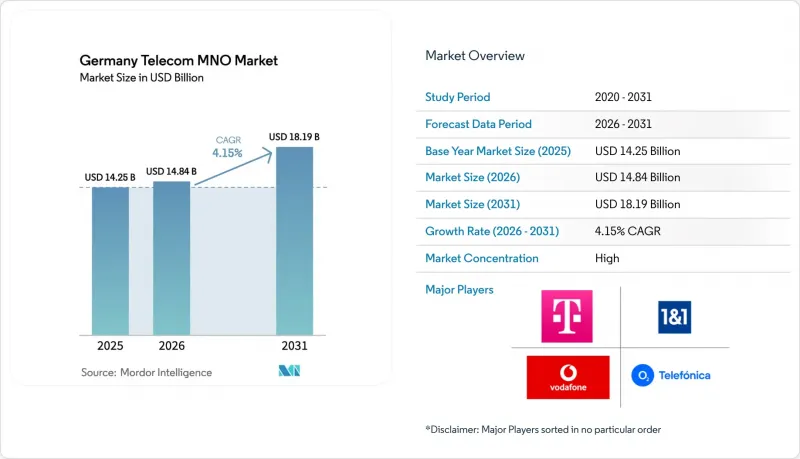
本報告按服務類型(語音服務、數據和網際網路服務、通訊服務、物聯網和機器對機器服務、OTT和付費電視服務等)和最終用戶(企業和一般消費者)進行分類。市場預測以價值(美元)和規模(用戶數量)為單位呈現。
德國電信行動網路營運商市場的趨勢與洞察
光纖到府(FTTH)的快速發展和政府的Gigabit目標
德國的Gigabit策略旨在2025年使50%的家庭接入光纖網路,並在2030年實現全國幾乎全境光纖覆蓋,為此,德國政府推出了一系列積極的投資計畫。聯邦政府提供的30億歐元「千兆挑戰2.0」補貼正在加速服務欠缺地區的光纖網路建設。同時,德國電信計畫在2030年新增1,000萬條光纖線路,沃達豐則計畫利用Unitymedia的資產,為2,500萬戶家庭提供光纖連線。光纖覆蓋範圍更廣的電信業者正透過多業務組合和高階企業線路來提高每用戶平均收入(ARPU)。雖然早期部署造成了暫時的市場碎片化,使光纖覆蓋範圍更廣的地區受益,但全國範圍的部署對於保持長期競爭力仍然至關重要。如果這項策略取得成功,將擴大資料通訊密集型服務的容量,並直接推動德國電信市場的收入成長。
5G SA 的快速部署正在推動對 eMBB 的需求。
德國三大全國性電信業者均已實現其最初設定的2024年99%覆蓋率目標,德國電信計畫在2025年實現99%的人口覆蓋率。獨立組網(SA)架構支援低延遲網路切片,這對於BMW、Mercedes-Benz和大眾等汽車製造和汽車產業園區至關重要。各業者的行動數據使用量也較去年同期成長了30-34%,隨著數據容量擴展和無限流量套餐的推出,消費者也為營運商帶來了更高的收入。營運商透過逐步淘汰傳統核心網路和整合頻段來提高效率,在降低每GB成本的同時提升用戶體驗。因此,早期採用5G SA的營運商已獲得永續的競爭優勢,並正在推動德國電信市場的進一步成長。
《多戶住宅有線電視法案》將大幅減少固定收入。
2024年7月取消「額外費用豁免」(Nebenkostenprivileg)後,沃達豐的MDU用戶群不再自動包含有線電視租金,面臨直接競爭,導致用戶數量從850萬驟降至400萬。整個產業面臨每年約8億歐元的收入損失風險,其中Tele Columbus在短短幾個月內就流失了40%的電視用戶。 Netflix、Amazon Prime、Waipu和Zattoo等串流平台無需承擔網路成本,便與沃達豐爭奪同一批用戶,加劇了價格競爭。營運商需要重新評估電視服務在套餐組合中的定位以保住市場佔有率,但在短期內,他們很可能繼續面臨解約率飆升和EBITDA下降的困境。
細分市場分析
累計到2025年,數據和網路服務將創造61.5億美元的收入,佔德國電信市場佔有率的43.12%。影片串流媒體和企業雲端連接的強勁表現預計將推動該市場在2031年前以4.33%的複合年成長率成長。電信業者報告稱,行動數據使用量激增:沃達豐成長34%至18億GB,德國電信成長30%至24億GB,O2超過30億GB。同時,固網使用量超過1,210億GB,平均每個家庭每月使用量為275GB。 5G獨立組網和光纖升級正在支援差異化的服務層級,吸引那些需要網路切片保障的工業用戶支付高價。因此,預計德國電信市場的特定細分領域成長將繼續超過傳統類別的成長。
預計到2025年,語音服務仍將創造39.1億美元的收入(佔總收入的27.45%),但由於向OTT(網路電視)的轉型以及計劃於2028年關閉2G服務,其收入預計將逐步萎縮。德國電信(Telefónica Germany)已將其80%的通話透過VoLTE進行路由,德國電信(Deutsche Telekom)和沃達豐(Vodafone)也正在將頻寬重新分配給5G。預計到2025年,物聯網(IoT)和機器對機器(M2M)服務將達到13.6億美元,其複合年成長率(CAGR)最高,達到4.45%,這反映了德國在互聯工廠和車用通訊系統領域的領先地位。付費電視和其他附加價值服務面臨來自串流媒體服務的直接競爭,而漫遊和批發流量正隨著國際旅行的復甦而回升。由於以數據為中心的產品表現優於語音通訊,整體產品組合正向成長率更高、利潤率更高的類別轉變。
其他好處:
- Excel格式的市場預測(ME)表
- 3個月的分析師支持
目錄
第1章:引言
- 研究假設和市場定義
- 調查範圍
第2章:調查方法
第3章執行摘要
第4章 市場狀況
- 市場概覽
- 監理與政策框架
- 頻譜的趨勢和競爭對手的擁有情形
- 通訊業生態系統
- 宏觀經濟與外在因素
- 波特五力分析
- 主要行動網路營運商 (MNO) 的關鍵績效指標 (KPI) (2020-2025)
- 行動用戶數量和普及率
- 行動網路使用者數量和普及率
- 按接入技術分類的SIM卡合約數量和滲透率
- 蜂巢式物聯網/機器對機器連接數
- 寬頻連線數(移動和固定)
- ARPU(每位用戶平均收入)
- 每用戶平均數據使用量(GB/月)
- 市場促進因素
- 光纖到府(FTTH)的快速擴張和政府的Gigabit目標
- 5G SA 的快速部署正在推動對 eMBB 的需求。
- 企業數位化和校園網路的引入
- 固話和手機融合套餐正在提升每位用戶平均收入 (ARPU)。
- 透過人工智慧驅動的網路自動化降低營運成本
- 頻譜共用和中立主機模型的興起
- 市場限制因素
- 《多單元住宅有線電視法案》大幅減少了固定收入。
- 嚴格的能源效率法規正在推動資本投資增加。
- 光纖和 5G 基礎設施所需的投資對新興企業來說是一個挑戰。
- 向OTT語音服務的轉變正在侵蝕傳統收入。
- 技術展望
- 通訊業關鍵經營模式分析
- 定價模型和定價分析
第5章 市場規模與成長預測
- 整個通訊業的收入和每用戶平均收入
- 服務類型
- 語音服務
- 數據和網際網路服務
- 通訊服務
- 物聯網和機器對機器服務
- OTT和付費電視服務
- 其他服務類型(附加價值服務、漫遊和國際服務、企業和批發服務等)
- 最終用戶
- 公司
- 消費者
第6章 競爭情勢
- 市場集中度
- 主要供應商的策略性舉措和投資(2023-2025 年)
- 2024年行動通訊業者(MNO)市佔率分析
- MNO snapshot(subscribers, churn rate, ARPU, etc.)
- 行動通訊業者(MNO)公司簡介*
- Deutsche Telekom
- Vodafone Germany
- O2 Telefonica Deutschland
- 1&1 AG
第7章 市場機會與未來展望
According to Mordor Intelligence, the Germany telecom MNO market size was valued at USD 14.25 billion in 2025 and estimated to grow from USD 14.84 billion in 2026 to reach USD 18.19 billion by 2031, at a CAGR of 4.15% during the forecast period (2026-2031).
This report is Segmented by Service Type (Voice Services, Data and Internet Services, Messaging Services, Iot and M2M Services, OTT and PayTV Services, and More), and End User (Enterprises, and Consumer). The Market Forecasts are Provided in Terms of Value (USD) and Volume (Subscribers).
Germany Telecom MNO Market Trends and Insights
Surging FTTH Build-out and Government Gigabit Targets
Germany's Gigabit Strategy requires 50% of premises to be fiber-connected by 2025 and near-universal coverage by 2030, spurring aggressive capital programs. EUR 3 billion in federal Gigabitforderung 2.0 subsidies accelerates builds in underserved districts, while Deutsche Telekom aims for 10 million additional fiber lines by 2030 and Vodafone leverages Unitymedia assets to pass 25 million homes. Operators with deeper fiber footprints command higher ARPU through multi-play bundles and premium enterprise links. Early deployments create temporary market fragmentation favoring fiber-rich localities, yet nationwide roll-out remains a prerequisite for long-term competitiveness. Successful execution directly lifts German telecom market revenue trajectories by expanding capacity for data-heavy services.
Rapid 5G SA Roll-outs Powering eMBB Demand
All three national carriers met initial 99% coverage targets by 2024, and Deutsche Telekom plans 99% population reach in 2025. Standalone architecture unlocks low-latency network slicing crucial for manufacturing and automotive campuses at BMW, Mercedes-Benz, and Volkswagen sites. Consumers are also driving revenue uplift as mobile data usage rose 30-34% year-over-year across operators, monetized via larger allowances and unlimited plans. Operators gain efficiency from retiring legacy cores and converging frequency layers, which lowers per-gigabyte costs while improving user experience. Early 5G SA adopters therefore secure durable competitive advantages and stimulate incremental German telecom market growth.
MDU Cable-TV Law Slashing Fixed Revenue
The July 2024 repeal of the Nebenkostenprivileg removed automatic inclusion of cable TV in rental bills, exposing Vodafone's MDU subscriber base to direct competition and slashing the cohort from 8.5 million to 4 million accounts. An estimated EUR 800 million in annual revenue is at risk sector-wide, with Tele Columbus losing 40% of TV customers in mere months. Streaming platforms such as Netflix, Amazon Prime, Waipu, and Zattoo now vie for the same households without bearing network costs, intensifying price pressure. Operators must reposition TV within convergent bundles to defend share, yet short-term churn spikes and EBITDA compression remain likely.
Other drivers and restraints analyzed in the detailed report include:
- Enterprise Digitalization and Campus-Network Uptake
- Fixed-Mobile Convergence Bundles Boosting ARPU
- Stringent Energy-Efficiency Rules Raising Capex
For complete list of drivers and restraints, kindly check the Table Of Contents.
Segment Analysis
Data and Internet Services delivered USD 6.15 billion in 2025, 43.12% of the German telecom market share, and are CAGR-forecast at 4.33% through 2031 on buoyant video streaming and enterprise cloud connectivity. Operators documented mobile data surges-Vodafone 34% to 1.8 billion GB, Deutsche Telekom 30% to 2.4 billion GB, and O2 beyond 3 billion GB-while fixed consumption surpassed 121 billion GB with average household loads of 275 GB monthly. 5G standalone and fiber upgrades underpin differentiated service tiers that fetch premium pricing from industrial users seeking network-slice guarantees. Consequently, German telecom market size gains at the segment level will continue to eclipse legacy categories.
Voice Services still produced USD 3.91 billion (27.45% share) in 2025, but OTT migration and planned 2G shutdowns by 2028 portend gradual contraction. Telefonica Deutschland already routes 80% of calls via VoLTE, and both Deutsche Telekom and Vodafone are reallocating spectrum to 5G. IoT and M2M Services, worth USD 1.36 billion in 2025, exhibit the fastest 4.45% CAGR, reflecting Germany's leadership in connected-factory and automotive telematics. Pay-TV and other value-added services face direct streaming competition, yet roaming and wholesale traffic are recovering alongside international travel. As data-centric products outpace voice, overall portfolio mix shifts toward higher-growth, margin-accretive categories.
Complete Report Scope:
- Overall Telecom Revenue and ARPU
- Service Type
- Voice Services
- Data and Internet Services
- Messaging Services
- IoT and M2M Services
- OTT and PayTV Services
- Other Service Types (VAS, Roaming And International Services, Enterprise And Wholesale Services, etc.)
- End-user
- Enterprises
- Consumer
List of Companies Covered in this Report:
- Deutsche Telekom
- Vodafone Germany
- O2 Telefonica Deutschland
- 1&1 AG
Additional Benefits:
- The market estimate (ME) sheet in Excel format
- 3 months of analyst support
TABLE OF CONTENTS
1 INTRODUCTION
- 1.1 Study Assumptions and Market Definition
- 1.2 Scope of the Study
2 RESEARCH METHODOLOGY
3 EXECUTIVE SUMMARY
4 Market Landscape
- 4.1 Market Overview
- 4.2 Regulatory And Policy Framework
- 4.3 Spectrum Landscape And Competitive Holdings
- 4.4 Telecom Industry Ecosystem
- 4.5 Macroeconomic And External Drivers
- 4.6 Porter's Five Forces Analysis
- 4.6.1 Competitive Rivalry
- 4.6.2 Threat of New Entrants
- 4.6.3 Bargaining Power of Suppliers
- 4.6.4 Bargaining Power of Buyers
- 4.6.5 Threat of Substitutes
- 4.7 Key MNO KPIs (2020-2025)
- 4.7.1 Unique Mobile Subscribers And Penetration Rate
- 4.7.2 Mobile Internet Users And Penetration Rate
- 4.7.3 SIM Connections by Access Technology And Penetration
- 4.7.4 Cellular IoT / M2M Connections
- 4.7.5 Broadband Connections (Mobile And Fixed)
- 4.7.6 ARPU (Average Revenue Per User)
- 4.7.7 Average Data Usage per Subscription (GB/month)
- 4.8 Market Drivers
- 4.8.1 Surging FTTH Build-out and Government Gigabit Targets
- 4.8.2 Rapid 5G SA Roll-outs Powering eMBB Demand
- 4.8.3 Enterprise Digitalization And Campus-Network Uptake
- 4.8.4 Fixed-Mobile Convergence Bundles Boosting ARPU
- 4.8.5 AI-based Network Automation Cutting OPEX (Under-the-radar)
- 4.8.6 Rising Spectrum-Sharing And Neutral-Host Models (Under-the-radar)
- 4.9 Market Restraints
- 4.9.1 MDU Cable-TV Law Slashing Fixed Revenue
- 4.9.2 Stringent Energy-Efficiency Rules Raising Capex
- 4.9.3 High Fibre And 5G Capex Burden on Challengers (Under-the-radar)
- 4.9.4 OTT Voice Migration Eroding Legacy Revenues (Under-the-radar)
- 4.10 Technological Outlook
- 4.11 Analysis of key business models in Telecom
- 4.12 Analysis of Pricing Models and Pricing
5 MARKET SIZE AND GROWTH FORECASTS (VALUE)
- 5.1 Overall Telecom Revenue and ARPU
- 5.2 Service Type
- 5.2.1 Voice Services
- 5.2.2 Data and Internet Services
- 5.2.3 Messaging Services
- 5.2.4 IoT and M2M Services
- 5.2.5 OTT and PayTV Services
- 5.2.6 Other Service Types (VAS, Roaming And International Services, Enterprise And Wholesale Services, etc.)
- 5.3 End-user
- 5.3.1 Enterprises
- 5.3.2 Consumer
6 COMPETITIVE LANDSCAPE
- 6.1 Market Concentration
- 6.2 Strategic Moves and Investments by key vendors, 2023-2025
- 6.3 Market share analysis for MNOs, 2024
- 6.4 MNO snapshot (subscribers, churn rate, ARPU, etc.)
- 6.5 Company Profiles* of MNOs (Includes Business Overview | Service Portfolio | Financials | Business Strategy and Recent Developments | SWOT Analysis)
- 6.5.1 Deutsche Telekom
- 6.5.2 Vodafone Germany
- 6.5.3 O2 Telefonica Deutschland
- 6.5.4 1&1 AG
7 MARKET OPPORTUNITIES AND FUTURE OUTLOOK
- 7.1 White-space And Unmet-Need Assessment

 中國行動網路業者(MNO):市佔率分析、產業趨勢與統計及成長預測(2026-2031)東協行動虛擬網路營運商:市場佔有率分析、產業趨勢與統計及成長預測(2026-2031)西班牙電信行動網路業者:市場佔有率分析、產業趨勢與統計、成長預測(2026-2031)馬來西亞電信行動網路業者:市場佔有率分析、產業趨勢與統計及成長預測(2026-2031 年)中東和非洲電信營運商(MNO):市場佔有率分析、行業趨勢和統計數據以及成長預測(2026-2031 年)印度電信行動網路業者:市場佔有率分析、產業趨勢與統計及成長預測(2026-2031 年)日本行動網路業者(MNO):市佔率分析、產業趨勢與統計及成長預測(2026-2031)法國電信行動網路業者:市場佔有率分析、產業趨勢與統計及成長預測(2026-2031 年)美國行動網路營運商(MNO):市場佔有率分析、產業趨勢與統計數據、成長預測(2026-2031 年)義大利行動網路營運商(MNO):市場佔有率分析、產業趨勢和統計數據以及成長預測(2026-2031 年)