


 |
市場調查報告書
商品編碼
2116893
印度電信行動網路業者:市場佔有率分析、產業趨勢與統計及成長預測(2026-2031 年)India Telecom MNO - Market Share Analysis, Industry Trends & Statistics, Growth Forecasts (2026 - 2031) |
||||||

※ 本網頁內容可能與最新版本有所差異。詳細情況請與我們聯繫。
根據 Mordor Intelligence 預測,印度電信行動網路營運商 (MNO) 市場規模預計將從 2025 年的 1538.3 億美元成長到 2026 年的 1598 億美元,然後在 2031 年達到 1933.4 億美元,2026 年至 2031 年的複合年成長率為 3.8%。
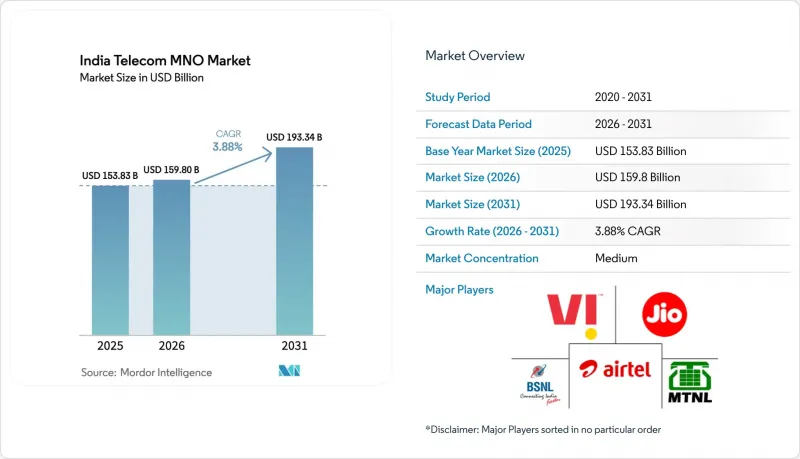
本報告按服務類型(語音服務、數據和網際網路服務、即時通訊服務、物聯網和機器對機器通訊服務、OTT和付費電視服務等)和最終用戶(企業和消費者)進行分類。市場預測以價值(美元)和規模(用戶數量)為單位呈現。
印度電信行動網路營運商市場的趨勢與洞察
行動數據流量激增是由低成本的 4G/5G 套餐推動的。
印度用戶平均每月數據消耗量已達30GB,光是Jio就佔全球行動流量的8%,凸顯了印度以數據為中心的成長軌跡。規模經濟使營運商能夠透過雲端服務、遊戲和人工智慧服務將不斷成長的數據量貨幣化,同時也能持續投資於網路建設。預計到2025年底,固定無線接取(FWA)用戶將超過1,000萬,為服務欠缺地區創造新的寬頻選擇。憑藉實惠的價格和高密度的5G部署,印度的行動網路營運商(MNO)市場有望成為數據密集型消費和工業應用領域的先驅。
透過「數位印度」和「Bharatnet」計畫擴大寬頻覆蓋範圍。
公共部門建設光纖骨幹網路降低了農村地區的部署邊際成本,使私人電信業者能夠將4G/5G網路擴展到以前無利可圖的村莊。 BSNL在政府資助下建立的4G網路,目標是在2025年3月前涵蓋10萬個地點,顯示政府獎勵策略如何在降低私人資本風險的同時,鞏固來自電子醫療、農業技術和數位學習領域的需求。遵守印度居住者資料法規也催生了對國內託管雲端服務和連接服務的需求,並引領印度行動網路營運商(MNO)市場開闢新的收入來源。
債務負擔加重限制了電信公司的資本投資。
沃達豐Idea高達270億美元的債務和資金籌措停滯凸顯了資金籌措挑戰如何拖慢其5G部署速度並削弱其競爭力。高槓桿率導致現金流緊張,迫使其優先考慮短期ARPU值而非長期創新,最終導致大量寶貴用戶流失到財務實力更強的競爭對手,並限制了整個印度電信行動網路營運商(MNO)市場的發展。
細分市場分析
到2025年,數據和網際網路服務將佔總收入的59.62%,鞏固其在印度電信行動網路營運商(MNO)市場的主導地位。該業務類股正以3.82%的複合年成長率成長,都市區飽和與新增農村用戶數基本持平。 5G固定無線存取(FWA)的部署帶來了強勁的成長勢頭,而強大的光纖回程回程傳輸則加速了Gigabit級服務的交付。語音服務目前仍佔總收入的16.74%,但VoLTE正在降低每分鐘通話成本,從而維持現金流。物聯網(IoT)和機器對機器(M2M)服務僅佔總營收的5.06%,但正以3.93%的複合年成長率成長,這得益於蜂巢模組出貨量年增32%。 OTT和付費電視佔總營收的6.85%,複合年成長率為3.84%,主要由獨家體育內容推動。
電信業者正利用數據分析來最佳化預付方案、精準定位本地客戶群並提升銷售雲端儲存服務。與競爭對手的差異化優勢體現在延遲、穩定的吞吐量以及對第三方應用程式的平台開放性等。衛星回程傳輸相關法規的明確化正在加速混合連接的普及,並擴大服務覆蓋的家庭數量。儘管用戶成長放緩,但所有這些變化都使印度電信行動網路營運商(MNO)市場保持著穩定成長的勢頭。
其他好處:
- Excel格式的市場預測(ME)表
- 3個月的分析師支持
目錄
第1章:引言
- 研究假設和市場定義
- 調查範圍
第2章:調查方法
第3章執行摘要
第4章 市場狀況
- 市場概覽
- 監理與政策框架
- 頻段狀況和競爭對手擁有情形
- 通訊業生態系統
- 宏觀經濟與外在因素
- 波特五力模型
- 行動網路營運商的關鍵KPI(2020-2025)
- 行動用戶數量和普及率
- 行動網路使用者數量和普及率
- 按接入技術分類的SIM卡合約數量和滲透率
- 蜂巢式物聯網/機器對機器連接數
- 寬頻連線數(移動和固定)
- ARPU(每位用戶平均收入)
- 每用戶平均數據使用量(GB/月)
- 市場促進因素
- 行動資料通訊的激增得益於低成本的 4G/5G 套餐。
- 「數位印度」和「印度寬頻網路」計畫正在加速寬頻的普及。
- 智慧型手機平均售價(ASP)的大幅下降正在擴大潛在用戶群。
- 企業對專用 5G/邊緣連線的需求
- 物聯網設備中 eSIM 和多 IMSI 的普及
- OTT內容捆綁銷售提升了ARPU值。
- 市場限制因素
- 債務負擔加重限制了企業在資本投資上的柔軟性。
- 高頻寬成本和行業附加稅
- 光纖電纜部署所需的道路使用許可核准延誤。
- 與資料在地化相關的合規成本不斷上升
- 技術展望
- 通訊業關鍵經營模式分析
- 定價模型和定價分析
第5章 市場規模與成長預測
- 整個通訊業的收入和每用戶平均收入
- 按服務類型
- 語音服務
- 數據網際網路服務
- 通訊服務
- 物聯網/機器對機器服務
- OTT(非櫃檯)和付費電視服務
- 其他服務(附加價值服務、漫遊和國際服務、企業和批發服務等)
- 最終用戶
- 公司
- 消費者
第6章 競爭情勢
- 市場集中度
- 主要供應商的策略性舉措和投資(2023-2025 年)
- 2024年行動通訊業者(MNO)市佔率分析
- MNO snapshot(subscribers, churn rate, ARPU, etc.)
- 行動通訊業者(MNO)公司簡介*
- Reliance Jio
- Bharti Airtel
- Vodafone Idea
- BSNL
第7章 市場機會與未來展望
According to Mordor Intelligence, the India telecom MNO market size is expected to grow from USD 153.83 billion in 2025 to USD 159.8 billion in 2026 and is forecast to reach USD 193.34 billion by 2031 at 3.88% CAGR over 2026-2031.
This report is Segmented by Service Type (Voice Services, Data and Internet Services, Messaging Services, Iot and M2M Services, OTT and PayTV Services, and Other Services), and End User (Enterprises, Consumer). The Market Forecasts are Provided in Terms of Value (USD) and Volume (Subscribers).
India Telecom MNO Market Trends and Insights
Surging mobile-data traffic fueled by low-cost 4G/5G plans
Average monthly consumption has hit 30 GB per user, and Jio alone carries 8% of global mobile traffic, validating India's data-centric trajectory. Scale economics now let operators monetize incremental gigabytes through cloud, gaming, and AI-enhanced services while sustaining network reinvestment. Fixed-wireless access (FWA) subscriptions are set to surpass 10 million by end-2025, creating an alternative broadband path in underserved zones. The combination of affordable pricing and dense 5G roll-outs positions the India telecom MNO market to pioneer data-intensive consumer and industrial applications.
Digital India and BharatNet programs widening broadband reach
Public-sector fiber backbones lower the marginal cost of rural roll-outs, letting private carriers extend 4G/5G to villages that were previously uneconomical. BSNL's state-funded 4G build-targeting 100,000 sites by March 2025-illustrates how government stimulus de-risks private capital while anchoring demand from e-health, agri-tech, and e-learning initiatives. Compliance with India-resident data rules adds parallel demand for locally hosted cloud and connectivity, pulling the India telecom MNO market into new revenue pools.
Elevated debt loads limiting operator capex
Vodafone Idea's USD 27 billion debt and stalled fund-raise underscore a financing overhang that defers 5G roll-outs and erodes competitiveness. High leverage tightens cash flows, prioritizes short-term ARPU over long-range innovation, and lets better-capitalized peers win premium subscribers-constraining the broader India telecom MNO market.
Other drivers and restraints analyzed in the detailed report include:
- Enterprise appetite for private 5G and edge connectivity
- Bundled OTT content driving ARPU uplift
- High spectrum costs and sector-specific levies
For complete list of drivers and restraints, kindly check the Table Of Contents.
Segment Analysis
Data and Internet Services delivered 59.62% of 2025 revenue, confirming their primacy in the India telecom MNO market. The segment is tracking a 3.82% CAGR as urban saturation balances rural onboarding. 5G FWA uptake underpins outsized momentum, while robust fiber backhaul accelerates gigabit-class offerings. Voice still holds 16.74% revenue; yet VoLTE lowers cost-per-minute, preserving cash flow. IoT and M2M Services, though only 5.06% of revenue, post a 3.93% CAGR and benefit from 32% YoY cellular-module shipment growth. OTT and PayTV contribute 6.85% with a 3.84% CAGR, boosted by exclusive sports content.
Operators leverage data analytics to curate prepaid bundles, microtarget rural cohorts, and upsell cloud storage. Competitive differentiation pivots on latency, consistent throughput, and platform openness for third-party apps. Regulatory clarity on satellite backhaul encourages hybrid connectivity, expanding addressable households. Altogether, these shifts keep the India telecom MNO market on a steady value-accretion path despite moderating subscriber additions.
Complete Report Scope:
- Overall Telecom Revenue and ARPU
- Service Type
- Voice Services
- Data and Internet Services
- Messaging Services
- IoT and M2M Services
- OTT and PayTV Services
- Other Services (VAS, Roaming and International Services, Enterprise and Wholesale Services, etc.)
- End-user
- Enterprises
- Consumer
List of Companies Covered in this Report:
- Reliance Jio
- Bharti Airtel
- Vodafone Idea
- BSNL
Additional Benefits:
- The market estimate (ME) sheet in Excel format
- 3 months of analyst support
TABLE OF CONTENTS
1 INTRODUCTION
- 1.1 Study Assumptions and Market Definition
- 1.2 Scope of the Study
2 RESEARCH METHODOLOGY
3 EXECUTIVE SUMMARY
4 Market Landscape
- 4.1 Market Overview
- 4.2 Regulatory and Policy Framework
- 4.3 Spectrum Landscape and Competitive Holdings
- 4.4 Telecom Industry Ecosystem
- 4.5 Macroeconomic and External Drivers
- 4.6 Porter's Five Forces
- 4.6.1 Competitive Rivalry
- 4.6.2 Threat of New Entrants
- 4.6.3 Bargaining Power of Suppliers
- 4.6.4 Bargaining Power of Buyers
- 4.6.5 Threat of Substitutes
- 4.7 Key MNO KPIs (2020-2025)
- 4.7.1 Unique Mobile Subscribers and Penetration Rate
- 4.7.2 Mobile Internet Users and Penetration Rate
- 4.7.3 SIM Connections by Access Technology and Penetration
- 4.7.4 Cellular IoT / M2M Connections
- 4.7.5 Broadband Connections (Mobile and Fixed)
- 4.7.6 ARPU (Average Revenue Per User)
- 4.7.7 Average Data Usage per Subscription (GB/month)
- 4.8 Market Drivers
- 4.8.1 Surging mobile-data traffic supported by low-cost 4G/5G plans
- 4.8.2 Digital India and BharatNet accelerating broadband penetration
- 4.8.3 Rapid decline in smartphone ASPs expanding addressable user base
- 4.8.4 Enterprise demand for private 5G / edge connectivity
- 4.8.5 e-SIM and multi-IMSI uptake in IoT devices
- 4.8.6 Bundled OTT content driving ARPU uplift
- 4.9 Market Restraints
- 4.9.1 Elevated debt loads curbing operator capex flexibility
- 4.9.2 High spectrum costs and sector-specific levies
- 4.9.3 Delays in municipal RoW approvals for fiber roll-outs
- 4.9.4 Rising data-localisation compliance costs
- 4.10 Technological Outlook
- 4.11 Analysis of key business models in Telecom
- 4.12 Analysis of Pricing Models and Pricing
5 MARKET SIZE AND GROWTH FORECASTS (VALUE)
- 5.1 Overall Telecom Revenue and ARPU
- 5.2 Service Type
- 5.2.1 Voice Services
- 5.2.2 Data and Internet Services
- 5.2.3 Messaging Services
- 5.2.4 IoT and M2M Services
- 5.2.5 OTT and PayTV Services
- 5.2.6 Other Services (VAS, Roaming and International Services, Enterprise and Wholesale Services, etc.)
- 5.3 End-user
- 5.3.1 Enterprises
- 5.3.2 Consumer
6 COMPETITIVE LANDSCAPE
- 6.1 Market Concentration
- 6.2 Strategic Moves and Investments by key vendors, 2023-2025
- 6.3 Market share analysis for MNOs, 2024
- 6.4 MNO snapshot (subscribers, churn rate, ARPU, etc.)
- 6.5 Company Profiles* of MNOs (Includes Business Overview | Service Portfolio | Financials | Business Strategy and Recent Developments | SWOT Analysis)
- 6.5.1 Reliance Jio
- 6.5.2 Bharti Airtel
- 6.5.3 Vodafone Idea
- 6.5.4 BSNL
7 MARKET OPPORTUNITIES AND FUTURE OUTLOOK
- 7.1 White-space and Unmet-Need Assessment

 中國行動網路業者(MNO):市佔率分析、產業趨勢與統計及成長預測(2026-2031)東協行動虛擬網路營運商:市場佔有率分析、產業趨勢與統計及成長預測(2026-2031)西班牙電信行動網路業者:市場佔有率分析、產業趨勢與統計、成長預測(2026-2031)馬來西亞電信行動網路業者:市場佔有率分析、產業趨勢與統計及成長預測(2026-2031 年)中東和非洲電信營運商(MNO):市場佔有率分析、行業趨勢和統計數據以及成長預測(2026-2031 年)德國電信行動網路業者:市場佔有率分析、產業趨勢與統計及成長預測(2026-2031 年)日本行動網路業者(MNO):市佔率分析、產業趨勢與統計及成長預測(2026-2031)法國電信行動網路業者:市場佔有率分析、產業趨勢與統計及成長預測(2026-2031 年)美國行動網路營運商(MNO):市場佔有率分析、產業趨勢與統計數據、成長預測(2026-2031 年)義大利行動網路營運商(MNO):市場佔有率分析、產業趨勢和統計數據以及成長預測(2026-2031 年)