


 |
市場調查報告書
商品編碼
2117242
中國行動網路業者(MNO):市佔率分析、產業趨勢與統計及成長預測(2026-2031)China Telecom MNO - Market Share Analysis, Industry Trends & Statistics, Growth Forecasts (2026 - 2031) |
||||||

※ 本網頁內容可能與最新版本有所差異。詳細情況請與我們聯繫。
根據 Mordor Intelligence 預測,中國行動網路營運商 (MNO) 市場規模預計將從 2025 年的 2,464.2 億美元成長到 2026 年的 2,553.4 億美元,然後從 2026 年到 2031 年以 3.62% 的複合成長率成長,達到 203.39.303 年到 2039.39.39.39.3003年。
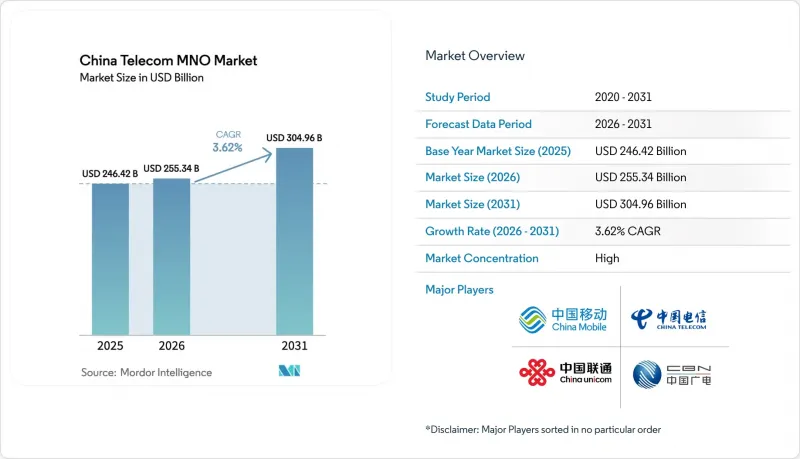
本報告按服務類型(語音服務、數據和網際網路服務、通訊服務、物聯網和機器對機器(M2M)服務、OTT和付費電視服務以及其他服務)和最終用戶(企業和一般消費者)進行分類。市場預測以價值(美元)和規模(用戶數量)為單位呈現。
中國電信網路營運商(MNO)市場趨勢與洞察。
全國部署 5G-Advanced 技術並支援資本支出 (CAPEX)
中國三大國有電信業者正在建造全球最大的5G-Advanced網路,並獲得了工信部提供的優惠融資和6GHz頻段的分配。中國移動計畫建造280萬個5G基地台,中國聯通的目標是到2025年在300個城市實現5G全面覆蓋,這將為網路切片和邊緣雲帶來協同效應,而這些對於工業自動化至關重要。基礎設施共用協議減少了重複投資,而國有銀行提供的信貸額度則支持了多年的資本投資週期。由此產生的高密度基地台能夠實現超低延遲服務,使中國行動網路營運商(MNO)市場成為全球大規模機器類型通訊(MMC)的標竿。
企業對雲端和網路融合的需求正在激增。
製造業和電子政府領域的數位轉型加速,正迫使各組織遷移到整合連接和雲端架構。電信業者正利用覆蓋全國的光纖骨幹網路和IDC資產,提供一站式SD-WAN、私人5G和混合雲端服務,例如中國移動的「大銀」運算平台。這種轉變推高了平均合約價值,透過託管安全服務提高了客戶留存率,並加速了中國電信行動網路營運商(MNO)市場B2B收入結構的形成。雖然需求主要集中在一線高科技產業走廊,但也正向省級產業園區擴散,這些園區正因政策誘因而大力推動智慧工廠試點計畫。
行動用戶飽和度
在主要大都會圈,SIM卡滲透率已超過115%,自然成長空間所剩無幾。如今,成長主要依賴於客戶維繫、多設備資料方案以及物聯網服務的提供。雖然家庭資料方案和智慧型裝置捆綁包有效降低了解約率,但每位用戶平均收入(ARPU)成長依然緩慢,迫使營運商進一步提升用戶終身價值。這種市場飽和正在拖累中國行動網路營運商(MNO)的消費者業務,促使其策略重心轉向企業和垂直產業物聯網合約。
細分市場分析
到2025年,數據和網際網路服務將佔中國電信行動網路營運商(MNO)市場佔有率的43.58%。這反映了中國以雲端遊戲、高清串流媒體和無現金零售為核心的「行動優先」數位生態系統。高容量的5G-Advanced小區和一體化光纖骨幹網路正在支撐資料流量的持續成長,而差異化的速率套餐和無限流量套餐則確保了每位用戶平均收入(ARPU)的穩定提升。製造業帶邊緣運算節點的興起推動了高階連接的需求,頻寬將提高部署工業4.0企業的生產力。同時,隨著OTT管道吸收點對點通訊,語音和通訊收入持續結構性下降。營運商正透過利用現有MPLS線路和企業級整合通訊套餐的Vo-over-NR服務來緩解收入稀釋。
同時,物聯網(IoT)和機器對機器(M2M)服務正以3.78%的複合年成長率快速成長,預計將在中國行動網路營運商(MNO)市場中佔據更大的增量價值。到2030年,預計將有超過20億個獲得許可的蜂巢式物聯網終端上線,涵蓋智慧電錶集群、自動導引運輸車(AGV)車隊、互聯農業區等眾多領域。電信業者正透過利用平台經濟、設備管理入口網站、自動化SIM卡生命週期管理和整合收費系統來加強客戶鎖定。由於物聯網連接的收入低於一般消費者線路,且顧客關懷成本極低,毛利率不斷提高。政府對車輛遠端資訊處理和電力計量方面的監管進一步推動了物聯網流量的成長,增強了其長期收入前景。
其他好處:
- Excel格式的市場預測(ME)表
- 3個月的分析師支持
目錄
第1章:引言
- 研究假設和市場定義
- 調查範圍
第2章:調查方法
第3章執行摘要
第4章 市場狀況
- 市場概覽
- 監理與政策框架
- 當前頻段狀況及擁有情形競爭
- 通訊業生態系統
- 宏觀經濟與外在因素
- 波特五力分析
- 主要行動網路營運商 (MNO) 的關鍵績效指標 (KPI) (2020-2025)
- 行動用戶數量和普及率
- 行動網路使用者數量和普及率
- 按接入技術分類的SIM卡合約數量和滲透率
- 蜂巢式物聯網/M2M連接數
- 寬頻連線數(移動和固定)
- ARPU(每位用戶平均收入)
- 每用戶平均數據使用量(GB/月)
- 市場促進因素
- 全國部署 5G-Advanced 技術並支援資本支出 (CAPEX)
- 企業對雲端和網路融合的需求正在激增。
- Gigabit光纖網路的廣泛應用導致寬頻ARPU(每用戶平均收入)增加。
- 短影片和XR技術導致行動數據流量爆炸性成長。
- 開放網路 API 貨幣化(GSMA 開放閘道器)
- 利用人工智慧獎勵綠色網路,旨在最佳化能源效率
- 市場限制因素
- 行動電話用戶飽和度
- OTT技術將取代傳統的語音通話和簡訊服務。
- 地方政府在數位行政管理競標中展開價格競爭。
- 5G核心半導體供應中的出口管制風險
- 技術展望
- 電信業關鍵經營模式分析
- 定價模型和定價分析
第5章 市場規模與成長預測
- 整個通訊業的收入和每用戶平均收入
- 按服務類型
- 語音服務
- 數據和網際網路服務
- 通訊服務
- 物聯網和機器對機器服務
- OTT和付費電視服務
- 其他服務(附加價值服務、漫遊和國際服務、企業和批發服務等)
- 最終用戶
- 公司
- 消費者
第6章 競爭情勢
- 市場集中度
- 主要供應商的策略性舉措與投資,2023-2025 年
- 2024年行動通訊業者(MNO)市佔率分析
- Product Benchmarking Analysis for mobile network services
- MNO snapshot(subscribers, churn rate, ARPU, etc.)
- 行動通訊業者(MNO)公司簡介*
- China Mobile Limited
- China Telecom Corporation Limited
- China United Network Communications Group Co., Ltd.
- China Broadnet(China Broadcast Network Co., Ltd.)
第7章 市場機會與未來展望
According to Mordor Intelligence, the China telecom MNO market size is expected to grow from USD 246.42 billion in 2025 to USD 255.34 billion in 2026 and is forecast to reach USD 304.96 billion by 2031 at 3.62% CAGR over 2026-2031.
This report is Segmented by Service Type (Voice Services, Data and Internet Services, Messaging Services, Iot and M2M Services, OTT and PayTV Services, and Other Services), and End User (Enterprises, Consumer). The Market Forecasts are Provided in Terms of Value (USD) and Volume (Subscribers).
China Telecom MNO Market Trends and Insights
National 5G-Advanced Rollout and CAPEX Support
China's three state-owned operators are in the middle of the world's largest 5G-Advanced build-out, backed by MIIT's preferential financing and 6 GHz spectrum allocations. China Mobile plans 2.8 million 5G cells, and China Unicom targets blanket coverage across 300 cities by 2025, enabling network slicing and edge-cloud synergies essential for industrial automation. Shared-infrastructure agreements reduce redundant spending, while access to state bank credit lines sustains the multi-year capex cycle. The resulting densification supports ultra-low-latency services, positioning the China Telecom MNO market as the global reference for massive machine-type communications.
Enterprise Cloud-Network Convergence Demand Surge
Digital-transformation mandates across manufacturing and e-government are pushing organizations toward integrated connectivity and cloud stacks. Operators are leveraging nationwide fiber backbones and IDC assets to deliver one-stop SD-WAN, private 5G, and hybrid-cloud offerings, such as China Mobile's Dayin computing platform . The shift lifts average contract values and deepens stickiness via managed security, accelerating the China Telecom MNO market's B2B revenue mix. Demand is clustered in Tier 1 tech corridors yet ripples into provincial industrial parks where policy incentives promote smart-factory pilots.
Mobile-Subscriber Saturation
Penetration exceeding 115% in the largest conurbations leaves little room for organic SIM additions. Growth now hinges on retention, multi-device data plans, and IoT provisioning. While family buckets and smart-device bundles slow churn, ARPU uplift remains modest, pressing operators to extract more lifetime value per account. The saturation ceiling weighs on the consumer slice of the China Telecom MNO market, shifting strategic weight toward enterprise and vertical-IoT contracts.
Other drivers and restraints analyzed in the detailed report include:
- Explosive Mobile-Data Traffic from Short-Video and XR
- Green-Network Incentives for AI-Optimized Energy Savings
- OTT Substitution of Legacy Voice and SMS
For complete list of drivers and restraints, kindly check the Table Of Contents.
Segment Analysis
Data and Internet Services held 43.58% China Telecom MNO market share in 2025, reflecting the nation's mobile-first digital ecosystem anchored by cloud gaming, HD streaming, and cash-light retail. High-capacity 5G-Advanced cells and converged fiber backbones underpin sustained data-traffic growth, while differentiated speed tiers and unlimited bundles sustain incremental ARPU. The rise of edge-computing nodes near manufacturing belts drives premium connectivity demand, converting bandwidth into productivity gains for Industry 4.0 adopters. Conversely, Voice and Messaging revenues continue their structural decline as OTT channels absorb person-to-person communications. Operators mitigate dilution through voice-over-NR and enterprise-grade unified-communications packages that piggyback on existing MPLS circuits.
In parallel, IoT and M2M Services are expanding at a 3.78% CAGR, set to capture outsized incremental value within the China Telecom MNO market size. Over 2 billion licensed cellular IoT endpoints are expected online by 2030, spanning smart-meter clusters, AGV fleets, and connected agriculture zones. Operators exploit platform economics, device management portals, SIM lifecycle automation, and integrated billing to deepen client lock-in. Revenue per connection is lower than consumer lines, yet gross margins improve owing to minimal customer-care overhead. Government mandates for vehicle telematics and electricity metering further institutionalize IoT traffic growth, reinforcing long-run revenue visibility.
Complete Report Scope:
- Overall Telecom Revenue and ARPU
- Service Type
- Voice Services
- Data and Internet Services
- Messaging Services
- IoT and M2M Services
- OTT and PayTV Services
- Other Services (VAS, Roaming and International Services, Enterprise and Wholesale Services, etc.)
- End-user
- Enterprises
- Consumer
List of Companies Covered in this Report:
- China Mobile Limited
- China Telecom Corporation Limited
- China United Network Communications Group Co., Ltd.
- China Broadnet (China Broadcast Network Co., Ltd.)
Additional Benefits:
- The market estimate (ME) sheet in Excel format
- 3 months of analyst support
TABLE OF CONTENTS
1 INTRODUCTION
- 1.1 Study Assumptions and Market Definition
- 1.2 Scope of the Study
2 RESEARCH METHODOLOGY
3 EXECUTIVE SUMMARY
4 MARKET LANDSCAPE
- 4.1 Market Overview
- 4.2 Regulatory and Policy Framework
- 4.3 Spectrum Landscape and Competitive Holdings
- 4.4 Telecom Industry Ecosystem
- 4.5 Macroeconomic and External Drivers
- 4.6 Porter's Five Forces Analysis
- 4.6.1 Competitive Rivalry
- 4.6.2 Threat of New Entrants
- 4.6.3 Bargaining Power of Suppliers
- 4.6.4 Bargaining Power of Buyers
- 4.6.5 Threat of Substitutes
- 4.7 Key MNO KPIs (2020-2025)
- 4.7.1 Unique Mobile Subscribers and Penetration Rate
- 4.7.2 Mobile Internet Users and Penetration Rate
- 4.7.3 SIM Connections by Access Technology and Penetration
- 4.7.4 Cellular IoT/M2M Connections
- 4.7.5 Broadband Connections (Mobile and Fixed)
- 4.7.6 ARPU (Average Revenue Per User)
- 4.7.7 Average Data Usage per Subscription (GB/month)
- 4.8 Market Drivers
- 4.8.1 National 5G-Advanced rollout and CAPEX support
- 4.8.2 Enterprise cloud-network convergence demand surge
- 4.8.3 Gigabit-fiber adoption lifting broadband ARPU
- 4.8.4 Explosive mobile-data traffic from short-video and XR
- 4.8.5 Monetisation of open-network APIs (GSMA Open Gateway)
- 4.8.6 Green-network incentives for AI-optimised energy savings
- 4.9 Market Restraints
- 4.9.1 Mobile-subscriber saturation
- 4.9.2 OTT substitution of legacy voice and SMS
- 4.9.3 Provincial price wars in digital-government tenders
- 4.9.4 Export-control risk for 5G core semiconductor supply
- 4.10 Technological Outlook
- 4.11 Analysis of key business models in Telecom Sector
- 4.12 Analysis of Pricing Models and Pricing
5 MARKET SIZE AND GROWTH FORECASTS (VALUE AND VOLUME)
- 5.1 Overall Telecom Revenue and ARPU
- 5.2 Service Type
- 5.2.1 Voice Services
- 5.2.2 Data and Internet Services
- 5.2.3 Messaging Services
- 5.2.4 IoT and M2M Services
- 5.2.5 OTT and PayTV Services
- 5.2.6 Other Services (VAS, Roaming and International Services, Enterprise and Wholesale Services, etc.)
- 5.3 End-user
- 5.3.1 Enterprises
- 5.3.2 Consumer
6 COMPETITIVE LANDSCAPE
- 6.1 Market Concentration
- 6.2 Strategic Moves and Investments by key vendors, 2023-2025
- 6.3 Market share analysis for MNOs, 2024
- 6.4 Product Benchmarking Analysis for mobile network services
- 6.5 MNO snapshot (subscribers, churn rate, ARPU, etc.)
- 6.6 Company Profiles* of MNOs (Includes Business Overview | Service Portfolio | Financials | Business Strategy and Recent Developments | SWOT Analysis)
- 6.6.1 China Mobile Limited
- 6.6.2 China Telecom Corporation Limited
- 6.6.3 China United Network Communications Group Co., Ltd.
- 6.6.4 China Broadnet (China Broadcast Network Co., Ltd.)
7 MARKET OPPORTUNITIES AND FUTURE OUTLOOK
- 7.1 White-space and Unmet-Need Assessment

 東協行動虛擬網路營運商:市場佔有率分析、產業趨勢與統計及成長預測(2026-2031)西班牙電信行動網路業者:市場佔有率分析、產業趨勢與統計、成長預測(2026-2031)馬來西亞電信行動網路業者:市場佔有率分析、產業趨勢與統計及成長預測(2026-2031 年)中東和非洲電信營運商(MNO):市場佔有率分析、行業趨勢和統計數據以及成長預測(2026-2031 年)印度電信行動網路業者:市場佔有率分析、產業趨勢與統計及成長預測(2026-2031 年)德國電信行動網路業者:市場佔有率分析、產業趨勢與統計及成長預測(2026-2031 年)日本行動網路業者(MNO):市佔率分析、產業趨勢與統計及成長預測(2026-2031)法國電信行動網路業者:市場佔有率分析、產業趨勢與統計及成長預測(2026-2031 年)美國行動網路營運商(MNO):市場佔有率分析、產業趨勢與統計數據、成長預測(2026-2031 年)義大利行動網路營運商(MNO):市場佔有率分析、產業趨勢和統計數據以及成長預測(2026-2031 年)