


 |
市場調查報告書
商品編碼
2125540
泰國資訊通訊技術:市場佔有率分析、產業趨勢與統計、成長預測(2026-2031)Thailand ICT - Market Share Analysis, Industry Trends & Statistics, Growth Forecasts (2026 - 2031) |
||||||

※ 本網頁內容可能與最新版本有所差異。詳細情況請與我們聯繫。
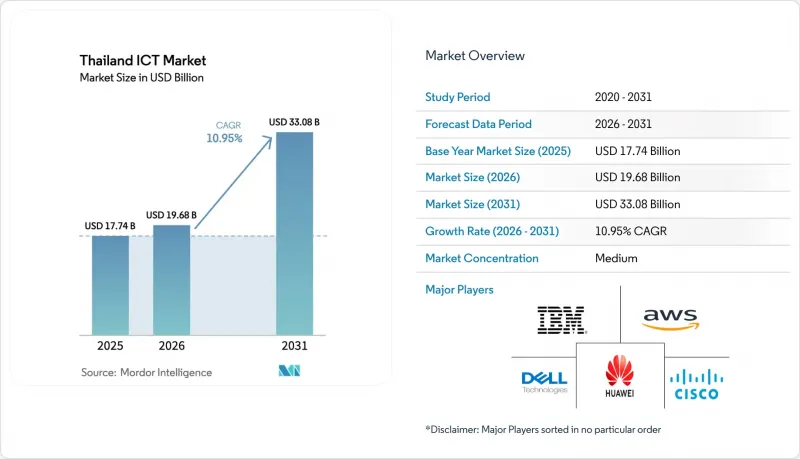
根據 Mordor Intelligence 預測,泰國 ICT 市場規模將從 2025 年的 177.4 億美元成長到 2026 年的 196.8 億美元,然後在 2031 年達到 330.8 億美元,2026 年至 2031 年的複合年成長率為 10.95%。
本報告按產品類型(IT硬體、IT軟體、IT服務、 IT基礎設施、 IT安全、通訊服務)、最終用戶公司規模(中小企業、大型企業)和最終用戶行業(政府/公共管理部門、銀行、金融服務和保險業、能源和公用事業等)進行分類。市場預測以美元計價。
泰國資訊通訊技術市場趨勢與洞察
5G網路快速部署和用戶不斷成長
到2024年,全國5G網路將覆蓋95%的人口,從而支援邊緣運算應用,例如製造業的預測性維護和物流的即時追蹤。電信業者正在採用網路切片技術,為關鍵任務應用提供專用頻寬,從而開立除消費者語音和資料通訊之外的全新企業收入來源。國家廣播和電信委員會關於頻段分配和基礎設施共用的法規正在降低農村地區的部署成本,加速曼谷以外地區5G的普及。東部經濟走廊的製造商正在整合5G感測器和人工智慧分析技術,以減少意外停機時間並提高吞吐量。 5G設備的普及率不斷提高,推動了用戶向5G網路遷移,用戶平均每月數據消耗量已達到兩位數GB等級。
政府的「雲端優先」政策正在加速雲端技術的普及應用。
自2024年起,所有公共機構必須證明其本地採購的合理性,以此作為例外情況,政府鼓勵各部會將舊有系統遷移至符合ISO 27001和《個人資料保護法》認證的國內雲端區域。耗資150億泰銖(約4.7億美元)的「智慧國家,智慧生活」計畫正在資助共用API閘道器和名為ThaiLLM的自主大型語言模式(LLM)平台,該平台託管於政府認可的雲端平台上。國有企業現在透過單一採購入口網站發布其服務目錄,為私人供應商提供清晰的整合藍圖。這項政策也促進了受監管行業的類似舉措,金融機構正在基於政府框架制定雲端安全基準。因此,雲端技能、參考架構和採購模板正在向私營部門傳播,泰國的ICT市場正在從中受益。
中小企業數位技能分散,網路安全應對力存在差距。
十家泰國中小企業中,有九家缺乏正式的數位化投資計劃,許多已遷移到雲端的企業也忽略了多因素身份驗證和基於角色的存取控制等基本安全設定。由於缺乏對零信任框架的認知,小規模企業極易遭受網路釣魚和勒索軟體攻擊,可能導致長達數週的業務中斷。儘管政府的「中小企業4.0」計畫提供代金券補貼培訓和諮詢,但由於企業主優先考慮的是眼前的現金流問題,該計畫的利用率仍低於30%。隨著保險公司將中小企業資料外洩事件的日益頻繁視為風險因素,網路保險費也在上漲。如果缺乏持續的技能發展,泰國資訊通訊技術市場在都市區的雲端運算普及率可能會放緩。
細分市場分析
到2025年,IT服務將佔據泰國ICT市場32.08%的最大佔有率,主要受託管服務合約和多重雲端遷移專案的推動。電信營運商正在將網路營運中心外包,製造商則利用系統整合商實施預測性維護。在此背景下,隨著企業將單體應用程式重構為API驅動的微服務,雲端服務預計將以11.45%的複合年成長率成長。硬體需求依然強勁,主要受5G無線設備升級和資料中心資本投資的推動;同時,由於網路攻擊手法日益成長,網路安全支出也在加速成長。
從資本支出 (Capex) 向營運支出 (OpEx) 的轉變正在重塑供應商的收入模式。泰國國家石油探勘與生產公司 (PTT Exploration and Production) 向雲端原生開發平台的遷移,使其應用程式發布週期縮短了 480%,充分展現了舊有系統現代化帶來的益處。邊緣運算設備在製造工廠中日益普及,以滿足低延遲需求,為通過泰國國家廣播和電信委員會 (NBTC) 標準認證的硬體供應商創造了新的收入來源。在泰國的 ICT 市場,低程式碼開發工具正被廣泛採用,使業務分析師能夠快速建立應用程式原型,從而緩解了開發人才短缺的困境。
其他好處:
- Excel格式的市場預測(ME)表
- 3個月的分析師支持
目錄
第1章:引言
- 研究假設和市場定義
- 調查範圍
第2章:調查方法
第3章執行摘要
第4章 市場狀況
- 市場概覽
- 市場促進因素
- 5G網路快速部署和用戶不斷成長
- 政府的「雲端優先」政策正在加速雲端技術的普及應用。
- 工業4.0驅動下的數位轉型在企業中迅速擴展
- 外國直接投資(FDI)流入超大規模資料中心
- 虛擬銀行牌照正在促進金融科技基礎設施的發展。
- Ambition 是一個人工智慧賦能、水冷式資料中心樞紐
- 市場限制因素
- 中小企業在數位技能和網路安全應對力方面存在差距。
- 高技能資訊通訊技術人才短缺和人事費用上升
- 更嚴格的資料本地化法規將增加整體擁有成本。
- 網路詐騙導致的賠償訴訟激增,使得資訊通訊技術預算不得不削減。
- 價值鏈分析
- 監理情勢
- 技術展望
- 波特五力分析
- 投資分析
- 宏觀經濟因素的影響
- 產業相關人員分析
第5章 市場規模與成長預測
- 依產品類型
- IT硬體
- 電腦硬體
- 網路裝置
- 周邊設備
- IT軟體
- IT服務
- IT諮詢與實施
- IT外包(ITO)
- 業務流程外包(BPO)
- 資安管理服務
- 雲端平台服務
- IT基礎設施
- IT安全/網路安全
- 通訊服務
- IT硬體
- 按公司規模
- 小型企業
- 大公司
- 按行業分類的最終用戶
- 政府/公共行政
- BFSI
- 資訊科技/通訊
- 能源公用事業
- 零售、電子商務、物流
- 製造業和工業4.0
- 醫療保健和生命科學
- 石油和天然氣
- 遊戲和電子競技
- 其他行業
第6章 競爭情勢
- 市場集中度
- 策略趨勢
- 市佔率分析
- 公司簡介
- Advanced Info Service Public Company Limited
- True Corporation Public Company Limited
- National Telecom Public Company Limited
- Huawei Technologies Co., Ltd.
- Cisco Systems, Inc.
- International Business Machines Corporation
- Dell Technologies Inc.
- Amazon Web Services, Inc.
- Google LLC
- Microsoft Corporation
- Oracle Corporation
- SAP SE
- Cognizant Technology Solutions Corporation
- Wipro Limited
- Ericsson AB
- Nokia Corporation
- Check Point Software Technologies Ltd.
- Palo Alto Networks, Inc.
- Alibaba Cloud Computing Co., Ltd.
- VMware, Inc.
- Fujitsu Limited
- NEC Corporation
- Accenture plc
- Hewlett Packard Enterprise Company
- Seagate Technology Holdings plc
第7章 市場機會與未來展望
According to Mordor Intelligence, the Thailand ICT market size is expected to grow from USD 17.74 billion in 2025 to USD 19.68 billion in 2026 and is forecast to reach USD 33.08 billion by 2031 at 10.95% CAGR over 2026-2031.
This report is Segmented by Product Type (IT Hardware, IT Software, IT Services, IT Infrastructure, IT Security, Communication Services), End-User Enterprise Size (Small and Medium Enterprises, Large Enterprises), and End-User Industry Vertical (Government and Public Administration, BFSI, Energy and Utilities, and More). The Market Forecasts are Provided in Terms of Value (USD).
Thailand ICT Market Trends and Insights
Rapid 5G Network Deployment and Subscriber Uptake
Nationwide 5G roll-out reached 95% population coverage by 2024, enabling edge-computing use cases for predictive maintenance in manufacturing and real-time logistics tracking. Operators deploy network-slicing to offer dedicated throughput for mission-critical applications, unlocking enterprise revenue streams that move beyond consumer voice and data. The National Broadcasting and Telecommunications Commission's spectrum allocations and infrastructure-sharing rules lower deployment costs for rural areas, accelerating adoption outside Bangkok. Manufacturers in the Eastern Economic Corridor integrate 5G sensors with AI analytics to cut unplanned downtime and boost throughput. Rising 5G handset penetration fuels subscriber migration, pushing average data consumption to double-digit gigabyte levels per user each month.
Government "Cloud-First" Policy Accelerating Adoption
Since 2024, every public-sector agency must justify on-premises procurements as exceptions, prompting ministries to migrate legacy systems onto domestic cloud regions certified under ISO 27001 and the Personal Data Protection Act. The THB 15 billion (USD 0.47 billion) Smart Nation Smart Life program funds shared API gateways and a sovereign large-language-model platform dubbed ThaiLLM hosted in government-approved clouds. State-owned enterprises now publish service catalogs through a single procurement portal, giving private vendors a clear roadmap for integration. The policy has catalyzed similar behavior in regulated industries, with financial institutions benchmarking cloud-security baselines against the government framework. As a result, the Thailand ICT market enjoys a multiplier effect as cloud skills, reference architectures, and procurement templates trickle into the private sector.
Fragmented SME Digital-Skills and Cyber-Readiness Gap
Nine in ten Thai SMEs lack formal digital investment plans, and many who do migrate to cloud overlook basic security configurations such as multi-factor authentication or role-based access. Limited awareness of zero-trust frameworks leaves smaller firms exposed to phishing and ransomware that can cripple operations for weeks. Government vouchers under the SME 4.0 program subsidize training and consulting, yet usage remains below 30% because owners prioritize immediate cash-flow concerns. Cyber-insurance premiums climb as underwriters factor in elevated breach frequency among small businesses. Without continuous skills development, the Thailand ICT market risks slower cloud uptake outside the urban core.
Other drivers and restraints analyzed in the detailed report include:
- Enterprise Industry 4.0 Digital-Transformation Surge
- Hyperscale Data-Center FDI Inflows
- Shortage of Advanced ICT Talent and Rising Labor Cost
For complete list of drivers and restraints, kindly check the Table Of Contents.
Segment Analysis
IT Services contributed the largest 32.08% slice of the Thailand ICT market share in 2025, led by managed services contracts and multi-cloud migration projects. Telecom operators outsource network operations centers, and manufacturers engage system integrators for predictive-maintenance deployments. Within this umbrella, Cloud Services is forecast to grow at an 11.45% CAGR as enterprises refactor monolithic applications into API-driven microservices. Hardware demand holds steady on the back of 5G radio upgrades and data-center capital expenditure, while cybersecurity outlays accelerate due to persistent threat vectors.
The migration from capex to opex spending reshapes vendor revenue models. PTT Exploration and Production's move to a cloud-native development platform reduced application release cycles by 480%, illustrating payoffs realized when legacy systems are modernized. Edge-computing appliances proliferate in manufacturing plants to meet low-latency requirements, creating fresh revenue for hardware vendors certified under National Broadcasting and Telecommunications Commission standards. The Thailand ICT market incorporates low-code development tools that empower business analysts to prototype applications, easing pressure on scarce developer talent.
Complete Report Scope:
- By Product Type
- IT Hardware
- Computer Hardware
- Networking Equipment
- Peripherals
- IT Software
- IT Services
- IT Consulting and Implementation
- IT Outsourcing (ITO)
- Business Process Outsourcing (BPO)
- Managed Security Services
- Cloud and Platform Services
- IT Infrastructure
- IT Security/Cybersecurity
- Communication Services
- IT Hardware
- By Enterprise Size
- Small and Medium-sized Enterprises
- Large Enterprises
- By End-user Industry Vertical
- Government and Public Administration
- BFSI
- IT and Telecom
- Energy and Utilities
- Retail, E-commerce, and Logistics
- Manufacturing and Industry 4.0
- Healthcare and Life Sciences
- Oil and Gas
- Gaming and Esports
- Other Verticals
List of Companies Covered in this Report:
- Advanced Info Service Public Company Limited
- True Corporation Public Company Limited
- National Telecom Public Company Limited
- Huawei Technologies Co., Ltd.
- Cisco Systems, Inc.
- International Business Machines Corporation
- Dell Technologies Inc.
- Amazon Web Services, Inc.
- Google LLC
- Microsoft Corporation
- Oracle Corporation
- SAP SE
- Cognizant Technology Solutions Corporation
- Wipro Limited
- Ericsson AB
- Nokia Corporation
- Check Point Software Technologies Ltd.
- Palo Alto Networks, Inc.
- Alibaba Cloud Computing Co., Ltd.
- VMware, Inc.
- Fujitsu Limited
- NEC Corporation
- Accenture plc
- Hewlett Packard Enterprise Company
- Seagate Technology Holdings plc
Additional Benefits:
- The market estimate (ME) sheet in Excel format
- 3 months of analyst support
TABLE OF CONTENTS
1 INTRODUCTION
- 1.1 Study Assumptions and Market Definition
- 1.2 Scope of the Study
2 RESEARCH METHODOLOGY
3 EXECUTIVE SUMMARY
4 MARKET LANDSCAPE
- 4.1 Market Overview
- 4.2 Market Drivers
- 4.2.1 Rapid 5G network deployment and subscriber uptake
- 4.2.2 Government "Cloud-First" policy accelerating adoption
- 4.2.3 Enterprise Industry 4.0 digital-transformation surge
- 4.2.4 Hyperscale data-center FDI inflows
- 4.2.5 Virtual-bank licensing fuelling fintech infrastructure
- 4.2.6 AI-ready, liquid-cooling data-center hub ambitions
- 4.3 Market Restraints
- 4.3.1 Fragmented SME digital-skills and cyber-readiness gap
- 4.3.2 Shortage of advanced ICT talent and rising labor cost
- 4.3.3 Stricter data-localization mandates increasing TCO
- 4.3.4 Soaring cyber-fraud liability dampening ICT budgets
- 4.4 Value Chain Analysis
- 4.5 Regulatory Landscape
- 4.6 Technological Outlook
- 4.7 Porter's Five Forces Analysis
- 4.7.1 Bargaining Power of Suppliers
- 4.7.2 Bargaining Power of Buyers
- 4.7.3 Threat of New Entrants
- 4.7.4 Threat of Substitutes
- 4.7.5 Intensity of Competitive Rivalry
- 4.8 Investment Analysis
- 4.9 Impact of Macroeconomic Factors
- 4.10 Industry Stakeholder Analysis
5 MARKET SIZE AND GROWTH FORECASTS (VALUE)
- 5.1 By Product Type
- 5.1.1 IT Hardware
- 5.1.1.1 Computer Hardware
- 5.1.1.2 Networking Equipment
- 5.1.1.3 Peripherals
- 5.1.2 IT Software
- 5.1.3 IT Services
- 5.1.3.1 IT Consulting and Implementation
- 5.1.3.2 IT Outsourcing (ITO)
- 5.1.3.3 Business Process Outsourcing (BPO)
- 5.1.3.4 Managed Security Services
- 5.1.3.5 Cloud and Platform Services
- 5.1.4 IT Infrastructure
- 5.1.5 IT Security/Cybersecurity
- 5.1.6 Communication Services
- 5.1.1 IT Hardware
- 5.2 By Enterprise Size
- 5.2.1 Small and Medium-sized Enterprises
- 5.2.2 Large Enterprises
- 5.3 By End-user Industry Vertical
- 5.3.1 Government and Public Administration
- 5.3.2 BFSI
- 5.3.3 IT and Telecom
- 5.3.4 Energy and Utilities
- 5.3.5 Retail, E-commerce, and Logistics
- 5.3.6 Manufacturing and Industry 4.0
- 5.3.7 Healthcare and Life Sciences
- 5.3.8 Oil and Gas
- 5.3.9 Gaming and Esports
- 5.3.10 Other Verticals
6 COMPETITIVE LANDSCAPE
- 6.1 Market Concentration
- 6.2 Strategic Moves
- 6.3 Market Share Analysis
- 6.4 Company Profiles (includes Global level Overview, Market level overview, Core Segments, Financials as available, Strategic Information, Market Rank/Share for key companies, Products and Services, and Recent Developments)
- 6.4.1 Advanced Info Service Public Company Limited
- 6.4.2 True Corporation Public Company Limited
- 6.4.3 National Telecom Public Company Limited
- 6.4.4 Huawei Technologies Co., Ltd.
- 6.4.5 Cisco Systems, Inc.
- 6.4.6 International Business Machines Corporation
- 6.4.7 Dell Technologies Inc.
- 6.4.8 Amazon Web Services, Inc.
- 6.4.9 Google LLC
- 6.4.10 Microsoft Corporation
- 6.4.11 Oracle Corporation
- 6.4.12 SAP SE
- 6.4.13 Cognizant Technology Solutions Corporation
- 6.4.14 Wipro Limited
- 6.4.15 Ericsson AB
- 6.4.16 Nokia Corporation
- 6.4.17 Check Point Software Technologies Ltd.
- 6.4.18 Palo Alto Networks, Inc.
- 6.4.19 Alibaba Cloud Computing Co., Ltd.
- 6.4.20 VMware, Inc.
- 6.4.21 Fujitsu Limited
- 6.4.22 NEC Corporation
- 6.4.23 Accenture plc
- 6.4.24 Hewlett Packard Enterprise Company
- 6.4.25 Seagate Technology Holdings plc
7 MARKET OPPORTUNITIES AND FUTURE OUTLOOK
- 7.1 White-space and unmet-need assessment

 中東和北非資訊通訊技術(ICT):市場佔有率分析、行業趨勢和統計數據以及成長預測(2026-2031 年)中國資訊通訊技術:市場佔有率分析、產業趨勢與統計及成長預測(2026-2031年)日本資訊通訊技術:市場佔有率分析、產業趨勢與統計、成長預測(2026-2031)西班牙資訊通訊技術:市場佔有率分析、產業趨勢與統計、成長預測(2026-2031)越南資訊通訊技術:市場佔有率分析、產業趨勢與統計、成長預測(2026-2031)印尼資訊通訊技術:市場佔有率分析、產業趨勢與統計及成長預測(2026-2031)新加坡資訊通訊技術:市場佔有率分析、產業趨勢與統計及成長預測(2026-2031 年)歐洲資訊通訊技術:市場佔有率分析、行業趨勢和統計數據、成長預測(2026-2031 年)法國資訊通訊技術:市場佔有率分析、產業趨勢與統計及成長預測(2026-2031 年)美國資訊通訊技術:市場佔有率分析、行業趨勢和統計數據、成長預測(2026-2031 年)