


 |
市場調查報告書
商品編碼
2116926
印尼資訊通訊技術:市場佔有率分析、產業趨勢與統計及成長預測(2026-2031)Indonesia ICT - Market Share Analysis, Industry Trends & Statistics, Growth Forecasts (2026 - 2031) |
||||||

※ 本網頁內容可能與最新版本有所差異。詳細情況請與我們聯繫。
根據 Mordor Intelligence 預測,印尼 ICT 市場規模預計在 2026 年達到 577.1 億美元,到 2031 年達到 1,149.6 億美元,複合年成長率為 14.78%。
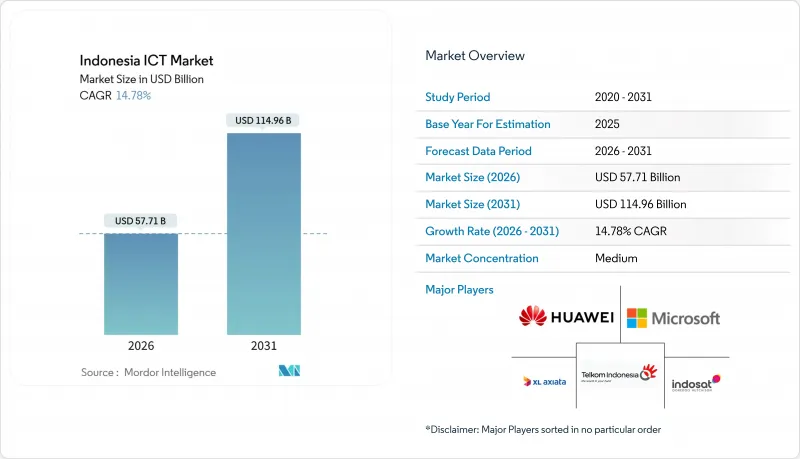
本報告按產品類型(IT硬體、IT軟體等)、公司規模(中小企業、大型企業)、最終用戶行業(銀行、金融服務和保險、政府及公共部門、石油和天然氣、IT和電信、零售和電子商務、製造業、能源等)以及部署模式(本地部署、雲端部署、混合部署)進行細分。市場預測以美元計價。
印尼資訊通訊技術市場趨勢與洞察
印尼企業的數位轉型
隨著大型企業集團將SAP和Oracle工作負載遷移到雲端原生架構,並在工廠車間部署物聯網感測器,其技術預算的很大一部分都投入了現代化改造舉措。Accenture與印尼電信(Indosat)合作建立“主權人工智慧雲端”,展現了電信營運商如何從單純的基礎設施供應商轉型為轉型合作夥伴。強制性的TKDN(本土化內容比例)標準正在鼓勵本地軟體開發,區域系統整合商則專注於提供兼具合規性和技術執行能力的承包解決方案。製造業正透過「印尼製造4.0」藍圖獲得明確的政策支持。然而,企業內部技能水準的差異使得外包成為一個頗具吸引力的選擇,這也解釋了印尼資訊通訊技術(ICT)市場業務收益持續兩位數成長的原因。
政府推廣數位技能和基礎設施
數位人才獎學金計畫旨在2018年至2024年培養一百萬名畢業生,並計畫在2025年再培訓十萬名畢業生。 SATRIA-1的150Gbps骨幹網路目前為3萬個公共設施提供支持,並與3.6萬公里未充分利用的「Palapa Ring」光纖網路形成互補。這些舉措正在將基礎網路連接擴展到先前缺乏可靠頻寬的省份,從而創造了對雲端運算、網路安全和電子政府平台的新需求。然而,對雇主的調查顯示,許多畢業生需要額外六個月的培訓才能勝任生產環境的工作,這凸顯了持續存在的技能缺口,阻礙了印尼資訊通訊技術市場短期生產力的提升。
高技能資訊通訊技術人員短缺
到2030年,印尼需要900萬資訊通訊技術(ICT)專業人才,但目前的教育體系只能培養600萬。自2023年以來,雅加達資深雲端工程師的薪資每年增加25%至30%,相較於區域中心城市的成本優勢正逐漸消失。全球供應商正在推出內部培訓機構以確保員工獲得認證等級的技能,但企業仍需要為新員工預留6至12個月的在職培訓時間,才能使其完全勝任工作。服務公司目前正在採用一種新模式,將本地年輕員工與來自印度和菲律賓的經驗豐富的海外架構師相結合,這種模式可以緩解工資上漲,但會增加協調成本,並可能在數據主權方面引發摩擦。
細分市場分析
預計到2025年,IT服務將佔印尼ICT市場佔有率的32.73%,並在2031年之前以15.22%的複合年成長率成長。由於企業將轉型相關的複雜流程外包,託管安全和雲端平台服務佔據了最大的市場佔有率。硬體更新周期正在延長,而軟體預算正轉向SaaS訂閱。零信任架構正在整合基礎架構和安全,迫使供應商提供整合式解決方案。在勒索軟體威脅和日益嚴格的合規要求的雙重壓力下,預計到2031年,印尼ICT服務市場規模將翻倍。
印尼語在地化SaaS的需求推動了本土軟體開發公司的發展,這些公司正利用國內內容要求(TKDN)激勵措施與跨國公司競爭。然而,熟練人才的短缺延緩了大規模ERP遷移的進程,需要分階段實施,延長了專案週期。 5G的資本密集特性也給電信服務的利潤率帶來了壓力,迫使營運商將重點轉向企業物聯網和邊緣分析等增值領域。
到2025年,大型企業將佔總支出的62.84%,但中小企業(SME)的複合年成長率(CAGR)最高,達到15.67%,且差距正在縮小。政府計畫已將1,700萬家微企業納入電子商務和金融科技生態系統,並降低了進入門檻。2D碼支付系統(QRIS)的普及使商家能夠透過智慧型手機接受非現金支付,從而節省了POS終端的資本投資。低程式碼平台進一步推動了應用開發的民主化,減少了對稀缺開發人員的依賴,並促進了印尼資訊通訊技術(ICT)市場中小企業的採用。
對大規模國營企業而言,舊有系統現代化是一項沉重的負擔。對大型主機的依賴以及複雜的合規要求,迫使遷移藍圖往往需要數年時間才能完成。儘管印尼電信光纖業務的剝離已將資金重新分配到雲端運算和安全領域,但組織架構的重組可能會延緩內部IT升級。能夠同時滿足快速發展的雲端原生中小企業和風險規避型成熟企業需求的供應商,可望獲得顯著的市佔率成長。
其他好處:
- Excel格式的市場預測(ME)表
- 3個月的分析師支持
目錄
第1章:引言
- 研究假設和市場定義
- 調查範圍
第2章:調查方法
第3章執行摘要
第4章 市場狀況
- 市場概覽
- 市場促進因素
- 印尼企業的數位轉型
- 政府促進數位技能和基礎設施發展
- 電子商務的快速發展正在推動線上支付。
- “帕拉帕環”和“薩特里亞-1”衛星的部署
- 向綠色資料中心轉型是由電價飆升推動的。
- 人工智慧驅動的雲端服務印尼語本地化
- 市場限制因素
- 資料隱私和網路安全問題
- 高技能資訊通訊技術人員短缺
- 在地採購(Tkdn)法規推高了硬體成本。
- 不斷上漲的電費威脅著資料中心的營運成本。
- 產業價值鏈分析
- 監理情勢
- 技術展望
- 雲端運算
- 人工智慧與分析
- 網路安全
- 物聯網和邊緣運算
- 5G及未來5G
- 波特五力分析
- 宏觀經濟因素的影響
第5章 市場規模與成長預測
- 依產品類型
- IT硬體
- 電腦硬體
- 網路裝置
- 周邊設備
- IT軟體
- IT服務
- IT諮詢與實施
- IT外包(ITO)
- 業務流程外包(BPO)
- 託管安全服務
- 雲端和平台服務
- IT基礎設施
- IT安全/網路安全
- 應用程式安全
- 雲端安全
- 資料安全
- 網路安全
- 端點安全
- 基礎設施保護
- 綜合風險管理
- 身分和存取管理 (IAM)
- 通訊服務
- IT硬體
- 按公司規模
- 小型企業
- 大公司
- 按最終用戶行業分類
- BFSI
- 政府/公共部門
- 石油和天然氣
- 資訊科技/通訊
- 零售、電子商務與消費者
- 製造業和工業
- 能源公用事業
- 衛生保健
- 其他終端用戶產業(交通運輸、物流、教育、飯店餐飲)
- 按部署模式
- 現場
- 雲
- 混合
第6章 競爭情勢
- 市場集中度
- 策略趨勢
- 市佔率分析
- 公司簡介
- PT Telkom Indonesia(Persero)Tbk
- Indosat Ooredoo Hutchison Tbk
- XL Axiata Tbk
- Huawei Technologies Co., Ltd.
- Microsoft Corporation
- Samsung Electronics Co., Ltd.
- Dell Technologies Inc.
- Lenovo Group Ltd.
- HP Inc.
- IBM Corporation
- Oracle Corporation
- SAP SE
- Accenture plc
- Cognizant Technology Solutions Corporation
- Infosys Limited
- Tata Consultancy Services Limited
- Tech Mahindra Limited
- Cisco Systems, Inc.
- Fortinet, Inc.
- Palo Alto Networks, Inc.
- Kaspersky Lab
- Trend Micro Incorporated
- Equinix, Inc.
- ST Telemedia Global Data Centres(STT GDC)
- NTT Ltd.
- Alibaba Cloud Computing Ltd.(added)
- Amazon Web Services, Inc.(added)
- Google Cloud Platform LLC(added)
- PT DCI Indonesia Tbk(added)
- PT Biznet Gio Nusantara(added)
第7章 市場機會與未來展望
According to Mordor Intelligence, indonesia iCT market size is USD 57.71 billion in 2026 and is projected to reach USD 114.96 billion by 2031, reflecting a 14.78% CAGR.
This report is Segmented by Product Type (IT Hardware, IT Software, and More), Enterprise Size (Small and Medium-Sized Enterprises, and Large Enterprises), End-User Industry Vertical (BFSI, Government and Public Sector, Oil and Gas, IT and Telecom, Retail and E-Commerce, Manufacturing, Energy, and More), Deployment Model (On-Premise, Cloud, and Hybrid). The Market Forecasts are Provided in Terms of Value (USD).
Indonesia ICT Market Trends and Insights
Digital Transformation Of Indonesian Enterprises
Modernization initiatives dominate technology budgets as conglomerates migrate SAP and Oracle workloads to cloud-native stacks while deploying IoT sensors on factory floors. Accenture's collaboration with Indosat to build a sovereign AI cloud shows how telcos are recasting themselves as transformation partners rather than pure connectivity utilities. Mandatory TKDN thresholds reward local software development, prompting regional integrators to package turnkey offerings that combine compliance and technical execution. Manufacturing receives explicit policy support through the Making Indonesia 4.0 roadmap. Yet uneven in-house skill levels make outsourcing attractive, which explains the sustained double-digit expansion of services revenue within the Indonesia ICT market.
Government Digital-Skills And Infrastructure Push
The Digital Talent Scholarship delivered 1 million graduates between 2018 and 2024 and targets 100,000 more in 2025. SATRIA-1's 150 Gbps backbone now supports 30,000 public facilities, complementing the under-utilized 36,000-km Palapa Ring fiber. These initiatives extend basic connectivity to provinces that historically lacked reliable bandwidth and create new addressable demand for cloud, cybersecurity, and e-government platforms. However, employer surveys reveal that many graduates require six months of additional training before they can run production workloads, highlighting persistent capability gaps that temper the Indonesia ICT market's near-term productivity gains.
Shortage Of Advanced ICT Talent
Indonesia needs 9 million ICT professionals by 2030, but current education pipelines will supply only 6 million. Salaries for senior cloud engineers in Jakarta climbed 25-30% each year since 2023, eroding cost advantages versus regional hubs. Global vendors launch in-house academies to assure certification-grade skills, yet enterprises still budget six to twelve months of shadowing before new hires achieve full productivity. Services firms now blend local juniors with seasoned offshore architects from India or the Philippines, which mitigates wage inflation but introduces coordination overhead and potential data-sovereignty friction.
Other drivers and restraints analyzed in the detailed report include:
- E-Commerce Boom Spurring Online Payments
- Palapa Ring And SATRIA-1 Satellite Roll-Out
- Data-Privacy And Cyber-Security Concerns
For complete list of drivers and restraints, kindly check the Table Of Contents.
Segment Analysis
IT services held 32.73% of the Indonesia ICT market share in 2025 and will grow at a 15.22% CAGR through 2031. Managed security and cloud platform services claim the lion's share as enterprises outsource transformation complexity. Hardware refresh cycles lengthen while software budgets tilt toward SaaS subscriptions. Zero-trust architectures merge infrastructure and security domains, forcing vendors to deliver integrated stacks. The Indonesia ICT market size for services stands to double by 2031 as ransomware threats and compliance mandates intensify.
Demand for localized SaaS in Bahasa Indonesia encourages domestic software houses, which leverage TKDN incentives to compete with multinationals. Nevertheless, talent scarcity delays large-scale ERP migrations, requiring phased rollouts that extend project timelines. Communication services margins compress under 5G capital intensity, pushing telcos to concentrate on enterprise IoT and edge analytics as value-add layers.
Large enterprises contributed 62.84% of 2025 spend, yet SMEs clock the fastest 15.67% CAGR, shrinking the gap. Government programs integrated 17 million micro-businesses into e-commerce and fintech ecosystems, lowering onboarding hurdles. QRIS ubiquity lets merchants accept cashless payments via smartphones, sparing them point-of-sale capex. Low-code platforms further democratize application creation, reducing dependence on scarce developers and propelling SME adoption inside the Indonesia ICT market.
Legacy modernization burdens large state-owned enterprises. Mainframe dependencies and complex compliance layers stretch migration roadmaps to multi-year horizons. Telkom Indonesia's fiber spin-off reallocates capital toward cloud and security, yet reorganizations can delay internal IT upgrades. Vendors able to serve both high-velocity cloud-native SMEs and risk-averse incumbents position themselves for outsized wallet share.
Complete Report Scope:
- By Product Type
- IT Hardware
- Computer Hardware
- Networking Equipment
- Peripherals
- IT Software
- IT Services
- IT Consulting and Implementation
- IT Outsourcing (ITO)
- Business Process Outsourcing (BPO)
- Managed Security Services
- Cloud and Platform Services
- IT Infrastructure
- IT Security / Cybersecurity
- Application Security
- Cloud Security
- Data Security
- Network Security
- Endpoint Security
- Infrastructure Protection
- Integrated Risk Management
- Identity and Access Management (IAM)
- Communication Services
- IT Hardware
- By Enterprise Size
- Small and Medium-sized Enterprises
- Large Enterprises
- By End-user Industry Vertical
- BFSI
- Government and Public Sector
- Oil and Gas
- IT and Telecom
- Retail, E-Commerce and Consumers
- Manufacturing and Industrial
- Energy and Utilities
- Healthcare
- Other End-user Industry Verticals (Transport, Logistics, Education, Hospitality)
- By Deployment Model
- On-premise
- Cloud
- Hybrid
List of Companies Covered in this Report:
- PT Telkom Indonesia (Persero) Tbk
- Indosat Ooredoo Hutchison Tbk
- XL Axiata Tbk
- Huawei Technologies Co., Ltd.
- Microsoft Corporation
- Samsung Electronics Co., Ltd.
- Dell Technologies Inc.
- Lenovo Group Ltd.
- HP Inc.
- IBM Corporation
- Oracle Corporation
- SAP SE
- Accenture plc
- Cognizant Technology Solutions Corporation
- Infosys Limited
- Tata Consultancy Services Limited
- Tech Mahindra Limited
- Cisco Systems, Inc.
- Fortinet, Inc.
- Palo Alto Networks, Inc.
- Kaspersky Lab
- Trend Micro Incorporated
- Equinix, Inc.
- ST Telemedia Global Data Centres (STT GDC)
- NTT Ltd.
- Alibaba Cloud Computing Ltd. (added)
- Amazon Web Services, Inc. (added)
- Google Cloud Platform LLC (added)
- PT DCI Indonesia Tbk (added)
- PT Biznet Gio Nusantara (added)
Additional Benefits:
- The market estimate (ME) sheet in Excel format
- 3 months of analyst support
TABLE OF CONTENTS
1 INTRODUCTION
- 1.1 Study Assumptions and Market Definition
- 1.2 Scope of the Study
2 RESEARCH METHODOLOGY
3 EXECUTIVE SUMMARY
4 MARKET LANDSCAPE
- 4.1 Market Overview
- 4.2 Market Drivers
- 4.2.1 Digital Transformation of Indonesian Enterprises
- 4.2.2 Government Digital-Skills And Infrastructure Push
- 4.2.3 E-Commerce Boom Spurring Online Payments
- 4.2.4 Palapa Ring And Satria-1 Satellite Roll-Out
- 4.2.5 Shift To Green Data-Centres Amid High Power Tariffs
- 4.2.6 Ai-Driven Localisation of Cloud Services For Bahasa Indonesia
- 4.3 Market Restraints
- 4.3.1 Data-Privacy And Cyber-Security Concerns
- 4.3.2 Shortage Of Advanced Ict Talent
- 4.3.3 Local-Content (Tkdn) Rules Inflate Hardware Costs
- 4.3.4 Rising Electricity Tariffs Threaten Data-Centre Opex
- 4.4 Industry Value Chain Analysis
- 4.5 Regulatory Landscape
- 4.6 Technological Outlook
- 4.6.1 Cloud Computing
- 4.6.2 Artificial Intelligence and Analytics
- 4.6.3 Cybersecurity
- 4.6.4 IoT and Edge Computing
- 4.6.5 5G and Beyond
- 4.7 Porter's Five Forces Analysis
- 4.7.1 Bargaining Power of Suppliers
- 4.7.2 Bargaining Power of Buyers
- 4.7.3 Threat of New Entrants
- 4.7.4 Threat of Substitutes
- 4.7.5 Intensity of Competitive Rivalry
- 4.8 Impact of Macroeconomic Factors
5 MARKET SIZE AND GROWTH FORECASTS (VALUE)
- 5.1 By Product Type
- 5.1.1 IT Hardware
- 5.1.1.1 Computer Hardware
- 5.1.1.2 Networking Equipment
- 5.1.1.3 Peripherals
- 5.1.2 IT Software
- 5.1.3 IT Services
- 5.1.3.1 IT Consulting and Implementation
- 5.1.3.2 IT Outsourcing (ITO)
- 5.1.3.3 Business Process Outsourcing (BPO)
- 5.1.3.4 Managed Security Services
- 5.1.3.5 Cloud and Platform Services
- 5.1.4 IT Infrastructure
- 5.1.5 IT Security / Cybersecurity
- 5.1.5.1 Application Security
- 5.1.5.2 Cloud Security
- 5.1.5.3 Data Security
- 5.1.5.4 Network Security
- 5.1.5.5 Endpoint Security
- 5.1.5.6 Infrastructure Protection
- 5.1.5.7 Integrated Risk Management
- 5.1.5.8 Identity and Access Management (IAM)
- 5.1.6 Communication Services
- 5.1.1 IT Hardware
- 5.2 By Enterprise Size
- 5.2.1 Small and Medium-sized Enterprises
- 5.2.2 Large Enterprises
- 5.3 By End-user Industry Vertical
- 5.3.1 BFSI
- 5.3.2 Government and Public Sector
- 5.3.3 Oil and Gas
- 5.3.4 IT and Telecom
- 5.3.5 Retail, E-Commerce and Consumers
- 5.3.6 Manufacturing and Industrial
- 5.3.7 Energy and Utilities
- 5.3.8 Healthcare
- 5.3.9 Other End-user Industry Verticals (Transport, Logistics, Education, Hospitality)
- 5.4 By Deployment Model
- 5.4.1 On-premise
- 5.4.2 Cloud
- 5.4.3 Hybrid
6 COMPETITIVE LANDSCAPE
- 6.1 Market Concentration
- 6.2 Strategic Moves
- 6.3 Market Share Analysis
- 6.4 Company Profiles (includes Global-level Overview, Market-level Overview, Core Segments, Financials as available, Strategic Information, Market Rank/Share, Products and Services, Recent Developments)
- 6.4.1 PT Telkom Indonesia (Persero) Tbk
- 6.4.2 Indosat Ooredoo Hutchison Tbk
- 6.4.3 XL Axiata Tbk
- 6.4.4 Huawei Technologies Co., Ltd.
- 6.4.5 Microsoft Corporation
- 6.4.6 Samsung Electronics Co., Ltd.
- 6.4.7 Dell Technologies Inc.
- 6.4.8 Lenovo Group Ltd.
- 6.4.9 HP Inc.
- 6.4.10 IBM Corporation
- 6.4.11 Oracle Corporation
- 6.4.12 SAP SE
- 6.4.13 Accenture plc
- 6.4.14 Cognizant Technology Solutions Corporation
- 6.4.15 Infosys Limited
- 6.4.16 Tata Consultancy Services Limited
- 6.4.17 Tech Mahindra Limited
- 6.4.18 Cisco Systems, Inc.
- 6.4.19 Fortinet, Inc.
- 6.4.20 Palo Alto Networks, Inc.
- 6.4.21 Kaspersky Lab
- 6.4.22 Trend Micro Incorporated
- 6.4.23 Equinix, Inc.
- 6.4.24 ST Telemedia Global Data Centres (STT GDC)
- 6.4.25 NTT Ltd.
- 6.4.26 Alibaba Cloud Computing Ltd. (added)
- 6.4.27 Amazon Web Services, Inc. (added)
- 6.4.28 Google Cloud Platform LLC (added)
- 6.4.29 PT DCI Indonesia Tbk (added)
- 6.4.30 PT Biznet Gio Nusantara (added)
7 MARKET OPPORTUNITIES AND FUTURE OUTLOOK
- 7.1 White-space and Unmet-need Assessment

 中東和北非資訊通訊技術(ICT):市場佔有率分析、行業趨勢和統計數據以及成長預測(2026-2031 年)中國資訊通訊技術:市場佔有率分析、產業趨勢與統計及成長預測(2026-2031年)日本資訊通訊技術:市場佔有率分析、產業趨勢與統計、成長預測(2026-2031)西班牙資訊通訊技術:市場佔有率分析、產業趨勢與統計、成長預測(2026-2031)越南資訊通訊技術:市場佔有率分析、產業趨勢與統計、成長預測(2026-2031)新加坡資訊通訊技術:市場佔有率分析、產業趨勢與統計及成長預測(2026-2031 年)歐洲資訊通訊技術:市場佔有率分析、行業趨勢和統計數據、成長預測(2026-2031 年)法國資訊通訊技術:市場佔有率分析、產業趨勢與統計及成長預測(2026-2031 年)泰國資訊通訊技術:市場佔有率分析、產業趨勢與統計、成長預測(2026-2031)美國資訊通訊技術:市場佔有率分析、行業趨勢和統計數據、成長預測(2026-2031 年)