


 |
市場調查報告書
商品編碼
2116879
英國資訊通訊技術:市場佔有率分析、行業趨勢和統計數據、成長預測(2026-2031 年)United Kingdom ICT - Market Share Analysis, Industry Trends & Statistics, Growth Forecasts (2026 - 2031) |
||||||

※ 本網頁內容可能與最新版本有所差異。詳細情況請與我們聯繫。
根據 Mordor Intelligence 估計,英國ICT 市場在 2026 年的價值將達到 1,954.7 億美元,高於 2025 年的 1,783.3 億美元,預計到 2031 年將達到 3,094.6 億美元。
預計從 2026 年到 2031 年,其複合年成長率將達到 9.62%。
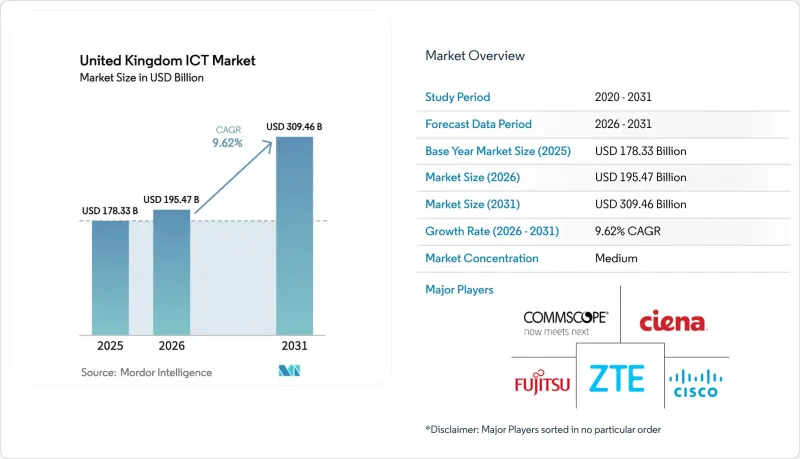
本報告按產品類型(IT硬體、IT軟體、IT服務、 IT基礎設施、 IT安全/網路安全、通訊服務)、公司規模(中小企業、大型企業)和最終用戶行業(政府/公共管理部門、銀行、金融服務和保險業、能源/公共產業等)進行細分。市場預測以美元計價。
英國資訊通訊技術市場趨勢與洞察
對SaaS(軟體即服務)的需求激增
SaaS 的應用範圍正從提升辦公室效率擴展到財務、人力資源和供應鏈等關鍵業務流程,徹底改變了以往以永久許可為主導的採購模式。英國政府的「助力數位化成長計畫」(Help to Grow Digital)向 120 萬家符合資格的公司發放了價值 5,000 英鎊(約 6,749 美元)的軟體代金券,由此催生了一批數位化程度較高的中小企業,為 SaaS 的持續成長提供了支撐。到 2024 年,英國約 90% 的公司將至少使用一項雲端服務,高於 2022 年的 78%。供應商也將業務重心轉向符合各自行業嚴格法規的產業專用的服務。免費增值模式、產品內建的 AI 助理和按使用量收費的模式,使 SaaS 成為注重預算的公司的理想選擇;此外,與英國稅務海關總署 (HMRC) 和公司註冊處 (Companies House) 的 API 整合,也免去了手動合規工作的麻煩。
擴大數位科技在醫療領域的應用
截至2024年,僅有63%的英國國民醫療服務系統(NHS)信託機構具備基本的電子病歷功能,導致投資缺口高達239.8億英鎊(323.6億美元)。 NHS.UK已將這一缺口累計,計劃在2026年前填補。優先支出項目包括可互通的資料倉儲、人工智慧驅動的診斷以及用於保護敏感醫療資訊的零信任安全層。一項遠距監控試點計畫已證實可使再入院率降低26%,並正在加速其在整個綜合醫療系統中的推廣。隨著各信託機構從概念驗證(PoC)階段過渡到生產部署階段,專注於HL7-FHIR整合、醫療級雲端託管和聯邦學習的供應商預計將加快採購週期。在新冠疫情期間興起的遠距遠端醫療服務目前仍佔門診就診量的30%以上,這推動了對安全視訊通訊、物聯網穿戴裝置和分析平台的需求。
半導體供應鏈波動與通膨壓力
英國98%的先進晶片依賴亞洲市場,而更長的前置作業時間和12%至18%的價格上漲正影響資料中心建設和設備升級週期。英國國內半導體銷售額為96億英鎊(129.5億美元),僅佔全球半導體市場的2%。英國國家半導體策略要求在未來十年內投資10億英鎊(13.4億美元)用於設計工具、複合晶圓廠和先進封裝技術。然而,由於產能提升預計要到2028年或更晚才能見效,系統整合商被迫重新設計材料清單(BOM),以適應更容易獲得的製程節點,並擴大在歐洲的晶片重新分配夥伴關係。
細分市場分析
2025年英國資訊通訊技術(ICT)市場將以服務為導向,其中IT服務支出佔33.78%。在該領域內,為緩解技能短缺而提供的託管服務成長了9.9%,而由於多重雲端日益複雜,雲端專業服務成長了12.4%。基礎設施和通訊的融合催生了整合運算、儲存和連接的承包平台。對支援混合辦公和物聯網的邊緣路由器和耐環境設備的硬體需求仍然強勁。
訂閱模式的興起重塑了軟體現金流,並提高了人工智慧推理引擎和低程式碼平台的普及率。供應商正利用產業專用的API和合規模組作為收入來源,將ERP和CRM套件轉型為生態系統。在安全領域——這個年複合成長率高達9.71%的快速成長領域——威脅情報和事件回應正在被整合,相關服務也已包含在授權費用中。這些趨勢使得以結果為導向的供應商有機會取代英國ICT市場中的傳統產品供應商。
其他好處:
- Excel格式的市場預測(ME)表
- 3個月的分析師支持
目錄
第1章:引言
- 研究假設和市場定義
- 調查範圍
第2章:調查方法
第3章執行摘要
第4章 市場狀況
- 市場概覽
- 市場促進因素
- 軟體即服務 (SaaS) 需求激增
- 在整個醫療領域推廣數位技術的應用
- 全國擴展5G基礎設施
- 英國公司增加網路安全支出
- 政府支持中小企業數位轉型的措施
- 擴大量子運算資料中心容量的投資
- 市場限制因素
- 半導體供應鏈的波動和通膨壓力
- 資料竊取和勒索軟體攻擊事件頻傳。
- 英國脫歐後監管合規的複雜性增加(數據本地化)
- 目前人工智慧/機器學習領域高技能人才嚴重短缺。
- 價值鏈分析
- 監理情勢
- 技術展望
- 波特五力分析
- 投資分析
- 宏觀經濟因素的影響
- 產業相關人員分析
第5章 市場規模與成長預測
- 依產品類型
- IT硬體
- 電腦硬體
- 網路裝置
- 周邊設備
- IT軟體
- IT服務
- IT諮詢與實施
- IT外包(ITO)
- 業務流程外包(BPO)
- 託管安全服務
- 雲端和平台服務
- IT基礎設施
- IT安全/網路安全
- 通訊服務
- IT硬體
- 按公司規模
- 小型企業
- 大公司
- 按最終用戶行業分類
- 政府/公共行政
- BFSI
- 資訊科技/通訊
- 能源與公共產業
- 零售、電子商務、物流
- 製造業和工業4.0
- 醫療保健和生命科學
- 石油和天然氣
- 遊戲和電子競技
- 其他
第6章 競爭情勢
- 市場集中度
- 策略趨勢
- 市佔率分析
- 公司簡介
- BT Group plc
- Vodafone Group Services Ltd
- Capita plc
- Computacenter plc
- Softcat plc
- Cisco Systems Inc.
- Dell Technologies Inc.
- Amazon Web Services EMEA SARL
- Microsoft Corp.
- Google Cloud UK Ltd
- IBM UK Ltd
- Fujitsu Services Ltd
- Nokia Corp.
- Juniper Networks Inc.
- Fortinet Inc.
- Palo Alto Networks Inc.
- ZTE Corp.
- Huawei Technologies Co. Ltd
- Ciena Corp.
- CommScope Holding Co. Inc.
第7章 市場機會與未來展望
According to Mordor Intelligence, United Kingdom ICT market size in 2026 is estimated at USD 195.47 billion, growing from 2025 value of USD 178.33 billion with 2031 projections showing USD 309.46 billion, growing at 9.62% CAGR over 2026-2031.
[1] Department for Science, Innovation & Technology, "National Semiconductor Strategy," gov.uk The growth outperforms traditional infrastructure categories because public- and private-sector buyers treat technology as a value generator rather than a cost center. This report is Segmented by Product Type (IT Hardware, IT Software, IT Services, IT Infrastructure, IT Security, Communication Services), Enterprise Size (Small and Medium Enterprises, Large Enterprises), and End-User Industry Vertical (Government and Public Administration, BFSI, Energy and Utilities, and More). The Market Forecasts are Provided in Terms of Value (USD).
United Kingdom ICT Market Trends and Insights
Rapid Surge in Demand for Software-as-a-Service (SaaS)
SaaS adoption extends from office productivity to mission-critical finance, HR, and supply-chain processes, rewriting procurement models that once favored perpetual licenses. The Help to Grow Digital program issued GBP 5,000 (USD 6,749.0) software vouchers to an addressable base of 1.2 million firms, creating a digitally enabled SME segment that now supports recurring SaaS revenues. Roughly 90% of UK companies used at least one cloud service in 2024, up from 78% in 2022, and vendors are pivoting to verticalized offerings addressing strict sectoral regulations. Freemium entry tiers, in-product AI assistants, and consumption-based billing make SaaS attractive to budget-conscious firms, while integrations with HMRC and Companies House APIs eliminate manual compliance effort.
Rise in Digital Technology Adoption Across Healthcare
Only 63% of NHS trusts had foundational electronic patient-record functionality in 2024, leaving a GBP 23.98 billion (USD 32.36 billion ) investment gap that is now earmarked for fulfillment by 2026 NHS.UK. Spending priorities encompass interoperable data warehouses, AI-assisted diagnostics, and zero-trust security layers to safeguard sensitive health information. Remote-monitoring pilots demonstrated 26% readmission reductions, encouraging scaling across integrated care systems. Vendors specializing in HL7-FHIR integration, medical-grade cloud hosting, and federated learning see accelerated procurement cycles as trusts move from proof of concept to production deployments. Telehealth services, normalized during COVID-19, remain above 30% of outpatient consultations, sustaining demand for secure video, IoT wearables, and analytics platforms.
Semiconductor Supply-Chain Volatility and Inflationary Pressure
The UK sources 98% of advanced chips from Asia, exposing data-center builds and device refresh cycles to prolonged lead times and 12-18% price inflations. Domestic revenue of GBP 9.6 billion (USD 12.95 billion) represents just 2% of the global semiconductor market, so the National Semiconductor Strategy directs GBP 1 billion (USD 1.34 billion) to design tools, compound fabs, and advanced packaging over ten years. Still, capacity additions will not mature before 2028, forcing integrators to redesign bill-of-materials around more readily available nodes and to expand die redistribution partnerships in Europe.
Other drivers and restraints analyzed in the detailed report include:
- Expansion of 5G Infrastructure Nationwide
- Escalating Cyber-Security Spending by UK Enterprises
- High Prevalence of Data Theft and Ransomware Incidents
For complete list of drivers and restraints, kindly check the Table Of Contents.
Segment Analysis
The United Kingdom ICT market posted a service-heavy mix in 2025 as IT services commanded 33.78% of spending. Within this stream, managed services grew at 9.9% to mitigate skills shortages, and cloud professional services rose 12.4% on multi-cloud complexity. The convergence of infrastructure and communications produced turnkey platforms blending compute, storage, and connectivity. Hardware demand remained resilient for edge routers and ruggedized devices that support hybrid working and IoT.
The shift to subscription models redefined software cash flows, boosting the attach rate of AI inference engines and low-code platforms. Vendors monetize vertical APIs and compliance modules, turning ERP and CRM suites into ecosystems. Security, the fastest-growing type at 9.71% CAGR, now bundles threat intelligence and incident response, embedding services into licensing fees. This dynamic positions outcome-based providers to displace legacy product vendors across the United Kingdom ICT market.
Complete Report Scope:
- By Product Type
- IT Hardware
- Computer Hardware
- Networking Equipment
- Peripherals
- IT Software
- IT Services
- IT Consulting and Implementation
- IT Outsourcing (ITO)
- Business Process Outsourcing (BPO)
- Managed Security Services
- Cloud and Platform Services
- IT Infrastructure
- IT Security/Cybersecurity
- Communication Services
- IT Hardware
- By Enterprise Size
- Small and Medium-sized Enterprises
- Large Enterprises
- By End-user Industry Vertical
- Government and Public Administration
- BFSI
- IT and Telecom
- Energy and Utilities
- Retail, E-commerce, and Logistics
- Manufacturing and Industry 4.0
- Healthcare and Life Sciences
- Oil and Gas
- Gaming and E-Sports
- Other Verticals
List of Companies Covered in this Report:
- BT Group plc
- Vodafone Group Services Ltd
- Capita plc
- Computacenter plc
- Softcat plc
- Cisco Systems Inc.
- Dell Technologies Inc.
- Amazon Web Services EMEA SARL
- Microsoft Corp.
- Google Cloud UK Ltd
- IBM UK Ltd
- Fujitsu Services Ltd
- Nokia Corp.
- Juniper Networks Inc.
- Fortinet Inc.
- Palo Alto Networks Inc.
- ZTE Corp.
- Huawei Technologies Co. Ltd
- Ciena Corp.
- CommScope Holding Co. Inc.
Additional Benefits:
- The market estimate (ME) sheet in Excel format
- 3 months of analyst support
TABLE OF CONTENTS
1 INTRODUCTION
- 1.1 Study Assumptions and Market Definition
- 1.2 Scope of the Study
2 RESEARCH METHODOLOGY
3 EXECUTIVE SUMMARY
4 MARKET LANDSCAPE
- 4.1 Market Overview
- 4.2 Market Drivers
- 4.2.1 Rapid surge in demand for Software-as-a-Service (SaaS)
- 4.2.2 Rise in digital technology adoption across healthcare
- 4.2.3 Expansion of 5G infrastructure nationwide
- 4.2.4 Escalating cyber-security spending by UK enterprises
- 4.2.5 Government incentives for SME digitalisation
- 4.2.6 Growing investment in quantum-ready data-centre capacity
- 4.3 Market Restraints
- 4.3.1 Semiconductor supply-chain volatility and inflationary pressure
- 4.3.2 High prevalence of data theft and ransomware incidents
- 4.3.3 Regulatory compliance complexity post-Brexit (data localisation)
- 4.3.4 Acute shortage of advanced AI/ML talent
- 4.4 Value Chain Analysis
- 4.5 Regulatory Landscape
- 4.6 Technological Outlook
- 4.7 Porter's Five Forces Analysis
- 4.7.1 Bargaining Power of Suppliers
- 4.7.2 Bargaining Power of Buyers
- 4.7.3 Threat of New Entrants
- 4.7.4 Threat of Substitutes
- 4.7.5 Intensity of Competitive Rivalry
- 4.8 Investment Analysis
- 4.9 Impact of Macroeconomic Factors
- 4.10 Industry Stakeholder Analysis
5 MARKET SIZE AND GROWTH FORECASTS (VALUE)
- 5.1 By Product Type
- 5.1.1 IT Hardware
- 5.1.1.1 Computer Hardware
- 5.1.1.2 Networking Equipment
- 5.1.1.3 Peripherals
- 5.1.2 IT Software
- 5.1.3 IT Services
- 5.1.3.1 IT Consulting and Implementation
- 5.1.3.2 IT Outsourcing (ITO)
- 5.1.3.3 Business Process Outsourcing (BPO)
- 5.1.3.4 Managed Security Services
- 5.1.3.5 Cloud and Platform Services
- 5.1.4 IT Infrastructure
- 5.1.5 IT Security/Cybersecurity
- 5.1.6 Communication Services
- 5.1.1 IT Hardware
- 5.2 By Enterprise Size
- 5.2.1 Small and Medium-sized Enterprises
- 5.2.2 Large Enterprises
- 5.3 By End-user Industry Vertical
- 5.3.1 Government and Public Administration
- 5.3.2 BFSI
- 5.3.3 IT and Telecom
- 5.3.4 Energy and Utilities
- 5.3.5 Retail, E-commerce, and Logistics
- 5.3.6 Manufacturing and Industry 4.0
- 5.3.7 Healthcare and Life Sciences
- 5.3.8 Oil and Gas
- 5.3.9 Gaming and E-Sports
- 5.3.10 Other Verticals
6 COMPETITIVE LANDSCAPE
- 6.1 Market Concentration
- 6.2 Strategic Moves
- 6.3 Market Share Analysis
- 6.4 Company Profiles (includes Global level Overview, Market level overview, Core Segments, Financials as available, Strategic Information, Market Rank/Share for key companies, Products and Services, and Recent Developments)
- 6.4.1 BT Group plc
- 6.4.2 Vodafone Group Services Ltd
- 6.4.3 Capita plc
- 6.4.4 Computacenter plc
- 6.4.5 Softcat plc
- 6.4.6 Cisco Systems Inc.
- 6.4.7 Dell Technologies Inc.
- 6.4.8 Amazon Web Services EMEA SARL
- 6.4.9 Microsoft Corp.
- 6.4.10 Google Cloud UK Ltd
- 6.4.11 IBM UK Ltd
- 6.4.12 Fujitsu Services Ltd
- 6.4.13 Nokia Corp.
- 6.4.14 Juniper Networks Inc.
- 6.4.15 Fortinet Inc.
- 6.4.16 Palo Alto Networks Inc.
- 6.4.17 ZTE Corp.
- 6.4.18 Huawei Technologies Co. Ltd
- 6.4.19 Ciena Corp.
- 6.4.20 CommScope Holding Co. Inc.
7 MARKET OPPORTUNITIES AND FUTURE OUTLOOK
- 7.1 White-space and Unmet-need Assessment

 中東和北非資訊通訊技術(ICT):市場佔有率分析、行業趨勢和統計數據以及成長預測(2026-2031 年)中國資訊通訊技術:市場佔有率分析、產業趨勢與統計及成長預測(2026-2031年)日本資訊通訊技術:市場佔有率分析、產業趨勢與統計、成長預測(2026-2031)西班牙資訊通訊技術:市場佔有率分析、產業趨勢與統計、成長預測(2026-2031)印尼資訊通訊技術:市場佔有率分析、產業趨勢與統計及成長預測(2026-2031)新加坡資訊通訊技術:市場佔有率分析、產業趨勢與統計及成長預測(2026-2031 年)歐洲資訊通訊技術:市場佔有率分析、行業趨勢和統計數據、成長預測(2026-2031 年)法國資訊通訊技術:市場佔有率分析、產業趨勢與統計及成長預測(2026-2031 年)泰國資訊通訊技術:市場佔有率分析、產業趨勢與統計、成長預測(2026-2031)美國資訊通訊技術:市場佔有率分析、行業趨勢和統計數據、成長預測(2026-2031 年)