


 |
市場調查報告書
商品編碼
2116937
中國資訊通訊技術:市場佔有率分析、產業趨勢與統計及成長預測(2026-2031年)China ICT - Market Share Analysis, Industry Trends & Statistics, Growth Forecasts (2026 - 2031) |
||||||

※ 本網頁內容可能與最新版本有所差異。詳細情況請與我們聯繫。
根據 Mordor Intelligence 預測,中國 ICT 市場規模將從 2025 年的 8,900 億美元成長到 2026 年的 9,500 億美元,到 2031 年將達到 1.35 兆美元,2026 年至 2031 年的複合年成長率為 7.14%。
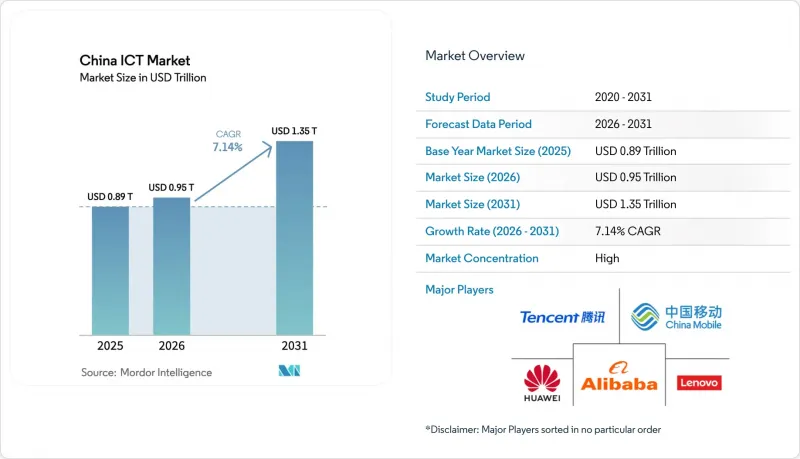
本報告按類型(硬體、軟體等)、公司規模(中小企業和大型企業)、產業(銀行、金融服務和保險、IT及電信、政府及公共部門等)、技術領域(雲端運算、人工智慧、網路安全等)和地區進行細分。市場預測以美元計價。
中國資訊通訊技術市場趨勢與洞察
網路和5G普及率不斷提高
到2024年,全國5G用戶已超過1.014億,行動上網使用率達78.6%。私有5G網路正在工業園區部署,以實現即時品管和自動導引運輸車)的運作。隨著基地台數量的增加,資料流量翻倍,邊緣伺服器和物聯網閘道器的工作負載也隨之增加。定價模式正從頻寬的計量收費轉向基於效果的合約模式,將服務費用與可衡量的生產力提升掛鉤。因此,隨著企業圍繞低延遲連接重新設計流程,中國的ICT市場正在同時獲得訂閱收入和高利潤的整合服務收入。
政府的「數位中國」與「十四五」資訊通訊技術規劃
中央政府的計畫為數位經濟設定了明確的目標,包括2030年數位經濟佔GDP比重達到45%的目標。統一的技術標準降低了智慧城市、遠端醫療和電子政府平台的整合成本。在「東方數據,西方計算」計畫下,省級津貼引導工作負載向西部轉移,從而降低能源成本並平衡各地區的處理能力。優先採購本地供應商的政策義務擴大了國內晶片、伺服器和中間件廠商的市場准入機會。透過這些政策支持,正在創造可預測的需求週期,推動中國資訊通訊技術市場在數量和價值兩方面實現成長。
國營企業遺留IT系統的複雜性
許多國營企業仍依賴沿用數十年的專有大型主機環境。將雲端應用與這些系統整合需要中間件和客製化連接器,這會增加專案週期和成本。採購架構高度重視供應商的過往業績,限制了新興軟體公司進入市場。此外,數位化工作流程常常與現有業務流程相衝突,使得員工再培訓成為一項重大的組織挑戰。這些慣性因素正在減緩中國資訊通訊技術市場滲透重工業價值鏈的整體速度。
細分市場分析
至2025年,硬體領域將佔中國ICT市場收入的42.65%。對5G基地台、高密度伺服器和邊緣閘道器的投資正在為全國數位轉型奠定重要基礎。智慧城市、交通運輸和製造業專案相關的採購確保了設備更新換代週期的穩定。資料中心營運商優先採購國產晶片和交換設備,以降低出口風險並實現本土價值。
儘管目前軟體產業規模較小,但預計其複合年成長率將達到10.09%,成為中國ICT市場成長最快的領域。平台即服務(PaaS)正在加速程式碼部署,而低程式碼工具則使不具備技術專長的員工能夠建立客戶應用程式原型。隨著企業對傳統工作負載進行現代化改造,系統基礎架構軟體正乘著雲端運算的浪潮蓬勃發展。硬體和軟體的融合正在建立一個整合堆疊,使華為等廠商能夠在單一合約下從半導體、作業系統和雲端服務中獲得收入。
到2025年,大型企業將透過實施大規模的ERP、SCM和CRM系統(這些系統需要客製化整合),在中國ICT市場維持63.55%的佔有率。這些企業的數位轉型藍圖已擴展至核心生產、財務和分銷職能,從而鞏固了對諮詢服務日益成長的需求。雖然採購週期較長,但成熟的合作關係能帶來多年持續的收入來源。
中小企業正經歷最快的成長,複合年成長率高達10.32%,為中國資訊通訊技術(ICT)市場注入了新的活力。諸如符合資格的軟體採購可享有稅收抵免等財政獎勵,降低了中小企業採用新技術的門檻。基於訂閱的雲端套件無需前期硬體投資即可存取人工智慧分析、網路安全和電子商務模組。P2P知識共用有助於建立信任,而本地服務合作夥伴則提供價格合理且客製化的服務。隨著中小企業數位化程度的提高,其每美元投資帶來的整體生產力提升往往超過大型企業,進一步凸顯了這個客戶群在結構上的重要性。
其他好處:
- Excel格式的市場預測(ME)表
- 3個月的分析師支持
目錄
第1章:引言
- 研究假設和市場定義
- 調查範圍
第2章:調查方法
第3章執行摘要
第4章 市場狀況
- 市場概覽
- 市場促進因素
- 網路和5G普及率不斷提高
- 政府的「數位中國」計劃和「十四五」資訊通訊技術規劃
- 加速企業向雲端遷移
- 人工智慧驅動各行業生產力提升
- 「黃鑫」的在地化措施正在提振國內需求。
- 強制性碳資訊揭露將推動綠色資訊通訊技術發展。
- 市場限制因素
- 國營企業遺留IT系統的複雜性
- 網路安全/資料主權風險日益惡化
- 美國對先進半導體出口實施限制
- 地方政府採購流程分散
- 產業價值鏈分析
- 監理情勢
- 技術展望
- 產業吸引力—五力分析
- 供應商的議價能力
- 消費者議價能力
- 新進入者的威脅
- 替代品的威脅
- 競爭公司之間的競爭
- 宏觀經濟因素對市場的影響
第5章 市場規模與成長預測
- 按類型
- 硬體
- 計算設備
- 網路裝置
- 資料中心基礎設施
- 軟體
- 系統基礎設施
- 企業應用
- IT服務
- 諮詢和系統整合
- 託管服務
- 通訊服務
- 行動服務
- 固定電話和寬頻
- 硬體
- 按公司規模
- 中小企業
- 大公司
- 按行業分類
- BFSI
- 資訊科技/通訊
- 政府/公共部門
- 零售與電子商務
- 製造業
- 能源公用事業
- 衛生保健
- 教育
- 運輸/物流
- 其他工業部門
- 按技術領域
- 雲端運算
- 人工智慧
- 網路安全
- 數位服務(SaaS、PaaS)
- 邊緣運算
- 物聯網
- 區塊鏈
- 按地區
- 中國東部
- 華南
- 中國北方和東北地區
- 華中地區
- 中國西部和西北部
第6章 競爭情勢
- 市場集中度
- 策略趨勢
- 市佔率分析
- 公司簡介
- Alibaba Group Holding Ltd.
- Huawei Technologies Co Ltd.
- Tencent Holdings Ltd.
- China Mobile Communications Group Co. Ltd.
- Lenovo Group Ltd.
- Baidu Inc.
- JD.com Inc.
- Xiaomi Corporation
- ZTE Corporation
- Inspur Group Co Ltd.
- Hikvision Digital Technology Co Ltd.
- Dahua Technology Co Ltd.
- Sangfor Technologies Inc.
- Venustech Group Inc.
- H3C Technologies Co Ltd.
- Kingsoft Cloud Holdings Ltd.
- UCloud Technology Co Ltd.
- Kingdee International Software Group Co Ltd.
- Neusoft Corporation
- iFlytek Co Ltd.
- SenseTime Group Inc.
- Cambricon Technologies Corp Ltd.
- GDS Holdings Ltd.
- FiberHome Telecom Technologies Co Ltd.
- China Unicom
- China Telecom
第7章 市場機會與未來趨勢
- 評估閒置頻段和未滿足的需求
According to Mordor Intelligence, the china iCT market size is expected to grow from USD 0.89 trillion in 2025 to USD 0.95 trillion in 2026 and is forecast to reach USD 1.35 trillion by 2031 at 7.14% CAGR over 2026-2031.
This report is Segmented by Type (Hardware, Software, and More), Enterprise Size (Small and Medium Enterprises and Large Enterprises), Industry Vertical (BFSI, IT and Telecom, Government and Public, and More), Technology Domain (Cloud Computing, Artificial Intelligence, Cybersecurity, and More), and Region. The Market Forecasts are Provided in Terms of Value (USD).
China ICT Market Trends and Insights
Rising Internet and 5G Penetration
Nationwide 5G rollout exceeded 101.4 million subscribers in 2024, lifting mobile internet usage to 78.6%. Industrial parks adopt private 5G networks to enable real-time quality control and autonomous guided vehicles. Each additional base station multiplies data traffic, increasing the addressable workload for edge servers and IoT gateways. Pricing models evolve from bandwidth metering toward outcome-based arrangements that link service fees to measured productivity uplifts. The China ICT market, therefore, captures both subscription revenues and high-margin integration services as enterprises redesign processes around low-latency connectivity.
Government "Digital China" and 14th Five-Year ICT Plan
Central planning sets explicit digital-economy targets, including a 45% GDP contribution by 2030. Unified technical standards lower integration costs for smart-city, telemedicine, and e-government platforms. Provincial grants funnel workloads westward under the "Eastern Data, Western Computing" program, cutting energy expenses and balancing regional capacity. Mandatory preference for local suppliers expands market access for domestic chip, server, and middleware vendors. The China ICT market thus gains both volume and value as policy support creates predictable demand cycles.
Legacy IT Complexity in State-Owned Enterprises
Many state actors still depend on proprietary mainframe environments installed over decades. Integrating cloud applications with these systems requires middleware and custom connectors that increase project timelines and costs. Procurement frameworks emphasize vendor track record, restricting market entry for emerging software firms. Workforce retraining adds an organizational challenge because digital workflows often conflict with established operating procedures. This inertia slows the overall pace at which the Chinese ICT market can penetrate heavy-industry value chains.
Other drivers and restraints analyzed in the detailed report include:
- Accelerated Enterprise Cloud Migration
- AI-Driven Productivity Gains Across Sectors
- Escalating Cybersecurity and Data-Sovereignty Risk
For complete list of drivers and restraints, kindly check the Table Of Contents.
Segment Analysis
The hardware segment accounted for 42.65% of China's ICT market revenue in 2025. Investments in 5G base stations, high-density servers, and edge gateways form the indispensable substrate for nationwide digitalization. Procurement linked to smart-city, transportation, and manufacturing projects guarantees a steady equipment refresh cycle. Datacenter operators prioritize domestic chips and switch gear to mitigate export risk, anchoring value locally.
Software, though smaller today, is forecast to post a 10.09% CAGR, making it the fastest-growing component of the China ICT market. Platform-as-a-Service offerings accelerate code deployment, while low-code tools let non-technical staff prototype customer-facing applications. System-infrastructure software rides the cloud wave as enterprises modernize legacy workloads. The convergence of hardware and software yields integrated stacks, allowing vendors such as Huawei to monetize silicon, operating systems, and cloud services in a single contract.
Large organizations retained 63.55% of the China ICT market share in 2025 due to sizable ERP, SCM, and CRM deployments that require bespoke integration. Their digital-transformation roadmaps span core production, finance, and distribution functions, locking in high consulting demand. Procurement cycles are lengthy yet produce multi-year recurring revenue streams once relationships mature.
SMEs log the fastest expansion at 10.32% CAGR, adding fresh addressable volume to the China ICT market size. Fiscal incentives, including tax rebates on qualifying software purchases, lower adoption barriers. Subscription-based cloud suites grant access to AI analytics, cybersecurity, and e-commerce modules without up-front hardware spend. Peer-to-peer knowledge sharing boosts confidence, and local service partners offer affordable customization. As SME digital intensity rises, overall productivity gains per USD invested often exceed those of larger rivals, reinforcing the structural importance of this customer layer.
Complete Report Scope:
- By Type
- Hardware
- Computing Devices
- Network Equipment
- Datacentre Infrastructure
- Software
- System Infrastructure
- Enterprise Applications
- IT Services
- Consulting and Integration
- Managed Services
- Telecommunication Services
- Mobile Services
- Fixed-Line and Broadband
- Hardware
- By Enterprise Size
- Small and Medium Enterprises (SMEs)
- Large Enterprises
- By Industry Vertical
- BFSI
- IT and Telecom
- Government and Public
- Retail and E-commerce
- Manufacturing
- Energy and Utilities
- Healthcare
- Education
- Transportation and Logistics
- Other Industry Verticals
- By Technology Domain
- Cloud Computing
- Artificial Intelligence
- Cybersecurity
- Digital Services (SaaS, PaaS)
- Edge Computing
- Internet of Things
- Blockchain
- By Region
- East China
- South China
- North and Northeast China
- Central China
- West and North-west China
List of Companies Covered in this Report:
- Alibaba Group Holding Ltd.
- Huawei Technologies Co Ltd.
- Tencent Holdings Ltd.
- China Mobile Communications Group Co. Ltd.
- Lenovo Group Ltd.
- Baidu Inc.
- JD.com Inc.
- Xiaomi Corporation
- ZTE Corporation
- Inspur Group Co Ltd.
- Hikvision Digital Technology Co Ltd.
- Dahua Technology Co Ltd.
- Sangfor Technologies Inc.
- Venustech Group Inc.
- H3C Technologies Co Ltd.
- Kingsoft Cloud Holdings Ltd.
- UCloud Technology Co Ltd.
- Kingdee International Software Group Co Ltd.
- Neusoft Corporation
- iFlytek Co Ltd.
- SenseTime Group Inc.
- Cambricon Technologies Corp Ltd.
- GDS Holdings Ltd.
- FiberHome Telecom Technologies Co Ltd.
- China Unicom
- China Telecom
Additional Benefits:
- The market estimate (ME) sheet in Excel format
- 3 months of analyst support
TABLE OF CONTENTS
1 INTRODUCTION
- 1.1 Study Assumptions and Market Definition
- 1.2 Scope of the Study
2 RESEARCH METHODOLOGY
3 EXECUTIVE SUMMARY
4 MARKET LANDSCAPE
- 4.1 Market Overview
- 4.2 Market Drivers
- 4.2.1 Rising internet and 5G penetration
- 4.2.2 Government "Digital China" and 14th Five-Year ICT plan
- 4.2.3 Accelerated enterprise cloud migration
- 4.2.4 AI?driven productivity gains across sectors
- 4.2.5 "XInc.huang" localisation push fuelling domestic demand
- 4.2.6 Carbon-informatisation mandates driving green ICT
- 4.3 Market Restraints
- 4.3.1 Legacy IT complexity in state-owned enterprises
- 4.3.2 Escalating cybersecurity/data-sovereignty risk
- 4.3.3 US export controls on advanced semiconductors
- 4.3.4 Fragmented provIncial procurement processes
- 4.4 Industry Value Chain Analysis
- 4.5 Regulatory Landscape
- 4.6 Technological Outlook
- 4.7 Industry Attractiveness - Porter's Five Forces Analysis
- 4.7.1 Bargaining Power of Suppliers
- 4.7.2 Bargaining Power of Consumers
- 4.7.3 Threat of New Entrants
- 4.7.4 Threat of Substitute Products
- 4.7.5 Intensity of Competitive Rivalry
- 4.8 Impact of Macroeconomic Factors on the Market
5 MARKET SIZE AND GROWTH FORECASTS (VALUES)
- 5.1 By Type
- 5.1.1 Hardware
- 5.1.1.1 Computing Devices
- 5.1.1.2 Network Equipment
- 5.1.1.3 Datacentre Infrastructure
- 5.1.2 Software
- 5.1.2.1 System Infrastructure
- 5.1.2.2 Enterprise Applications
- 5.1.3 IT Services
- 5.1.3.1 Consulting and Integration
- 5.1.3.2 Managed Services
- 5.1.4 Telecommunication Services
- 5.1.4.1 Mobile Services
- 5.1.4.2 Fixed-Line and Broadband
- 5.1.1 Hardware
- 5.2 By Enterprise Size
- 5.2.1 Small and Medium Enterprises (SMEs)
- 5.2.2 Large Enterprises
- 5.3 By Industry Vertical
- 5.3.1 BFSI
- 5.3.2 IT and Telecom
- 5.3.3 Government and Public
- 5.3.4 Retail and E-commerce
- 5.3.5 Manufacturing
- 5.3.6 Energy and Utilities
- 5.3.7 Healthcare
- 5.3.8 Education
- 5.3.9 Transportation and Logistics
- 5.3.10 Other Industry Verticals
- 5.4 By Technology Domain
- 5.4.1 Cloud Computing
- 5.4.2 Artificial Intelligence
- 5.4.3 Cybersecurity
- 5.4.4 Digital Services (SaaS, PaaS)
- 5.4.5 Edge Computing
- 5.4.6 Internet of Things
- 5.4.7 Blockchain
- 5.5 By Region
- 5.5.1 East China
- 5.5.2 South China
- 5.5.3 North and Northeast China
- 5.5.4 Central China
- 5.5.5 West and North-west China
6 COMPETITIVE LANDSCAPE
- 6.1 Market Concentration
- 6.2 Strategic Moves
- 6.3 Market Share Analysis
- 6.4 Company Profiles (includes Global level Overview, Market level overview, Core Segments, Financials as available, Strategic Information, Market Rank/Share for key companies, Products and Services, and Recent Developments)
- 6.4.1 Alibaba Group Holding Ltd.
- 6.4.2 Huawei Technologies Co Ltd.
- 6.4.3 Tencent Holdings Ltd.
- 6.4.4 China Mobile Communications Group Co. Ltd.
- 6.4.5 Lenovo Group Ltd.
- 6.4.6 Baidu Inc.
- 6.4.7 JD.com Inc.
- 6.4.8 Xiaomi Corporation
- 6.4.9 ZTE Corporation
- 6.4.10 Inspur Group Co Ltd.
- 6.4.11 Hikvision Digital Technology Co Ltd.
- 6.4.12 Dahua Technology Co Ltd.
- 6.4.13 Sangfor Technologies Inc.
- 6.4.14 Venustech Group Inc.
- 6.4.15 H3C Technologies Co Ltd.
- 6.4.16 Kingsoft Cloud Holdings Ltd.
- 6.4.17 UCloud Technology Co Ltd.
- 6.4.18 Kingdee International Software Group Co Ltd.
- 6.4.19 Neusoft Corporation
- 6.4.20 iFlytek Co Ltd.
- 6.4.21 SenseTime Group Inc.
- 6.4.22 Cambricon Technologies Corp Ltd.
- 6.4.23 GDS Holdings Ltd.
- 6.4.24 FiberHome Telecom Technologies Co Ltd.
- 6.4.25 China Unicom
- 6.4.26 China Telecom
7 MARKET OPPORTUNITIES AND FUTURE TRENDS
- 7.1 White-Space and Unmet-Need Assessment

 中東和北非資訊通訊技術(ICT):市場佔有率分析、行業趨勢和統計數據以及成長預測(2026-2031 年)日本資訊通訊技術:市場佔有率分析、產業趨勢與統計、成長預測(2026-2031)西班牙資訊通訊技術:市場佔有率分析、產業趨勢與統計、成長預測(2026-2031)越南資訊通訊技術:市場佔有率分析、產業趨勢與統計、成長預測(2026-2031)印尼資訊通訊技術:市場佔有率分析、產業趨勢與統計及成長預測(2026-2031)新加坡資訊通訊技術:市場佔有率分析、產業趨勢與統計及成長預測(2026-2031 年)歐洲資訊通訊技術:市場佔有率分析、行業趨勢和統計數據、成長預測(2026-2031 年)法國資訊通訊技術:市場佔有率分析、產業趨勢與統計及成長預測(2026-2031 年)泰國資訊通訊技術:市場佔有率分析、產業趨勢與統計、成長預測(2026-2031)美國資訊通訊技術:市場佔有率分析、行業趨勢和統計數據、成長預測(2026-2031 年)