

 |
市場調查報告書
商品編碼
2116957
日本資訊通訊技術:市場佔有率分析、產業趨勢與統計、成長預測(2026-2031)Japan ICT - Market Share Analysis, Industry Trends & Statistics, Growth Forecasts (2026 - 2031) |
||||||

※ 本網頁內容可能與最新版本有所差異。詳細情況請與我們聯繫。
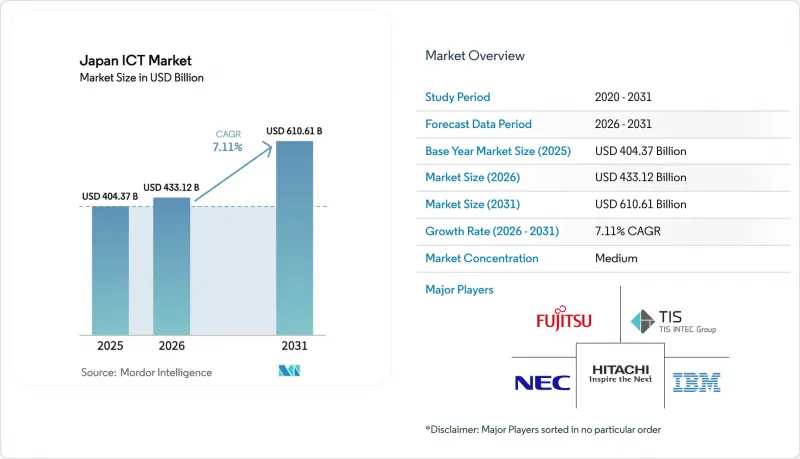
根據 Mordor Intelligence 估計,日本 ICT 市場規模從 2025 年的 4,043.7 億美元成長到 2026 年的 4,331.2 億美元,預計到 2031 年將達到 6,106.1 億美元。
預計從 2026 年到 2031 年,其複合年成長率將達到 7.11%。
[1] Brad Smith,“微軟在日本資料中心投資29億美元”,Data Center Dynamics,datacenterdynamics.com。隨著「2025年懸崖」的臨近,企業正在對其傳統的大型主機環境進行現代化改造,「社會5.0」政策舉措正在推動對混合雲端、人工智慧基礎設施和網路安全解決方案的加速投資。 [2] IBM日本新聞辦公室,“SCSK與IBM日本建立混合雲端戰略夥伴關係”,ibm.com。預計從2024年起,超大規模資料中心業者資料中心在日本的區域擴張投資將超過179億美元,這將擴大日本的資料中心容量,並對軟體、網路和託管服務的需求產生連鎖反應。雖然勞動力減少活性化,但ISMAP認證正在透過優先考慮滿足1000多項詳細安全控制要求的供應商來重組採購流程。 [3] “ISMS雲端安全認證機構清單”,ISMS認證中心,isms.jp。儘管日本ICT市場成長強勁,但仍面臨許多結構性挑戰,例如雲端運算和人工智慧專家嚴重短缺、網路攻擊範圍不斷擴大以及數位貿易逆差持續虧損,凸顯了日本對海外平台的持續依賴。本報告按產品類型(IT硬體、IT軟體、IT服務、 IT基礎設施、 IT安全、電信服務)、公司規模(中小企業、大型企業)和最終用戶產業(政府和公共管理部門、銀行、金融服務和公共產業等)進行細分。市場預測以美元計價。
日本ICT市場趨勢與洞察
大型企業加速數位轉型投資
為了應對“2025年懸崖效應”,大型企業正在增加IT預算。 78%的大型企業計劃在2026年前將IT支出加倍,因為屆時對舊有系統的支援將終止。根據日本經濟產業省(METI)估計,現代化進程的延誤可能導致每年高達12兆日圓(約800億美元)的經濟損失,這推動了大型主機到雲端遷移服務的快速普及。Panasonic從COBOL到Java的轉換已經節省了數千億日圓的營運成本,展現了實質的投資報酬率。金融機構是這項需求的主要動力,舊有系統轉型蘊藏著5,000億日圓(約33.8億美元)的商機。系統整合商和雲端服務供應商透過簽訂包含評估、平台遷移和託管服務在內的多年期契約,確保了持續的收入。
超大規模資料中心業者企業資本投資快速成長,並持續擴張區域基地
微軟、AWS 和Google雲端已累計在 2025 年在日本新建資料中心區域,投資總合180 億美元,並在大阪、福岡和北海道等地增設高功率密度園區。Softbank Corporation400 兆瓦的人工智慧資料中心和 KDDI 在原夏普堺工廠舊址上建造的、由英偉達提供技術支援的資料中心,都是日本大力發展本地化、低延遲計算環境的典型例證,這些環境能夠訓練擁有數兆參數的模型。這些投資正在重振日本國內供應鏈,涵蓋電力、冷卻、網路互連和專業服務等領域。在土地資源有限的大都會圈,「棕地改造」正在進行中,將閒置的工業用地創造性地開發成 Tier IV 級資料中心,從而提升區域多樣性並提高能源效率標準。
雲端運算/人工智慧人才嚴重短缺。
到2030年,日本可能面臨40萬至80萬名工程師的缺口,這將導致工程師薪資比傳統IT工作高出40%至60%,並可能延誤專案進度。 50歲以上傳統大型主機專家(COBOL維修專家)的需求空前高漲,許多人甚至收到多個工作邀約。政府提供的技能再培訓津貼和簡化的「特定技能」簽證旨在擴大勞動力隊伍,但其短期效果可能有限。儘管企業正在將一些特定任務境外外包,但語言和安全的擔憂限制了策略性工作境外外包。這種人才短缺推高了整體擁有成本(TCO),迫使企業優先考慮投資報酬率高的項目,並減緩了日本資訊通訊技術(ICT)市場的整體成長動能。
細分市場分析
到2025年,IT服務將佔日本ICT市場佔有率的40.73%,反映出企業對系統整合和託管營運在關鍵業務工作負載方面的持續依賴。在超大規模資料中心業者營運商179億美元的資本支出(CAPEX)的支持下,雲端服務預計將以7.78%的複合年成長率成長,其在日本ICT市場中的規模預計將從2025年的1970億美元成長到2031年的3089億美元。
系統整合商透過將應用重構、資料中心退役和持續管治等服務捆綁在一起,確保了多年的持續收入。同時,硬體需求集中在人工智慧最佳化的GPU和高密度機架式配電系統。國內軟體供應商落後於海外同行,加劇了數位虧損,並增加了對SaaS進口的需求。電信服務供應商正在利用5G獨立網路核心網路實現網路切片,並在邊緣分析領域創造交叉銷售機會。網路安全供應商正在將零信任套件與可觀測性平台整合,以實現跨混合環境的統一威脅偵測。
其他好處:
- Excel格式的市場預測(ME)表
- 三個月的分析師支持
目錄
第1章:引言
- 本研究的假設與市場定義
- 調查範圍
第2章:調查方法
第3章執行摘要
第4章 市場狀況
- 市場概覽
- 市場促進因素
- 大型企業加速數位轉型投資
- 由於超大規模資料中心業者和各地區基礎設施的發展,資本投資激增
- 政府雲端計畫正在促進公共部門的IT發展。
- 在服務不足的中小企業領域採用人工智慧驅動的SaaS
- 投資用於人工智慧基礎設施的半導體製造設備
- 隨著人口老化,工作場所對自動化的需求日益成長。
- 市場限制因素
- 雲端運算/人工智慧人才嚴重短缺。
- 網路攻擊範圍不斷擴大,合規成本不斷上升。
- 依賴傳統大型機會增加遷移風險。
- 數位虧損給國內軟體支出帶來了壓力。
- 價值鏈分析
- 監理情勢
- 技術展望
- 波特五力分析
- 投資分析
- 宏觀經濟因素的影響
- 產業相關人員分析
第5章 市場規模與成長預測
- 依產品類型
- IT硬體
- 電腦硬體
- 網路裝置
- 周邊設備
- IT軟體
- IT服務
- IT諮詢與實施
- IT外包(ITO)
- 業務流程外包(BPO)
- 託管安全服務
- 雲端和平台服務
- IT基礎設施
- IT安全/網路安全
- 通訊服務
- IT硬體
- 按公司規模
- 小型企業
- 大公司
- 按最終用戶行業分類
- 政府/公共行政
- BFSI
- 資訊科技/通訊
- 能源公用事業
- 零售、電子商務、物流
- 製造業和工業4.0
- 醫療保健和生命科學
- 石油和天然氣
- 其他行業
第6章 競爭情勢
- 市場集中度
- 策略趨勢
- 市佔率分析
- 公司簡介
- Fujitsu Limited
- NEC Corporation
- Hitachi, Ltd.
- TIS Inc.
- IBM Japan, Ltd.
- ITOCHU Techno-Solutions Corporation
- Panasonic Holdings Corporation
- Sony Group Corporation
- Salesforce Japan Co., Ltd.
- SCSK Corporation
- NTT DATA Corporation
- KDDI Corporation
- SoftBank Corp.
- Internet Initiative Japan Inc.
- Rakuten Group, Inc.
- Nomura Research Institute, Ltd.
- Oracle Corporation Japan
- Microsoft Japan Co., Ltd.
- Google Cloud Japan GK
- Amazon Web Services Japan GK
第7章 市場機會與未來展望
According to Mordor Intelligence, japan iCT market size in 2026 is estimated at USD 433.12 billion, growing from 2025 value of USD 404.37 billion with 2031 projections showing USD 610.61 billion, growing at 7.11% CAGR over 2026-2031.
[1] Brad Smith, "Microsoft to Spend USD 2.9 Billion on Japanese Data Centers," Data Center Dynamics, datacenterdynamics.com Enterprise commitments to modernize legacy mainframe estates before the "2025 cliff," combined with Society 5.0 policy initiatives, are accelerating spending on hybrid cloud, AI infrastructure, and cybersecurity solutions. [2] IBM Japan Press Desk, "SCSK and IBM Japan Sign Strategic Partnership for Hybrid Cloud," ibm.com Hyperscaler region build-outs exceeding USD 17.9 billion since 2024 are expanding domestic data-center capacity and creating multiplier effects for software, networking, and managed services demand Shrinking working-age population is intensifying automation investments, while ISMAP certification is reshaping procurement by favoring providers that meet more than 1,000 detailed security controls. [3] "List of ISMS Cloud Security Certified Organizations," ISMS Accreditation Center, isms.jp Despite robust growth, the Japan ICT market faces structural challenges from an acute shortage of cloud and AI professionals, an expanding cyber-attack surface, and a widening digital trade deficit that highlights continued dependency on overseas platforms. This report is Segmented by Product Type (IT Hardware, IT Software, IT Services, IT Infrastructure, IT Security, Communication Services), Enterprise Size (Small and Medium Enterprises, Large Enterprises), and End-User Industry Vertical (Government and Public Administration, BFSI, Energy and Utilities and More). The Market Forecasts are Provided in Terms of Value (USD).
Japan ICT Market Trends and Insights
Accelerating DX Spending by Large Enterprises
Large corporations are raising IT budgets to mitigate the "2025 cliff," with 78% of major firms planning to double spend by 2026 as legacy systems reach end-of-life. METI estimates that economic losses could reach JPY 12 trillion (USD 0.08 trillion) per year if modernization lags, prompting rapid uptake of mainframe-to-cloud migration services. Panasonic's COBOL-to-Java conversion has already saved tens of billions of yen in operating costs, demonstrating tangible ROI. Financial institutions lead demand, representing a JPY 500 billion (USD 3.38 billion) opportunity for legacy system transformation. Systems integrators and cloud providers alike are bundling assessment, re-platforming, and managed services into multi-year contracts that lock in recurring revenue.
Hyperscaler CAPEX Surge and Local Region Build-Outs
Microsoft, AWS, and Google Cloud have collectively earmarked more than USD 18 billion for new Japanese regions through 2025, adding power-dense campuses in Osaka, Fukuoka, and Hokkaido. SoftBank's 400 MW AI facility and KDDI's NVIDIA-powered center at the former Sharp Sakai site exemplify Japan's push for local, low-latency compute that can train trillion-parameter models. These investments stimulate domestic supply chains for power, cooling, network interconnects, and professional services. Land-constrained metros are seeing creative brownfield conversions of idle industrial sites into tier-IV data centers, increasing region diversity and energy-efficiency standards.
Acute Shortage of Cloud/AI Talent
Japan may face a 400,000-to-800,000 engineer deficit by 2030, inflating salaries 40-60% above traditional IT roles and delaying project timelines. Legacy mainframe specialists over age 50 are in unprecedented demand for COBOL remediation, commanding multiple offers. Government reskilling grants and simplified "Specified Skilled Worker" visas aim to broaden the labor pool but will have limited near-term effect. Enterprises are offshoring niche tasks, yet language and security concerns restrict strategic workloads. This scarcity raises total cost of ownership and forces prioritization of high-ROI projects, tempering the overall Japan ICT market growth momentum.
Other drivers and restraints analyzed in the detailed report include:
- Government Cloud Program Boosting Public-Sector IT
- AI-Enabled SaaS Adoption in Underserved SMB Segment
- Intensifying Cyber-Attack Surface and Compliance Costs
For complete list of drivers and restraints, kindly check the Table Of Contents.
Segment Analysis
IT Services contributed 40.73% to Japan ICT market share in 2025, reflecting persistent reliance on systems integration and managed operations for mission-critical workloads. Cloud Services, powered by USD 17.9 billion hyperscaler CAPEX, is forecast to post an 7.78% CAGR, propelling the Japan ICT market size of this sub-segment from a 2025 base of USD 197.0 billion to USD 308.9 billion by 2031.
Systems integrators bundle application refactoring, data-center decommissioning, and ongoing governance, securing multi-year annuity revenue. Meanwhile, hardware demand clusters around AI-optimized GPUs and high-density rack power distribution. Domestic software publishers lag global peers, widening the digital trade deficit and reinforcing demand for SaaS imports. Communication Services leverage 5G Stand-Alone cores that enable network slicing, creating cross-sell opportunities for edge analytics. Cybersecurity vendors integrate zero-trust suites with observability platforms, delivering unified threat detection across hybrid estates.
Complete Report Scope:
- By Product Type
- IT Hardware
- Computer Hardware
- Networking Equipment
- Peripherals
- IT Software
- IT Services
- IT Consulting and Implementation
- IT Outsourcing (ITO)
- Business Process Outsourcing (BPO)
- Managed Security Services
- Cloud and Platform Services
- IT Infrastructure
- IT Security/Cybersecurity
- Communication Services
- IT Hardware
- By Enterprise Size
- Small and Medium-sized Enterprises
- Large Enterprises
- By End-user Industry Vertical
- Government and Public Administration
- BFSI
- IT and Telecom
- Energy and Utilities
- Retail, E-commerce, and Logistics
- Manufacturing and Industry 4.0
- Healthcare and Life Sciences
- Oil and Gas
- Other Verticals
List of Companies Covered in this Report:
- Fujitsu Limited
- NEC Corporation
- Hitachi, Ltd.
- TIS Inc.
- IBM Japan, Ltd.
- ITOCHU Techno-Solutions Corporation
- Panasonic Holdings Corporation
- Sony Group Corporation
- Salesforce Japan Co., Ltd.
- SCSK Corporation
- NTT DATA Corporation
- KDDI Corporation
- SoftBank Corp.
- Internet Initiative Japan Inc.
- Rakuten Group, Inc.
- Nomura Research Institute, Ltd.
- Oracle Corporation Japan
- Microsoft Japan Co., Ltd.
- Google Cloud Japan G.K.
- Amazon Web Services Japan G.K.
Additional Benefits:
- The market estimate (ME) sheet in Excel format
- 3 months of analyst support
TABLE OF CONTENTS
1 INTRODUCTION
- 1.1 Study Assumptions and Market Definitions
- 1.2 Scope of the Study
2 RESEARCH METHODOLOGY
3 EXECUTIVE SUMMARY
4 MARKET LANDSCAPE
- 4.1 Market Overview
- 4.2 Market Drivers
- 4.2.1 Accelerating DX spending by large enterprises
- 4.2.2 Hyperscaler CAPEX surge and local region build-outs
- 4.2.3 Government Cloud program boosting public?sector IT
- 4.2.4 AI-enabled SaaS adoption in underserved SMB segment
- 4.2.5 Semiconductor-equipment investments for AI infrastructure
- 4.2.6 Workforce-automation demand amid ageing demographics
- 4.3 Market Restraints
- 4.3.1 Acute shortage of cloud/AI talent
- 4.3.2 Intensifying cyber-attack surface and compliance costs
- 4.3.3 Legacy mainframe dependence raising migration risk
- 4.3.4 Digital-trade deficit draining domestic software spend
- 4.4 Value Chain Analysis
- 4.5 Regulatory Landscape
- 4.6 Technological Outlook
- 4.7 Porter's Five Forces Analysis
- 4.7.1 Bargaining Power of Suppliers
- 4.7.2 Bargaining Power of Buyers
- 4.7.3 Threat of New Entrants
- 4.7.4 Threat of Substitutes
- 4.7.5 Intensity of Competitive Rivalry
- 4.8 Investment Analysis
- 4.9 Impact of Macroeconomic Factors
- 4.10 Industry Stakeholder Analysis
5 MARKET SIZE AND GROWTH FORECASTS (VALUE)
- 5.1 By Product Type
- 5.1.1 IT Hardware
- 5.1.1.1 Computer Hardware
- 5.1.1.2 Networking Equipment
- 5.1.1.3 Peripherals
- 5.1.2 IT Software
- 5.1.3 IT Services
- 5.1.3.1 IT Consulting and Implementation
- 5.1.3.2 IT Outsourcing (ITO)
- 5.1.3.3 Business Process Outsourcing (BPO)
- 5.1.3.4 Managed Security Services
- 5.1.3.5 Cloud and Platform Services
- 5.1.4 IT Infrastructure
- 5.1.5 IT Security/Cybersecurity
- 5.1.6 Communication Services
- 5.1.1 IT Hardware
- 5.2 By Enterprise Size
- 5.2.1 Small and Medium-sized Enterprises
- 5.2.2 Large Enterprises
- 5.3 By End-user Industry Vertical
- 5.3.1 Government and Public Administration
- 5.3.2 BFSI
- 5.3.3 IT and Telecom
- 5.3.4 Energy and Utilities
- 5.3.5 Retail, E-commerce, and Logistics
- 5.3.6 Manufacturing and Industry 4.0
- 5.3.7 Healthcare and Life Sciences
- 5.3.8 Oil and Gas
- 5.3.9 Other Verticals
6 COMPETITIVE LANDSCAPE
- 6.1 Market Concentration
- 6.2 Strategic Moves
- 6.3 Market Share Analysis
- 6.4 Company Profiles (includes Global level Overview, Market level overview, Core Segments, Financials as available, Strategic Information, Market Rank/Share for key companies, Products and Services, and Recent Developments)
- 6.4.1 Fujitsu Limited
- 6.4.2 NEC Corporation
- 6.4.3 Hitachi, Ltd.
- 6.4.4 TIS Inc.
- 6.4.5 IBM Japan, Ltd.
- 6.4.6 ITOCHU Techno-Solutions Corporation
- 6.4.7 Panasonic Holdings Corporation
- 6.4.8 Sony Group Corporation
- 6.4.9 Salesforce Japan Co., Ltd.
- 6.4.10 SCSK Corporation
- 6.4.11 NTT DATA Corporation
- 6.4.12 KDDI Corporation
- 6.4.13 SoftBank Corp.
- 6.4.14 Internet Initiative Japan Inc.
- 6.4.15 Rakuten Group, Inc.
- 6.4.16 Nomura Research Institute, Ltd.
- 6.4.17 Oracle Corporation Japan
- 6.4.18 Microsoft Japan Co., Ltd.
- 6.4.19 Google Cloud Japan G.K.
- 6.4.20 Amazon Web Services Japan G.K.
7 MARKET OPPORTUNITIES AND FUTURE OUTLOOK
- 7.1 White-space and Unmet-need Assessment

 中東和北非資訊通訊技術(ICT):市場佔有率分析、行業趨勢和統計數據以及成長預測(2026-2031 年)中國資訊通訊技術:市場佔有率分析、產業趨勢與統計及成長預測(2026-2031年)西班牙資訊通訊技術:市場佔有率分析、產業趨勢與統計、成長預測(2026-2031)越南資訊通訊技術:市場佔有率分析、產業趨勢與統計、成長預測(2026-2031)印尼資訊通訊技術:市場佔有率分析、產業趨勢與統計及成長預測(2026-2031)新加坡資訊通訊技術:市場佔有率分析、產業趨勢與統計及成長預測(2026-2031 年)歐洲資訊通訊技術:市場佔有率分析、行業趨勢和統計數據、成長預測(2026-2031 年)法國資訊通訊技術:市場佔有率分析、產業趨勢與統計及成長預測(2026-2031 年)泰國資訊通訊技術:市場佔有率分析、產業趨勢與統計、成長預測(2026-2031)美國資訊通訊技術:市場佔有率分析、行業趨勢和統計數據、成長預測(2026-2031 年)