


 |
市場調查報告書
商品編碼
2125535
新加坡資訊通訊技術:市場佔有率分析、產業趨勢與統計及成長預測(2026-2031 年)Singapore ICT - Market Share Analysis, Industry Trends & Statistics, Growth Forecasts (2026 - 2031) |
||||||

※ 本網頁內容可能與最新版本有所差異。詳細情況請與我們聯繫。
根據 Mordor Intelligence 預測,新加坡 ICT 市場規模將從 2025 年的 697.7 億美元成長到 2026 年的 792.4 億美元,然後在 2031 年達到 1,496.8 億美元,2026 年至 2031 年的複合年成長率為 13.57%。
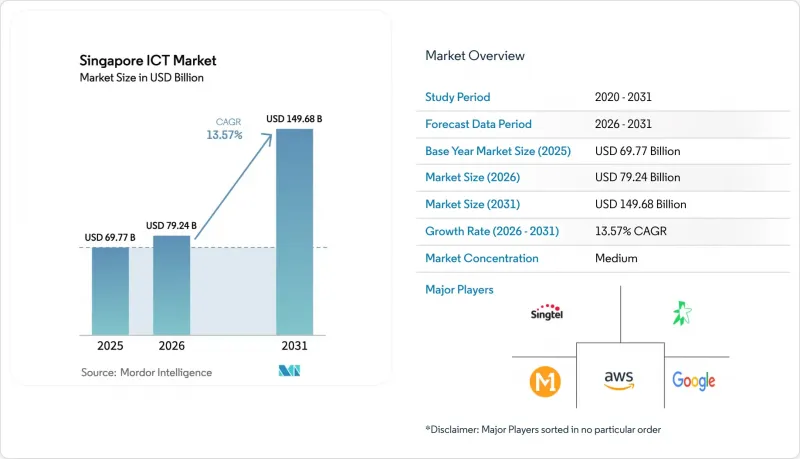
本報告按類型(IT硬體、IT軟體等)、最終用戶公司規模(中小企業、大型企業)、部署模式(本地部署等)和最終用戶行業(政府、公共管理部門等)進行分類。市場預測以美元計價。
新加坡資訊通訊技術市場趨勢與洞察
政府在「智慧國家」計劃上的支出激增。
「智慧國家2.0」計畫正推動新加坡從單純的數位轉型為「數位優先」的管治,2024會計年度將投資33億美元用於網路安全、數據平台和現代化基礎建設。這筆支出正在加速分析引擎、邊緣設備和即時處理工具的採購,刺激需求遠遠超出公共部門。反映這些標準的監管要求正迫使私人企業,尤其是金融和醫療保健行業的企業,升級其舊有系統。專注於API編配和跨平台安全的供應商看到了直接獲得大規模期合約的機會,而互通框架正在減少跨行業整合中的摩擦。
企業「雲端優先」政策
「雲端優先」策略徹底改變了基礎設施規劃,雲端工作負載成長了17.7%,而本地部署僅成長了11.2%。多重雲端策略透過降低廠商鎖定風險並滿足資料主權法規要求,正在推動價值35億美元的國內雲端市場發展。中小企業(SME)正以最快的速度採用雲端技術,他們利用基於訂閱的人工智慧、分析和自動化功能來實現企業級能力。這也催生了對整合式可觀測性儀表板、混合連接架構和自動化策略管治的次要需求,以使分散式環境符合法規要求。
熟練數位人才短缺
網路安全專業人員短缺2800至4400人,阻礙了部署進度並推高了人事費用。同時,預計到2029年,安全需求將達到48.2億美元。人工智慧工程師和雲端架構師也面臨人才短缺,迫使中小企業在薪資方面與跨國公司競爭。政府支持的技能發展項目,例如擁有4500名學員的IBM SkillsBuild項目,只能逐步緩解人才短缺問題。因此,企業正將重點轉向低程式碼平台、人工智慧驅動的開發和託管服務,以減少對稀缺專業人才的依賴。
細分市場分析
2025年,在資料中心、網路設備和伺服器容量持續投資的推動下, IT基礎設施將佔新加坡ICT市場規模的25.86%。該領域正受益於超大規模擴張的舉措,例如AWS的120億美元計劃,但隨著虛擬化提高了伺服器機架密度,其年成長率正在放緩。 IT軟體的複合年成長率(CAGR)為16.35%,在雲端原生平台、人工智慧工具鍊和工作流程自動化套件的驅動下,表現優於所有其他類別。這種向軟體的轉變推動了對容器編排管理、微服務安全和敏捷整合服務的需求。基礎架構和應用程式的平行擴展是均衡成長的基礎。企業擴大採用企業軟體的訂閱定價模式,這有助於抑制資本支出激增並穩定現金流。儘管隨著商品化程度的加深,硬體利潤率正在下降,但專用人工智慧加速器和邊緣設備仍能賣出高價。 SAP等主要供應商已在新加坡設立研發中心,其「數位創新加速器」就是典型例證。這些加速器將特定產業的人工智慧模型應用於本地用例。強大的基礎設施與先進的軟體相輔相成,形成良性循環,推動新加坡資訊通訊技術市場持續成長。
到2025年,大型企業將佔據新加坡資訊通訊技術(ICT)市場66.78%的佔有率,它們將利用自身的預算和內部人才推動複雜且多方面的數位轉型。然而,由於許多公司已經完成了轉型的第一階段,其成長率正在放緩至12.84%。相較之下,中小企業(SME)的複合年成長率(CAGR)高達14.88%,這得益於政府津貼和雲端訂閱服務縮短了引進週期。承包人工智慧(AI)服務的日益普及,使中小企業無需購買昂貴的硬體即可整合聊天機器人、分析和機器人流程自動化(RPA)。人才發展舉措也在確保中小企業獲得永續的數位人才供應。 IBM的SkillsBuild計畫就是一個例子,它提供資料分析和網路安全的免費認證課程。諸如獎勵 )之類的財政津貼進一步提高了採用條件的公平性,可報銷高達70%的符合條件的技術投資。隨著中小企業 (SME) 的發展壯大,它們為託管服務供應商和增值轉售商提供了龐大的基本客群,從而加強了支撐新加坡 ICT 市場的多元化供應商生態系統。
其他好處:
- Excel格式的市場預測(ME)表
- 3個月的分析師支持
目錄
第1章:引言
- 市場定義與研究假設
- 調查範圍
第2章:調查方法
第3章執行摘要
第4章 市場狀況
- 市場概覽
- 市場促進因素
- 政府在「智慧國家」計劃上的支出激增。
- 5G的快速部署與普及
- 企業「雲端優先」政策
- 數位銀行牌照促進了金融服務業的技術投資。
- 國家人工智慧運算資源(NACR)的部署
- 鼓勵超大規模資料中心使用綠色電力
- 市場限制因素
- 熟練數位人才短缺
- 網路攻擊範圍不斷擴大
- 新建資料中心對電網容量的限制
- 由於限制接收外籍勞工,導致薪資上漲。
- 價值鏈分析
- 重要法規結構的評估
- 技術展望
- 波特五力分析
- 宏觀經濟因素的影響
第5章 市場規模與成長預測
- 按類型
- IT硬體
- 電腦硬體
- 網路裝置
- 周邊設備
- IT軟體
- IT服務
- 託管服務
- 業務流程服務
- 商業諮詢服務
- 雲端服務
- IT基礎設施
- 通訊服務
- IT硬體
- 按最終用戶公司規模分類
- 小型企業
- 大公司
- 按部署模式
- 現場
- 雲
- 混合
- 按行業分類的最終用戶
- 政府/行政部門
- BFSI
- 能源公用事業
- 零售、電子商務、物流
- 製造業和工業4.0
- 醫療保健和生命科學
- 石油和天然氣(上游、中游和下游)
- 遊戲和電子競技
- 其他行業
第6章 競爭情勢
- 市場集中度
- 策略趨勢
- 市佔率分析
- 公司簡介
- Amazon Web Services(AWS)Singapore
- International Business Machines Corporation(IBM Singapore Pte. Ltd.)
- Cognizant Technology Solutions Asia Pacific Pte. Ltd.
- Micron Semiconductor Asia Operations Pte. Ltd.
- SAP Asia Pte. Ltd.
- Wipro Ltd.(Singapore)
- Hewlett Packard Enterprise Singapore Pte. Ltd.
- Intel Technology Asia Pte. Ltd.
- Singapore Telecommunications Ltd.(Singtel)
- StarHub Ltd.
- M1 Ltd.
- TPG Telecom Pte. Ltd.(SIMBA Telecom)
- NCS Pte. Ltd.
- NEC Asia Pacific Pte. Ltd.
- Dell Technologies Singapore Pte. Ltd.
- Google Asia Pacific Pte. Ltd.
- Microsoft Operations Pte. Ltd.(Microsoft Singapore)
- Equinix Singapore Pte. Ltd.
- Alibaba Cloud(Singapore)Private Limited
- Palo Alto Networks(Singapore)Pte. Ltd.
- Check Point Software Technologies(Singapore)Pte. Ltd.
- Trend Micro(Singapore)Pte. Ltd.
第7章 市場機會與未來趨勢
- 評估未開發領域和未滿足的需求
According to Mordor Intelligence, the Singapore ICT market size is expected to grow from USD 69.77 billion in 2025 to USD 79.24 billion in 2026 and is forecast to reach USD 149.68 billion by 2031 at 13.57% CAGR over 2026-2031.
This report is Segmented by Type (IT Hardware, IT Software, and More), End-User Enterprise Size (Small and Medium Enterprises and Large Enterprises), Deployment Model (On-Premise, and More), and End-User Industry (Government and Public Administration, and More). The Market Forecasts are Provided in Terms of Value (USD).
Singapore ICT Market Trends and Insights
Government Smart-Nation Expenditure Surge
Smart Nation 2.0 moves Singapore from digital adoption toward digital-first governance, channeling USD 3.3 billion in fiscal 2024 into cybersecurity, data platforms, and modernized infrastructure. The outlay accelerates procurement of analytics engines, edge devices, and real-time processing tools, catalyzing demand far beyond the public sector. Regulatory requirements that mirror these standards push private organizations, especially in finance and healthcare, to upgrade legacy systems. Vendors specializing in API orchestration and cross-platform security gain direct access to large multi-year contracts, while interoperable frameworks reduce integration friction across verticals.
Enterprise Cloud-first Mandates
Cloud-first policies have flipped infrastructure planning, with cloud workloads growing 17.7% against 11.2% for on-premise deployments. Multi-cloud strategies lessen vendor lock-in and satisfy data-sovereignty rules, prompting a USD 3.5 billion domestic cloud market. SMEs drive the fastest uptake, using subscription-based AI, analytics, and automation to match big-company capabilities. Secondary demand is emerging for unified observability dashboards, hybrid connectivity fabrics, and automated policy governance that keep distributed environments in regulatory compliance.
Scarcity of Skilled Digital Talent
A shortage of 2,800 to 4,400 cybersecurity professionals shackles rollout schedules and elevates salary costs, even as security demand is set to hit USD 4.82 billion by 2029. The gap extends to AI engineers and cloud architects, forcing SMEs to compete with multinationals on compensation. Government-backed upskilling programs, including IBM's SkillsBuild, which targets 4,500 learners, will narrow deficits only gradually. Firms therefore pivot to low-code platforms, AI-assisted development, and managed services that reduce reliance on scarce specialists.
Other drivers and restraints analyzed in the detailed report include:
- Digital Bank Licenses Boost BFSI Tech Spend
- National AI Compute Resource Roll-out
- Escalating Cyber-attack Surface
For complete list of drivers and restraints, kindly check the Table Of Contents.
Segment Analysis
IT infrastructure owned 25.86% of Singapore ICT market size in 2025, underlining continued investment in data centers, networking gear, and server capacity . The segment benefits from hyperscale expansion commitments such as AWS's USD 12 billion plan, but year-on-year growth is moderating as virtualization densifies server racks. IT software outpaces all other categories with a 16.35% CAGR, propelled by cloud-native platforms, AI toolchains, and workflow automation suites. This software pivot lifts demand for container orchestration, micro-services security, and agile integration services. Parallel expansion of infrastructure and applications underpins a balanced growth profile. Companies increasingly adopt subscription pricing for enterprise software, flattening capex spikes and smoothing cash flows. Hardware margins tighten amid commoditization, though specialized AI accelerators and edge devices command premiums. Major vendors such as SAP anchor R&D in Singapore, exemplified by its Digital Innovation Accelerator that aligns industry-specific AI models with local use cases . The interplay of high-capacity infrastructure with advanced software creates a virtuous cycle that keeps the Singapore ICT market on its upward trajectory.
Large enterprises held 66.78% of Singapore ICT market share in 2025, leveraging budgets and in-house talent to execute complex, multi-domain digitization. Growth, however, is slowing to 12.84% as many have already completed first-wave transformations. SMEs, in contrast, are posting a 14.88% CAGR, driven by government grants and cloud subscriptions that compress deployment cycles. The widening availability of turnkey AI services empowers small firms to integrate chatbots, analytics, and robotic process automation without owning expensive hardware. Training initiatives keep the pipeline of digital talent flowing to smaller companies. IBM's SkillsBuild is one example that provides free certification tracks for data analytics and cybersecurity . Financial incentives such as the Productivity Solutions Grant reimburse up to 70% of qualifying tech investments, further equalizing adoption conditions. As SMEs scale, they form a sizeable customer base for managed-service providers and value-added resellers, reinforcing a diversified vendor ecosystem that underpins the Singapore ICT market.
Complete Report Scope:
- By Type
- IT Hardware
- Computer Hardware
- Networking Equipment
- Peripherals
- IT Software
- IT Services
- Managed Services
- Business Process Services
- Business Consulting Services
- Cloud Services
- IT Infrastructure
- Communication Services
- IT Hardware
- By End-User Enterprise Size
- Small and Medium Enterprises
- Large Enterprises
- By Deployment Model
- On-premise
- Cloud
- Hybrid
- By End-user Industry Vertical
- Government and Public Administration
- BFSI
- Energy and Utilities
- Retail, E-commerce and Logistics
- Manufacturing and Industry 4.0
- Healthcare and Life Sciences
- Oil and Gas (Up-, Mid-, Down-stream)
- Gaming and Esports
- Other Verticals
List of Companies Covered in this Report:
- Amazon Web Services (AWS) Singapore
- International Business Machines Corporation (IBM Singapore Pte. Ltd.)
- Cognizant Technology Solutions Asia Pacific Pte. Ltd.
- Micron Semiconductor Asia Operations Pte. Ltd.
- SAP Asia Pte. Ltd.
- Wipro Ltd. (Singapore)
- Hewlett Packard Enterprise Singapore Pte. Ltd.
- Intel Technology Asia Pte. Ltd.
- Singapore Telecommunications Ltd. (Singtel)
- StarHub Ltd.
- M1 Ltd.
- TPG Telecom Pte. Ltd. (SIMBA Telecom)
- NCS Pte. Ltd.
- NEC Asia Pacific Pte. Ltd.
- Dell Technologies Singapore Pte. Ltd.
- Google Asia Pacific Pte. Ltd.
- Microsoft Operations Pte. Ltd. (Microsoft Singapore)
- Equinix Singapore Pte. Ltd.
- Alibaba Cloud (Singapore) Private Limited
- Palo Alto Networks (Singapore) Pte. Ltd.
- Check Point Software Technologies (Singapore) Pte. Ltd.
- Trend Micro (Singapore) Pte. Ltd.
Additional Benefits:
- The market estimate (ME) sheet in Excel format
- 3 months of analyst support
TABLE OF CONTENTS
1 INTRODUCTION
- 1.1 Market Definition and Study Assumptions
- 1.2 Scope of the Study
2 RESEARCH METHODOLOGY
3 EXECUTIVE SUMMARY
4 MARKET LANDSCAPE
- 4.1 Market Overview
- 4.2 Market Drivers
- 4.2.1 Government Smart-Nation Expenditure Surge
- 4.2.2 Rapid 5G Roll-out and Adoption
- 4.2.3 Enterprise Cloud-first Mandates
- 4.2.4 Digital Bank Licences Boost BFSI Tech Spend
- 4.2.5 National AI Compute Resource (NACR) Roll-out
- 4.2.6 Green-Powered Hyperscale Data-centre Incentives
- 4.3 Market Restraints
- 4.3.1 Scarcity of Skilled Digital Talent
- 4.3.2 Escalating Cyber-attack Surface
- 4.3.3 Power-grid Capacity Caps on New DC Builds
- 4.3.4 Wage Inflation from Foreign-Labour Curbs
- 4.4 Value Chain Analysis
- 4.5 Evaluation of Critical Regulatory Framework
- 4.6 Technological Outlook
- 4.7 Porter's Five Forces Analysis
- 4.7.1 Bargaining Power of Suppliers
- 4.7.2 Bargaining Power of Consumers
- 4.7.3 Threat of New Entrants
- 4.7.4 Threat of Substitutes
- 4.7.5 Intensity of Competitive Rivalry
- 4.8 Impact of Macro-economic Factors
5 MARKET SIZE AND GROWTH FORECASTS (VALUE)
- 5.1 By Type
- 5.1.1 IT Hardware
- 5.1.1.1 Computer Hardware
- 5.1.1.2 Networking Equipment
- 5.1.1.3 Peripherals
- 5.1.2 IT Software
- 5.1.3 IT Services
- 5.1.3.1 Managed Services
- 5.1.3.2 Business Process Services
- 5.1.3.3 Business Consulting Services
- 5.1.3.4 Cloud Services
- 5.1.4 IT Infrastructure
- 5.1.5 Communication Services
- 5.1.1 IT Hardware
- 5.2 By End-User Enterprise Size
- 5.2.1 Small and Medium Enterprises
- 5.2.2 Large Enterprises
- 5.3 By Deployment Model
- 5.3.1 On-premise
- 5.3.2 Cloud
- 5.3.3 Hybrid
- 5.4 By End-user Industry Vertical
- 5.4.1 Government and Public Administration
- 5.4.2 BFSI
- 5.4.3 Energy and Utilities
- 5.4.4 Retail, E-commerce and Logistics
- 5.4.5 Manufacturing and Industry 4.0
- 5.4.6 Healthcare and Life Sciences
- 5.4.7 Oil and Gas (Up-, Mid-, Down-stream)
- 5.4.8 Gaming and Esports
- 5.4.9 Other Verticals
6 COMPETITIVE LANDSCAPE
- 6.1 Market Concentration
- 6.2 Strategic Moves
- 6.3 Market Share Analysis
- 6.4 Company Profiles (includes Global level Overview, Market level overview, Core Segments, Financials as available, Strategic Information, Market Rank/Share for key companies, Products and Services, and Recent Developments)
- 6.4.1 Amazon Web Services (AWS) Singapore
- 6.4.2 International Business Machines Corporation (IBM Singapore Pte. Ltd.)
- 6.4.3 Cognizant Technology Solutions Asia Pacific Pte. Ltd.
- 6.4.4 Micron Semiconductor Asia Operations Pte. Ltd.
- 6.4.5 SAP Asia Pte. Ltd.
- 6.4.6 Wipro Ltd. (Singapore)
- 6.4.7 Hewlett Packard Enterprise Singapore Pte. Ltd.
- 6.4.8 Intel Technology Asia Pte. Ltd.
- 6.4.9 Singapore Telecommunications Ltd. (Singtel)
- 6.4.10 StarHub Ltd.
- 6.4.11 M1 Ltd.
- 6.4.12 TPG Telecom Pte. Ltd. (SIMBA Telecom)
- 6.4.13 NCS Pte. Ltd.
- 6.4.14 NEC Asia Pacific Pte. Ltd.
- 6.4.15 Dell Technologies Singapore Pte. Ltd.
- 6.4.16 Google Asia Pacific Pte. Ltd.
- 6.4.17 Microsoft Operations Pte. Ltd. (Microsoft Singapore)
- 6.4.18 Equinix Singapore Pte. Ltd.
- 6.4.19 Alibaba Cloud (Singapore) Private Limited
- 6.4.20 Palo Alto Networks (Singapore) Pte. Ltd.
- 6.4.21 Check Point Software Technologies (Singapore) Pte. Ltd.
- 6.4.22 Trend Micro (Singapore) Pte. Ltd.
7 MARKET OPPORTUNITIES AND FUTURE TRENDS
- 7.1 White-space and Unmet-need Assessment

 中東和北非資訊通訊技術(ICT):市場佔有率分析、行業趨勢和統計數據以及成長預測(2026-2031 年)中國資訊通訊技術:市場佔有率分析、產業趨勢與統計及成長預測(2026-2031年)日本資訊通訊技術:市場佔有率分析、產業趨勢與統計、成長預測(2026-2031)西班牙資訊通訊技術:市場佔有率分析、產業趨勢與統計、成長預測(2026-2031)越南資訊通訊技術:市場佔有率分析、產業趨勢與統計、成長預測(2026-2031)印尼資訊通訊技術:市場佔有率分析、產業趨勢與統計及成長預測(2026-2031)歐洲資訊通訊技術:市場佔有率分析、行業趨勢和統計數據、成長預測(2026-2031 年)法國資訊通訊技術:市場佔有率分析、產業趨勢與統計及成長預測(2026-2031 年)泰國資訊通訊技術:市場佔有率分析、產業趨勢與統計、成長預測(2026-2031)美國資訊通訊技術:市場佔有率分析、行業趨勢和統計數據、成長預測(2026-2031 年)