


 |
市場調查報告書
商品編碼
2116885
美國資訊通訊技術:市場佔有率分析、行業趨勢和統計數據、成長預測(2026-2031 年)United States ICT - Market Share Analysis, Industry Trends & Statistics, Growth Forecasts (2026 - 2031) |
||||||

※ 本網頁內容可能與最新版本有所差異。詳細情況請與我們聯繫。
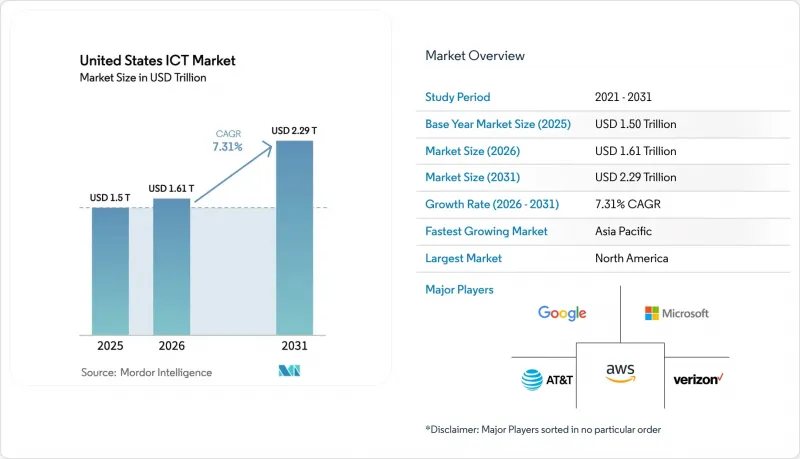
根據 Mordor Intelligence 估計,美國 ICT 市場規模在 2026 年將達到 1.61 兆美元,高於 2025 年的 1.5 兆美元,預計到 2031 年將達到 2.29 兆美元。
預計從 2026 年到 2031 年,其複合年成長率將達到 7.31%。
本報告按類型(IT硬體、IT軟體、IT服務、 IT基礎設施/資料中心、 IT安全/網路安全、通訊服務)、企業規模(中小企業、大型企業)、產業(銀行、金融服務和保險、IT及電信、政府機構、零售和電子商務、製造業等)以及部署模式(本地部署、雲端部署、混合部署)進行分類。市場預測以美元計價。
美國資訊通訊技術市場趨勢與洞察
加速聯邦和州政府對寬頻的撥款
總額達 424.5 億美元的 BEAD 計畫是美國史上規模最大的寬頻投資項目,目前已獲準分配給美國全部 56 個州和地區。該資金優先用於建立光纖網路,確保最低 100/20 Mbps 的服務速度,從而迅速擴大 SaaS 供應商和託管服務供應商的潛在基本客群。加州和德克薩斯州等州分別追加了 130 億美元和 54 億美元的聯邦津貼,加速了當地技術走廊的形成。私人網路服務供應商 (ISP) 和超大規模資料中心業者正在利用這些公共資金擴展骨幹線路和邊緣節點,從而帶動專業服務、維護合約和雲端採用支援等業務的蓬勃發展。該計劃為低收入家庭提供的費用補貼確保了新網路的長期使用,並將網路連接的改善與永續的收入來源聯繫起來。
快速部署5G網路
2024年第三季度,企業5G連線數達到1.76億,涵蓋47%的人口。這主要得益於固定無線存取(FWA)佔新增家庭寬頻用戶的40%。除了提升通訊速度外,專用5G還支援製造自動化、遠端醫療監控和智慧物流等應用,為整合商帶來持續效益。 CBRS頻段法規促成了從汽車工廠到NFL體育場等各種場景的部署,凸顯了5G的多功能性。經濟模型預測,到2025年,這項技術可望為資訊通訊技術(ICT)產業創造2,512億美元的GDP。隨著人工智慧工作負載向用戶端遷移,5G的低延遲路徑將成為邊緣運算部署的基礎,確保對延遲敏感的推理任務能夠以接近即時的速度運行。
網路安全人員短缺
網路安全領域仍有約44.8萬個職缺缺口,企業難以抵禦不斷擴大的攻擊面,導致數位化專案進展緩慢。雲端安全架構、人工智慧/機器學習防禦和營運技術(OT)保護的人才短缺,阻礙了雲端遷移和物聯網(IoT)的擴展。儘管過去十年網路安全學位持有者人數增加了271%,但人才供應仍落後於需求。不斷上漲的薪資更有利於大型企業和政府機構,而中小企業則面臨高技能人才的激烈競爭。此外,人才多樣性差距依然存在,西班牙裔和拉丁裔專業人士的代表性不足,進一步縮小了可用人才庫。因此,企業正在投資技能再培訓、自動化以及與資安管理服務機構的合作,以彌補人力資本的不足。
細分市場分析
到了2025年,IT服務將占美國ICT市場的37.65%,凸顯客戶對託管遷移、增強網路安全和人工智慧整合的依賴。這個細分市場的規模反映了對承包專業服務的需求,尤其是在那些快速現代化但又面臨內部技能缺口的企業中。相較之下, IT安全預計將成為所有類別中複合年成長率最高的,達到10.85%,這主要受全國範圍內的人才短缺以及企業尋求零信任框架和持續威脅監控訂閱服務的影響。
儘管受雲端整合影響,IT硬體支出依然低迷,但IT軟體卻受益於訂閱模式的轉型和生成式人工智慧(AI)附加元件的普及。隨著5G固定無線存取(FWA)的持續部署,通訊服務經常性連線收入翻番,業務也隨之成長。像微軟這樣將諮詢、部署和管理服務合約結合的供應商,例如微軟與Accenture和Avanade三方合作,共同提供AI賦能的Copilot解決方案,將表現出色。硬體、軟體和連接圍繞整合用例的整合表明,未來的收益將不再由單一產品驅動,而是由能夠提供端到端價值鏈的平台驅動。隨著工業4.0工作負載的擴展,將安全和AI加速器整合到緊湊外形規格中的邊緣硬體專家預計也將迎來顯著成長。
到2025年,大型企業將佔總支出的62.45%,它們利用多年預算簽訂複雜的混合雲端和網路安全專案契約,這些專案對供應商提出了諸多要求。同時,中小企業(SME)正以9.62%的複合年成長率成長,隨著雲端運算普及和低程式碼平台的普及降低了准入門檻,傳統差距正在縮小。中小企業透過採用雲端原生ERP、人工智慧驅動的CRM和基於訂閱的網路安全解決方案,克服了傳統限制,而無需巨額資本投資。因此,在固定廣域存取(FWA)擴展高頻寬通訊覆蓋範圍和遍遠地區光纖基礎設施建設的支援下,預計到2031年,美國中小企業ICT市場將顯著成長。
大型企業的採購負責人越來越重視多重雲端管治、工作負載可移植性和人工智慧倫理,這為編配平台和合規即服務 (CaaS) 產品創造了新的機會。同時,中小企業 (SME) 的供應商需要在易用性和價格可負擔性之間取得平衡,而分級定價方案和計量收費模式已被證明是最有效的。諸如美國小型企業管理局 (SBA) 的網路安全彈性計劃等政策獎勵可以進一步促進中小企業的安全支出,並縮小其與大型企業在風險敞口方面的差距。
其他好處:
- Excel格式的市場預測(ME)表
- 3個月的分析師支持
目錄
第1章:引言
- 研究假設和市場定義
- 調查範圍
第2章:調查方法
第3章執行摘要
第4章 市場狀況
- 市場概覽
- 市場促進因素
- 加速聯邦和州政府寬頻資金投入
- 快速部署5G網路
- 企業向混合式多重雲端遷移
- 工業4.0推動了對邊緣運算的需求。
- 美國主要區域城市超大規模資料中心的擴張
- AI/ML GPU 伺服器支出激增
- 市場限制因素
- 網路安全人員短缺
- 先進節點半導體供應受限
- 各州的資料隱私法律各不相同。
- 資料中心能源成本上升和永續性壓力
- 價值供應鏈分析
- 監理情勢
- 技術展望
- 波特五力分析
第5章 市場規模與成長預測
- 按類型
- IT硬體
- 電腦硬體
- 網路裝置
- 周邊設備
- IT軟體
- IT服務
- 託管服務
- 業務流程服務
- 商業諮詢服務
- 雲端服務
- IT基礎設施/資料中心
- 託管資料中心
- 貯存
- 伺服器
- 計算
- IT安全/網路安全
- 應用程式安全
- 雲端安全
- 資料安全
- 身分和存取管理
- 基礎設施保護
- 綜合風險管理
- 網路安全設備
- 端點安全
- 通訊服務
- IT硬體
- 按公司規模
- 小型企業
- 大公司
- 按行業
- BFSI
- 資訊科技/通訊
- 政府
- 零售與電子商務
- 製造業
- 能源與公共產業
- 其他
- 按部署模式
- 現場
- 雲
- 混合
第6章 競爭情勢
- 市場集中度
- 策略趨勢
- 市佔率分析
- 公司簡介
- AT&T Inc.
- Verizon Communications Inc.
- Microsoft Corporation
- International Business Machines Corporation
- Amazon Web Services, Inc.
- Alphabet Inc.(Google Cloud)
- Oracle Corporation
- Adobe Inc.
- Dell Technologies Inc.
- Cisco Systems, Inc.
- T-Mobile US, Inc.
- Comcast Corporation
- Charter Communications, Inc.
- Lumen Technologies, Inc.
- Cognizant Technology Solutions Corp.
- Wipro Limited
- HCL Technologies Ltd.
- Salesforce, Inc.
- PayPal Holdings, Inc.
- Capgemini SE
第7章 市場機會與未來展望
According to Mordor Intelligence, United States ICT market size in 2026 is estimated at USD 1.61 trillion, growing from 2025 value of USD 1.50 trillion with 2031 projections showing USD 2.29 trillion, growing at 7.31% CAGR over 2026-2031.
This report is Segmented by Type (IT Hardware, IT Software, IT Services, IT Infrastructure, Communication Services), Enterprise Size (Small and Medium Enterprises, Large Enterprises), Industry Vertical (BFSI, IT and Telecom, Government, Retail and E-Commerce, Manufacturing, and More), and Deployment Model (On-Premises, Cloud, Hybrid). The Market Forecasts are Provided in Terms of Value (USD).
United States ICT Market Trends and Insights
Accelerated Federal and State Broadband Funding
The USD 42.45 billion BEAD program marks the largest broadband investment in U.S. history, with all 56 states and territories now approved for allocations . Funding prioritizes fiber builds that guarantee minimum 100/20 Mbps service, immediately expanding the addressable base for SaaS vendors and managed service providers. States such as California and Texas have layered additional USD 13 billion and USD 5.4 billion, respectively, onto federal grants, catalyzing regional technology corridors [GOVTECH.COM]. Private ISPs and hyperscalers are leveraging these public funds to extend backbone routes and edge nodes, creating multiplier effects across professional services, maintenance contracts, and cloud on-ramps. The program's affordability provisions for low-income households secure long-run utilization of newly built networks, translating connectivity gains into sustainable revenue streams.
Rapid 5G Network Roll-Out
Enterprise 5G connections climbed to 176 million in Q3 2024, representing 47% population coverage as fixed-wireless access (FWA) accounted for 40% of new home broadband additions. Beyond speed improvements, private 5G enables manufacturing automation, remote healthcare monitoring, and smart-logistics applications that generate recurring integrator revenue. CBRS spectrum rules have seeded diverse deployments from automotive plants to NFL stadiums highlighting 5G versatility. Economic modeling suggests the technology could unlock USD 251.2 billion in GDP for the ICT domain by 2025. As AI workloads migrate closer to users, 5G's low-latency pathways form the backbone for edge-computing rollouts, ensuring that latency-sensitive inference tasks operate at near-real-time speeds.
Cyber-Security Talent Shortage
Roughly 448,000 cybersecurity vacancies persist, curbing the pace of digital projects as enterprises struggle to secure expanded attack surfaces . Shortfalls in cloud-security architecture, AI/ML defense, and OT protection delay cloud migrations and IoT scale-outs. While degree completions in cyber fields grew 271% over the past decade, supply still trails demand. Wage inflation favors large enterprises and public agencies, leaving SMEs exposed to skilled-labor bidding wars. Diversity gaps-Hispanic and Latino professionals remain underrepresented-further shrink the available pool, compelling firms to invest in reskilling, automation, and managed-security partnerships that offset human-capital constraints.
Other drivers and restraints analyzed in the detailed report include:
- Enterprise Migration to Hybrid Multi-Cloud
- Edge-Computing Demand from Industry 4.0
- Rising Energy Costs and Sustainability Pressure on Data Centers
For complete list of drivers and restraints, kindly check the Table Of Contents.
Segment Analysis
IT Services retained 37.65% of the United States ICT market in 2025, underscoring client reliance on managed migrations, cybersecurity hardening, and AI integration. The segment's scale reflects demand for turnkey expertise, especially among firms racing to modernize but battling internal skills gaps. In contrast, IT Security, bolstered by the national talent deficit, is set to post an 10.85% CAGR, the fastest across categories, as organizations pursue zero-trust frameworks and continuous threat-monitoring subscriptions.
Spending on IT Hardware remains tempered by cloud consolidation, while IT Software benefits from subscription transitions and generative-AI add-ons. Communication Services lift on sustained 5G FWA uptake that multiplies recurring-connectivity revenue. Providers blending consulting, implementation, and managed-service contracts will outperform, mirroring Microsoft's tri-partite partnership with Accenture and Avanade to deliver AI-enabled Copilot solutions. The convergence of hardware, software, and connectivity around integrated use-cases signals that future gains will accrue to platforms offering end-to-end value chains rather than single-point products. Edge hardware specialists that embed security and AI accelerators into compact form factors are also positioned for outsized upside as Industry 4.0 workloads proliferate.
Large Enterprises controlled 62.45% of 2025 spend, leveraging multi-year budgets to contract complex hybrid-cloud and cybersecurity programs that lock in sizable vendor obligations. Yet Small & Medium Enterprises are advancing at a 9.62% CAGR, shrinking historical disparities as cloud democratization and low-code platforms lower entry barriers. SMEs leapfrog legacy constraints, adopting cloud-native ERP, AI-driven CRM, and subscription-based cybersecurity without heavy capital outlays. The United States ICT market size for SMEs is therefore projected to widen meaningfully by 2031, supported by FWA and rural fiber builds that extend high-bandwidth reach.
Large-enterprise buyers increasingly emphasize multi-cloud governance, workload portability, and AI ethics, generating opportunities for orchestration platforms and compliance-as-a-service offerings. Meanwhile, vendors courting the SME cohort must balance ease-of-use with affordability-tiered packages and pay-as-you-go consumption models have proven most effective. Policy incentives such as the SBA's Cybersecurity Resilience Program may further catalyze SME security spend, narrowing risk exposure differentials with corporate peers.
Complete Report Scope:
- By Type
- IT Hardware
- Computer Hardware
- Networking Equipment
- Peripherals
- IT Software
- IT Services
- Managed Services
- Business Process Services
- Business Consulting Services
- Cloud Services
- IT Infrastructure / Data Centers
- Colocation Data Centers
- Storage
- Servers
- Compute
- IT Security / Cyber-security
- Application Security
- Cloud Security
- Data Security
- Identity and Access Management
- Infrastructure Protection
- Integrated Risk Management
- Network Security Equipment
- Endpoint Security
- Communication Services
- IT Hardware
- By Enterprise Size
- Small and Medium Enterprises
- Large Enterprises
- By Industry Vertical
- BFSI
- IT and Telecom
- Government
- Retail and E-commerce
- Manufacturing
- Energy and Utilities
- Others
- By Deployment Model
- On-premises
- Cloud-only
- Hybrid
List of Companies Covered in this Report:
- AT&T Inc.
- Verizon Communications Inc.
- Microsoft Corporation
- International Business Machines Corporation
- Amazon Web Services, Inc.
- Alphabet Inc. (Google Cloud)
- Oracle Corporation
- Adobe Inc.
- Dell Technologies Inc.
- Cisco Systems, Inc.
- T-Mobile US, Inc.
- Comcast Corporation
- Charter Communications, Inc.
- Lumen Technologies, Inc.
- Cognizant Technology Solutions Corp.
- Wipro Limited
- HCL Technologies Ltd.
- Salesforce, Inc.
- PayPal Holdings, Inc.
- Capgemini SE
Additional Benefits:
- The market estimate (ME) sheet in Excel format
- 3 months of analyst support
TABLE OF CONTENTS
1 INTRODUCTION
- 1.1 Study Assumptions and Market Definition
- 1.2 Scope of the Study
2 RESEARCH METHODOLOGY
3 EXECUTIVE SUMMARY
4 MARKET LANDSCAPE
- 4.1 Market Overview
- 4.2 Market Drivers
- 4.2.1 Accelerated federal and state broadband funding
- 4.2.2 Rapid 5G network roll-out
- 4.2.3 Enterprise migration to hybrid multi-cloud
- 4.2.4 Edge-computing demand from Industry 4.0
- 4.2.5 Hyperscale data-center expansion in secondary U.S. metros
- 4.2.6 Surge in AI/ML GPU server spending
- 4.3 Market Restraints
- 4.3.1 Cyber-security talent shortage
- 4.3.2 Advanced-node semiconductor supply constraints
- 4.3.3 Patchwork state-level data-privacy legislation
- 4.3.4 Rising energy costs and sustainability pressure on data centers
- 4.4 Value / Supply-Chain Analysis
- 4.5 Regulatory Landscape
- 4.6 Technological Outlook
- 4.7 Porter's Five Forces Analysis
- 4.7.1 Bargaining Power of Suppliers
- 4.7.2 Bargaining Power of Consumers
- 4.7.3 Threat of New Entrants
- 4.7.4 Threat of Substitutes
- 4.7.5 Intensity of Competitive Rivalry
5 MARKET SIZE and GROWTH FORECASTS (VALUE, USD)
- 5.1 By Type
- 5.1.1 IT Hardware
- 5.1.1.1 Computer Hardware
- 5.1.1.2 Networking Equipment
- 5.1.1.3 Peripherals
- 5.1.2 IT Software
- 5.1.3 IT Services
- 5.1.3.1 Managed Services
- 5.1.3.2 Business Process Services
- 5.1.3.3 Business Consulting Services
- 5.1.3.4 Cloud Services
- 5.1.4 IT Infrastructure / Data Centers
- 5.1.4.1 Colocation Data Centers
- 5.1.4.2 Storage
- 5.1.4.3 Servers
- 5.1.4.4 Compute
- 5.1.5 IT Security / Cyber-security
- 5.1.5.1 Application Security
- 5.1.5.2 Cloud Security
- 5.1.5.3 Data Security
- 5.1.5.4 Identity and Access Management
- 5.1.5.5 Infrastructure Protection
- 5.1.5.6 Integrated Risk Management
- 5.1.5.7 Network Security Equipment
- 5.1.5.8 Endpoint Security
- 5.1.6 Communication Services
- 5.1.1 IT Hardware
- 5.2 By Enterprise Size
- 5.2.1 Small and Medium Enterprises
- 5.2.2 Large Enterprises
- 5.3 By Industry Vertical
- 5.3.1 BFSI
- 5.3.2 IT and Telecom
- 5.3.3 Government
- 5.3.4 Retail and E-commerce
- 5.3.5 Manufacturing
- 5.3.6 Energy and Utilities
- 5.3.7 Others
- 5.4 By Deployment Model
- 5.4.1 On-premises
- 5.4.2 Cloud-only
- 5.4.3 Hybrid
6 COMPETITIVE LANDSCAPE
- 6.1 Market Concentration
- 6.2 Strategic Moves
- 6.3 Market Share Analysis
- 6.4 Company Profiles (includes Global-level Overview, Market-level Overview, Core Segments, Financials as available, Strategic Information, Market Rank/Share, Products and Services, Recent Developments)
- 6.4.1 AT&T Inc.
- 6.4.2 Verizon Communications Inc.
- 6.4.3 Microsoft Corporation
- 6.4.4 International Business Machines Corporation
- 6.4.5 Amazon Web Services, Inc.
- 6.4.6 Alphabet Inc. (Google Cloud)
- 6.4.7 Oracle Corporation
- 6.4.8 Adobe Inc.
- 6.4.9 Dell Technologies Inc.
- 6.4.10 Cisco Systems, Inc.
- 6.4.11 T-Mobile US, Inc.
- 6.4.12 Comcast Corporation
- 6.4.13 Charter Communications, Inc.
- 6.4.14 Lumen Technologies, Inc.
- 6.4.15 Cognizant Technology Solutions Corp.
- 6.4.16 Wipro Limited
- 6.4.17 HCL Technologies Ltd.
- 6.4.18 Salesforce, Inc.
- 6.4.19 PayPal Holdings, Inc.
- 6.4.20 Capgemini SE
7 MARKET OPPORTUNITIES and FUTURE OUTLOOK
- 7.1 White-space and Unmet-Need Assessment

 中東和北非資訊通訊技術(ICT):市場佔有率分析、行業趨勢和統計數據以及成長預測(2026-2031 年)中國資訊通訊技術:市場佔有率分析、產業趨勢與統計及成長預測(2026-2031年)日本資訊通訊技術:市場佔有率分析、產業趨勢與統計、成長預測(2026-2031)西班牙資訊通訊技術:市場佔有率分析、產業趨勢與統計、成長預測(2026-2031)越南資訊通訊技術:市場佔有率分析、產業趨勢與統計、成長預測(2026-2031)印尼資訊通訊技術:市場佔有率分析、產業趨勢與統計及成長預測(2026-2031)新加坡資訊通訊技術:市場佔有率分析、產業趨勢與統計及成長預測(2026-2031 年)歐洲資訊通訊技術:市場佔有率分析、行業趨勢和統計數據、成長預測(2026-2031 年)法國資訊通訊技術:市場佔有率分析、產業趨勢與統計及成長預測(2026-2031 年)泰國資訊通訊技術:市場佔有率分析、產業趨勢與統計、成長預測(2026-2031)