


 |
市場調查報告書
商品編碼
2119802
中東和北非資訊通訊技術(ICT):市場佔有率分析、行業趨勢和統計數據以及成長預測(2026-2031 年)MENA Information And Communications Technology (ICT) - Market Share Analysis, Industry Trends & Statistics, Growth Forecasts (2026 - 2031) |
||||||

※ 本網頁內容可能與最新版本有所差異。詳細情況請與我們聯繫。
根據 Mordor Intelligence 預測,中東和北非的 ICT 市場規模預計將從 2025 年的 1,771 億美元成長到 2026 年的 1,938.9 億美元,並將從 2026 年到 2031 年以 9.5% 的複合年成長,到 2031 年達到 3052 億美元。
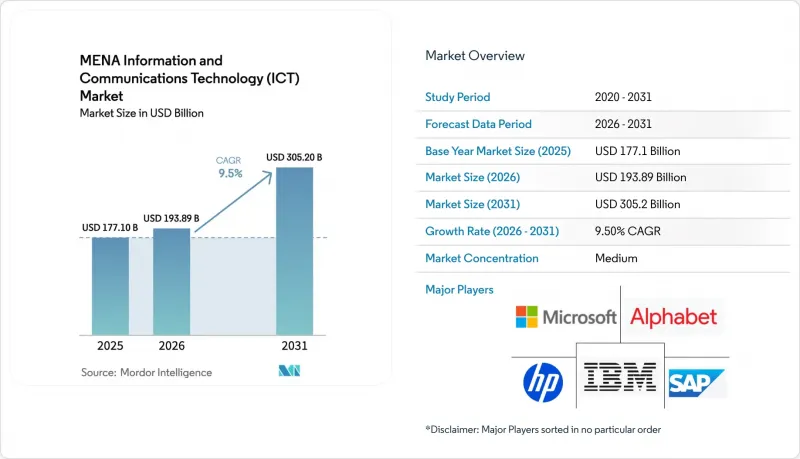
本報告按類型(IT硬體、IT軟體、其他)、企業規模(中小企業、大型企業)、部署模式(本地部署、雲端部署、混合部署)、最終用戶產業(政府/公共管理部門、銀行、金融服務和保險業、其他)以及國家(沙烏地阿拉伯、卡達、其他國家)進行細分。市場預測以美元計價。
中東和北非資訊通訊技術(ICT)市場趨勢與洞察
政府主導的智慧城市大型企劃
沙烏地阿拉伯的NEOM已撥款50億美元用於建構一個整合交通、能源和公共服務系統的技術平台。阿拉伯聯合大公國的杜拜2040城市總體規劃也旨在2025年實現25%的政府服務由人工智慧驅動。這些措施正在持續催生對雲端容量、物聯網感測器和網路安全解決方案的需求,其影響遠遠超出最初的建設週期。市政當局需要可互通的平台來整合交通、公共產業和公共安全領域的數據,從而加速邊緣運算和分析能力的普及應用。海灣合作理事會(GCC)層面的政策協調正在推動供應商標準化,並降低區域供應商的整合成本。一些成功的先導計畫,例如在「智慧杜拜」項目下處理的24億筆數位交易,正在展現規模經濟效益,並吸引更多政府資金的投入。
對超大規模雲端運算和資料中心的投資
微軟在沙烏地阿拉伯投資21億美元建設資料中心綜合體,甲骨文在利雅德投資15億美元建設區域項目,以及AWS投資53億美元實施多年擴張計劃,都顯示中東和北非的ICT市場是全球供應商的優先發展領域。在地化部署降低了企業工作負載的延遲,同時滿足了資料主權法規的要求,並刺激了對網路設備、託管服務和主機託管空間的二次需求。阿拉伯聯合大公國與Core42達成的價值130億美元(35.4億美元)的主權雲合作協議,將這種模式擴展到了公共部門的工作負載,並成為其他國家政府開始效仿的藍圖。邊緣節點正在人口稠密地區附近迅速擴展,以支援遊戲、自動駕駛汽車和即時分析等應用,進一步擴大了基礎設施的覆蓋範圍。
網路安全人員短缺
2024年,沙烏地阿拉伯和阿拉伯聯合大公國的網路安全職缺數量分別增加了26.8%和9.7%。儘管勞動力市場實現了兩位數成長,但職缺依然存在,凸顯了該地區日益嚴重的人才短缺問題。因此,企業被迫延後雲端遷移,轉而依賴昂貴的諮詢服務。公共部門網路每天遭受約5萬次網路攻擊,但51%的安全負責人表示資金不足是主要障礙。大學教育計畫無法滿足雲端安全架構師和事件回應分析師3:1的供需比例。政府主導的舉措,包括沙烏地阿拉伯國家網路安全局的獎學金項目,旨在五年內彌合這一缺口,但短期人才短缺問題依然存在。這限制了企業部署高度安全關鍵型工作負載(例如多重雲端分析)的速度。
細分市場分析
到2025年,IT服務領域將佔中東和北非ICT市場27.10%的佔有率,凸顯了在複雜的雲端遷移中整合專業知識的迫切需求。隨著對符合資料主權標準的架構的需求加速成長,系統整合商和託管服務供應商正逐漸成為超大規模資料中心業者和大型企業的策略合作夥伴。該領域受益於與多年轉型計劃、網路安全審計和應用現代化合約相關的經常性收入模式。隨著平台即服務(PaaS)解決方案的普及,隨著企業將傳統工作負載遷移到不同平台,諮詢機會也進一步擴大。本地服務供應商憑藉其阿拉伯語支援和對區域法規結構的熟悉程度脫穎而出,這為純粹的國際顧問公司設定了准入門檻。
雲端服務以9.85%的複合年成長率(CAGR)呈現最高成長態勢,預計2031年將縮小與IT服務之間的收入差距。微軟、Oracle和AWS等公司建立的主權雲端區域正在透過降低延遲和合規性障礙來加速工作負載遷移。企業擴大採用多重雲端策略以避免供應商鎖定,這推動了對編配工具和成本最佳化服務的需求。人工智慧模型訓練和即時分析等資料密集型應用的激增正在擴大基礎設施即服務(IaaS)的使用。同時,IT硬體對於5G回程傳輸和邊緣運算節點仍然至關重要,但由於虛擬化趨勢,其成長速度與以服務為中心的類別相比正在放緩。
到2025年,大型企業將佔總支出的61.35%,它們將利用自身規模優勢,推動從ERP現代化、網路安全整合到人工智慧實驗等一系列端到端的數位舉措。這群人能夠從超大規模資料中心業者和電信業者獲得優惠價格,從而增強其在採購上的影響力。能源、航空和金融業的跨國公司正在推動跨區域雲端部署,進而帶動資料管治軟體和SD-WAN解決方案等相關領域的成長。
預計中小企業 (SME) 的複合年成長率將達到 10.04%,高於整體市場成長率,這主要得益於「雲端優先」策略降低了進入高級軟體套件的門檻。阿拉伯聯合大公國的穆罕默德·本·拉希德創新基金和沙烏地阿拉伯的卡法拉計畫正在資助技術升級,以幫助中小企業滿足電子採購要求 (MBRF.AE)。自 2022 年以來,中小企業採用軟體即服務 (SaaS) 的比例增加了兩倍,尤其是在客戶關係管理 (CRM)、會計和終端安全工具方面。隨著供應鏈日益數位化,大型企業越來越依賴中小企業供應商提供的專業人工智慧、區塊鏈和物聯網 (IoT) 能力,從而將中小企業融入本地生態系統。
其他好處
- Excel格式的市場預測(ME)表
- 3個月的分析師支持
目錄
第1章:引言
- 研究假設和市場定義
- 調查範圍
第2章:調查方法
第3章執行摘要
第4章 市場狀況
- 市場概覽
- 市場促進因素
- 政府主導的智慧城市大型企劃
- 各國數位轉型促進計劃
- 對超大規模雲端運算和資料中心的投資
- 5G技術推動行動數據流量爆炸性成長
- 政府支持的資金為人工智慧和半導體領域提供資金。
- 資料居住要求正在推動本地IaaS的發展。
- 市場限制因素
- 網路安全人員短缺
- 能源補貼改革將增加資料中心的營運成本。
- 水和電之間的相互作用限制了北非資料中心的發展。
- 黎凡特地區光纖走廊的政治風險
- 產業價值鏈分析
- 監理情勢
- 宏觀經濟因素的影響
- 技術展望
- 波特五力分析
- 主要用例
- 政府項目和舉措
- 生態系分析
第5章 市場規模與成長預測
- 按類型
- IT硬體
- 電腦硬體
- 網路裝置
- 周邊設備
- IT軟體
- IT服務
- 託管服務
- 業務流程服務
- 商業諮詢服務
- 雲端服務
- IT基礎設施
- IT安全
- 通訊服務
- IT硬體
- 按公司規模
- 小型企業
- 大公司
- 按部署模式
- 現場
- 雲
- 混合
- 按最終用戶行業分類
- 政府和公共行政
- BFSI
- 能源與公共產業
- 零售、電子商務、物流
- 製造業和工業4.0
- 醫療保健和生命科學
- (上游、中游、下游)
- 遊戲與電子競技
- 國家
- 沙烏地阿拉伯
- 阿拉伯聯合大公國
- 卡達
- 阿曼
- 埃及
- 中東和北非其他地區
第6章 競爭情勢
- 市場集中度
- 策略趨勢
- 市佔率分析
- 公司簡介
- Alphabet Inc.(Google LLC)
- IBM Corporation
- Microsoft Corporation
- HP Inc.
- SAP SE
- Emirates Telecommunications Group Company PJSC(e&)
- Oracle Corporation
- Salesforce Inc.
- Accenture plc
- Amazon Web Services, Inc.
- Cisco Systems, Inc.
- Huawei Investment and Holding Co., Ltd.
- Dell Technologies Inc.
- Orange Business Services SA
- Saudi Telecom Company(stc solutions)
- Ooredoo QPSC
- Injazat Data Systems LLC
- Gulf Business Machines FZ-LLC
- Etihad Etisalat Co.(Mobily)
- Mobile Telecommunications Company KSCP(Zain Group)
- Ericsson AB
- Nokia Corporation
第7章 市場機會與未來展望
According to Mordor Intelligence, the Middle East and North Africa ICT market size is expected to grow from USD 177.1 billion in 2025 to USD 193.89 billion in 2026 and is forecast to reach USD 305.2 billion by 2031 at 9.5% CAGR over 2026-2031.
This report is Segmented by Type (IT Hardware, IT Software, and More), Enterprise Size (Small and Medium Enterprises, Large Enterprises), Deployment Model (On-Premise, Cloud, Hybrid), End-User Industry Vertical (Government and Public Administration, BFSI, and More), Country (Saudi Arabia, Qatar, and More). The Market Forecasts are Provided in Terms of Value (USD).
MENA Information And Communications Technology (ICT) Market Trends and Insights
Government-led Smart City Mega-projects
Saudi Arabia's NEOM allocates USD 5 billion for technology platforms that integrate traffic, energy, and citizen-service systems; UAE's Dubai 2040 Urban Master Plan targets AI delivery of 25% of government services by 2025. These initiatives generate recurring demand for cloud capacity, IoT sensors, and cybersecurity solutions well beyond initial construction cycles. Municipalities require interoperable platforms that aggregate data across transport, utilities, and public-safety domains, accelerating procurement of edge computing and analytics capabilities. GCC-level policy coordination enables vendor standardization, reducing integration costs for regional suppliers. Successful pilots, such as the 2.4 billion digital transactions processed under Smart Dubai, showcase scale economics that entice additional sovereign wealth-fund backing.
Hyperscale Cloud and Data-center Investments
Microsoft's USD 2.1 billion Saudi data-center complex, Oracle's USD 1.5 billion Riyadh region, and AWS's USD 5.3 billion multi-year expansion validate the Middle East and North Africa ICT market as a priority for global providers. Local presence satisfies data-sovereignty regulations while cutting latency for enterprise workloads, spurring secondary demand for networking gear, managed services, and colocation space. The UAE's AED 13 billion (USD 3.54 billion) sovereign-cloud partnership with Core42 extends the model to public-sector workloads, creating a blueprint other governments are adopting. Edge nodes are proliferating near population centers to support gaming, autonomous vehicles, and real-time analytics, further widening the infrastructure footprint.
Cyber-skill Shortages
Unfilled cybersecurity positions grew 26.8% in Saudi Arabia and 9.7% in the UAE during 2024, despite double-digit workforce expansion, widening a regional talent gap that forces enterprises to delay cloud migrations or rely on costly consultants. Public-sector networks endure about 50,000 daily cyberattack attempts, yet 51% of security leaders cite under-funding as their main obstacle. University programs cannot keep pace with 3:1 demand-supply ratios for cloud-security architects and incident-response analysts. Government initiatives, including Saudi Arabia's National Cybersecurity Authority scholarships, aim to close the gap within five years, but near-term shortages persist. This limits the speed at which enterprises adopt advanced, security-sensitive workloads such as multicloud analytics.
Other drivers and restraints analyzed in the detailed report include:
- 5G-driven Mobile Data-traffic Explosion
- National Digital-transformation Agendas
- Energy-subsidy Reforms Raising DC OPEX
For complete list of drivers and restraints, kindly check the Table Of Contents.
Segment Analysis
The IT Services segment accounted for 27.10% of the Middle East and North Africa ICT market in 2025, underscoring the need for integration expertise during complex cloud migrations. Accelerating demand for data-sovereignty compliant architectures positions system integrators and managed service providers as strategic partners to both hyperscalers and enterprises. The segment benefits from recurring revenue models tied to multiyear transformation programs, cybersecurity audits, and application modernization contracts. Rising adoption of platform-as-a-service solutions further expands advisory opportunities as organizations re-platform legacy workloads. Local providers differentiate through Arabic language support and familiarity with regional regulatory frameworks, creating barriers to entry for purely international consultancies.
Cloud Services recorded the highest growth trajectory at a 9.85% CAGR and are expected to narrow the revenue gap with IT Services by 2031. Establishment of sovereign cloud regions by Microsoft, Oracle, and AWS reduces latency and compliance hurdles, accelerating workload migration. Enterprises increasingly adopt multicloud strategies to avoid vendor lock-in, driving demand for orchestration tools and cost-optimization services. The surge in data-intensive applications such as AI model training and real-time analytics amplifies infrastructure-as-a-service consumption. Meanwhile, IT Hardware remains essential for 5G backhaul and edge-computing nodes, although its growth lags service-centric categories due to virtualization trends.
Large enterprises generated 61.35% of spending in 2025, leveraging scale to pursue end-to-end digital initiatives spanning ERP modernization, cybersecurity consolidation, and AI experimentation. This cohort secures preferential pricing from hyperscalers and telecom operators, reinforcing its procurement influence. Multinational corporations in the energy, aviation, and finance sectors anchor multi-region cloud deployments that uplift ancillary segments such as data-governance software and SD-WAN solutions.
Small and medium enterprises are set to outpace overall market growth with a 10.04% CAGR, underpinned by cloud-first policies that lower entry barriers to sophisticated software suites. UAE's Mohammed Bin Rashid Innovation Fund and Saudi Arabia's Kafalah program funnel capital toward technology upgrades that enable SMEs to fulfill electronic procurement mandates MBRF.AE. Software-as-a-service adoption among SMEs tripled since 2022, particularly in CRM, accounting, and endpoint-security tools. As supply-chain digitization deepens, large enterprises increasingly rely on SME tech vendors for niche AI, blockchain, and IoT capabilities, weaving smaller firms into regional ecosystems.
Complete Report Scope:
- By Type
- IT Hardware
- Computer Hardware
- Networking Equipment
- Peripherals
- IT Software
- IT Services
- Managed Services
- Business Process Services
- Business Consulting Services
- Cloud Services
- IT Infrastructure
- IT Security
- Communication Services
- IT Hardware
- By Enterprise Size
- Small and Medium Enterprises
- Large Enterprises
- By Deployment Model
- On-premise
- Cloud
- Hybrid
- By End-user Industry Vertical
- Government and Public Administration
- BFSI
- Energy and Utilities
- Retail, E-commerce and Logistics
- Manufacturing and Industry 4.0
- Healthcare and Life Sciences
- (Up/Mid/Down-stream)
- Gaming and Esports
- By Country
- Saudi Arabia
- United Arab Emirates
- Qatar
- Oman
- Egypt
- Rest of MENA
List of Companies Covered in this Report:
- Alphabet Inc. (Google LLC)
- IBM Corporation
- Microsoft Corporation
- HP Inc.
- SAP SE
- Emirates Telecommunications Group Company PJSC (e&)
- Oracle Corporation
- Salesforce Inc.
- Accenture plc
- Amazon Web Services, Inc.
- Cisco Systems, Inc.
- Huawei Investment and Holding Co., Ltd.
- Dell Technologies Inc.
- Orange Business Services S.A.
- Saudi Telecom Company (stc solutions)
- Ooredoo Q.P.S.C.
- Injazat Data Systems LLC
- Gulf Business Machines FZ-LLC
- Etihad Etisalat Co. (Mobily)
- Mobile Telecommunications Company K.S.C.P. (Zain Group)
- Ericsson AB
- Nokia Corporation
Additional Benefits:
- The market estimate (ME) sheet in Excel format
- 3 months of analyst support
TABLE OF CONTENTS
1 INTRODUCTION
- 1.1 Study Assumptions and Market Definition
- 1.2 Scope of the Study
2 RESEARCH METHODOLOGY
3 EXECUTIVE SUMMARY
4 MARKET LANDSCAPE
- 4.1 Market Overview
- 4.2 Market Drivers
- 4.2.1 Government-led smart city mega-projects
- 4.2.2 National digital transformation agendas
- 4.2.3 Hyperscale cloud and data-center investments
- 4.2.4 5G-driven mobile data-traffic explosion
- 4.2.5 Sovereign-wealth AI and semiconductor funding
- 4.2.6 Data-residency mandates boosting local IaaS
- 4.3 Market Restraints
- 4.3.1 Cyber-skill shortages
- 4.3.2 Energy-subsidy reforms raising DC OPEX
- 4.3.3 Water-power nexus limiting N. Africa DCs
- 4.3.4 Political risk in Levant fiber corridors
- 4.4 Industry Value Chain Analysis
- 4.5 Regulatory Landscape
- 4.6 Impact of Macroeconomic Factors
- 4.7 Technological Outlook
- 4.8 Porter's Five Forces Analysis
- 4.8.1 Bargaining Power of Suppliers
- 4.8.2 Bargaining Power of Consumers
- 4.8.3 Threat of New Entrants
- 4.8.4 Threat of Substitutes
- 4.8.5 Intensity of Competitive Rivalry
- 4.9 Key Use-Cases
- 4.10 Government Projects and Initiatives
- 4.11 Ecosystem Analysis
5 MARKET SIZE AND GROWTH FORECASTS (VALUE)
- 5.1 By Type
- 5.1.1 IT Hardware
- 5.1.1.1 Computer Hardware
- 5.1.1.2 Networking Equipment
- 5.1.1.3 Peripherals
- 5.1.2 IT Software
- 5.1.3 IT Services
- 5.1.3.1 Managed Services
- 5.1.3.2 Business Process Services
- 5.1.3.3 Business Consulting Services
- 5.1.3.4 Cloud Services
- 5.1.4 IT Infrastructure
- 5.1.5 IT Security
- 5.1.6 Communication Services
- 5.1.1 IT Hardware
- 5.2 By Enterprise Size
- 5.2.1 Small and Medium Enterprises
- 5.2.2 Large Enterprises
- 5.3 By Deployment Model
- 5.3.1 On-premise
- 5.3.2 Cloud
- 5.3.3 Hybrid
- 5.4 By End-user Industry Vertical
- 5.4.1 Government and Public Administration
- 5.4.2 BFSI
- 5.4.3 Energy and Utilities
- 5.4.4 Retail, E-commerce and Logistics
- 5.4.5 Manufacturing and Industry 4.0
- 5.4.6 Healthcare and Life Sciences
- 5.4.7 (Up/Mid/Down-stream)
- 5.4.8 Gaming and Esports
- 5.5 By Country
- 5.5.1 Saudi Arabia
- 5.5.2 United Arab Emirates
- 5.5.3 Qatar
- 5.5.4 Oman
- 5.5.5 Egypt
- 5.5.6 Rest of MENA
6 COMPETITIVE LANDSCAPE
- 6.1 Market Concentration
- 6.2 Strategic Moves
- 6.3 Market Share Analysis
- 6.4 Company Profiles (includes Global level Overview, Market level overview, Core Segments, Financials as available, Strategic Information, Market Rank/Share for key companies, Products and Services, and Recent Developments)
- 6.4.1 Alphabet Inc. (Google LLC)
- 6.4.2 IBM Corporation
- 6.4.3 Microsoft Corporation
- 6.4.4 HP Inc.
- 6.4.5 SAP SE
- 6.4.6 Emirates Telecommunications Group Company PJSC (e&)
- 6.4.7 Oracle Corporation
- 6.4.8 Salesforce Inc.
- 6.4.9 Accenture plc
- 6.4.10 Amazon Web Services, Inc.
- 6.4.11 Cisco Systems, Inc.
- 6.4.12 Huawei Investment and Holding Co., Ltd.
- 6.4.13 Dell Technologies Inc.
- 6.4.14 Orange Business Services S.A.
- 6.4.15 Saudi Telecom Company (stc solutions)
- 6.4.16 Ooredoo Q.P.S.C.
- 6.4.17 Injazat Data Systems LLC
- 6.4.18 Gulf Business Machines FZ-LLC
- 6.4.19 Etihad Etisalat Co. (Mobily)
- 6.4.20 Mobile Telecommunications Company K.S.C.P. (Zain Group)
- 6.4.21 Ericsson AB
- 6.4.22 Nokia Corporation
7 MARKET OPPORTUNITIES AND FUTURE OUTLOOK
- 7.1 White-space and Unmet-Need Assessment

 中國資訊通訊技術:市場佔有率分析、產業趨勢與統計及成長預測(2026-2031年)日本資訊通訊技術:市場佔有率分析、產業趨勢與統計、成長預測(2026-2031)西班牙資訊通訊技術:市場佔有率分析、產業趨勢與統計、成長預測(2026-2031)越南資訊通訊技術:市場佔有率分析、產業趨勢與統計、成長預測(2026-2031)印尼資訊通訊技術:市場佔有率分析、產業趨勢與統計及成長預測(2026-2031)新加坡資訊通訊技術:市場佔有率分析、產業趨勢與統計及成長預測(2026-2031 年)歐洲資訊通訊技術:市場佔有率分析、行業趨勢和統計數據、成長預測(2026-2031 年)法國資訊通訊技術:市場佔有率分析、產業趨勢與統計及成長預測(2026-2031 年)泰國資訊通訊技術:市場佔有率分析、產業趨勢與統計、成長預測(2026-2031)美國資訊通訊技術:市場佔有率分析、行業趨勢和統計數據、成長預測(2026-2031 年)