


 |
市場調查報告書
商品編碼
2117267
西班牙資訊通訊技術:市場佔有率分析、產業趨勢與統計、成長預測(2026-2031)Spain ICT - Market Share Analysis, Industry Trends & Statistics, Growth Forecasts (2026 - 2031) |
||||||

※ 本網頁內容可能與最新版本有所差異。詳細情況請與我們聯繫。
根據 Mordor Intelligence 預測,西班牙 ICT 市場規模將從 2025 年的 623.3 億美元成長到 2026 年的 676.9 億美元,到 2031 年將達到 977.2 億美元,2026 年至 2031 年的複合年成長率預計為 7.62%預計。
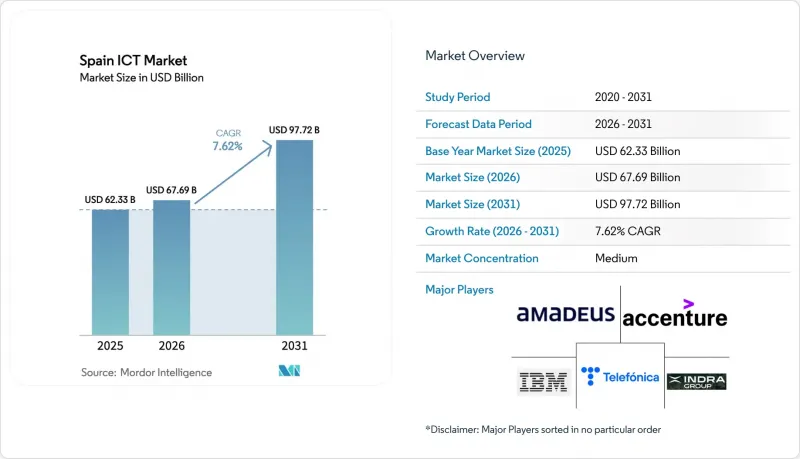
本報告按產品類型(IT硬體、IT軟體、IT服務、 IT基礎設施基礎設施等)、公司規模(中小企業和大型企業)以及行業領域(政府和公共管理、銀行、金融服務和保險、IT和電信、能源和公共產業、零售、電子商務和物流等)進行分類。市場預測以美元計價。
西班牙資訊通訊技術市場的趨勢與洞察
加速西班牙中小企業採用雲端運算
憑藉超過71萬張價值29億歐元(34.4億美元)的代金券,SaaS投資的投資回收期已從三年縮短至不到18個月,預計到2025年底,中小企業的雲端採用率將達到34%。軟體供應商目前正專注於創造月度經常性收入(MRR),並整合符合GDPR的模組,以約束企業簽訂多年合約。馬德里和加泰隆尼亞地區獲得了近一半的代金券,而埃斯特雷馬杜拉大區的採用率較低,原因是寬頻接入有限。當補貼於2026年底結束時,客戶解約率指標將揭示中小企業是會建立雲端工作流程還是會回歸本地部署環境。在西班牙的ICT市場,補貼結束後,留住現有客戶而非取得新客戶將成為決定性因素。
歐盟資助的數位化快速擴張計畫將於2026年及以後啟動
西班牙在歐盟成員國中獲得了最高的人均數位化預算撥款,預計到2025年人均將超過800歐元(約949.24美元)。 「PERTE晶片」舉措正在投資122.5億歐元(約145.4億美元)用於半導體研發,而「西班牙數位2026」計畫的目標是在2026年底前建立覆蓋全國的光纖網路,並實現所有公共服務的線上化。隨著政府各部門加快步伐以實現歐盟目標,擁有框架合約的系統整合商預計將訂單多個項目。另一方面,缺乏專案管理能力的市政當局可能面臨無法獲得資金的風險,加劇都市區之間的數位落差。從2027年起,津貼將轉向混合融資模式,優先考慮能夠承擔資產負債表風險的合作夥伴。此舉將重塑西班牙資訊通訊技術市場的競爭格局。
資深雲架構師長期短缺
到2025年,西班牙將有多達20萬個資訊通訊技術(ICT)相關職缺,高階雲端架構師的收入將比其他職位高出20-30%。人才多樣性和供應受到阻礙,僅有9.2%的學生獲得STEM(科學、技術、工程和數學)學位,而ICT專業人員中女性僅佔1.4%。專案等待時間已延長至6-12個月,導致過渡成本增加高達25%。儘管政府支持的「數位人才」計畫為培訓班津貼,但首批畢業生要到2026年下半年才能進入就業市場,這將造成嚴重的人才短缺,並減緩西班牙ICT市場的成長速度。
細分市場分析
到2025年,IT服務將佔西班牙ICT市場總收入的38.23%,在所有產品線中佔最大佔有率。隨著企業向混合架構轉型,託管服務、應用現代化和整合營運正在推動這一主導地位。同時,受勒索軟體激增和NIS2合規期限的推動, IT安全收入預計到2031年將以8.18%的複合年成長率成長,成為所有類別中成長率最高的。在硬體領域,客戶升級週期延長擠壓了利潤空間,而5G的部署則推動了對網路設備的需求。
支出模式正在相互重疊。雲端供應商如今正在整合自動修補程式功能,而託管安全服務供應商則提供合規性儀表板,這模糊了傳統產品之間的界線。阿拉貢超大規模資料中心的建設清晰地展現了這種融合趨勢,它將基礎設施投資與高利潤的專業服務相結合。這些變化正在增強西班牙資訊通訊技術市場在服務和安全交叉領域的規模,並推動供應商創新轉向基於結果的定價模式。
其他好處:
- Excel格式的市場預測(ME)表
- 3個月的分析師支持
目錄
第1章:引言
- 研究假設和市場定義
- 調查範圍
第2章:調查方法
第3章執行摘要
第4章 市場狀況
- 市場概覽
- 市場促進因素
- 加速西班牙中小企業採用雲端運算
- 從 2026 年起,歐盟資助的數位化津貼預計將大幅增加。
- 5G的快速普及正在推動邊緣運算的需求。
- 歐盟內部對近岸外包的偏好日益成長
- 網路攻擊手段日益複雜,推高了安全支出。
- 西班牙汽車產業走廊智慧製造中心的擴張
- 市場限制因素
- 資深雲架構師長期短缺
- 電價飆升正在削弱本地資料中心的獲利能力。
- 政府機構對傳統ERP系統的鎖定問題
- 採購流程的複雜性正在減緩大型IT專案的進展。
- 產業價值鏈分析
- 監理情勢
- 技術展望
- 波特五力分析
- 投資分析?
- 宏觀經濟因素會產生哪些影響?
- 產業相關人員分析
第5章 市場規模與成長預測
- 依產品類型
- IT硬體
- 電腦硬體
- 網路裝置
- 周邊設備
- IT軟體
- IT服務
- IT諮詢與實施
- IT外包(ITO)
- 業務流程外包(BPO)
- 託管安全服務
- 雲端和平台服務
- IT基礎設施
- IT安全/網路安全
- 通訊服務
- IT硬體
- 按公司規模
- 小型企業
- 大公司
- 按行業分類
- 政府/行政部門
- BFSI
- 資訊科技/通訊
- 能源公用事業
- 零售、電子商務、物流
- 製造業和工業4.0
- 醫療保健和生命科學
- 石油和天然氣
- 其他工業部門
第6章 競爭情勢
- 市場集中度
- 策略趨勢
- 市佔率分析
- 公司簡介
- Telefonica SA
- Indra Sistemas SA
- Amadeus IT Group SA
- IBM Corporation
- Accenture plc
- Atos SE
- NTT DATA Espana, SLU(Everis)
- Capgemini SE
- Vodafone Group Plc
- Orange SA
- Hewlett Packard Enterprise Company
- Cisco Systems Inc.
- Microsoft Corporation
- Amazon Web Services Inc.
- Google LLC
- DXC Technology Company
- Fujitsu Limited
- SAP SE
- Oracle Corporation
- Inetum SA
- T-Systems Iberia SAU
- Sopra Steria Group SA
第7章 市場機會與未來展望
According to Mordor Intelligence, the Spain ICT market size is expected to increase from USD 62.33 billion in 2025 to USD 67.69 billion in 2026 and reach USD 97.72 billion by 2031, growing at a CAGR of 7.62% over 2026-2031.
This report is Segmented by Product Type (IT Hardware, IT Software, IT Services, IT Infrastructure, and More), Enterprise Size (Small and Medium-Sized Enterprises, and Large Enterprises), and Industry Vertical (Government and Public Administration, BFSI, IT and Telecom, Energy and Utilities, Retail E-Commerce and Logistics, and More). The Market Forecasts are Provided in Terms of Value (USD).
Spain ICT Market Trends and Insights
Accelerated Cloud Adoption Among Spanish SMEs
More than 710,000 vouchers worth EUR 2.9 billion (USD 3.44 billion) lowered the payback period on SaaS investments from three years to under 18 months, lifting the SME cloud-utilization rate to 34% in late 2025. Software vendors now chase monthly recurring revenue, embedding GDPR modules that lock firms into multi-year contracts. Madrid and Catalonia captured nearly half of all vouchers, while rural Extremadura trailed because of limited broadband. As subsidies sunset in late 2026, churn metrics will reveal whether SMEs internalize cloud workflows or retreat to on-premise stacks. For the Spain ICT market, retention, not acquisition, will determine post-subsidy momentum.
EU-Funded Digitalization Surge Post-2026
Spain received the EU's highest per-capita digital allocation, exceeding EUR 800 (USD 949.24) per inhabitant through 2025. The PERTE Chip initiative injects EUR 12.25 billion (USD 14.54 billion) into semiconductor R&D, while Spain Digital 2026 targets nationwide fiber coverage and online availability of all public services by end-2026. Systems integrators with framework agreements stand to book back-to-back projects as ministries race to hit EU milestones. Municipalities lacking project-management bandwidth risk missing funds, widening the urban-rural digital divide. From 2027 onward, grants morph into blended finance, favoring partners able to absorb balance-sheet risk, a dynamic that reshapes the Spain ICT market's competitive landscape.
Persistent Shortage of Senior Cloud Architects
Spain had up to 200,000 unfilled ICT roles in 2025, with senior cloud architects commanding 20-30% salary premiums. Only 9.2% of graduates emerge with STEM degrees, and women fill just 1.4% of ICT posts, dampening diversity and supply lines. Project queues lengthen 6-12 months, inflating migration costs by up to 25%. Although a government-backed Digital Talent program subsidizes bootcamps, the first cohort enters the labor market in late 2026, leaving a critical talent gap that slows the Spain ICT market's velocity.
Other drivers and restraints analyzed in the detailed report include:
- Rapid 5G Roll-Out Catalyzing Edge Demand
- Rising Cyber-Attack Sophistication Driving Security Spend
- High Electricity Prices and Grid Saturation
For complete list of drivers and restraints, kindly check the Table Of Contents.
Segment Analysis
IT services contributed 38.23% of 2025 revenue, giving the segment the largest Spain ICT market share across product lines. Managed services, application modernization, and integration workstreams drive this dominance as enterprises transition to hybrid architectures. Meanwhile, IT security revenue is set to grow at an 8.18% CAGR to 2031, the fastest among all categories, driven by ransomware escalation and NIS2 compliance deadlines. Hardware faces margin compression as clients prolong refresh cycles, though network equipment enjoys a bump from 5G rollouts.
Spending patterns demonstrate overlap: cloud vendors now embed automated patching, while managed security providers supply compliance dashboards, blurring classic product boundaries. Hyperscale data-center builds in Aragon illustrate this convergence, pairing infrastructure investment with high-margin professional services. These shifts reinforce the Spain ICT market size at the intersection of services and security, redirecting vendor innovation toward outcome-based pricing.
Complete Report Scope:
- By Product Type
- IT Hardware
- Computer Hardware
- Networking Equipment
- Peripherals
- IT Software
- IT Services
- IT Consulting and Implementation
- IT Outsourcing (ITO)
- Business Process Outsourcing (BPO)
- Managed Security Services
- Cloud and Platform Services
- IT Infrastructure
- IT Security/Cybersecurity
- Communication Services
- IT Hardware
- By Enterprise Size
- Small and Medium-sized Enterprises
- Large Enterprises
- By Industry Vertical
- Government and Public Administration
- BFSI
- IT and Telecom
- Energy and Utilities
- Retail, E-commerce, and Logistics
- Manufacturing and Industry 4.0
- Healthcare and Life Sciences
- Oil and Gas
- Other Industry Verticals
List of Companies Covered in this Report:
- Telefonica S.A.
- Indra Sistemas S.A.
- Amadeus IT Group S.A.
- IBM Corporation
- Accenture plc
- Atos SE
- NTT DATA Espana, S.L.U. (Everis)
- Capgemini SE
- Vodafone Group Plc
- Orange S.A.
- Hewlett Packard Enterprise Company
- Cisco Systems Inc.
- Microsoft Corporation
- Amazon Web Services Inc.
- Google LLC
- DXC Technology Company
- Fujitsu Limited
- SAP SE
- Oracle Corporation
- Inetum S.A.
- T-Systems Iberia S.A.U.
- Sopra Steria Group SA
Additional Benefits:
- The market estimate (ME) sheet in Excel format
- 3 months of analyst support
TABLE OF CONTENTS
1 INTRODUCTION
- 1.1 Study Assumptions and Market Definition
- 1.2 Scope of the Study
2 RESEARCH METHODOLOGY
3 EXECUTIVE SUMMARY
4 MARKET LANDSCAPE
- 4.1 Market Overview
- 4.2 Market Drivers
- 4.2.1 Accelerated Cloud Adoption Among Spanish SMEs
- 4.2.2 Surge in EU-Funded Digitalisation Grants Post-2026
- 4.2.3 Rapid 5G Roll-out Catalysing Edge Computing Demand
- 4.2.4 Growing Near-Shore Outsourcing Preference Within EU
- 4.2.5 Rising Cyber-attack Sophistication Driving Security Spend
- 4.2.6 Expansion of Smart Manufacturing Hubs in Spain's Automotive Corridor
- 4.3 Market Restraints
- 4.3.1 Persistent Shortage of Senior Cloud Architects
- 4.3.2 High Electricity Prices Undermining Local Data-centre Economics
- 4.3.3 Legacy ERP Lock-in Across Public Administration
- 4.3.4 Procurement Bureaucracy Slowing Large-Scale IT Projects
- 4.4 Industry Value Chain Analysis
- 4.5 Regulatory Landscape
- 4.6 Technological Outlook
- 4.7 Porter's Five Forces Analysis
- 4.7.1 Threat of New Entrants
- 4.7.2 Bargaining Power of Suppliers
- 4.7.3 Bargaining Power of Buyers
- 4.7.4 Threat of Substitutes
- 4.7.5 Intensity of Competitive Rivalry
- 4.8 Investment Analysis?
- 4.9 Impact of Macroeconomic Factors?
- 4.10 Industry Stakeholder Analysis
5 MARKET SIZE AND GROWTH FORECASTS (VALUE)
- 5.1 By Product Type
- 5.1.1 IT Hardware
- 5.1.1.1 Computer Hardware
- 5.1.1.2 Networking Equipment
- 5.1.1.3 Peripherals
- 5.1.2 IT Software
- 5.1.3 IT Services
- 5.1.3.1 IT Consulting and Implementation
- 5.1.3.2 IT Outsourcing (ITO)
- 5.1.3.3 Business Process Outsourcing (BPO)
- 5.1.3.4 Managed Security Services
- 5.1.3.5 Cloud and Platform Services
- 5.1.4 IT Infrastructure
- 5.1.5 IT Security/Cybersecurity
- 5.1.6 Communication Services
- 5.1.1 IT Hardware
- 5.2 By Enterprise Size
- 5.2.1 Small and Medium-sized Enterprises
- 5.2.2 Large Enterprises
- 5.3 By Industry Vertical
- 5.3.1 Government and Public Administration
- 5.3.2 BFSI
- 5.3.3 IT and Telecom
- 5.3.4 Energy and Utilities
- 5.3.5 Retail, E-commerce, and Logistics
- 5.3.6 Manufacturing and Industry 4.0
- 5.3.7 Healthcare and Life Sciences
- 5.3.8 Oil and Gas
- 5.3.9 Other Industry Verticals
6 COMPETITIVE LANDSCAPE
- 6.1 Market Concentration
- 6.2 Strategic Moves
- 6.3 Market Share Analysis
- 6.4 Company Profiles (includes Global level Overview, Market level overview, Core Segments, Financials as available, Strategic Information, Market Rank/Share for key companies, Products and Services, and Recent Developments)
- 6.4.1 Telefonica S.A.
- 6.4.2 Indra Sistemas S.A.
- 6.4.3 Amadeus IT Group S.A.
- 6.4.4 IBM Corporation
- 6.4.5 Accenture plc
- 6.4.6 Atos SE
- 6.4.7 NTT DATA Espana, S.L.U. (Everis)
- 6.4.8 Capgemini SE
- 6.4.9 Vodafone Group Plc
- 6.4.10 Orange S.A.
- 6.4.11 Hewlett Packard Enterprise Company
- 6.4.12 Cisco Systems Inc.
- 6.4.13 Microsoft Corporation
- 6.4.14 Amazon Web Services Inc.
- 6.4.15 Google LLC
- 6.4.16 DXC Technology Company
- 6.4.17 Fujitsu Limited
- 6.4.18 SAP SE
- 6.4.19 Oracle Corporation
- 6.4.20 Inetum S.A.
- 6.4.21 T-Systems Iberia S.A.U.
- 6.4.22 Sopra Steria Group SA
7 MARKET OPPORTUNITIES AND FUTURE OUTLOOK
- 7.1 White-space and Unmet-Need Assessment

 中東和北非資訊通訊技術(ICT):市場佔有率分析、行業趨勢和統計數據以及成長預測(2026-2031 年)中國資訊通訊技術:市場佔有率分析、產業趨勢與統計及成長預測(2026-2031年)日本資訊通訊技術:市場佔有率分析、產業趨勢與統計、成長預測(2026-2031)越南資訊通訊技術:市場佔有率分析、產業趨勢與統計、成長預測(2026-2031)印尼資訊通訊技術:市場佔有率分析、產業趨勢與統計及成長預測(2026-2031)新加坡資訊通訊技術:市場佔有率分析、產業趨勢與統計及成長預測(2026-2031 年)歐洲資訊通訊技術:市場佔有率分析、行業趨勢和統計數據、成長預測(2026-2031 年)法國資訊通訊技術:市場佔有率分析、產業趨勢與統計及成長預測(2026-2031 年)泰國資訊通訊技術:市場佔有率分析、產業趨勢與統計、成長預測(2026-2031)美國資訊通訊技術:市場佔有率分析、行業趨勢和統計數據、成長預測(2026-2031 年)