


 |
市場調查報告書
商品編碼
2116878
法國資訊通訊技術:市場佔有率分析、產業趨勢與統計及成長預測(2026-2031 年)France ICT - Market Share Analysis, Industry Trends & Statistics, Growth Forecasts (2026 - 2031) |
||||||

※ 本網頁內容可能與最新版本有所差異。詳細情況請與我們聯繫。
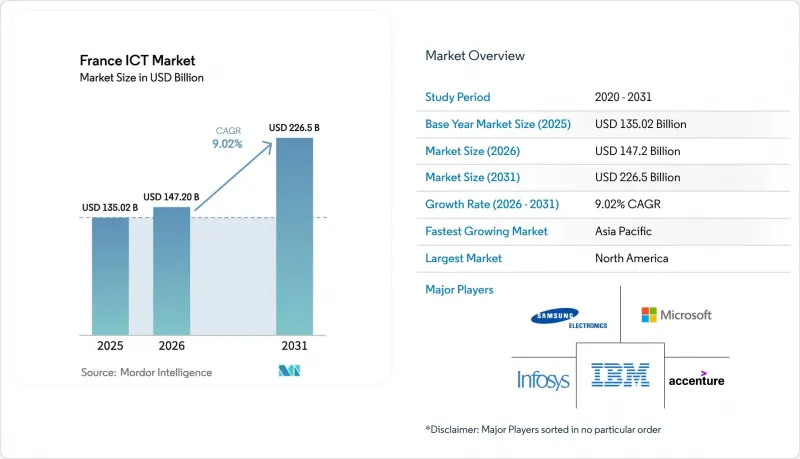
根據 Mordor Intelligence 的數據,2025 年法國 ICT 市值為 1,350.2 億美元,預計到 2031 年將達到 2,265 億美元,而 2026 年為 1,472 億美元,預測期(2026-2031 年)的複合年成長率為 9.02%。
本報告按類型(IT硬體、IT軟體、IT服務、 IT基礎設施/資料中心、 IT安全/網路安全、電信服務)、公司規模(中小企業、大型企業)和產業(政府/公共管理部門、銀行、金融服務和保險等)對產業進行分類。市場預測以美元計價。
法國資訊通訊技術市場的趨勢與洞察
5G頻段競標和網路建設的激增正在推動企業轉型。
繼Free Mobile於2024年推出覆蓋全國的5G-SA服務,部署超過2萬個基地台後,競爭對手紛紛效仿,到2025年3月,獲得許可的5G基地台總數達到50268個,服務覆蓋率提升至95%。獨立組網(SA)架構支援網路切片,使製造商、物流供應商和公共安全機構能夠獲得專屬頻寬。 Orange、SFR和Bouygues Telecom正在重新分配700MHz和2.1GHz頻段的頻率,而ARCEP正在準備3.8-4.2GHz頻段的新頻率分配,以支援邊緣人工智慧工作負載。對延遲敏感的應用場景,例如協作機器人和自動導引運輸車,在4G環境下發展停滯不前,如今正逐步進入商業試點階段。同時,系統整合商正在透過將 5G 專用網路設計與託管邊緣服務結合,在法國 ICT 市場實現連接 + 運算堆疊的貨幣化。
法國的「Cloud de Confiance」認證正在為主權運算創造一種範式。
由凱捷(Capgemini)和Orange合資成立的Bleu平台,耗資5.25億歐元,採用微軟技術,於2024年開始商業運營,旨在滿足法國資料主權立法所涵蓋的工作負載需求。 ANSSI SecNumCloud框架實施360度全方位管控,涵蓋行政隔離和歐洲法律豁免等,並指南國防、醫療保健和關鍵基礎設施領域的競標標準。未通過SecNumCloud認證的超大規模資料中心業者服務商將失去進入許可權公共合約的機會,除非他們與認證供應商合作,這將重塑整個法國ICT市場的供應商候選名單。因此,處理高度敏感工作負荷的組織除了考慮成本和功能集之外,還必須認真考慮資料主權,而合規性正日益成為採購決策中的決定性因素。這種國家層級的立場也影響歐盟的監管。巴黎的目標是維持其在主權雲端服務領域的領先地位,並抵制範圍更廣、監管更寬鬆的方案。
分散的中小型企業通路對技術提供者造成了規模劣勢。
儘管法國73%的中小企業已連接光纖網路,但僅有52%達到歐盟基本的數位整合標準,這迫使供應商投入成本高昂的培訓週期,從而擠壓了利潤空間。採購分散在400萬家企業中,每家企業都需要單獨的支持,而合約金額卻仍然小規模。因此,訂單的行銷成本是服務大型企業的數倍,阻礙了可擴展SaaS模式的普及。雖然政府津貼和法國數位行銷協會(France Num)的指導緩解了一些障礙,但宣傳宣傳活動的分散性仍然是一個挑戰。在通路聚合平台和區域數位化諮詢中心成熟之前,圍繞服務發現、採用和變更管理的摩擦將繼續抑制法國資訊通訊技術市場的發展勢頭。
細分市場分析
到2025年,隨著企業將複雜的數位轉型工作負載外包,IT服務將佔據45.20%的市場。人工智慧整合、增強網路安全和舊有系統現代化改造等溢價需求已被納入多年期託管服務合約。雲端服務正以12.10%的複合年成長率快速成長,直接受益於主權雲端指令和對綠色資料中心的偏好。隨著政府機構將敏感工作負載從本地環境遷移到支援SecNumCloud的環境,預計隨著Bleu的部署,雲端服務領域的市場規模將進一步擴大。儘管邊緣閘道器和企業Wi-Fi 7升級的硬體升級週期仍在繼續,但價值正從實體資產轉向利用人才短缺實現盈利的「X即服務」模式。
中期展望的重點在於平台編配。能夠整合可觀測性、財務營運 (FinOps) 和人工智慧營運 (AI-Ops) 能力的供應商將超越純粹的轉售商。軟體供應商正在將生成式人工智慧輔助駕駛系統整合到企業資源計畫 (ERP) 和客戶關係管理 (CRM) 套件中,以提升輔助收入。電信服務供應商正透過將 5G-MEC 容量與 SaaS 市場融合,重新定位自身業務,成為數位體驗的編排者。這些趨勢共同強化了法國資訊通訊技術 (ICT) 市場以服務為中心的結構,並將利潤率轉移到知識密集型服務。
到2025年,大型企業佔據了法國資訊通訊技術(ICT)市場70.30%的佔有率,但由於大型主機維修和合規性審計導致專案週期延長,其成長速度正在放緩。同時,預計複合年成長率(CAGR)為9.55%的中小型企業(SME)正透過利用雲端市場和低程式碼工具來克服舊有系統的限制。基於訂閱的網路安全套餐和全包式區域網路託管服務降低了初始成本門檻,使中小型企業能夠實現數位化平等。
法國政府的補貼計畫France Num支援硬體升級和數位技能培訓,擴大了合格的買家群體。從一開始就整合了會計、電子商務和網路保險等服務的市場聚合平台,如同一個一站式商店,繞過了分散的經銷商生態系統。隨著光纖到戶(FTTH)的普及消除了「最後一公里」的限制,即使是本地微企業也開始採用基於SaaS的POS系統和雲端儲存。這股浪潮正在縮小數位化使用率的差距,並將更多資金重新分配給法國資訊通訊技術(ICT)市場的中小企業。
其他好處:
- Excel格式的市場預測(ME)表
- 3個月的分析師支持
目錄
第1章:引言
- 研究假設和市場定義
- 調查範圍
第2章:調查方法
第3章執行摘要
第4章 市場狀況
- 市場概覽
- 市場促進因素
- 5G頻段競標和網路建設激增
- 法國的 Cloud de Confiance 認證正在加速主權雲的採用(這一趨勢尚未得到足夠的關注)。
- 歐盟晶片法下的獎勵措施正在加速振興本地半導體設計中心。
- 企業脫碳目標正在推動對綠色資料中心的需求(這一趨勢尚未得到足夠的重視)。
- 全國範圍內的光纖到府 (FTTH) 網路的發展將能夠提供高附加價值服務。
- 專為法國公共部門設計的AI語言模型的興起(這一發展尚未得到足夠的關注)
- 市場限制因素
- 針對中小企業的銷售管道高度分散,推高了市場進入門檻。
- 雙語(法語和英語)網路安全專業人員的短缺正在阻礙專案進展(這一趨勢尚未得到足夠的重視)。
- 銀行、金融服務和保險 (BFSI) 行業的傳統大型主機環境正在減緩雲端遷移的速度。
- 對歐盟以外超超大規模資料中心業者的日益依賴引發了人們對資料主權的擔憂(這項發展尚未得到足夠的重視)。
- 價值供應鏈分析
- 監理情勢
- 技術展望
- 波特五力模型
第5章:關鍵技術投資
- 雲端技術
- 人工智慧
- 網路安全
- 數位服務
第6章 市場規模與成長預測
- 按類型
- IT硬體
- 電腦硬體
- 網路裝置
- 周邊設備
- IT軟體
- IT服務
- 託管服務
- 業務流程服務
- 商業諮詢服務
- 雲端服務
- IT基礎設施/資料中心
- IT安全/網路安全
- 通訊服務
- IT硬體
- 按部署模式
- 現場
- 公共雲端
- 私有雲端
- 混合雲端
- 按公司規模
- 中小企業
- 大公司
- 按行業
- 政府/公共行政
- 銀行、金融服務和保險(BFSI)
- 零售、電子商務、物流
- 製造業和工業4.0
- 能源公用事業
- 醫療保健和生命科學
- 遊戲和電子競技
- 教育
- 其他
第7章 競爭情勢
- 市場集中度
- 策略趨勢
- 市佔率分析
- 公司簡介
- Apple Inc.
- Samsung Electronics Co., Ltd.
- Cisco Systems, Inc.
- Microsoft Corporation
- Tata Consultancy Services Limited
- International Business Machines Corporation
- Tech Mahindra Limited
- Infosys Limited
- Wipro Limited
- Accenture plc
- Orange SA
- Capgemini SE
- Atos SE
- Dassault Systemes SE
- Sopra Steria Group SA
- Thales Group
- OVHcloud
- Iliad SA(Free)
- Hewlett Packard Enterprise Company
- Amazon Web Services, Inc.
第8章 市場機會與未來展望
- 未開發市場和未滿足需求的評估
第9章 投資分析
According to Mordor Intelligence, the France ICT market size was valued at USD 135.02 billion in 2025 and estimated to grow from USD 147.2 billion in 2026 to reach USD 226.5 billion by 2031, at a CAGR of 9.02% during the forecast period (2026-2031).
This report Segments the Industry Into by Type (IT Hardware, IT Software, IT Services, IT Infrastructure/Data Centers, IT Security/ Cybersecurity, Communication Services), by Enterprise Size (Small and Medium Enterprises, Large Enterprises), and by Industry Vertical (BFSI, IT and Telecom, Government, and More). The Market Forecasts are Provided in Terms of Value (USD).
France ICT Market Trends and Insights
Surge in 5G Spectrum Auctions and Network Build-Outs Drive Enterprise Transformation
Free Mobile's national 5G-SA launch over 20,000 sites in 2024 triggered a wave of competitive deployments, lifting authorized 5G sites to 50,268 by March 2025 and extending coverage to 95% of residents. Standalone architecture brings network-slicing that lets manufacturers, logistics operators, and public-safety agencies reserve deterministic bandwidth. Orange, SFR, and Bouygues Telecom are refarming 700 MHz and 2.1 GHz spectrum while ARCEP prepares new 3.8-4.2 GHz allocations to accommodate edge-AI workloads. Latency-sensitive use cases such as collaborative robotics and autonomous guided vehicles that stalled under 4G now move to commercial pilots. In parallel, systems integrators bundle 5G private-network design with managed-edge services, monetizing the connectivity-plus-compute stack across the France ICT market.
France's "Cloud de Confiance" Certification Creates a Sovereign-Computing Paradigm
The Bleu platform, a EUR 525 million joint venture of Capgemini and Orange using Microsoft technology, began commercial operations in 2024 to serve workloads subject to French data-sovereignty statutes. The ANSSI SecNumCloud framework enforces 360 controls spanning administrative isolation and European legal immunity, guiding tender criteria in defense, healthcare, and critical-infrastructure domains. Hyperscalers without SecNumCloud status now partner with certified operators or lose access to public contracts, reshaping vendor shortlists across the France ICT market. Organizations handling sensitive workloads must therefore weigh sovereignty alongside cost and feature sets, elevating compliance as a decisive buying factor. The national stance also influences EU regulation: Paris resists broader, less stringent schemes, aiming to preserve its first-mover advantage in sovereign-cloud services.
Fragmented SME Channel Creates Scale Disadvantages for Technology Providers
Only 52% of French SMEs meet the EU's basic-digital-intensity benchmark despite 73% enjoying fiber access, forcing vendors into high-touch education cycles that erode margins. Procurement is splintered across 4 million firms, each demanding tailored support yet generating modest contract values. Marketing spend per euro booked, therefore, remains multiples higher than enterprise business, deterring scale-out SaaS models. Government grants and France Num coaching temper the barrier, but suffer from fragmented awareness campaigns. Unless channel aggregators or regional digital-advisory hubs mature, friction around discovery, onboarding, and change management will continue to trim momentum for the France ICT market.
Other drivers and restraints analyzed in the detailed report include:
- Corporate Decarbonization Targets Reshape Data-Center Investment Patterns
- Nationwide FTTH Completion Enables Service Innovation Beyond Connectivity
- Cybersecurity Talent Shortage Constrains Market Growth Despite Rising Demand
For complete list of drivers and restraints, kindly check the Table Of Contents.
Segment Analysis
IT Services contributed 45.20% to the France ICT market share in 2025 as enterprises outsourced complex digital-transformation workloads. Price-premium mandates around AI integration, cybersecurity hardening, and legacy modernization are locked in multiyear managed-service contracts. Cloud Services, advancing at a 12.10% CAGR, benefit directly from sovereign-cloud mandates and green-data-center preferences. The France ICT market size for Cloud Services is projected to rise in tandem with Bleu's roll-out as ministries port sensitive workloads from on-premise stacks to SecNumCloud-ready environments. Hardware refresh cycles persist around edge gateways and enterprise Wi-Fi 7 upgrades, yet value shifts decisively toward X-as-a-Service models that monetize talent scarcity rather than physical assets.
The mid-term narrative centers on platform orchestration: providers bundling observability, FinOps, and AI-ops capabilities out-compete pure-play resellers. Software vendors embed generative-AI copilots into ERP and CRM suites, lifting attach revenues. Communication-service providers reposition into digital-experience orchestrators, fusing 5G-MEC capacity with SaaS marketplaces. Collectively, these trends reinforce the service-weighted composition of the France ICT market and tilt margins toward knowledge-intensive offerings.
Large enterprises retained 70.30% of the France ICT market size in 2025 but face slower expansion as mainframe remediation and compliance reviews elongate project cycles. SMEs, posting a 9.55% CAGR, leverage cloud marketplaces and low-code tooling to bypass legacy constraints. Subscription-priced cybersecurity bundles and all-inclusive managed-LAN packages flatten upfront cost barriers, letting SMEs achieve digital parity.
Government vouchers under France Num subsidize hardware refreshes and digital-skills training, widening the funnel of qualified buyers. Marketplace aggregators that pre-integrate accounting, e-commerce, and cyber-insurance serve as one-stop shops, sidestepping the fragmented reseller ecosystem. As FTTH penetration removes last-mile constraints, rural micro-enterprises adopt SaaS POS and cloud storage. This groundswell narrows the digital-intensity gap and reallocates incremental spending toward the SME cohort within the France ICT market.
Complete Report Scope:
- By Type
- IT Hardware
- Computer Hardware
- Networking Equipment
- Peripherals
- IT Software
- IT Services
- Managed Services
- Business Process Services
- Business Consulting Services
- Cloud Services
- IT Infrastructure
- IT Security
- Communication Services
- IT Hardware
- By Deployment Model
- On-Premise
- Public Cloud
- Private Cloud
- Hybrid Cloud
- By Enterprise Size
- Small and Medium Enterprises (SMEs)
- Large Enterprises
- By Industry Vertical
- Government and Public Administration
- Banking, Financial Services and Insurance (BFSI)
- Retail, E-commerce and Logistics
- Manufacturing and Industry 4.0
- Energy and Utilities
- Healthcare and Life Sciences
- Gaming and Esports
- Education
- Other Verticals
List of Companies Covered in this Report:
- Apple Inc.
- Samsung Electronics Co., Ltd.
- Cisco Systems, Inc.
- Microsoft Corporation
- Tata Consultancy Services Limited
- International Business Machines Corporation
- Tech Mahindra Limited
- Infosys Limited
- Wipro Limited
- Accenture plc
- Orange S.A.
- Capgemini SE
- Atos SE
- Dassault Systemes SE
- Sopra Steria Group SA
- Thales Group
- OVHcloud
- Iliad S.A. (Free)
- Hewlett Packard Enterprise Company
- Amazon Web Services, Inc.
Additional Benefits:
- The market estimate (ME) sheet in Excel format
- 3 months of analyst support
TABLE OF CONTENTS
1 INTRODUCTION
- 1.1 Study Assumptions and Market Definition
- 1.2 Scope of the Study
2 RESEARCH METHODOLOGY
3 EXECUTIVE SUMMARY
4 MARKET LANDSCAPE
- 4.1 Market Overview
- 4.2 Market Drivers
- 4.2.1 Surge in 5G spectrum auctions and network build-outs
- 4.2.2 France's "Cloud de Confiance" certification drives sovereign-cloud uptake (under-reported)
- 4.2.3 EU Chips Act incentives accelerate local semiconductor design hubs
- 4.2.4 Corporate decarbonisation targets boost demand for green data-centres (under-reported)
- 4.2.5 Nationwide fibre-to-the-home (FTTH) completion unlocking higher-value services
- 4.2.6 Rise of AI-powered language models tailored for French public sector (under-reported)
- 4.3 Market Restraints
- 4.3.1 Highly fragmented SME channel inflates go-to-market costs
- 4.3.2 Shortage of bilingual (FR/EN) cyber-security talent limits project delivery (under-reported)
- 4.3.3 Legacy mainframe estates in BFSI slow cloud migration
- 4.3.4 Growing dependence on non-EU hyperscalers raises data-sovereignty concerns (under-reported)
- 4.4 Value / Supply-Chain Analysis
- 4.5 Regulatory Landscape
- 4.6 Technological Outlook
- 4.7 Porter's Five Forces
- 4.7.1 Bargaining Power of Suppliers
- 4.7.2 Bargaining Power of Buyers
- 4.7.3 Threat of New Entrants
- 4.7.4 Threat of Substitutes
- 4.7.5 Intensity of Competitive Rivalry
5 Key Technology Investments
- 5.1 Cloud Technology
- 5.2 Artificial Intelligence
- 5.3 Cyber-security
- 5.4 Digital Services
6 MARKET SIZE AND GROWTH FORECASTS (VALUE, USD)
- 6.1 By Type
- 6.1.1 IT Hardware
- 6.1.1.1 Computer Hardware
- 6.1.1.2 Networking Equipment
- 6.1.1.3 Peripherals
- 6.1.2 IT Software
- 6.1.3 IT Services
- 6.1.3.1 Managed Services
- 6.1.3.2 Business Process Services
- 6.1.3.3 Business Consulting Services
- 6.1.3.4 Cloud Services
- 6.1.4 IT Infrastructure
- 6.1.5 IT Security
- 6.1.6 Communication Services
- 6.1.1 IT Hardware
- 6.2 By Deployment Model
- 6.2.1 On-Premise
- 6.2.2 Public Cloud
- 6.2.3 Private Cloud
- 6.2.4 Hybrid Cloud
- 6.3 By Enterprise Size
- 6.3.1 Small and Medium Enterprises (SMEs)
- 6.3.2 Large Enterprises
- 6.4 By Industry Vertical
- 6.4.1 Government and Public Administration
- 6.4.2 Banking, Financial Services and Insurance (BFSI)
- 6.4.3 Retail, E-commerce and Logistics
- 6.4.4 Manufacturing and Industry 4.0
- 6.4.5 Energy and Utilities
- 6.4.6 Healthcare and Life Sciences
- 6.4.7 Gaming and Esports
- 6.4.8 Education
- 6.4.9 Other Verticals
7 COMPETITIVE LANDSCAPE
- 7.1 Market Concentration
- 7.2 Strategic Moves
- 7.3 Market Share Analysis
- 7.4 Company Profiles {(includes Global level Overview, Market level overview, Core Segments, Financials as available, Strategic Information, Market Rank/Share, Products and Services, Recent Developments)}
- 7.4.1 Apple Inc.
- 7.4.2 Samsung Electronics Co., Ltd.
- 7.4.3 Cisco Systems, Inc.
- 7.4.4 Microsoft Corporation
- 7.4.5 Tata Consultancy Services Limited
- 7.4.6 International Business Machines Corporation
- 7.4.7 Tech Mahindra Limited
- 7.4.8 Infosys Limited
- 7.4.9 Wipro Limited
- 7.4.10 Accenture plc
- 7.4.11 Orange S.A.
- 7.4.12 Capgemini SE
- 7.4.13 Atos SE
- 7.4.14 Dassault Systemes SE
- 7.4.15 Sopra Steria Group SA
- 7.4.16 Thales Group
- 7.4.17 OVHcloud
- 7.4.18 Iliad S.A. (Free)
- 7.4.19 Hewlett Packard Enterprise Company
- 7.4.20 Amazon Web Services, Inc.
8 MARKET OPPORTUNITIES AND FUTURE OUTLOOK
- 8.1 White-space and Unmet-need Assessment
9 INVESTMENT ANALYSIS

 中東和北非資訊通訊技術(ICT):市場佔有率分析、行業趨勢和統計數據以及成長預測(2026-2031 年)中國資訊通訊技術:市場佔有率分析、產業趨勢與統計及成長預測(2026-2031年)日本資訊通訊技術:市場佔有率分析、產業趨勢與統計、成長預測(2026-2031)西班牙資訊通訊技術:市場佔有率分析、產業趨勢與統計、成長預測(2026-2031)越南資訊通訊技術:市場佔有率分析、產業趨勢與統計、成長預測(2026-2031)印尼資訊通訊技術:市場佔有率分析、產業趨勢與統計及成長預測(2026-2031)新加坡資訊通訊技術:市場佔有率分析、產業趨勢與統計及成長預測(2026-2031 年)歐洲資訊通訊技術:市場佔有率分析、行業趨勢和統計數據、成長預測(2026-2031 年)泰國資訊通訊技術:市場佔有率分析、產業趨勢與統計、成長預測(2026-2031)美國資訊通訊技術:市場佔有率分析、行業趨勢和統計數據、成長預測(2026-2031 年)