


 |
市場調查報告書
商品編碼
2125476
印尼二手車金融:市場佔有率分析、產業趨勢與統計及成長預測(2026-2031)Indonesia Used Car Financing - Market Share Analysis, Industry Trends & Statistics, Growth Forecasts (2026 - 2031) |
||||||

※ 本網頁內容可能與最新版本有所差異。詳細情況請與我們聯繫。
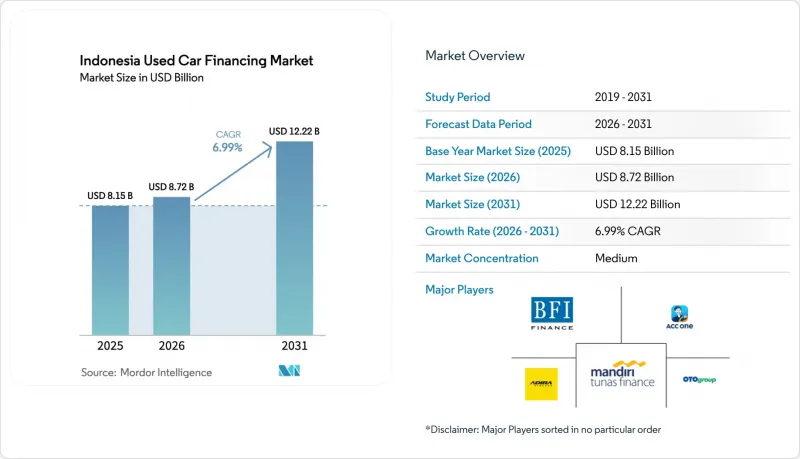
根據 Mordor Intelligence 預測,印尼二手車金融市場規模將從 2025 年的 81.5 億美元和 2026 年的 87.2 億美元成長到 2031 年的 122.2 億美元,2026 年至 2031 年的複合年成長率為 6.99%。
本報告按車輛類型(掀背車、轎車等)、貸款機構(汽車製造商金融、商業銀行等)、貸款期限(24個月或以下、25-48個月、其他)、車輛車齡(3年或以下、4-7年、其他)以及省份(雅加達、西爪哇等)進行分類。市場預測以美元計價。
印尼二手車金融市場趨勢及洞察
受高利率影響,人們對二手車的需求逐漸從新車轉向二手車。
2024年,二手車銷售量達到180萬輛,而新車註冊量僅889,680輛。這反映出成本驅動的替代需求,因為名目工資成長未能跟上汽車價格上漲的腳步。 2024年9月,印尼央行維持政策利率不變。因此,許多家庭仍然面臨高額的汽車貸款還款壓力。這種情況進一步凸顯了車齡三年及以上的多用途汽車(MPV)的價格優勢,其月供遠低於新車。多元化金融公司迅速做出反應,調整了其投資組合。特別是,BFI Finance在2024年展示室相關應收帳款顯著成長,證實了有組織零售通路的強勁需求。為了抵銷購買力下降的影響並維持貸款發放,貸款機構開始延長貸款期限,趨勢逐年加劇。然而,這種策略也帶來了更高的信用風險。總體而言,這些趨勢表明,經濟承受能力是資本流入印尼二手車金融市場的主要驅動力。
拓展二手手車領域,涉及多元金融和銀行貸款組合。
截至2024年6月,隨著貸款機構因新車需求下降而將重心轉向盈利更高的二手車市場,汽車貸款發放總額顯著成長。 2025年10月,Adira Finance與Mandala Multifinance合併,打造了一個擁有龐大用戶群和廣泛服務網點的平台,並大幅擴展了其企業發展。同樣,2024年9月,BCA Finance精簡了其二二手部門,統一了風險管理體系,並大幅降低了貸款處理成本。由於二手車貸款的資產風險認知較高,其利差往往較大,但車主頻繁的重複購買行為(通常每3-4年更換一次新車)可以抵銷部分風險。因此,即使貸款機構實施了更嚴格的估值措施以降低違約風險,印尼二手車金融市場仍持續吸引大量機構資本。
持續存在的信任問題和里程表詐欺問題
產業調查顯示,約四分之一的交易車輛里程數被篡改,導致車輛殘值虛高,給借貸雙方都造成了意想不到的維修費用,從而降低了車輛的抵押價值。由於缺乏全國統一的車輛歷史登記系統,貸款機構不得不依賴人工檢查,導致核准時間延長,營運成本增加。儘管印尼公共服務部(POJK)第46/2024號法令規定了更嚴格的評估標準和借款人身分驗證,但各地執行情況的不一致使得一些非官方經銷商得以規避審查,加劇了信任危機。一些金融公司正在試行區塊鏈註冊系統,旨在建立防篡改的車輛維護記錄,但這需要跨部門的資料共用。在系統覆蓋範圍擴大到全國之前,這種信任危機將阻礙新客戶的獲取,並減緩印尼二手車金融市場的成長。
細分市場分析
2025年,多用途汽車(MPV)貸款發放額佔比達44.15%,凸顯了其對印尼人口結構中占主導地位的大家庭的適用性。緊湊型SUV以8.45%的複合年成長率(CAGR)超越其他所有車型,其高離地間隙和高階形象吸引了雄心勃勃的中產階級買家,他們也更願意為這類車型支付高於同級別轎車的轉售溢價。由於MPV和SUV流動性高且抵押價值可預測,金融機構通常對車齡三年及以上的MPV和SUV採用高達80%的貸款價值比(LTV)。因此,預計在預測期內,印尼二手車融資市場中與這些細分市場相關的規模將保持強勁成長。
隨著汽車製造商逐步停止生產低利潤的小型車,轎車和掀背車的市佔率正在萎縮。共享出行仍然支撐著轎車的需求,但私人車主正轉向跨界車,因為跨界車能帶來更高的身份地位和更安全的車身結構。目前,不同車型的貸款期限也存在差異。 SUV 的貸款期限最長可達 72 個月,而舊款掀背車由於折舊免稅額率較高,貸款期限通常限制在 48 個月。這些信貸評估的細微差別進一步凸顯了印尼二手車融資市場中存在的細分市場分化。
低成本存款和交叉銷售能力鞏固了商業銀行在印尼二手車金融市場的主導地位,預計到2025年將佔70.25%的貸款發放佔有率。然而,P2P(P2P)和金融科技平台持續以9.75%的複合年成長率成長,提供即時評估和替代信用分析,使那些會被傳統評分系統拒之門外的申請人也能獲得貸款。非銀行多元化金融公司則介於兩者之間,它們既擁有深厚的汽車產業知識,又具備一定程度的數位化能力,但其資金籌措管道正受到來自兩方面的擠壓。
夥伴關係模式正在迅速擴展。 BCA Finance的應用程式現已整合到各大主流市場,在保持基於存款定價的同時,彌合了其與純粹金融科技公司在便利性方面的差距。 40/2024號監理條例規定,P2P借貸機構必須維持最低3級綜合評級,且股本至少達到實繳資本的50%,這提高了准入門檻,加速了產業整合。因此,數位借貸機構與中型銀行的合資企業是擴大印尼二手車融資市場業務規模的關鍵途徑。
其他好處:
- Excel格式的市場預測(ME)表
- 3個月的分析師支持
目錄
第1章:引言
- 研究假設和市場定義
- 調查範圍
第2章:調查方法
第3章執行摘要
第4章 市場狀況
- 市場概覽
- 市場促進因素
- 在高利率環境下,我們看到市場需求正從新車穩步轉向二手車。
- 擴大二手車領域的多通路金融和銀行貸款組合。
- 具備即時貸款核准功能的數位市場
- 符合伊斯蘭教法的汽車金融產品的成長
- 「先買後付」首付方案
- 對二手混合動力汽車和電動車的獎勵正在創造小眾需求。
- 市場限制因素
- 持續存在的信任問題和里程表詐欺問題
- 高貸款利率和宏觀經濟波動
- 抵押物詐騙和車輛被盜風險增加
- 對金融服務管理局(OJK)徵收的金融科技貸款手續費上限實施更嚴格的監管。
- 價值供應鏈分析
- 監管和經濟影響分析
- 技術展望
- 波特五力模型
第5章 市場規模與成長預測
- 車輛類型
- 掀背車
- 轎車
- 運動型多用途車(SUV)
- 多用途汽車(MPV)
- 由資助者
- 原始設備製造商營運的融資
- 商業銀行
- 非銀行金融公司
- P2P/金融科技貸款機構
- 按貸款期限
- 24個月以下
- 25-48個月
- 49-72個月
- 72個月或以上
- 車輛年份
- 3年或以下
- 已經過了4-7年。
- 超過7年
- 按州
- 雅加達
- 西爪哇
- 東爪哇
- 中爪哇
- 萬登
- 北蘇門答臘
- 其他州
第6章 競爭情勢
- 市場集中度
- 策略趨勢
- 市佔率分析
- 公司簡介
- Astra Credit Companies(ACC)
- BFI Finance Indonesia
- Adira Dinamika Multi Finance
- Oto Multiartha
- Mandiri Tunas Finance
- PT Toyota Astra Financial Services
- Suzuki Finance Indonesia
- PT JACCS MPM Finance Indonesia
- BCA Finance
- Bussan Auto Finance
- Dipo Star Finance
- Batavia Prosperindo Finance
- BRI Multifinance Indonesia
- Clipan Finance Indonesia
- BNI Multifinance
- CIMB Niaga Auto Finance
- Bank Syariah Indonesia-OTO Finance
第7章 市場機會與未來展望
According to Mordor Intelligence, the indonesian used car financing market size is projected to expand from USD 8.15 billion in 2025, USD 8.72 billion in 2026, to USD 12.22 billion by 2031, registering a 6.99% CAGR from 2026 to 2031.
This report is Segmented by Vehicle Type (Hatchback, Sedan, and More), Financing Provider (Captive OEM Finance, Commercial Banks, and More), Financing Tenor (<=24 Months, 25-48 Months, and More), Vehicle Age (<=3 Years Old, 4-7 Years Old, and More), and Province (Jakarta, West Java, and More). The Market Forecasts are Provided in Terms of Value (USD).
Indonesia Used Car Financing Market Trends and Insights
Robust Demand Shift from New- to Used-Cars Amid High Interest Rates
Used-car sales hit 1.8 million units in 2024 versus 889,680 new-car registrations, reflecting cost-driven substitution as nominal wage growth lags vehicle inflation . In September 2024, Bank Indonesia held its policy rate steady. As a result, many families faced auto-loan coupons that remained high. This scenario has amplified the affordability edge of three-year-old multi-purpose vehicles (MPVs), with their monthly installments being significantly lower than their brand-new counterparts. Responding swiftly, multifinance companies adjusted their portfolios. Notably, BFI Finance experienced a notable rise in showroom-linked receivables in 2024, underscoring a strong demand in organized retail channels. To counteract the effects of diminished purchasing power and sustain loan origination flows, lenders have begun extending loan tenors beyond the typical duration, showing an annual increase. However, this strategy does come with an extended credit-risk exposure. Overall, these dynamics underscore that affordability challenges are the primary drivers steering flows into Indonesia's used car financing market.
Expansion of Multi-Finance and Bank Loan Portfolios into Used-Cars
By June 2024, total motor-vehicle disbursements saw significant growth as lenders shifted focus to higher-yield pre-owned segments, responding to a dip in new-car demand. Adira Finance's merger with Mandala Multifinance in October 2025 birthed a platform with a substantial user base and extensive service points, significantly broadening its geographic footprint. In a similar vein, BCA Finance, in September 2024, streamlined its used-car specialist arm, harmonizing risk systems and slashing loan processing costs. While used-car financing commands wider spreads due to heightened asset risk perceptions, this is balanced by swift repeat purchases, with owners upgrading to newer models every three to four years. As a result, the Indonesian used car financing market continues to attract robust institutional capital, even as lenders implement stricter valuation measures to mitigate default risks.
Persistent Trust and Odometer Fraud Issues
Industry surveys reveal mileage manipulation in roughly one quarter of traded units, inflating residual values and saddling both borrowers and lenders with unexpected repair bills that erode collateral cover. The absence of a nationwide vehicle-history ledger forces lenders to rely on manual inspections that extend approval times and increase operating expenditure. While POJK 46/2024 mandates stronger appraisal standards and borrower verification, uneven regional enforcement allows informal dealers to bypass scrutiny, perpetuating credibility gaps. Blockchain registries piloted by selected multifinance firms aim to stamp immutable service records yet require cross-ministerial data sharing. Until coverage becomes universal, trust deficits will curb first-time penetration and temper Indonesia used car financing market.
Other drivers and restraints analyzed in the detailed report include:
- Digital Marketplaces Embedding Instant Loan Approvals
- Growth of Sharia-Compliant Auto Finance Products
- Elevated Lending Rates and Macro-Volatility
For complete list of drivers and restraints, kindly check the Table Of Contents.
Segment Analysis
Multi-purpose vehicles held 44.15% of 2025 financing originations, underscoring their suitability for extended families that dominate Indonesian demographics. Compact SUVs are outpacing all other categories at an 8.45% CAGR as aspirational middle-class buyers gravitate toward higher ground clearance and premium perception, often paying resale premiums above same-age sedans. Lenders typically extend up to 80% loan-to-value on three-year-old MPVs or SUVs because of strong liquidity and predictable collateral curves, ensuring that the Indonesia used car financing market size tied to these segments remains robust through the forecast window.
Sedans and hatchbacks account for a dwindling slice as OEMs phase out low-margin small cars. Ride-hailing fleets still sustain sedan demand, but private owners pivot to crossover designs with more perceived status and safer cabin structure. Loan products now differentiate tenor ceilings: SUVs can qualify for 72-month terms, whereas older hatchbacks often cap at 48 months due to steeper depreciation. These underwriting nuances reinforce segmental divergence within the Indonesian used car financing market.
Due to low-cost deposits and the ability to cross-sell, commercial banks secured a commanding 70.25% share of the 2025 origination, solidifying their dominance in Indonesia's used car financing market. Yet peer-to-peer and fintech platforms are growing at 9.75% CAGR by offering real-time decisions and alternative credit analytics that onboard applicants sidelined by legacy scorecards. Non-bank multifinance firms sit between these poles, blending deep vehicle knowledge with moderate digital enablement, although their funding spreads face a squeeze from both ends.
Partnership models are proliferating: BCA Finance's app now embeds inside leading marketplaces, closing the convenience gap with pure fintechs while preserving deposit-funded pricing. Regulation 40/2024 obliges peer-to-peer lenders to maintain a minimum composite rating of 3 and equity equivalent to 50% of paid-up capital, which raises thresholds and triggers consolidation. Joint ventures between digital lenders and mid-tier banks, therefore, become a critical route to scale inside the Indonesian used car financing market.
Complete Report Scope:
- By Vehicle Type
- Hatchback
- Sedan
- Sport Utility Vehicle (SUV)
- Multi-Purpose Vehicle (MPV)
- By Financing Provider
- Captive OEM Finance
- Commercial Banks
- Non-Bank Finance Companies
- Peer-to-Peer / Fintech Lenders
- By Financing Tenor
- Less than/Equals 24 Months
- 25 - 48 Months
- 49 - 72 Months
- Above 72 Months
- By Vehicle Age
- Less than/Equals 3 Years Old
- 4 -7 Years Old
- Above 7 Years Old
- By Province
- Jakarta
- West Java
- East Java
- Central Java
- Banten
- North Sumatra
- Other Provinces
List of Companies Covered in this Report:
- Astra Credit Companies (ACC)
- BFI Finance Indonesia
- Adira Dinamika Multi Finance
- Oto Multiartha
- Mandiri Tunas Finance
- PT Toyota Astra Financial Services
- Suzuki Finance Indonesia
- PT JACCS MPM Finance Indonesia
- BCA Finance
- Bussan Auto Finance
- Dipo Star Finance
- Batavia Prosperindo Finance
- BRI Multifinance Indonesia
- Clipan Finance Indonesia
- BNI Multifinance
- CIMB Niaga Auto Finance
- Bank Syariah Indonesia - OTO Finance
Additional Benefits:
- The market estimate (ME) sheet in Excel format
- 3 months of analyst support
TABLE OF CONTENTS
1 Introduction
- 1.1 Study Assumptions and Market Definition
- 1.2 Scope of the Study
2 Research Methodology
3 Executive Summary
4 Market Landscape
- 4.1 Market Overview
- 4.2 Market Drivers
- 4.2.1 Robust Demand Shift from New- to Used-Cars Amid High Interest Rates
- 4.2.2 Expansion of Multi-Finance and Bank Loan Portfolios into Used-Cars
- 4.2.3 Digital Marketplaces Embedding Instant Loan Approvals
- 4.2.4 Growth of Sharia-Compliant Auto Finance Products
- 4.2.5 Buy-Now-Pay-Later Down-Payment Solutions
- 4.2.6 Second-Hand Hybrid and EV Incentives Creating Niche Demand
- 4.3 Market Restraints
- 4.3.1 Persistent Trust and Odometer Fraud Issues
- 4.3.2 Elevated Lending Rates and Macro-Volatility
- 4.3.3 Rise in Collateral Fraud and Stolen-Vehicle Risk
- 4.3.4 Stricter OJK Caps on Fintech Lending Fees
- 4.4 Value / Supply-Chain Analysis
- 4.5 Regulatory and Economic Impact Analysis
- 4.6 Technological Outlook
- 4.7 Porter's Five Forces
- 4.7.1 Threat of New Entrants
- 4.7.2 Bargaining Power of Buyers
- 4.7.3 Bargaining Power of Suppliers
- 4.7.4 Threat of Substitutes
- 4.7.5 Intensity of Rivalry
5 Market Size and Growth Forecasts (Value, USD)
- 5.1 By Vehicle Type
- 5.1.1 Hatchback
- 5.1.2 Sedan
- 5.1.3 Sport Utility Vehicle (SUV)
- 5.1.4 Multi-Purpose Vehicle (MPV)
- 5.2 By Financing Provider
- 5.2.1 Captive OEM Finance
- 5.2.2 Commercial Banks
- 5.2.3 Non-Bank Finance Companies
- 5.2.4 Peer-to-Peer / Fintech Lenders
- 5.3 By Financing Tenor
- 5.3.1 Less than/Equals 24 Months
- 5.3.2 25 - 48 Months
- 5.3.3 49 - 72 Months
- 5.3.4 Above 72 Months
- 5.4 By Vehicle Age
- 5.4.1 Less than/Equals 3 Years Old
- 5.4.2 4 -7 Years Old
- 5.4.3 Above 7 Years Old
- 5.5 By Province
- 5.5.1 Jakarta
- 5.5.2 West Java
- 5.5.3 East Java
- 5.5.4 Central Java
- 5.5.5 Banten
- 5.5.6 North Sumatra
- 5.5.7 Other Provinces
6 Competitive Landscape
- 6.1 Market Concentration
- 6.2 Strategic Moves
- 6.3 Market Share Analysis
- 6.4 Company Profiles (Includes Global Level Overview, Market Level Overview, Core Segments, Financials as Available, Strategic Information, Market Rank/Share for Key Companies, Products and Services, SWOT Analysis, and Recent Developments)
- 6.4.1 Astra Credit Companies (ACC)
- 6.4.2 BFI Finance Indonesia
- 6.4.3 Adira Dinamika Multi Finance
- 6.4.4 Oto Multiartha
- 6.4.5 Mandiri Tunas Finance
- 6.4.6 PT Toyota Astra Financial Services
- 6.4.7 Suzuki Finance Indonesia
- 6.4.8 PT JACCS MPM Finance Indonesia
- 6.4.9 BCA Finance
- 6.4.10 Bussan Auto Finance
- 6.4.11 Dipo Star Finance
- 6.4.12 Batavia Prosperindo Finance
- 6.4.13 BRI Multifinance Indonesia
- 6.4.14 Clipan Finance Indonesia
- 6.4.15 BNI Multifinance
- 6.4.16 CIMB Niaga Auto Finance
- 6.4.17 Bank Syariah Indonesia - OTO Finance
7 Market Opportunities & Future Outlook
- 7.1 White-space & Unmet-Need Assessment

 中國二手車市場:市場佔有率分析、產業趨勢與統計及成長預測(2026-2031)中東和非洲二手車市場:市場佔有率分析、行業趨勢和統計數據以及成長預測(2026-2031 年)印尼二手車市場:市佔率分析、產業趨勢與統計及成長預測(2026-2031)新加坡二手車市場:市佔率分析、產業趨勢與統計及成長預測(2026-2031)法國二手車市場:市場佔有率分析、產業趨勢與統計及成長預測(2026-2031)義大利二手車市場:市佔率分析、產業趨勢與統計及成長預測(2026-2031)英國二手車市場:市佔率分析、產業趨勢與統計及成長預測(2026-2031)西班牙二手車市場:市佔率分析、產業趨勢與統計及成長預測(2026-2031)馬來西亞二手車市場:市場佔有率分析、產業趨勢與統計及成長預測(2026-2031)東南亞二手車市場:市場佔有率分析、產業趨勢與統計及成長預測(2026-2031)