


 |
市場調查報告書
商品編碼
2117214
中國二手車市場:市場佔有率分析、產業趨勢與統計及成長預測(2026-2031)China Used Car - Market Share Analysis, Industry Trends & Statistics, Growth Forecasts (2026 - 2031) |
||||||

※ 本網頁內容可能與最新版本有所差異。詳細情況請與我們聯繫。
根據 Mordor Intelligence 預測,中國二手車市場規模將從 2025 年的 1,697.1 億美元成長到 2026 年的 1,801.8 億美元,然後在 2031 年達到 2,430.6 億美元,2026 年至 2031 年的複合年成長率為 6.17%。
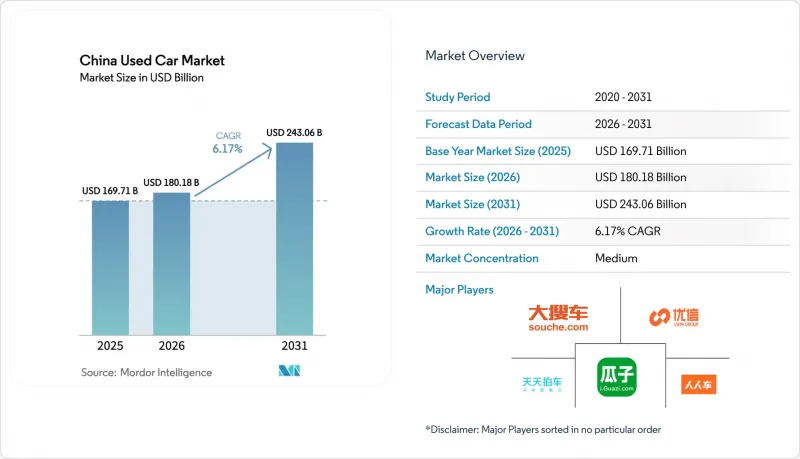
本報告按車輛類型(例如,掀背車)、銷售管道(例如,線上平台)、供應商類型(正規供應商和非正規供應商)、交易類型(一次性付款和貸款)、燃料類型(例如,汽油)、車輛年份(例如,0-2年)、價格範圍(例如,低於5000美元)和地區進行細分。市場預測以價值(美元)和數量(輛)兩種形式呈現。
中國二手車市場趨勢與洞察
可支配所得增加和更換週期縮短
預計到2024年,都市區居民人均可支配收入將達到54,188元人民幣(約7,748美元),這將推動車輛更換週期加快,從先前的6-8年縮短至5-6年[1]。隨著富裕車主為了享受更新的ADAS功能和更長續航里程的電池而更早更換車輛,中國二手車市場出現了準新車激增的現象。車齡0-2年的二手車市場年均複合成長率顯著提高,反映了這種消費行為的轉變,同時金融機構也看到了信用評等的提高和違約風險的降低。同時,收入的成長緩解了車輛折舊造成的損失,使得賣家更願意提前出售車輛。這一趨勢在上海、北京和深圳最為明顯,這些城市的家庭收入高於全國平均。
放寬城際搬遷限制
商務部正逐步統一車輛過戶法規,計畫於2026年前完成,消除先前因地域保護主義而導致的庫存積壓。簡化手續、排放氣體標準,使得經銷商能夠將庫存從內陸銷售基地(庫存過剩)轉移到需求集中的沿海樞紐。率先在中國東部地區推行此項措施的企業,已縮短了平均銷售週期,釋放了營運資金,並提高了利潤率。隨著物流網路的擴展,跨區域套利可望穩定殘值,提升流動性。此外,隨著整合即時運輸狀態資訊的數位化銷售平台的推出,以及經銷商採購效率的提升,預計中期利潤將進一步成長。
由於新車大幅折扣,價格出現波動。
在2024年至2025年的價格競爭中,汽車製造商大幅降低了車輛標價,縮小了新車和準新車庫存價格之間的差距。比亞迪內部強制推行的付款條款改革導致其銷售目標大幅調整,凸顯了盈利的挑戰。對於二手車經銷商,每次廠商回饋後都需要重新調整預期價格,這往往會降低利潤率。庫存積壓滯銷轎車的經銷商正面臨巨額虧損。監管機構正在加強監管以遏制不公平的價格競爭,但這些監管措施不足以抑制影響消費者決策的價格波動。
細分市場分析
儘管預計到2025年轎車仍將維持44.21%的市場佔有率,但SUV在中國二手車市場正以16.21%的強勁複合年成長率(CAGR)從2026年到2031年持續成長。高駕駛視野、安全保障和提升身分等因素,使得SUV成為都市區的「標準更換」。 BMW、賓士和蔚來等高階車型即使在購買三年後,其殘值仍保持顯著優勢,因此不易受到新車大幅折扣的影響。為此,經銷商正在為SUV庫存分配充足的展廳空間,並投資開發能夠滿足消費者高昂購車成本的金融方案。轎車仍然是銷售主力,但入門車型(易受價格競爭影響)與配備ADAS(高級駕駛輔助系統)的高階車型之間的殘值有顯著差異。這一趨勢表明,到 2031 年,SUV 將佔交易量的很大一部分,這可能會改變經銷商的庫存策略,並壓縮轎車的轉售價格曲線。
SUV 市場結構性轉變與更廣泛的都市化趨勢相符,後者優先考慮貨物柔軟性和家庭便利性。雖然跨界車、小轎車和敞篷車的市場佔有率較小,但它們在沿海城市仍然擁有強大的擁躉,因為那裡的居民可支配收入足以支撐他們購買注重生活方式的車型。掀背車和 MPV 分別佔據了首次購車者和多子女家庭等細分市場,但隨著汽車製造商將研發預算投入大規模生產的 SUV 平台,它們的成長速度正在放緩。因此,中國二手車市場的供應將集中於 SUV 和豪華轎車,這將迫使競標行調整其評估演算法,因為這些演算法傳統上嚴重偏向轎車的標準。
儘管預計到2025年線下銷售管道仍將佔據32.18%的市場佔有率,但從2026年到2031年,線上零售商的複合年成長率預計將達到20.34%,顯著超過汽車製造商自有經銷商的市場佔有率。人工智慧賦能的估值和全國的庫存整合,使得線上平台能夠將銷售週期從數週縮短至數天,從而幫助經銷商擺脫資金閒置的困境。優信的全通路超市展示了豐富的車型選擇,在2025年第二季度實現了交易量的顯著成長。像汽車之家這樣的分類廣告入口網站正在轉型為金融科技平台,透過貸款提升銷售和追加銷售保固服務來實現盈利。同時,線下展示室作為體驗式觸點依然具有優勢,但高昂的租金和人事費用正迫使它們採用數位化預約系統和遠端視訊看車等方式。
線上瀏覽與線下最終簽約相結合的混合模式正在零售業逐漸成為主流。獨立經銷商和實體競標行難以與數據豐富、行銷覆蓋範圍廣的全國性平台競爭,導致利潤空間不斷萎縮。公共安全推行的電子牌照制度意味著即時檢測數據直接反映在線上清單中,削弱了線下車輛偵測的資訊優勢。因此,非正規經銷商正轉向周邊市場,或將業務重心轉移到5,000美元以下的庫存車輛,因為這類車輛對數位化檢驗的需求相對較低。正規平台則透過疊加忠誠度計畫、延長保固和回購保證等服務來增強自身競爭優勢,進而提升顧客終身價值,並建立回頭客。
預計到2025年,正規供應商將佔據63.11%的市場佔有率,並在2031年之前以10.36%的複合年成長率成長,進一步擴大其對非正規供應商的領先優勢。規模優勢能夠降低庫存資金籌措成本和批量採購成本,進而降低單位成本。官民合作關係,例如優信在武漢投資百萬美元的合資企業,能夠提供小規模企業無法獲得的稅收優惠和土地使用權。政府對零里程詐欺的打擊給缺乏合規體系的非正規經銷商帶來了沉重負擔,加速了其退出市場和被迫合併。隨著正規企業整合基於區塊鏈的里程追蹤和取得專利的人工智慧估值技術,它們正在建立一道信任護城河,將新進入者拒之門外。
儘管如此,中國二手車市場在三線城市仍然存在數千家家族式經營的經銷商,這些地區的資訊鴻溝根深蒂固。這些企業依靠瞄準價格敏感型買家並利用其本地人脈維持生存。然而,隨著平台允許賣家即時比較來自全國各地的報價,它們的議價能力正在下降。在預測期內,市場集中度將會增加,但針對壟斷行為的監管將限制任何單一企業的壟斷地位。
其他好處:
- Excel格式的市場預測(ME)表
- 3個月的分析師支持
目錄
第1章:引言
- 研究假設和市場定義
- 調查範圍
第2章:調查方法
第3章執行摘要
第4章 市場狀況
- 市場概覽
- 市場促進因素
- 可支配所得增加和更換週期
- 放寬城際旅行限制
- 為淘汰老舊內燃機車 (ICE) 提供碳權獎勵
- 廠商主導的認證二手車專案正在提升消費者的信任度。
- 二手能源汽車電池健康認證
- 人工智慧驅動的殘值預測平台
- 市場限制因素
- 新車銷售中大幅折扣導致價格波動
- 里程表讀數造假與資訊不對稱
- 電池租賃的複雜性限制了電動車的融資。
- 對老式內燃機車的城市車牌分配限制
- 價值供應鏈分析
- 監理情勢
- 技術展望
- 波特五力分析
第5章 市場規模與成長預測
- 按車輛類型
- 掀背車
- 轎車
- 運動型多用途車(SUV)
- 多用途汽車(MPV)
- 其他(敞篷車、小轎車、跨界車、跑車)
- 按銷售管道
- 線上分類入口網站
- 專業線上零售商
- OEM認證網路商店
- 線下OEM特許經銷商
- 多品牌獨立經銷商
- 實體店面競標行
- 依供應商類型
- 分類
- 雜亂無章
- 按交易類型
- 全額付款
- 金融
- 按燃料類型
- 汽油
- 柴油引擎
- 混合
- 電的
- 液化石油氣/壓縮天然氣/其他
- 車輛年份
- 0-2歲
- 3-5年
- 6-8歲
- 9-12歲
- 超過12年
- 按價格範圍
- 不到5000美元
- 5,000-9,999 美元
- 10,000 美元至 14,999 美元
- 15,000 美元 – 19,999 美元
- 20,000美元至29,999美元
- 超過3萬美元
- 按地區
- 中國東部
- 中國北方
- 華南
- 華中地區
- 中國西部
第6章 競爭情勢
- 市場集中度
- 策略趨勢
- 市佔率分析
- 公司簡介
- Guazi Used Cars(Chehaoduo Group)
- Uxin Limited
- Renrenche
- Souche
- CAR Inc.
- Autohome Inc.
- Yixin Used Car Co., Ltd.
- Tiantian Paiche
- Foshan Guangcai International Trade Co., Ltd.
- Chongqing Senkai Automobile Sales & Service Co., Ltd.
- PLC Auction
- Dongdong Automobile
第7章 市場機會與未來展望
According to Mordor Intelligence, the China used car market size is expected to grow from USD 169.71 billion in 2025 to USD 180.18 billion in 2026 and is forecasted to reach USD 243.06 billion by 2031 at a 6.17% CAGR over 2026-2031.
This report is Segmented by Vehicle Type (Hatchbacks and More), Sales Channel (Online Portals and More), Vendor Type (Organized and Unorganized), Transaction Type (Full Payment and Finance), Fuel Type (Petrol, and More), Vehicle Age (0 To 2 Years and More), Price Segment (Less Than USD 5, 000 and More), and Geography. The Market Forecasts are Provided in Terms of Value (USD) and Volume (Units).
China Used Car Market Trends and Insights
Rising Disposable Income and Upgrade Cycles
Urban disposable income averaged CNY 54,188 (~USD 7,748) in 2024, fueling faster replacement cycles that now run 5-6 years instead of the previous 6-8 years [1]. Affluent owners trade up earlier to access new ADAS features and longer-range batteries, feeding a surge of nearly-new units into the Chinese used car market. The 0-to-2-year bracket's notable CAGR mirrors this behavioral shift, while lenders observe higher creditworthiness, lowering default risk. Concurrently, rising incomes cushion depreciation losses, encouraging sellers to accept quicker turnarounds. The effect is most pronounced in Shanghai, Beijing, and Shenzhen, where household earnings exceed the national average.e.
Deregulation of Inter-City Transfer Restrictions
The Ministry of Commerce is phasing in harmonized vehicle-transfer rules by 2026, eliminating local protectionism that once trapped inventory at its origin. Relaxed documentation and emissions alignment allow dealers to relocate stock from surplus inland lots to coastal hubs with denser demand. Early adopters in East China are already reducing average time-to-sale, freeing up working capital, and increasing margins. As logistics networks scale, cross-regional arbitrage should stabilize residual values and boost liquidity. Medium-term gains are forecast to compound as digital listing platforms integrate real-time transport availability, improving dealer sourcing efficiency.
Price Volatility from Aggressive New-Car Discounting
During the 2024-2025 price war, OEMs significantly reduced sticker prices, narrowing the divide between new and nearly-new inventories. BYD's reforms to payment terms, mandated by the company, led to a notable adjustment in its sales target, underscoring profitability challenges. For sellers in the used-car market, each factory rebate requires recalibrating asking prices, often diminishing profit margins. Dealers with a stock of slower-moving sedans are facing outsized losses. While regulatory bodies are intensifying scrutiny to mitigate predatory pricing, this oversight hasn't quelled the volatility that hampers buyer decisions.
Other drivers and restraints analyzed in the detailed report include:
- OEM-Led Certified Pre-Owned Programs Expand Trust
- Battery-Health Certification for Used NEVs
- Mileage Fraud and Information Asymmetry
For complete list of drivers and restraints, kindly check the Table Of Contents.
Segment Analysis
Sedans retained a 44.21% share in 2025, whereas the Chinese used-car market for SUVs is expanding at a robust 16.21% CAGR from 2026 to 2031. Higher seating positions, perceived safety, and elevated status make SUVs the default upgrade for urban households. Premium models from BMW, Mercedes-Benz, and NIO sustain a notable percentage-point residual-value premium three years post-purchase, insulating them from aggressive new-car discounts. In response, dealers allocate larger floor space to SUV inventory and invest in financing bundles that cater to buyers' higher ticket sizes. Sedans continue to anchor volumes, yet residual values diverge sharply between entry-level models, those susceptible to price wars, and high-end trims that incorporate advanced driver-assistance systems. The trajectory suggests that SUVs could account for a notable share of transaction counts by 2031, reshaping dealer stocking strategies and compressing the resale curves of sedans.
The structural pivot toward SUVs aligns with broader urbanization trends that prioritize cargo flexibility and family utility. Crossovers, coupes, and convertibles command a marginal share but maintain loyal followings in coastal cities, where discretionary income supports lifestyle purchases. Hatchbacks and MPVs occupy niche spaces, first-time buyers and multi-child families respectively, but encounter slower growth as OEMs allocate R&D budgets to high-volume SUV platforms. The China used car market will therefore see supply concentration in SUVs and premium sedans, prompting auction houses to recalibrate appraisal algorithms that formerly weighted sedan benchmarks more heavily.
Offline sales channels captured a 32.18% share in 2025, while online e-retailers are forecasted to post a 20.34% CAGR from 2026 to 2031, dwarfing the share of OEM-franchised outlets. AI-enabled valuations and nationwide inventory aggregation enable online platforms to shorten time-to-sale from weeks to days, thereby freeing up dealer capital. Uxin's omnichannel superstores showcased a wide range of vehicles and recorded significant transaction growth in the second quarter of 2025. Classified portals like Autohome evolve into fintech gateways, monetizing financing referrals and warranty up-sells. While offline showrooms excel at experiential touchpoints, they shoulder higher rent and labor costs, compelling them to integrate digital appointment systems and remote video inspections.
Hybrid models, online browsing with in-store finalization, are emerging as the dominant retail template. Independent dealers and physical auction houses face shrinking margins because they cannot match the depth of data or marketing reach of national platforms. The Ministry of Public Security's electronic license rollout feeds real-time inspection data directly into online listings, eroding the information edge of physical inspections. Consequently, unorganized dealers migrate to peripheral markets or pivot to sub-USD 5,000 inventory, where digital verification is less in demand. Organized platforms reinforce their advantage by layering loyalty programs, extended warranties, and buy-back guarantees that boost customer lifetime value and lock in repeat transactions.
Organized vendors held 63.11% market share in 2025 and are projected to grow at a 10.36% CAGR through 2031, widening their lead over unorganized vendors. Scale unlocks cheaper inventory financing and bulk reconditioning, reducing per-unit costs. Public-private partnerships, such as Uxin's million joint venture in Wuhan, grant tax incentives and land access that small operators cannot secure. Government crackdowns on zero-mileage fraud disproportionately burden unorganized dealers lacking compliance infrastructure, accelerating exits or forced mergers. As organized players integrate blockchain odometer logs and patented AI appraisals, they build trust moats that fend off new entrants.
Nevertheless, the Chinese used-car industry still hosts thousands of family-run dealerships in tier-three cities, where information asymmetry persists. These operators survive by targeting price-sensitive buyers and leveraging local relationships. Yet their bargaining power declines as platforms enable sellers to compare instant offers nationwide. Over the forecast horizon, market concentration will increase, but regulatory vigilance against monopolistic behavior will limit any single player's dominance.
Complete Report Scope:
- By Vehicle Type
- Hatchbacks
- Sedans
- Sport Utility Vehicles (SUVs)
- Multi-Utility Vehicles (MPVs)
- Others (Convertibles, Coupes, Crossovers, Sports Cars)
- By Sales Channel
- Online Digital Classified Portals
- Pure-play e-Retailers
- OEM-Certified Online Stores
- Offline OEM-Franchised Dealers
- Multi-brand Independent Dealers
- Physical Auction Houses
- By Vendor Type
- Organized
- Unorganized
- By Transaction Type
- Full Payment
- Finance
- By Fuel Type
- Petrol
- Diesel
- Hybrid
- Electric
- LPG / CNG / Others
- By Vehicle Age
- 0 to 2 Years
- 3 to 5 Years
- 6 to 8 Years
- 9 to 12 Years
- More Than 12 Years
- By Price Segment
- Less Than USD 5,000
- USD 5,000 to 9,999
- USD 10,000 to 14,999
- USD 15,000 to 19,999
- USD 20,000 to 29,999
- More Than USD 30,000
- By Geography
- East China
- North China
- South China
- Central China
- West China
List of Companies Covered in this Report:
- Guazi Used Cars (Chehaoduo Group)
- Uxin Limited
- Renrenche
- Souche
- CAR Inc.
- Autohome Inc.
- Yixin Used Car Co., Ltd.
- Tiantian Paiche
- Foshan Guangcai International Trade Co., Ltd.
- Chongqing Senkai Automobile Sales & Service Co., Ltd.
- PLC Auction
- Dongdong Automobile
Additional Benefits:
- The market estimate (ME) sheet in Excel format
- 3 months of analyst support
TABLE OF CONTENTS
1 Introduction
- 1.1 Study Assumptions and Market Definition
- 1.2 Scope of the Study
2 Research Methodology
3 Executive Summary
4 Market Landscape
- 4.1 Market Overview
- 4.2 Market Drivers
- 4.2.1 Rising Disposable Income and Upgrade Cycles
- 4.2.2 Deregulation of Inter-City Transfer Restrictions
- 4.2.3 Carbon-Credit Incentives for Scrapping Old ICE Cars
- 4.2.4 OEM-Led Certified-Pre-Owned Programs Expand Trust
- 4.2.5 Battery-Health Certification for Used NEVs
- 4.2.6 AI-Driven Residual-Value Prediction Platforms
- 4.3 Market Restraints
- 4.3.1 Price Volatility from Aggressive New-Car Discounting
- 4.3.2 Mileage Fraud and Information Asymmetry
- 4.3.3 Limited EV Financing Due to Battery-Lease Complexity
- 4.3.4 City License-Plate Quota Tightening on Older ICE Cars
- 4.4 Value / Supply-Chain Analysis
- 4.5 Regulatory Landscape
- 4.6 Technological Outlook
- 4.7 Porter's Five Forces Analysis
- 4.7.1 Threat of New Entrants
- 4.7.2 Bargaining Power of Buyers/Consumers
- 4.7.3 Bargaining Power of Suppliers
- 4.7.4 Threat of Substitute Products
- 4.7.5 Intensity of Competitive Rivalry
5 Market Size and Growth Forecasts (Value (USD) and Volume (Units))
- 5.1 By Vehicle Type
- 5.1.1 Hatchbacks
- 5.1.2 Sedans
- 5.1.3 Sport Utility Vehicles (SUVs)
- 5.1.4 Multi-Utility Vehicles (MPVs)
- 5.1.5 Others (Convertibles, Coupes, Crossovers, Sports Cars)
- 5.2 By Sales Channel
- 5.2.1 Online Digital Classified Portals
- 5.2.2 Pure-play e-Retailers
- 5.2.3 OEM-Certified Online Stores
- 5.2.4 Offline OEM-Franchised Dealers
- 5.2.5 Multi-brand Independent Dealers
- 5.2.6 Physical Auction Houses
- 5.3 By Vendor Type
- 5.3.1 Organized
- 5.3.2 Unorganized
- 5.4 By Transaction Type
- 5.4.1 Full Payment
- 5.4.2 Finance
- 5.5 By Fuel Type
- 5.5.1 Petrol
- 5.5.2 Diesel
- 5.5.3 Hybrid
- 5.5.4 Electric
- 5.5.5 LPG / CNG / Others
- 5.6 By Vehicle Age
- 5.6.1 0 to 2 Years
- 5.6.2 3 to 5 Years
- 5.6.3 6 to 8 Years
- 5.6.4 9 to 12 Years
- 5.6.5 More Than 12 Years
- 5.7 By Price Segment
- 5.7.1 Less Than USD 5,000
- 5.7.2 USD 5,000 to 9,999
- 5.7.3 USD 10,000 to 14,999
- 5.7.4 USD 15,000 to 19,999
- 5.7.5 USD 20,000 to 29,999
- 5.7.6 More Than USD 30,000
- 5.8 By Geography
- 5.8.1 East China
- 5.8.2 North China
- 5.8.3 South China
- 5.8.4 Central China
- 5.8.5 West China
6 Competitive Landscape
- 6.1 Market Concentration
- 6.2 Strategic Moves
- 6.3 Market Share Analysis
- 6.4 Company Profiles (includes Global Level Overview, Market Level Overview, Core Segments, Financials as Available, Strategic Information, Market Rank/Share for Key Companies, Products and Services, SWOT Analysis, and Recent Developments)
- 6.4.1 Guazi Used Cars (Chehaoduo Group)
- 6.4.2 Uxin Limited
- 6.4.3 Renrenche
- 6.4.4 Souche
- 6.4.5 CAR Inc.
- 6.4.6 Autohome Inc.
- 6.4.7 Yixin Used Car Co., Ltd.
- 6.4.8 Tiantian Paiche
- 6.4.9 Foshan Guangcai International Trade Co., Ltd.
- 6.4.10 Chongqing Senkai Automobile Sales & Service Co., Ltd.
- 6.4.11 PLC Auction
- 6.4.12 Dongdong Automobile
7 Market Opportunities and Future Outlook
- 7.1 White-space and Unmet-Need Assessment

 印尼二手車金融:市場佔有率分析、產業趨勢與統計及成長預測(2026-2031)中東和非洲二手車市場:市場佔有率分析、行業趨勢和統計數據以及成長預測(2026-2031 年)印尼二手車市場:市佔率分析、產業趨勢與統計及成長預測(2026-2031)新加坡二手車市場:市佔率分析、產業趨勢與統計及成長預測(2026-2031)法國二手車市場:市場佔有率分析、產業趨勢與統計及成長預測(2026-2031)義大利二手車市場:市佔率分析、產業趨勢與統計及成長預測(2026-2031)英國二手車市場:市佔率分析、產業趨勢與統計及成長預測(2026-2031)西班牙二手車市場:市佔率分析、產業趨勢與統計及成長預測(2026-2031)馬來西亞二手車市場:市場佔有率分析、產業趨勢與統計及成長預測(2026-2031)東南亞二手車市場:市場佔有率分析、產業趨勢與統計及成長預測(2026-2031)