


 |
市場調查報告書
商品編碼
2116659
法國二手車市場:市場佔有率分析、產業趨勢與統計及成長預測(2026-2031)France Used Car - Market Share Analysis, Industry Trends & Statistics, Growth Forecasts (2026 - 2031) |
||||||

※ 本網頁內容可能與最新版本有所差異。詳細情況請與我們聯繫。
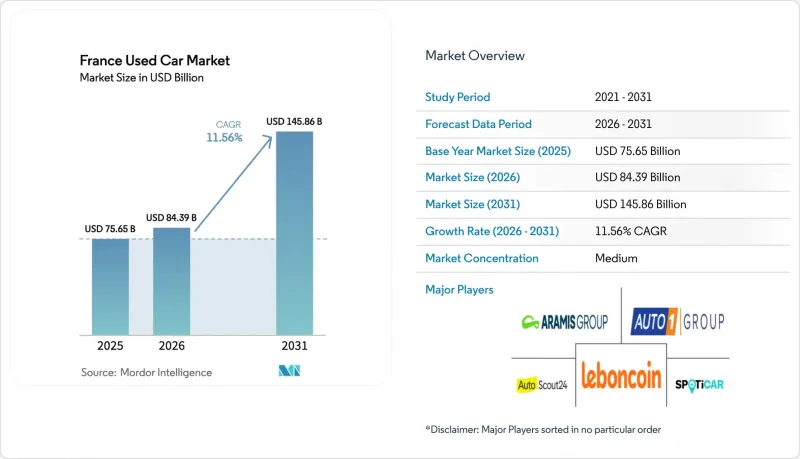
根據 Mordor Intelligence 估計,2026 年法國二手車市場規模將達到 843.9 億美元,高於 2025 年的 756.5 億美元,預計到 2031 年將達到 1,458.6 億美元。
預計 2026 年至 2031 年的複合年成長率為 11.56%。
本報告按供應商類型(正規/非正規)、車輛類型(例如,掀背車)、燃料類型(例如,汽油、柴油)、車齡(例如,0-2年、3-5年)、價格區間(低於5000美元、5000-9999美元及以上)和銷售管道(線上[例如,市場預測以價值(美元)和銷售(輛)為單位呈現。
法國二手車市場趨勢與洞察
新車價格上漲正在拉大二手車之間的價格差距。
截至2025年4月,法國新車註冊量較去年同期下降7%,而二手車交易量成長3.1%,凸顯了法國市場向二手車市場的結構性轉變。新車與同款三年車齡車型相比的平均溢價從2024年的45%擴大到2025年12月的52%。經銷商透過擴大採購和翻新管道,正從中獲利。對於有保固的認證二手車(CPO)而言,這一優勢尤其顯著,其價格仍比新車低約30%。
拓展線上二手車平台和數位展示室
在人工智慧檢測亭和端對端金融整合的推動下,預計到2030年,線上通路將以每年17.75%的速度成長,儘管目前「點擊購買」僅佔銷售額的13.11%。使用ProovStation自動化掃描技術的企業正在降低都市區千禧世代的主導門檻,他們正日益成為法國二手車市場的主要交易群體。 ProovStation的自動化掃描技術可將評估時間縮短至幾秒鐘,並立即發出具有約束力的報價。
經銷商市場高度分散,給利潤率帶來了壓力。
法國二手車市場擁有超過15,000家小規模經銷商,遍佈全國,採購議價能力有限,規模經濟難以實現。非正規供應商仍佔據57.08%的市場佔有率,導致價格競爭加劇,侵蝕毛利率,並阻礙了法國二手車市場下一階段成長所必需的技術升級。
細分市場分析
到2025年,SUV將佔法國二手車市場佔有率的38.10%,預計到2031年,二手車型市場規模將以12.05%的年複合成長率(CAGR)持續成長,這主要得益於消費者對更高座椅位置的偏好以及緊湊型電動跨界車通過租賃系統湧入市場。此細分市場的多樣性使正規零售商能夠最佳化庫存規劃。另一方面,掀背車在城市地區依然保持著較高的受歡迎程度,但由於重量稅更有利於輕量化車型,其市場受到一定限制。在鄉村地區,由於大型SUV的多功能性,消費者更傾向於選擇大型SUV;而在巴黎市區,適合狹窄停車位的緊湊型SUV則越來越受歡迎。
SUV交易頻率的不斷提高,增強了動態定價的數據可用性,並支援人工智慧輔助分析以最佳化存貨周轉。同時,轎車和MPV的市佔率正在下降,隨著消費者轉向多功能車,轎車的轉售價值也在降低。 MPV仍然滿足家庭出行的需求,但它們面臨來自SUV的競爭,後者提供類似的貨物空間和更高的殘值。敞篷車和小轎車生活風格車型銷售仍然較低,但在愛好者的推動下,它們保持著穩定的利潤率。
預計到2025年,非正規經銷商將佔法國二手車市場56.40%的佔有率,而正規銷售網路正以每年13.35%的速度成長,顯示市場結構正在逐步重新平衡。憑藉規模經濟優勢,全國連鎖店正在實現維護保養的標準化、延長保固期以及統一的數位化銷售平台。特許經營集團則利用集中式二手車銷售點,將維護週期縮短兩位數,從而擴大了利潤空間。
小規模獨立經銷商憑藉緊密的本地關係和低營運成本保持靈活性,但隨著比價網站在法國二手車市場日益普及,不透明的定價正逐漸成為其劣勢。資金限制了對全通路技術和電動車庫存電池診斷的投資,進一步擴大了產能缺口。預計最終會形成一種共生平衡,但整體趨勢更有利於那些利用認證二手車(CPO)可靠性的品牌網路。
其他好處:
- Excel格式的市場預測(ME)表
- 3個月的分析師支持
目錄
第1章:引言
- 研究假設和市場定義
- 調查範圍
第2章:調查方法
第3章執行摘要
第4章 市場狀況
- 市場概覽
- 市場促進因素
- 新車價格上漲,導致新車和二手車之間的價格差距越來越大。
- 拓展線上二手車平台和數位展示室
- 從 2026 年開始,短期訂閱和租賃車輛的退還數量將激增。
- 擴大認證二手車 (CPO) 項目
- 法國將於 2025 年實施新的基於二氧化碳排放量/重量的稅收制度,這鼓勵買家選擇更輕的二手車。
- 透過利用人工智慧進行翻新和維護,我們降低了翻新成本,提高了周轉率。
- 市場限制因素
- 經銷商行業的嚴重分散化給利潤率帶來了壓力。
- 電動車殘值下降會對庫存價值構成風險。
- 將法定保固期延長三年(至 2027 年),將擴大經銷商的責任。
- 歐盟關於廢棄電池產品的法規將增加二手電動車貿易的合規成本。
- 價值供應鏈分析
- 監理情勢
- 技術展望
- 波特五力模型
第5章 市場規模及成長預測(價值與數量,2020-2030 年)
- 車輛類型
- 掀背車
- 轎車
- SUV
- MPV
- 其他(敞篷車、小轎車、跨界車、跑車)
- 依供應商類型
- 分類
- 非組織性的
- 按燃料類型
- 汽油
- 柴油引擎
- 混合
- 電的
- 液化石油氣/壓縮天然氣/其他
- 車輛年份
- 0-2歲
- 3-5年
- 6-8歲
- 9-12歲
- 超過12年
- 按價格範圍
- 不到5000美元
- 5,000-9,999 美元
- 10,000 美元至 14,999 美元
- 15,000 美元 – 19,999 美元
- 20,000美元至29,999美元
- 超過3萬美元
- 按銷售管道
- 線上
- 數位分類廣告門戶
- 全職電子商務業務
- OEM授權網路商店
- 離線
- 原廠授權經銷商
- 多品牌獨立零售商
- 實體店面競標行
- 線上
第6章 競爭情勢
- 市場集中度
- 策略趨勢
- 市佔率分析
- 公司簡介
- AutoScout24(SMG Swiss Marketplace Group)
- Leboncoin
- Aramis Group(Aramisauto)
- La Centrale
- Reezocar
- Heycar
- BYmyCAR Group
- Stellantis NV(Spoticar)
- BNP Paribas(Arval AutoSelect)
- Autosphere
- ParuVendu
- Auto1 Group(Autohero)
- Cazoo Group
- Hiflow
- CAR Avenue
- Speedy France
- Feu Vert
- Emil Frey France
- GPA Motors
- Edenauto
第7章 市場機會與未來展望
According to Mordor Intelligence, France used car market size in 2026 is estimated at USD 84.39 billion, growing from 2025 value of USD 75.65 billion with 2031 projections showing USD 145.86 billion, growing at 11.56% CAGR over 2026-2031.
This report is Segmented by Vendor Type (Organized and Unorganized), Vehicle Type (Hatchbacks and More), Fuel Type (Petrol, Diesel, and More), Vehicle Age (0 -2 Years, 3 -5 Years, and More), Price Segment (Under USD 5, 000, USD 5, 000 - 9, 999, and More), Sales Channel (Online [Digital Classifieds Portals and More] and Offline). The Market Forecasts are Provided in Terms of Value (USD) and Volume (Units).
France Used Car Market Trends and Insights
Rising New-Car Prices Widen the Value Gap to Used Cars
New-car registrations fell 7% year-on-year through April 2025, while pre-owned transactions climbed 3.1%, underscoring a structural shift toward the France used car market. The average price premium for a new vehicle over a comparable three-year-old model widened from 45% in 2024 to 52% by December 2025. Dealers that scale sourcing and refurbishing pipelines capture this arbitrage, especially within warranty-backed CPO stock that still undercuts new-car outlays by roughly 30%.
Expansion of Online Used-Car Platforms & Digital Showrooms
Online channels, fuelled by AI inspection kiosks and end-to-end finance integration, are compounding at 17.75% through 2030 even though click-to-buy makes up only 13.11% of current turnover. Players deploying ProovStation's automated scanning cut appraisal time to seconds and issue instant binding offers, lowering friction for urban millennials increasingly steering activity within the France used car market.
Highly Fragmented Dealer Landscape Compresses Margins
More than 15,000 small-scale dealerships operate nationwide, limiting purchasing leverage and curtailing economies of scale. With unorganised vendors still commanding 57.08% share, pricing wars erode gross margins and delay technology upgrades critical for the next phase of growth in the France used car market.
Other drivers and restraints analyzed in the detailed report include:
- Short-Term Subscription & Lease Fleet Returns Surge From 2026
- Growth of Certified-Pre-Owned (CPO) Programmes
- Falling BEV Residual Values Create Stock-Value Risk
For complete list of drivers and restraints, kindly check the Table Of Contents.
Segment Analysis
SUVs held 38.10% of the French used car market share in 2025 and are expanding the French used car market size for this body style at a 12.05% CAGR to 2031, fuelled by consumer preference for elevated seating and the influx of compact electric crossovers from leasing schemes. The segment's depth lets organised retailers optimise stocking plans, while hatchbacks retain inner-city loyalty but face weight-tax headwinds favouring lighter platforms. Rural territories lean toward larger SUVs for versatility, whereas Parisian districts gravitate to sub-compact variants apt for tight parking zones.
Higher transaction velocity in SUVs boosts data availability for dynamic pricing, supporting AI-assisted analytics that refine inventory turns. Conversely, sedans and MPVs cede mindshare, with sedan resale values dipping as buyers gravitate to multi-purpose silhouettes. MPVs still address family mobility but battle SUV substitutes offering comparable boot volume and better residuals. Lifestyle categories, convertibles, and coupes remain low in volume yet enjoy resilient margins driven by enthusiast appetite.
Unorganised outlets retained 56.40% of France used car market size in 2025, but organised networks are compounding at 13.35%, signalling a gradual re-balancing. Scale advantages allow nationwide chains to standardise refurbishment, extend warranties, and unify digital storefronts. Franchise groups employ centralised remarketing hubs to shave reconditioning cycles by double-digit percentages, reinforcing margin differential.
Small independents maintain agility through local rapport and lower overhead; yet opaque pricing is steadily penalised as comparison engines proliferate across the French used car market. Capital constraints limit their investment in omnichannel tech and battery diagnostics for EV stock, widening the capability gap. A coexistence equilibrium is likely, but shared drift favours branded networks leveraging CPO credibility.
Complete Report Scope:
- By Vehicle Type
- Hatchbacks
- Sedans
- SUVs
- MPVs
- Others (convertibles, coupes, crossovers, sports cars)
- By Vendor Type
- Organized
- Unorganized
- By Fuel Type
- Petrol
- Diesel
- Hybrid
- Electric
- LPG / CNG / Others
- By Vehicle Age
- 0 - 2 Years
- 3 - 5 Years
- 6 - 8 Years
- 9 - 12 Years
- Above 12 Years
- By Price Segment
- Under USD 5,000
- USD 5,000 - 9,999
- USD 10,000 - 14,999
- USD 15,000 - 19,999
- USD 20,000 - 29,999
- USD 30,000 and Above
- By Sales Channel
- Online
- Digital Classifieds Portals
- Pure-play e-Retailers
- OEM-Certified Online Stores
- Offline
- OEM-Franchised Dealers
- Multi-brand Independent Dealers
- Physical Auction Houses
- Online
List of Companies Covered in this Report:
- AutoScout24 (SMG Swiss Marketplace Group)
- Leboncoin
- Aramis Group (Aramisauto)
- La Centrale
- Reezocar
- Heycar
- BYmyCAR Group
- Stellantis N.V. (Spoticar)
- BNP Paribas (Arval AutoSelect)
- Autosphere
- ParuVendu
- Auto1 Group (Autohero)
- Cazoo Group
- Hiflow
- CAR Avenue
- Speedy France
- Feu Vert
- Emil Frey France
- GPA Motors
- Edenauto
Additional Benefits:
- The market estimate (ME) sheet in Excel format
- 3 months of analyst support
TABLE OF CONTENTS
1 Introduction
- 1.1 Study Assumptions & Market Definition
- 1.2 Scope of the Study
2 Research Methodology
3 Executive Summary
4 Market Landscape
- 4.1 Market Overview
- 4.2 Market Drivers
- 4.2.1 Rising new-car prices widen the value gap to used cars
- 4.2.2 Expansion of online used-car platforms & digital showrooms
- 4.2.3 Short-term subscription & lease fleet returns surge from 2026
- 4.2.4 Growth of certified-pre-owned (CPO) programmes
- 4.2.5 2025 French CO?/weight tax pushes buyers to lighter used models
- 4.2.6 AI-driven reconditioning cuts refurb costs & speeds turnover
- 4.3 Market Restraints
- 4.3.1 Highly fragmented dealer landscape compresses margins
- 4.3.2 Falling BEV residual values create stock-value risk
- 4.3.3 Extended 3-year statutory warranty (2027) raises dealer liability
- 4.3.4 EU battery end-of-life rules add compliance cost for used-EV trade
- 4.4 Value / Supply-Chain Analysis
- 4.5 Regulatory Landscape
- 4.6 Technological Outlook
- 4.7 Porter's Five Forces
- 4.7.1 Threat of New Entrants
- 4.7.2 Bargaining Power of Buyers
- 4.7.3 Bargaining Power of Suppliers
- 4.7.4 Threat of Substitute Products
- 4.7.5 Intensity of Competitive Rivalry
5 Market Size & Growth Forecasts (Value & Volume, 2020-2030)
- 5.1 By Vehicle Type
- 5.1.1 Hatchbacks
- 5.1.2 Sedans
- 5.1.3 SUVs
- 5.1.4 MPVs
- 5.1.5 Others (convertibles, coupes, crossovers, sports cars)
- 5.2 By Vendor Type
- 5.2.1 Organized
- 5.2.2 Unorganized
- 5.3 By Fuel Type
- 5.3.1 Petrol
- 5.3.2 Diesel
- 5.3.3 Hybrid
- 5.3.4 Electric
- 5.3.5 LPG / CNG / Others
- 5.4 By Vehicle Age
- 5.4.1 0 - 2 Years
- 5.4.2 3 - 5 Years
- 5.4.3 6 - 8 Years
- 5.4.4 9 - 12 Years
- 5.4.5 Above 12 Years
- 5.5 By Price Segment
- 5.5.1 Under USD 5,000
- 5.5.2 USD 5,000 - 9,999
- 5.5.3 USD 10,000 - 14,999
- 5.5.4 USD 15,000 - 19,999
- 5.5.5 USD 20,000 - 29,999
- 5.5.6 USD 30,000 and Above
- 5.6 By Sales Channel
- 5.6.1 Online
- 5.6.1.1 Digital Classifieds Portals
- 5.6.1.2 Pure-play e-Retailers
- 5.6.1.3 OEM-Certified Online Stores
- 5.6.2 Offline
- 5.6.2.1 OEM-Franchised Dealers
- 5.6.2.2 Multi-brand Independent Dealers
- 5.6.2.3 Physical Auction Houses
- 5.6.1 Online
6 Competitive Landscape
- 6.1 Market Concentration
- 6.2 Strategic Moves
- 6.3 Market Share Analysis
- 6.4 Company Profiles (includes Global level Overview, Market level overview, Core Segments, Financials as available, Strategic Information, Market Rank/Share for key companies, Products & Services, and Recent Developments)
- 6.4.1 AutoScout24 (SMG Swiss Marketplace Group)
- 6.4.2 Leboncoin
- 6.4.3 Aramis Group (Aramisauto)
- 6.4.4 La Centrale
- 6.4.5 Reezocar
- 6.4.6 Heycar
- 6.4.7 BYmyCAR Group
- 6.4.8 Stellantis N.V. (Spoticar)
- 6.4.9 BNP Paribas (Arval AutoSelect)
- 6.4.10 Autosphere
- 6.4.11 ParuVendu
- 6.4.12 Auto1 Group (Autohero)
- 6.4.13 Cazoo Group
- 6.4.14 Hiflow
- 6.4.15 CAR Avenue
- 6.4.16 Speedy France
- 6.4.17 Feu Vert
- 6.4.18 Emil Frey France
- 6.4.19 GPA Motors
- 6.4.20 Edenauto
7 Market Opportunities & Future Outlook

 中國二手車市場:市場佔有率分析、產業趨勢與統計及成長預測(2026-2031)印尼二手車金融:市場佔有率分析、產業趨勢與統計及成長預測(2026-2031)中東和非洲二手車市場:市場佔有率分析、行業趨勢和統計數據以及成長預測(2026-2031 年)印尼二手車市場:市佔率分析、產業趨勢與統計及成長預測(2026-2031)新加坡二手車市場:市佔率分析、產業趨勢與統計及成長預測(2026-2031)義大利二手車市場:市佔率分析、產業趨勢與統計及成長預測(2026-2031)英國二手車市場:市佔率分析、產業趨勢與統計及成長預測(2026-2031)西班牙二手車市場:市佔率分析、產業趨勢與統計及成長預測(2026-2031)馬來西亞二手車市場:市場佔有率分析、產業趨勢與統計及成長預測(2026-2031)東南亞二手車市場:市場佔有率分析、產業趨勢與統計及成長預測(2026-2031)