


 |
市場調查報告書
商品編碼
2116657
西班牙二手車市場:市佔率分析、產業趨勢與統計及成長預測(2026-2031)Spain Used Car - Market Share Analysis, Industry Trends & Statistics, Growth Forecasts (2026 - 2031) |
||||||

※ 本網頁內容可能與最新版本有所差異。詳細情況請與我們聯繫。
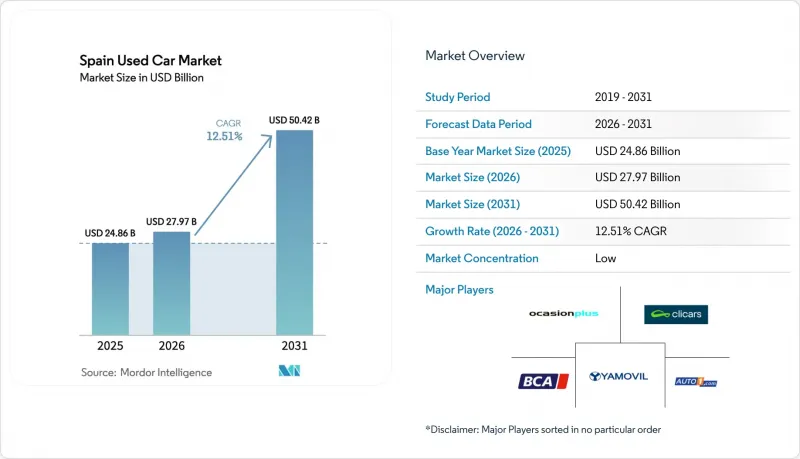
根據Mordor Intelligence的數據顯示,西班牙二手車市場2025年的市場規模為248.6億美元,預計將從2026年的279.7億美元成長至2031年的504.2億美元,預測期內(2026-2031年)的複合年成長率(CAGR)為12.51%。這一成長主要歸因於消費者因更嚴格的歐7排放標準以及宏觀經濟形勢的謹慎態度而轉向價格更實惠的二手車。
[1] 歐盟委員會交通運輸總司,《歐7車輛排放氣體法規提案》,ec.europa.eu。需求主要受國內車輛數量驅動,這些車輛的平均車齡超過14年。這一因素增加了符合以舊換新條件的車輛供應,降低了老舊柴油車的折舊免稅額,並使新型電動車型更具吸引力。本報告按車身類型(掀背車、轎車等)、供應商類型(正規、非正規)、預訂方式(線上、線下)、燃料類型(汽油、柴油等)、車齡(0-2年、3-5年等)、價格範圍、客戶類型和地區進行細分。市場預測以價值(美元)和數量(輛)表示。
西班牙二手車市場趨勢與洞察
租賃和計程車輛到期供應量增加,導致相對較新的庫存增加。
在西班牙二手車市場,大量租賃車隊在約兩年後歸還車輛,導致近乎全新的二手車數量空前湧入。作為市場主要參與者之一的Arval旗下MotorTrade平台每年向市場供應大量車輛,其「再租賃」提案(即重新租賃較新的車輛)正經歷顯著成長。同時,租車公司也在縮短車輛報廢週期,這進一步推動了相對較新車輛市場的成長。新車的湧入提高了車輛的平均質量,減少了維護時間,並促進了包含保固和道路救援系統的「認證二手車專案」的普及。
歐盟排放氣體法規導致老舊內燃機汽車的置換數量增加。
計畫於2025年生效的歐7排放標準提高了老舊柴油和汽油車的擁有成本,促使車主在低排放氣體都市區地區更嚴格的法規實施前處置不符合標準的車輛。西班牙車輛的平均使用壽命為14.2年,這導致柴油車的置換需求激增,尤其是車齡6-8年的柴油車,這些車輛目前正經歷快速貶值。為了加快車輛更換速度,2024年第4號皇家法令引入了低排放氣體車輛的加速折舊政策。這項激勵措施鼓勵車主更快更換車輛。在一些地區,老舊內燃機(ICE)車輛的湧入尤其顯著。這一趨勢正在改變經銷商行業的格局,有組織的經銷商專注於新庫存以提高利潤率。供應量的增加使消費者對價格更加敏感,這一趨勢有利於擅長演算法定價的大規模市場平台。
隨著電氣化程度的提高,內燃機資產價值有快速下降的風險。
儘管柴油車仍主導市場主導地位,但其價格跌幅更大,同時新車註冊量也大幅下降。現有數據顯示,近乎全新的電池式電動車(BEV)在市場上滯銷時間較長,顯示供應過剩,並可能對其殘值造成風險。相比之下,汽油車和混合動力汽車的市場停滯期較短。經銷商,尤其是那些柴油車庫存量大的經銷商,受到的影響尤其顯著。他們正在大幅降低利潤率以清理庫存,對於即將進行年度車輛檢驗(ITV)的舊款車型來說,這種趨勢尤其明顯。隨著馬德里和巴塞隆納對低排放氣體區實施更嚴格的法規,情況變得更加嚴峻,這促使消費者對混合動力汽車表現出更大的興趣。
細分市場分析
預計到2025年,運動型多用途車(SUV)和多用途車(MPV)的銷量將佔總銷量的46.03%,年複合成長率(CAGR)為13.45%,其銷量將超過掀背車和轎車,因為家庭用戶需要更高的乘坐空間和更靈活的載物空間。途勝和獅跑等新型混合動力汽車的上市,得益於非車隊銷售的推動,為市場提供了更多節能的選擇。隨著汽車製造商在新車型中更加重視跨界設計,以及二手車供應充足,西班牙二手SUV市場預計將進一步擴張。由於停車位有限,緊湊型車輛在都市區仍然很受歡迎,但掀背車的絕對市場佔有率正在下降。
推動需求成長的因素包括:低排放氣體SUV的稅收優惠、輕度混合動力車燃油效率的提升以及消費者偏好穩定帶來的強勁殘值。隨著公共充電基礎設施的完善,電動SUV可望取代舊款柴油MPV,進而推高平均交易價格。因此,如果目前的趨勢持續下去,預計到下一個十年末,SUV在西班牙二手車市場的佔有率將進一步擴大。
儘管2025年非正規經銷商的交易量佔比高達66.13%,但預計到2031年,正規銷售管道的複合年成長率將達到14.65%。利潤率的下降(3-5%)被貸款費用和高周轉率所抵銷。各平台在透明度方面各有特色,整合了miDGT報告、基於區塊鏈的檢驗以及14天退貨政策。隨著正規銷售管道向農村地區的滲透率提高,預計到2031年,由正規經銷商主導的西班牙二手車市場規模將進一步擴大。
在人際關係和靈活的現金支付方式根深蒂固的農村地區,獨立經銷商仍保持著強大的影響力。然而,隨著智慧型手機普及率接近飽和,以及透過與銀行的合作,信用評分服務逐漸向大眾開放,數位市場的影響力正在進一步擴大。它們能夠保證車輛質量,並在數小時內將車輛送達全國各地,這正在重新定義購車者的期望,並提高他們再次轉換傳統經銷商的成本。
隨著年輕購車者越來越重視便利性,線上預訂預計將以15.46%的複合年成長率成長。 360度全景虛擬看車、一鍵貸款核准以及兩小時內提車等服務顯著降低了購車流程中的摩擦。 2025年,線下通路仍將佔據75.25%的市場佔有率,繼續保持主導地位,尤其是在重視親眼查看車輛實體的年長消費者群體中。經銷商正透過提供線上預訂和72小時內商店提車的混合模式來彌補這一缺口。
限制成長的因素包括網路安全問題和人口稀少的農村地區寬頻接入有限,但隨著5G覆蓋範圍的擴大,這些障礙正在逐步消除。此外,向線上平台的轉變正在擴大西班牙二手車行業的資料庫,從而改進定價演算法,使標價更接近市場均衡,並最終提高周轉率。
其他好處:
- Excel格式的市場預測(ME)表
- 3個月的分析師支持
目錄
第1章:引言
- 研究假設和市場定義
- 調查範圍
第2章:調查方法
第3章執行摘要
第4章 市場狀況
- 市場概覽
- 市場促進因素
- 租賃到期車輛和租賃車輛的供應量不斷增加,同時還有更新的車輛進入市場。
- 歐盟排放氣體法規正在擴大可以以舊換新的老舊內燃機汽車的範圍。
- 具備宅配功能的端到端數位零售平台
- 在經濟不確定性日益加劇的背景下,消費者對價格的敏感度越來越高。
- 擴大原廠認證二手車(CPO)項目
- 車輛歷史記錄和檢驗報告的取得變得如此便捷,提高了買家的信心。
- 市場限制因素
- 隨著電氣化程度的不斷提高,內燃機資產價值有快速下降的風險。
- 公共充電站的缺乏限制了二手電動車的殘值。
- 半導體短缺的緩解縮小了新產品和二手產品之間的價格差距。
- 與跨區域轉移相關的複雜增值稅和登記稅
- 價值供應鏈分析
- 監理情勢
- 技術展望
- 波特五力模型
- 消費者行為與偏好分析
第5章 市場規模與成長預測
- 按車身樣式
- 掀背車
- 轎車
- 運動型多用途車(SUV)和多用途車(MPV)
- 依供應商類型
- 分類
- 雜亂無章
- 按預訂類型
- 線上
- 離線
- 按燃料類型
- 汽油
- 柴油引擎
- 電的
- 混合
- 其他
- 車輛年份
- 0-2歲
- 3-5年
- 6-8歲
- 8年以上
- 按價格範圍
- 不到1萬美元
- 10,000美元至15,000美元
- 15,000美元至25,000美元
- 超過25,000美元
- 依客戶類型
- 個人
- 企業/車隊
- 西班牙各地區
- 安達盧西亞
- 加泰隆尼亞
- 馬德里自治區
- 瓦倫西亞
- 西班牙其他地區
第6章 競爭情勢
- 市場集中度
- 策略趨勢
- 市佔率分析
- 公司簡介
- Clicars Spain SL
- BCA Group
- AUTO1.com GmbH
- OcasionPlus
- YAMOVIL SA
- AutoScout24
- Flexicar
- Coches.net(Adevinta)
- Wallapop Motors
- Grupo Quadis
- Ayvens Carmarket
- Hertz Car Sales(the Hertz Corporation)
- Arval AutoSelect
- Caetano Retail Espana
- Autofesa
- Costamapps Autotrader
- CAR OUTLET DEL AUTOMOVIL
- OOYYO Corp
第7章 市場機會與未來展望
According to Mordor Intelligence, the Spain used car market size was valued at USD 24.86 billion in 2025 and is estimated to grow from USD 27.97 billion in 2026 to reach USD 50.42 billion by 2031, at a CAGR of 12.51% during the forecast period (2026-2031), as tightening Euro 7 rules and macroeconomic caution channel buyers toward affordable second-hand mobility.
[1] Directorate-General for Mobility and Transport, "Euro 7 Vehicle Emissions Proposal," European Commission, ec.europa.eu Demand is reinforced by a national fleet whose average age exceeds 14 years, a factor that broadens the stock of trade-ins, compresses depreciation in older diesel inventory, and raises the appeal of younger, electrified models. This report is Segmented by Vehicle Body Style (Hatchbacks, Sedans, and More), Vendor Type (Organized, and Unorganized), Booking Type (Online and Offline), Fuel Type (Petrol, Diesel, and More), Vehicle Age (0-2 Years, 3-5 Years, and More), Price Band, Customer Type, and Region. The Market Forecasts are Provided in Terms of Value (USD) and Volume (Units).
Spain Used Car Market Trends and Insights
Growing Supply of Off-Lease and Rental Fleet Vehicles Adds Younger Inventory
In Spain's used-car market, an unprecedented influx of near-new stock is being injected as leasing fleets, now exceeding significant volumes, return vehicles after approximately 2 years. Arval's MotorTrade platform, a key player, annually pushes a substantial number of units and has shown remarkable growth in its Re-lease proposition, which recontracts late-model cars. Meanwhile, rental companies are disposing of cars within a shorter time frame, driving growth in the younger vehicle segment. This influx of younger vehicles not only elevates average quality and reduces reconditioning times but also bolsters the rise of certified pre-owned programs, which come bundled with warranties and roadside assistance.
EU Emissions Rules Enlarging Pool of Trade-Ins for Older ICE Vehicles
Euro 7 standards, scheduled to take effect from 2025, raise the cost of ownership for aging diesel and petrol cars, encouraging owners to dispose of non-compliant units before urban low-emission zones tighten enforcement. Spain's fleet age of 14.2 years is driving a surge of diesel trade-ins that are now facing rapid price compression, particularly in the 6-8-year bracket. In a bid to hasten fleet renewal, Royal Decree Law 4/2024 offers accelerated depreciation for low-emission vehicles. This incentive is pushing fleet operators to refresh their assets at a quicker pace. Certain regions are experiencing the largest influx of older internal combustion engine (ICE) vehicles. This trend is altering the dealer landscape, as organized vendors pivot to focus on younger inventory for better margins. The uptick in supply is making consumers more price-sensitive, a trend that favors larger marketplaces adept at algorithmic pricing.
Rapid Depreciation Risk for ICE Assets Amid Electrification
Transactions continue to be led by diesel units, yet these units are witnessing sharper price drops, coinciding with a significant decline in new diesel registrations. Current data indicates that young BEVs are sitting on the market for extended periods, pointing to an oversupply and potential risks to their residual value. In contrast, petrol and hybrid units are spending less time on the market. Dealers, particularly those with substantial diesel inventories, are feeling the pinch. They're slashing margins to offload stock, especially for older cars nearing their annual ITV inspections. With low-emission zone restrictions tightening in Madrid and Barcelona, the stakes are raised, steering buyers more towards hybrid options.
Other drivers and restraints analyzed in the detailed report include:
- End-to-End Digital Retail Platforms With Home Delivery
- Economic Uncertainty Heightens Value-Conscious Consumer Behavior
- Sparse Public Charging Limits Residuals on Used EVs
For complete list of drivers and restraints, kindly check the Table Of Contents.
Segment Analysis
Sport Utility Vehicles (SUVs) and Multi-Purpose Vehicles (MPVs) accounted for 46.03% of sales in 2025 and are growing at a 13.45% CAGR, outpacing hatchbacks and sedans as families seek higher seating positions and flexible cargo space. Fleet disposals supply late-model hybrids such as the Tucson and Sportage, bolstering fuel-efficient choices. The Spanish used-car market for SUVs is projected to expand further as OEMs focus new-car launches on crossover designs, ensuring a robust secondary pipeline. Hatchbacks remain popular in urban areas where parking density favors compact dimensions, yet their share declines in absolute terms.
Demand drivers include tax incentives for low-emission SUVs, improved mild-hybrid efficiency, and stronger residuals linked to consumer preference stability. As public charging improves, electrified SUVs will likely displace older diesel MPVs, raising average transaction values. The Spanish used-car market share for SUVs is therefore poised to expand by the decade's end if current flow dynamics persist.
Unorganized dealers controlled 66.13% of transactions in 2025, yet organized channels are compounding at 14.65% annually by 2031. Margin compression to 3-5% is offset by financing commissions and high sales velocity. Platforms integrate miDGT reports, blockchain verification, and 14-day returns to differentiate on transparency. The Spanish used car market size attributable to organized vendors is set to expand by 2031 as rural penetration improves.
Unorganized outlets retain strength in rural areas where personal relationships and flexible cash terms persist. However, as smartphone adoption saturates and bank partnerships extend credit scoring deeper into the population, digital marketplaces gain further leverage. Their ability to guarantee vehicle quality and deliver cars nationwide within hours reshapes buyer expectations, raising switching costs back to traditional lots.
Online bookings will grow at a 15.46% CAGR as younger buyers prioritize convenience. Virtual 360-degree tours, single-click financing approval, and two-hour delivery reduce buying friction by a step change. Offline channels remain dominant with a 75.25% share in 2025, especially among older consumers who value tactile inspection. Dealers address that gap by offering hybrid models that enable online reservations and in-person pickup within 72 hours.
Growth headwinds include cybersecurity concerns and limited broadband in sparsely populated provinces, but as 5G coverage widens, these barriers recede. The shift to online is also expanding the Spanish used-car industry's data pool, enhancing pricing algorithms that keep listed prices close to market-clearing levels, thereby accelerating stock turnover.
Complete Report Scope:
- By Vehicle Body Style
- Hatchbacks
- Sedans
- Sport Utility Vehicles (SUVs) and Multi-Purpose Vehicles (MPVs)
- By Vendor Type
- Organized
- Unorganized
- By Booking Type
- Online
- Offline
- By Fuel Type
- Petrol
- Diesel
- Electric
- Hybrid
- Others
- By Vehicle Age
- 0-2 Years
- 3-5 Years
- 6-8 Years
- Above 8 Years
- By Price Band
- Below USD 10,000
- USD 10,000-15,000
- USD 15,000-25,000
- Above USD 25,000
- By Customer Type
- Individual
- Corporate/Fleet
- By Spanish Region
- Andalusia
- Catalonia
- Community of Madrid
- Valencian Community
- Rest of Spain
List of Companies Covered in this Report:
- Clicars Spain SL
- BCA Group
- AUTO1.com GmbH
- OcasionPlus
- YAMOVIL SA
- AutoScout24
- Flexicar
- Coches.net (Adevinta)
- Wallapop Motors
- Grupo Quadis
- Ayvens Carmarket
- Hertz Car Sales (the Hertz Corporation)
- Arval AutoSelect
- Caetano Retail Espana
- Autofesa
- Costamapps Autotrader
- CAR OUTLET DEL AUTOMOVIL
- OOYYO Corp
Additional Benefits:
- The market estimate (ME) sheet in Excel format
- 3 months of analyst support
TABLE OF CONTENTS
1 Introduction
- 1.1 Study Assumptions & Market Definition
- 1.2 Scope of the Study
2 Research Methodology
3 Executive Summary
4 Market Landscape
- 4.1 Market Overview
- 4.2 Market Drivers
- 4.2.1 Growing Supply of Off-Lease and Rental Fleet Vehicles Adds Younger Inventory
- 4.2.2 EU Emissions Rules Enlarging Pool of Trade-Ins for Older ICE Vehicles
- 4.2.3 End-to-End Digital Retail Platforms With Home Delivery
- 4.2.4 Economic Uncertainty Heightens Value-Conscious Consumer Behavior
- 4.2.5 Expansion of OEM Certified-Pre-Owned (CPO) Programs
- 4.2.6 Widespread Availability of Vehicle-History and Inspection Reports Boosts Buyer Confidence
- 4.3 Market Restraints
- 4.3.1 Rapid Depreciation Risk for ICE Assets Amid Electrification
- 4.3.2 Sparse Public Charging Limits Residuals on Used EVs
- 4.3.3 Chip-Shortage Easing Narrows New-vs-Used Price Gap
- 4.3.4 Complex VAT and Registration Taxes for Inter-Region Transfers
- 4.4 Value / Supply-Chain Analysis
- 4.5 Regulatory Landscape
- 4.6 Technological Outlook
- 4.7 Porter's Five Forces
- 4.7.1 Threat of New Entrants
- 4.7.2 Bargaining Power of Buyers
- 4.7.3 Bargaining Power of Suppliers
- 4.7.4 Threat of Substitutes
- 4.7.5 Intensity of Competitive Rivalry
- 4.8 Consumer Behaviour & Preference Analysis
5 Market Size & Growth Forecasts (Value (USD) and Volume (Units))
- 5.1 By Vehicle Body Style
- 5.1.1 Hatchbacks
- 5.1.2 Sedans
- 5.1.3 Sport Utility Vehicles (SUVs) and Multi-Purpose Vehicles (MPVs)
- 5.2 By Vendor Type
- 5.2.1 Organized
- 5.2.2 Unorganized
- 5.3 By Booking Type
- 5.3.1 Online
- 5.3.2 Offline
- 5.4 By Fuel Type
- 5.4.1 Petrol
- 5.4.2 Diesel
- 5.4.3 Electric
- 5.4.4 Hybrid
- 5.4.5 Others
- 5.5 By Vehicle Age
- 5.5.1 0-2 Years
- 5.5.2 3-5 Years
- 5.5.3 6-8 Years
- 5.5.4 Above 8 Years
- 5.6 By Price Band
- 5.6.1 Below USD 10,000
- 5.6.2 USD 10,000-15,000
- 5.6.3 USD 15,000-25,000
- 5.6.4 Above USD 25,000
- 5.7 By Customer Type
- 5.7.1 Individual
- 5.7.2 Corporate/Fleet
- 5.8 By Spanish Region
- 5.8.1 Andalusia
- 5.8.2 Catalonia
- 5.8.3 Community of Madrid
- 5.8.4 Valencian Community
- 5.8.5 Rest of Spain
6 Competitive Landscape
- 6.1 Market Concentration
- 6.2 Strategic Moves
- 6.3 Market Share Analysis
- 6.4 Company Profiles (includes Global Level Overview, Market Level Overview, Core Segments, Financials as Available, Strategic Information, Market Rank/Share for Key Companies, Products and Services, SWOT Analysis, and Recent Developments)
- 6.4.1 Clicars Spain SL
- 6.4.2 BCA Group
- 6.4.3 AUTO1.com GmbH
- 6.4.4 OcasionPlus
- 6.4.5 YAMOVIL SA
- 6.4.6 AutoScout24
- 6.4.7 Flexicar
- 6.4.8 Coches.net (Adevinta)
- 6.4.9 Wallapop Motors
- 6.4.10 Grupo Quadis
- 6.4.11 Ayvens Carmarket
- 6.4.12 Hertz Car Sales (the Hertz Corporation)
- 6.4.13 Arval AutoSelect
- 6.4.14 Caetano Retail Espana
- 6.4.15 Autofesa
- 6.4.16 Costamapps Autotrader
- 6.4.17 CAR OUTLET DEL AUTOMOVIL
- 6.4.18 OOYYO Corp
7 Market Opportunities & Future Outlook
- 7.1 White-space & Unmet-Need Assessment

 中國二手車市場:市場佔有率分析、產業趨勢與統計及成長預測(2026-2031)印尼二手車金融:市場佔有率分析、產業趨勢與統計及成長預測(2026-2031)中東和非洲二手車市場:市場佔有率分析、行業趨勢和統計數據以及成長預測(2026-2031 年)印尼二手車市場:市佔率分析、產業趨勢與統計及成長預測(2026-2031)新加坡二手車市場:市佔率分析、產業趨勢與統計及成長預測(2026-2031)法國二手車市場:市場佔有率分析、產業趨勢與統計及成長預測(2026-2031)義大利二手車市場:市佔率分析、產業趨勢與統計及成長預測(2026-2031)英國二手車市場:市佔率分析、產業趨勢與統計及成長預測(2026-2031)馬來西亞二手車市場:市場佔有率分析、產業趨勢與統計及成長預測(2026-2031)東南亞二手車市場:市場佔有率分析、產業趨勢與統計及成長預測(2026-2031)