

 |
市場調查報告書
商品編碼
2125278
印尼二手車市場:市佔率分析、產業趨勢與統計及成長預測(2026-2031)Indonesia Used Car - Market Share Analysis, Industry Trends & Statistics, Growth Forecasts (2026 - 2031) |
||||||

※ 本網頁內容可能與最新版本有所差異。詳細情況請與我們聯繫。
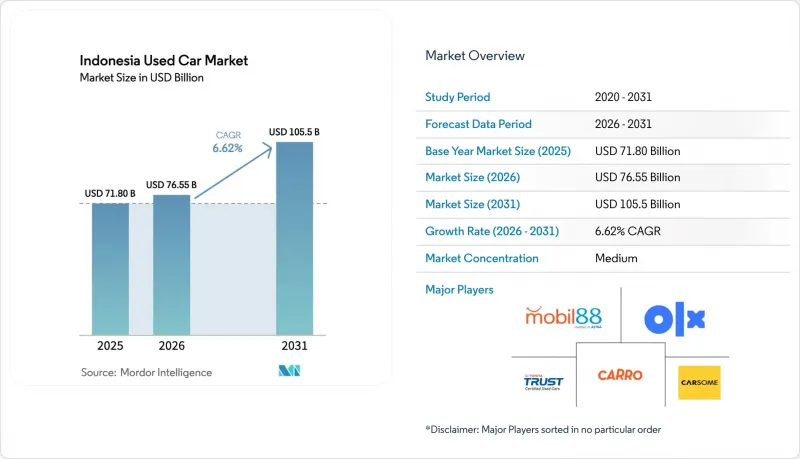
根據 Mordor Intelligence 預測,印尼二手車市場規模將從 2025 年的 718 億美元成長到 2026 年的 765.5 億美元,然後在 2031 年達到 1055 億美元,2026 年至 2031 年的複合年成長率為 6.62%。
本報告按車輛類型(掀背車、轎車、其他)、燃料類型(汽油、柴油、其他)、價格區間(低於 5,500 美元、5,500 美元至 10,999 美元、其他)、配銷通路(線上數位分類入口網站、專用電子商務平台、其他)、供應商類型(正規、非正規)所在的車輛、非正式資金來源和州內進行資金。市場預測以美元計價。
印尼二手車市場趨勢與洞察
擴大線上分類廣告和電子商務活動
數位入口網站使消費者能夠在聯繫賣家之前比較價格、里程和照片,從而簡化交易流程。平台營運商整合了車輛偵測、融資和文件辦理等服務,減少了在經銷商密度低的農村地區搜尋車輛的麻煩。 SEVA在2024年實現了17,500筆車輛交易和8.2兆印尼幣的總交易額,凸顯了這種經營模式的有效性,推動了資本流入和獨角獸企業的湧現。傳統企業集團也積極回應。 Astra收購OLX後,將其自身的金融、檢測中心和物流整合到統一的服務系統中。 OJK對平台內數位融資的監管支持完善了無縫體驗,進一步推動了印尼二手車市場的線上滲透。
銀行專注於專門針對二手車的貸款產品。
印尼主要銀行如BCA預測,到2024年,汽車貸款未償餘額將達到65.3兆印尼幣(約41億美元)。隨著貸款機構追求更高收益,二手車的比例也不斷上升。其專有的評分系統經過改進,納入了多種重要因素,不再局限於傳統的借款人收入,而是涵蓋了里程範圍、詳細的車輛檢測評估以及預期轉售價格等。這種創新方法使得線上市場能夠實現即時預核准,將核准時間大幅縮短至數小時。因此,這個簡化的流程不僅提高了貸款轉換率,也刺激了印尼二手車市場的流動性,為買賣雙方創造了更多機會。
竄改里程表讀數和偽造事故記錄的現象仍然十分猖獗。
各州的STNK和BPKB系統互不互聯,這使得不法經銷商可以在車輛跨州運輸時篡改里程或隱瞞水淹損壞。首次購車者和網購者因此被迫以高價購買問題車輛。這種信任缺失推高了貸款風險溢價,並減緩了印尼二手車市場的交易速度,直到人工智慧驅動的檢測和集中式資料管理成為主流。
細分市場分析
預計到2025年,SUV將佔印尼二手車市場佔有率的37.62%。這主要得益於SUV較高的離地間隙以及在擁擠道路上更高的安全性。 MPV的複合年成長率(CAGR)為7.05%,深受重視滑動門和靈活座椅佈局的多代家庭的青睞。轎車則迎合了追求燃油效率的通勤者,而掀背車則瞄準了首次購車者,滿足了他們對狹窄停車位的需求。印尼二手車市場SUV的規模預計將受到車隊更新換代需求的強勁推動,儘管在爪哇島農村地區,由於對專車服務的需求不斷成長,MPV的周轉速度更快。中國汽車製造商正憑藉極具競爭力的混合模式進軍這兩個細分市場,迫使二手日本汽車製造商更頻繁地更新其產品陣容。
在雅加達和泗水,新能源SUV滿足了高階消費者的需求,而緊湊型MPV則在路況各異的偏遠島嶼地區佔據主導地位。數位平台利用演算法向潛在的共乘用戶推薦SUV,向會員人數不斷成長的家庭推薦MPV,從而提高了匹配效率。由於SUV和MPV可以透過保固提升銷售帶來更高的盈利,因此在認證二手車專案中,SUV和MPV的比例高於轎車。
即使到了2025年,汽油動力車仍將佔據印尼二手車市場63.10%的佔有率,但混合動力汽車和電動車預計將以12.34%的複合年成長率成長,這主要得益於增值稅(VAT)的降低和奢侈品稅的豁免。與此同時,由於補貼削減和更嚴格的排放氣體法規的討論,柴油車的市佔率正在萎縮。儘管電動車在印尼二手車市場仍然規模較小,但快速充電樁的引入和政府的藍圖預計將促進未來的二手車銷售。自2024年以來,雅加達競標會上混合動力汽車的殘值比汽油車高出6-8%,顯示買家的購車標準發生了轉變。
電池劣化的不確定性阻礙了電動車的廣泛普及。經銷商不願進貨未經原廠測試的舊款純電動車車型。在電池保固問題最終確定之前,銀行對純電動車採取了更短的貸款期限和更高的抵押品減免政策。然而,在充電基礎設施仍然不足的農村交易市場,汽油車仍保持著流動性優勢。
預計到2025年,售價在11,000美元至21,999美元之間的車輛將佔印尼二手車市場銷量的39.05%,年複合成長率達7.33%。此價格區間與家庭購買力中位數和銀行信貸額度相符。售價低於5,500美元的入門級車型吸引了三線城市的現金買家,而售價高於22,000美元的高階車型則瞄準了追求豪華品牌的富裕都市區。印尼中檔二手車市場佔有率的成長得益於大量的置換車輛和包含一年保固的認證項目。
提供分期付款模擬的線上計算器正在提升消費者對中檔車的認知度。在各大入口網站上,首付20%、分48個月還款的Avanza車型(售價1.5萬美元)仍是搜尋最高的組合。外籍人士的流動和公司用車的處置推動了高階車市場的成長,但與注重成本績效的核心市場相比,它仍然是一個小眾市場。
其他好處
- Excel格式的市場預測(ME)表
- 3個月的分析師支持
目錄
第1章:引言
- 研究假設和市場定義
- 調查範圍
第2章:調查方法
第3章執行摘要
第4章 市場狀況
- 市場概覽
- 市場促進因素
- 擴大線上分類廣告和電子商務活動
- 銀行專注於專門針對二手車的貸款產品。
- 在 Java 以外地區拓展有組織的經銷商網路
- 叫車服務(Grab 和 Gojek)的車輛更換週期
- 透過原廠回購計畫提升殘值
- 利用人工智慧驅動的狀況評級平台降低價格波動。
- 市場限制因素
- 竄改里程表讀數和偽造事故記錄的現象仍然十分猖獗。
- 註冊資料庫是分散的,每個州都有自己獨立的資料庫。
- 島際物流成本高昂阻礙了爪哇島與爪哇島以外地區的貿易。
- 針對二手電動車的認證電池狀況診斷服務有限。
- 監理情勢
- 技術展望
- 波特五力模型
第5章 市場規模與成長預測
- 按車輛類型
- 掀背車
- 轎車
- SUV
- MPV
- 按燃料類型
- 汽油
- 柴油引擎
- 混合動力和電動車
- 其他(液化石油氣、壓縮天然氣等)
- 按價格範圍
- 低於 5,500 美元
- 5,500 美元至 10,999 美元
- 11,000 美元 – 21,999 美元
- 超過22,000美元
- 透過分銷管道
- 線上分類入口網站
- 專業電子商務企業
- 經銷商/OEM線上平台
- 實體店面加盟零售商
- 獨立經營的二手車經銷店
- 競標行(混合型,結合實體店和線上通路)
- 個人之間的私人交易
- 依供應商類型
- 組織
- 雜亂無章
- 車輛年份
- 0-2歲
- 3-5年
- 6-8歲
- 超過8年
- 由資助者
- 原始設備製造商 (OEM)
- 銀行
- 非銀行金融公司
- 按州
- 西爪哇
- 東爪哇
- 中爪哇
- 北蘇門答臘
- 萬登
- 雅加達
- 其他州
第6章 競爭情勢
- 市場集中度
- 策略趨勢
- 市佔率分析
- 公司簡介
- Mobil88(PT Serasi Auto Raya(SERA))
- Toyota Astra Motor(Toyota Trust)
- PT Tunas Ridean Tbk.
- PT Inchcape Indomobil Distribution Indonesia(IIDI)(Mercedes Certified)
- BMW Premium Selection(BME Eurokars)
- OLX Indonesia
- Carro Indonesia(Trusty Cars Ltd)
- Carsome Indonesia
- Broom.id
- Carmudi Indonesia
- Moladin
- Mobil123
第7章 市場機會與未來展望
According to Mordor Intelligence, the Indonesia used car market size is expected to grow from USD 71.80 billion in 2025 to USD 76.55 billion in 2026 and is forecast to reach USD 105.5 billion by 2031 at 6.62% CAGR over 2026-2031.
This report is Segmented by Vehicle Type (Hatchbacks, Sedans, and More), Fuel Type (Petrol, Diesel, and More), Price Segment (Below USD 5, 500, USD 5, 500-10, 999, and More), Sales Channel (Online Digital Classified Portals, Pure-Play E-Retailers, and More), Vendor Type (Organized and Unorganized), Vehicle Age, Financing Providers, and Province. The Market Forecasts are Provided in Terms of Value (USD).
Indonesia Used Car Market Trends and Insights
Growing Online Classified and E-retail Activity
Digital portals empower consumers to compare prices, mileage, and photos, streamlining their transactions before reaching out to sellers. Platform operators integrate inspection, financing, and documentation, reducing search friction in secondary cities where dealer density is low. SEVA's 17,500-unit throughput and IDR 8.2 trillion gross transaction value in 2024 validated the model, encouraging capital inflows and unicorn creation . Traditional conglomerates have reacted: Astra's OLX acquisition aligned captive financing, inspection centers, and logistics into a single stack. Regulatory support from OJK for in-platform digital lending completes a frictionless experience, propelling the Indonesian used car market toward deeper online penetration.
Banks' Pivot to Used-car Specific Loan Products
Major banks such as BCA expanded vehicle loan books to IDR 65.3 trillion (USD 4.1 billion) in 2024, with used cars forming an increasing share as lenders chase higher yields . Proprietary scorecards have evolved to incorporate a range of crucial factors, including mileage bands, detailed inspection grades, and projected resale values, moving beyond the traditional focus on borrower income. This innovative approach allows for instant pre-approval within online marketplaces, significantly reducing approval times to just a few hours. As a result, this streamlined process not only enhances conversion rates but also invigorates liquidity in the Indonesian used car market, creating dynamic opportunities for both buyers and sellers.
Odometer and Accident-history Fraud Remains Pervasive
Provincial STNK and BPKB systems operate in silos, letting bad actors reset mileage or hide flood damage when vehicles cross borders. First-time buyers and online shoppers bear the brunt, paying inflated prices for compromised cars. Trust deficits raise financing risk premiums, dampening the Indonesia used car market velocity until AI inspection and centralized data become mainstream.
Other drivers and restraints analyzed in the detailed report include:
- Expanding Organized Dealer Networks Outside Java
- Ride-hailing Fleet Renewal Cycles (Grab and Gojek)
- Fragmented Provincial Registration Databases
For complete list of drivers and restraints, kindly check the Table Of Contents.
Segment Analysis
SUVs owned 37.62% of the Indonesia used car market share in 2025, buoyed by high ground clearance and perceived safety in congested streets. MPVs, climbing at 7.05% CAGR, appeal to multi-generational households that prize sliding doors and flexible seating. Sedans cater to commuters seeking fuel efficiency, and hatchbacks target first-time owners navigating tight parking norms. The Indonesia used car market size for SUVs is projected to keep pace with robust supply from fleet replacements, yet MPVs fetch quicker days-to-sale in suburban Java as school-run demand rises. Chinese OEMs have entered both segments with competitive hybrid trims, pushing Japanese incumbents to refresh line-ups more frequently.
New-energy SUVs feed aspirational buyers in Jakarta and Surabaya, while compact MPVs dominate outer-island lanes where road quality varies. Digital platforms algorithmically recommend SUVs to ride-hailing prospects and MPVs to growing families, increasing match efficiency. Certified programs overweight SUVs and MPVs because warranty upsells monetize better than sedans.
Petrol models still command 63.10% of the Indonesia used car market size in 2025, yet hybrids and electric models exhibit a 12.34% CAGR, propelled by VAT cuts and zero luxury tax. The diesel share erodes amid rising subsidy talk and emissions scrutiny. The Indonesia used car market size for electric models remains small, but fast-charger rollouts and government roadmaps catalyze future secondary sales. Residual values of hybrids have outperformed petrol peers in Jakarta auctions by 6-8% since 2024, hinting at shifting buyer calculus.
Battery degradation uncertainty curbs wider uptake. Dealers hesitate to stock older BEVs without OEM testing. Banks apply shorter tenures and higher collateral haircuts for BEVs pending battery warranties. Petrol cars, however, keep liquidity advantages in rural exchanges where charging remains scarce.
Units priced USD 11,000-21,999 held 39.05% of the Indonesia used car market revenue in 2025 and expanded at 7.33% CAGR, aligning with median household affordability and bank lending brackets. Entry models under USD 5,500 attract cash buyers in tier-3 cities, while premium brackets above USD 22,000 serve affluent urbanites eyeing luxury badges. The Indonesia used car market share of mid-range vehicles benefits from abundant trade-ins and certified programs bundling one-year warranties.
Online calculators showcasing installment scenarios boost mid-range visibility: a USD 15,000 Avanza with a 20% down payment and a 48-month tenor remains the most-searched combination on leading portals. Growth in premium slices rides on expatriate turnovers and corporate fleet disposals, but remains niche relative to value-centric core segments.
Complete Report Scope:
- By Vehicle Type
- Hatchbacks
- Sedans
- SUVs
- MPVs
- By Fuel Type
- Petrol
- Diesel
- Hybrid and Electric
- Others (LPG, CNG, etc.)
- By Price Segment
- Below USD 5,500
- USD 5,500 - 10,999
- USD 11,000 - 21,999
- >= USD 22,000
- By Sales Channel
- Online Digital Classified Portals
- Pure-play e-Retailers
- Dealer/OEM Online Platforms
- Physical Franchise Dealerships
- Independent Used-Car Lots
- Auction Houses (Physical and Online Hybrid)
- Peer-to-Peer (Private) Sales
- By Vendor Type
- Organized
- Unorganized
- By Vehicle Age
- 0 - 2 Years
- 3 - 5 Years
- 6 - 8 Years
- Above 8 Years
- By Financing Providers
- Original Equipment Manufacturers (OEMs)
- Banks
- Non-Banking Financial Companies
- By Province
- West Java
- East Java
- Central Java
- North Sumatra
- Banten
- Jakarta
- Other Provinces
List of Companies Covered in this Report:
- Mobil88 (PT Serasi Auto Raya (SERA))
- Toyota Astra Motor (Toyota Trust)
- PT Tunas Ridean Tbk.
- PT Inchcape Indomobil Distribution Indonesia (IIDI) (Mercedes Certified)
- BMW Premium Selection (BME Eurokars)
- OLX Indonesia
- Carro Indonesia (Trusty Cars Ltd )
- Carsome Indonesia
- Broom.id
- Carmudi Indonesia
- Moladin
- Mobil123
Additional Benefits:
- The market estimate (ME) sheet in Excel format
- 3 months of analyst support
TABLE OF CONTENTS
1 Introduction
- 1.1 Study Assumptions & Market Definition
- 1.2 Scope of the Study
2 Research Methodology
3 Executive Summary
4 Market Landscape
- 4.1 Market Overview
- 4.2 Market Drivers
- 4.2.1 Growing Online Classified and E-retail Activity
- 4.2.2 Banks' Pivot to Used-car Specific Loan Products
- 4.2.3 Expanding Organized Dealer Networks Outside Java
- 4.2.4 Ride-hailing Fleet Renewal Cycles (Grab and Gojek)
- 4.2.5 OEM Buy-back Schemes Boosting Residual Values
- 4.2.6 AI-led Condition Grading Platforms Reducing Price Dispersion
- 4.3 Market Restraints
- 4.3.1 Odometer and Accident-history Fraud Remains Pervasive
- 4.3.2 Fragmented Provincial Registration Databases
- 4.3.3 High Inter-island Logistics Cost Discourages Non-Java Trade
- 4.3.4 Limited Certified-battery Health Checks for Used EVs
- 4.4 Regulatory Landscape
- 4.5 Technological Outlook
- 4.6 Porter's Five Forces
- 4.6.1 Threat of New Entrants
- 4.6.2 Bargaining Power of Buyers
- 4.6.3 Bargaining Power of Suppliers
- 4.6.4 Threat of Substitute Products
- 4.6.5 Intensity of Competitive Rivalry
5 Market Size & Growth Forecasts (Value, USD)
- 5.1 By Vehicle Type
- 5.1.1 Hatchbacks
- 5.1.2 Sedans
- 5.1.3 SUVs
- 5.1.4 MPVs
- 5.2 By Fuel Type
- 5.2.1 Petrol
- 5.2.2 Diesel
- 5.2.3 Hybrid and Electric
- 5.2.4 Others (LPG, CNG, etc.)
- 5.3 By Price Segment
- 5.3.1 Below USD 5,500
- 5.3.2 USD 5,500 - 10,999
- 5.3.3 USD 11,000 - 21,999
- 5.3.4 >= USD 22,000
- 5.4 By Sales Channel
- 5.4.1 Online Digital Classified Portals
- 5.4.2 Pure-play e-Retailers
- 5.4.3 Dealer/OEM Online Platforms
- 5.4.4 Physical Franchise Dealerships
- 5.4.5 Independent Used-Car Lots
- 5.4.6 Auction Houses (Physical and Online Hybrid)
- 5.4.7 Peer-to-Peer (Private) Sales
- 5.5 By Vendor Type
- 5.5.1 Organized
- 5.5.2 Unorganized
- 5.6 By Vehicle Age
- 5.6.1 0 - 2 Years
- 5.6.2 3 - 5 Years
- 5.6.3 6 - 8 Years
- 5.6.4 Above 8 Years
- 5.7 By Financing Providers
- 5.7.1 Original Equipment Manufacturers (OEMs)
- 5.7.2 Banks
- 5.7.3 Non-Banking Financial Companies
- 5.8 By Province
- 5.8.1 West Java
- 5.8.2 East Java
- 5.8.3 Central Java
- 5.8.4 North Sumatra
- 5.8.5 Banten
- 5.8.6 Jakarta
- 5.8.7 Other Provinces
6 Competitive Landscape
- 6.1 Market Concentration
- 6.2 Strategic Moves
- 6.3 Market Share Analysis
- 6.4 Company Profiles (Includes Global Level Overview, Market Level Overview, Core Segments, Financials as Available, Strategic Information, Market Rank/Share for Key Companies, Products and Services, SWOT Analysis, and Recent Developments)
- 6.4.1 Mobil88 (PT Serasi Auto Raya (SERA))
- 6.4.2 Toyota Astra Motor (Toyota Trust)
- 6.4.3 PT Tunas Ridean Tbk.
- 6.4.4 PT Inchcape Indomobil Distribution Indonesia (IIDI) (Mercedes Certified)
- 6.4.5 BMW Premium Selection (BME Eurokars)
- 6.4.6 OLX Indonesia
- 6.4.7 Carro Indonesia (Trusty Cars Ltd )
- 6.4.8 Carsome Indonesia
- 6.4.9 Broom.id
- 6.4.10 Carmudi Indonesia
- 6.4.11 Moladin
- 6.4.12 Mobil123
7 Market Opportunities & Future Outlook
- 7.1 White-space & Unmet-Need Assessment

 中國二手車市場:市場佔有率分析、產業趨勢與統計及成長預測(2026-2031)印尼二手車金融:市場佔有率分析、產業趨勢與統計及成長預測(2026-2031)中東和非洲二手車市場:市場佔有率分析、行業趨勢和統計數據以及成長預測(2026-2031 年)新加坡二手車市場:市佔率分析、產業趨勢與統計及成長預測(2026-2031)法國二手車市場:市場佔有率分析、產業趨勢與統計及成長預測(2026-2031)義大利二手車市場:市佔率分析、產業趨勢與統計及成長預測(2026-2031)英國二手車市場:市佔率分析、產業趨勢與統計及成長預測(2026-2031)西班牙二手車市場:市佔率分析、產業趨勢與統計及成長預測(2026-2031)馬來西亞二手車市場:市場佔有率分析、產業趨勢與統計及成長預測(2026-2031)東南亞二手車市場:市場佔有率分析、產業趨勢與統計及成長預測(2026-2031)