


 |
市場調查報告書
商品編碼
2116550
中東和非洲二手車市場:市場佔有率分析、行業趨勢和統計數據以及成長預測(2026-2031 年)Middle East And Africa Used Car - Market Share Analysis, Industry Trends & Statistics, Growth Forecasts (2026 - 2031) |
||||||

※ 本網頁內容可能與最新版本有所差異。詳細情況請與我們聯繫。
據 Mordor Intelligence 稱,2025 年中東和非洲二手車市場價值 930.1 億美元,預計將從 2026 年的 978.7 億美元成長到 2031 年的 1263.4 億美元。
預測期(2026-2031 年)的複合年成長率預計為 5.23%。
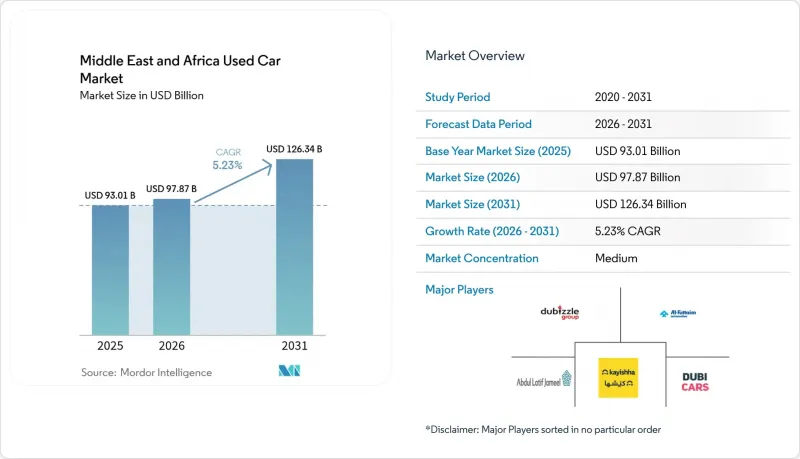
本報告按車輛類型(掀背車、轎車等)、供應商(正規、非正規)、燃料類型(汽油、柴油等)、車輛年份(0-2年、3-5年等)、銷售管道(線上廣告/電子商務、線下/實體店)和國家/地區(阿拉伯聯合大公國、沙烏地阿拉伯等)進行細分。市場預測以美元(USD)計價。
中東和非洲二手車市場趨勢與洞察
新車價格上漲和供應鏈延誤
紅海航運瓶頸導致車輛交付前置作業時間延長至多六週。這促使區域經銷商在2024年全年提高新車價格,迫使價格敏感型買家轉向中東和非洲的二手車市場。在購車負擔加重的情況下,對車齡兩到三年的二手車的需求正在上升,而企業車隊也在縮短更換週期,以確保殘值,應對預期中的進一步價格上漲。熱門車款的經銷商庫存僅夠四到六個月的銷售量,迫使消費者購買之前從未考慮過的二手車。租賃公司透過轉售低里程的退租車輛獲利,確保了近乎全新的車輛庫存穩定。這些因素共同推動了交易量的成長,並維持了熱門品牌和車型的高轉售價值。
中國平價品牌的進入將提升周轉率。
比亞迪、吉利和奇瑞積極拓展業務,以低於傳統競爭對手的價格提供極具吸引力的新車選擇,刺激了市場對新車的需求。這種需求正迅速蔓延二手市場。本地組裝合資企業縮短了供應週期,並加深了服務中心對每款車型的了解,從而降低了消費者對車輛擁有風險的認知。車隊營運商為了控制資本支出,紛紛採用中國製造的轎車和SUV,導致市場上持續供應車齡2-4年的二手車。全景影像和先進的資訊娛樂系統等極具競爭力的配置,也越來越受到精通科技的消費者的青睞。因此,中東和非洲二手車市場的周轉率加快,各個價位的庫存都變得更加充足。
非洲無序供應商的主導地位
在非洲主要經濟體中,非正規街頭經銷商主導絕大多數交易,現金交易和不透明的定價模式十分普遍,阻礙了信貸的普及。缺乏標準化的檢驗系統導致產品品質參差不齊,削弱了消費者信心,並限制了該地區的出口前景。由於資源有限且根深蒂固的家族式貿易網路,監管機構在執法方面舉步維艱。數位廣告發展勢頭強勁,但註冊和課稅的阻力阻礙了正規市場的化進程。由於法律的不確定性降低了中東和非洲二手車市場收益的可預測性,外國投資者仍然保持謹慎。
細分市場分析
預計到2025年,SUV將在中東和非洲二手車市場佔據42.72%的佔有率,超過轎車和掀背車,並在2031年之前以5.55%的複合年成長率成長。 2025年中東和非洲二手車市場SUV市場的規模反映了消費者對高離地間隙、能夠應對沙漠地形的車款的持續需求。耐用性優勢使其折舊免稅額更慢,因此,經過認證的二手SUV能夠比行駛里程相近的轎車賣出更高的價格。中國製造的新型SUV車型憑藉其極具競爭力的價格,正促使車隊管理者將採購範圍擴展到傳統日本品牌之外。
從陶瓷保護塗層到自我調整懸吊套件,不斷成長的售後市場進一步提升了車輛的感知價值,並促進了周轉率的提高。轎車保持著穩定的市場佔有率,這得益於都市區通勤者對燃油效率和緊湊停車位的重視。另一方面,掀背車仍然是預算有限的首次購車者的入門車型。 MPV 則滿足了大家庭和特定商業領域的需求。然而,隨著建築、石油和旅遊業基礎設施的擴張,中東和非洲二手車市場對越野性能車輛的需求持續成長,預計 SUV 的主導地位將繼續保持。
2025年,正規經銷商的複合年成長率將達到61.70%,但預計到2031年,正規經銷商的複合年成長率將達到6.55%,成為成長最快的經銷商,這凸顯了消費者對系統化保障和透明定價的偏好轉變。 2025年,中東和非洲二手車市場規模大幅成長,授權經銷商的銷售量大幅提升,反映出認證二手車專案的普及程度不斷提高。海灣合作理事會(GCC)國家的監管改革要求經銷商實現庫存數位化並提供檢驗文件,從而減少資訊不對稱,增強消費者對貸款機構的信心。
數位化平台使授權供應商共用商品訊息,從而利用先前受地理限制的庫存資源。同時,由於監管部門對違規行為處以嚴厲處罰,授權管道對非正規貿易商的吸引力日益增強。這一趨勢在沙烏地阿拉伯尤為明顯,該國取消報關代理要求縮短了進口處理時間,使授權貿易商能夠加快庫存週轉。隨著銀行進一步拓展汽車金融業務,並將信貸核准與檢驗的車輛數據掛鉤,預計市場佔有率的轉變將進一步加速。
其他好處:
- Excel格式的市場預測(ME)表
- 3個月的分析師支持
目錄
第1章:引言
- 研究假設和市場定義
- 調查範圍
第2章:調查方法
第3章執行摘要
第4章 市場狀況
- 市場概覽
- 市場促進因素
- 新車價格上漲和供應鏈延誤
- 大量價格親民的中國品牌湧入市場,促進了銷售成長。
- 數位細分廣告和O2O平台的普及
- 在崎嶇地形中,人們更傾向於選擇SUV和皮卡。
- 擴大檢驗和歷史核實服務
- 早期向二手車市場供應電動車
- 市場限制因素
- 非正規商販在非洲的主導地位
- 嚴格的跨境進口限制
- 里程表造假和駕駛歷史缺乏透明度
- 電池因高溫而劣化,阻礙了二手電動車的廣泛普及。
- 價值供應鏈分析
- 監理情勢
- 技術展望
- 波特五力模型
第5章 市場規模與成長預測
- 車輛類型
- 掀背車
- 轎車
- SUV 與跨界車
- MPV
- 依供應商類型
- 有組織的銷售網路(經銷商和認證二手車經銷商)
- 非組織性(獨立和P2P)
- 按燃料類型
- 汽油
- 柴油引擎
- 混合
- 電池式電動車
- 車輛年份
- 0-2歲
- 3-5年
- 6-8歲
- 8年以上
- 透過分銷管道
- 線上分類廣告與電子商務
- 線下/實體店
- 國家
- 阿拉伯聯合大公國
- 沙烏地阿拉伯
- 埃及
- 肯亞
- 南非
- 摩洛哥
- 奈及利亞
- 科威特
- 阿曼
- 其他中東和非洲國家
第6章 競爭情勢
- 市場集中度
- 策略趨勢
- 市佔率分析
- 公司簡介
- Al-Futtaim Automotive
- Dubizzle Motors(OLX UAE)
- Kayishha(SellAnyCar KSA)
- Abdul Latif Jameel Motors
- YallaMotor
- DubiCars
- Cars24 Middle East
- CarSwitch
- OpenSooq Motors
- Motory Saudi Arabia
- CarMax East Africa Limited
- Alba Cars
- CFAO Mobility South Africa
- Expat Motors
第7章 市場機會與未來展望
According to Mordor Intelligence, the Middle East and Africa used car market size was valued at USD 93.01 billion in 2025 and estimated to grow from USD 97.87 billion in 2026 to reach USD 126.34 billion by 2031, at a CAGR of 5.23% during the forecast period (2026-2031).
This report is Segmented by Vehicle Type (Hatchbacks, Sedans, and More), Vendor Type (Organized, Unorganized), Fuel Type (Petrol, Diesel, and More), Vehicle Age (0-2 Years, 3-5 Years, and More), Distribution Channel (Online Classified and E-Commerce, Offline/Brick-and-Mortar), and Country (United Arab Emirates, Saudi Arabia, and More). The Market Forecasts are Provided in Terms of Value (USD).
Middle East And Africa Used Car Market Trends and Insights
High New-Vehicle Prices and Supply-Chain Delays
Red Sea shipping bottlenecks have extended delivery lead times by up to six weeks, prompting regional distributors to raise new-car prices during 2024 and pushing budget-sensitive buyers into the Middle East and Africa used car market. Affordability gaps intensify demand for 2-3-year-old vehicles, while corporate fleets shorten replacement cycles to lock in residual values ahead of further price inflation. Dealer inventories of popular models remain tight for four to six months, compelling consumers to consider used options previously out of scope. Leasing companies capitalize by remarketing low-mileage returns, creating a steady pipeline of nearly-new stock. Collectively, these factors elevate transaction volumes and sustain premium resale values across high-demand nameplates.
Influx of Affordable Chinese Brands Boosts Turnover
Aggressive expansion by BYD, Geely, and Chery delivers attractively priced alternatives often below legacy competitors, stoking new-vehicle uptake that swiftly filters into secondary channels. Local assembly joint ventures shorten supply cycles and raise model familiarity among service workshops, lowering perceived ownership risk. Fleet operators embrace Chinese sedans and SUVs to contain capital outlays, thereby feeding a pipeline of 2-4-year returns. Competitive feature sets-such as panoramic cameras and advanced infotainment-heighten appeal to tech-savvy buyers. Consequently, turnover accelerates, deepening inventory across price tiers within the Middle East and Africa used car market.
Dominance of Unorganized Vendors in Africa
Informal street-level traders retain control over a majority of transactions across key African economies, perpetuating cash-only dealings and opaque pricing that hinder credit penetration. Absence of standardized inspections allows quality variance that suppresses consumer confidence and limits regional export prospects. Regulatory agencies struggle with enforcement owing to limited resources and entrenched familial trading networks. Although digital classifieds gain traction, resistance to registration and taxation slows formalization. Foreign investors remain cautious, citing legal uncertainties that dilute return predictability in the Middle East and Africa used car market.
Other drivers and restraints analyzed in the detailed report include:
- Digital Classifieds and O2O Platforms Proliferation
- SUV and Pickup Preference for Harsh Terrain
- Restrictive Cross-Border Import Regulations
For complete list of drivers and restraints, kindly check the Table Of Contents.
Segment Analysis
SUVs posted 42.72% share of the Middle East and Africa used car market in 2025, outpacing sedans and hatchbacks and expanding at a 5.55% CAGR to 2031. The Middle East and Africa used car market size for SUVs in 2025, reflected entrenched demand for high-ground-clearance designs that withstand desert terrains. Durability advantages translate into slower depreciation, enabling certified pre-owned SUVs to command premiums over equivalent mileage sedans. Emerging Chinese SUV models introduce competitive price tiers, enticing fleet managers to broaden procurement beyond traditional Japanese nameplates.
Growing aftermarket sectors-from ceramic protective coatings to adaptive suspension kits-further elevate perceived value, contributing to higher turnover velocity. Sedans hold a stable share, driven by urban commuters prioritizing fuel economy and compact parking footprints, while hatchbacks remain the entry point for budget-constrained first-time buyers. MPVs cater to large families and niche commercial segments. Nevertheless, SUV dominance is expected to persist as infrastructure expansions in construction, oil, and tourism sectors sustain off-road-capable vehicle requirements across the Middle East and Africa used car market.
Unorganized dealers accounted for 61.70% of transactions in 2025, but organized vendors are growing with fastest 6.55% CAGR by 2031, underscoring shifting consumer preferences toward structured warranties and transparent pricing. The Middle East and Africa used car market size recorded significant organized sales during 2025, reflecting rising adoption of certified pre-owned programs. Regulatory reforms in GCC states compel dealers to digitize inventories and provide inspection documentation, reducing asymmetry and increasing lender confidence.
Digital platforms empower organized vendors to syndicate listings across borders, tapping inventory pools previously constrained by geography. Conversely, informal traders face punitive penalties for non-compliance, enhancing the relative attractiveness of formal channels. Momentum is most evident in Saudi Arabia, where removal of the customs-broker requirement trims import processing times, enabling organized players to rotate stock faster. The share shift is expected to accelerate as banks deepen auto-finance penetration, tethering credit approvals to verifiable vehicle data.
Complete Report Scope:
- By Vehicle Type
- Hatchbacks
- Sedans
- SUVs and Crossovers
- MPVs
- By Vendor Type
- Organized (Dealerships and CPO)
- Unorganized (Independents and P2P)
- By Fuel Type
- Petrol
- Diesel
- Hybrid
- Battery-Electric
- By Vehicle Age
- 0-2 Years
- 3-5 Years
- 6-8 Years
- Above 8 Years
- By Distribution Channel
- Online Classified and E-commerce
- Offline / Brick-and-Mortar
- By Country
- United Arab Emirates
- Saudi Arabia
- Egypt
- Kenya
- South Africa
- Morocco
- Nigeria
- Kuwait
- Oman
- Rest of Middle East and Africa
List of Companies Covered in this Report:
- Al-Futtaim Automotive
- Dubizzle Motors (OLX UAE)
- Kayishha (SellAnyCar KSA)
- Abdul Latif Jameel Motors
- YallaMotor
- DubiCars
- Cars24 Middle East
- CarSwitch
- OpenSooq Motors
- Motory Saudi Arabia
- CarMax East Africa Limited
- Alba Cars
- CFAO Mobility South Africa
- Expat Motors
Additional Benefits:
- The market estimate (ME) sheet in Excel format
- 3 months of analyst support
TABLE OF CONTENTS
1 Introduction
- 1.1 Study Assumptions & Market Definition
- 1.2 Scope of the Study
2 Research Methodology
3 Executive Summary
4 Market Landscape
- 4.1 Market Overview
- 4.2 Market Drivers
- 4.2.1 High New-Vehicle Prices and Supply-Chain Delays
- 4.2.2 Influx of Affordable Chinese Brands Boosts Turnover
- 4.2.3 Digital Classifieds and O2O Platforms Proliferation
- 4.2.4 SUV and Pickup Preference for Harsh Terrain
- 4.2.5 Expansion of Inspection/History-Verification Services
- 4.2.6 Early Secondary-Market Supply of Electrified Fleets
- 4.3 Market Restraints
- 4.3.1 Dominance of Unorganized Vendors in Africa
- 4.3.2 Restrictive Cross-Border Import Regulations
- 4.3.3 Odometer Fraud and Limited History Transparency
- 4.3.4 Heat-Induced Battery Degradation Limits Used-EV Uptake
- 4.4 Value / Supply-Chain Analysis
- 4.5 Regulatory Landscape
- 4.6 Technological Outlook
- 4.7 Porter's Five Forces
- 4.7.1 Threat of New Entrants
- 4.7.2 Bargaining Power of Buyers
- 4.7.3 Bargaining Power of Suppliers
- 4.7.4 Threat of Substitute Products
- 4.7.5 Intensity of Competitive Rivalry
5 Market Size & Growth Forecasts (Value, USD)
- 5.1 By Vehicle Type
- 5.1.1 Hatchbacks
- 5.1.2 Sedans
- 5.1.3 SUVs and Crossovers
- 5.1.4 MPVs
- 5.2 By Vendor Type
- 5.2.1 Organized (Dealerships and CPO)
- 5.2.2 Unorganized (Independents and P2P)
- 5.3 By Fuel Type
- 5.3.1 Petrol
- 5.3.2 Diesel
- 5.3.3 Hybrid
- 5.3.4 Battery-Electric
- 5.4 By Vehicle Age
- 5.4.1 0-2 Years
- 5.4.2 3-5 Years
- 5.4.3 6-8 Years
- 5.4.4 Above 8 Years
- 5.5 By Distribution Channel
- 5.5.1 Online Classified and E-commerce
- 5.5.2 Offline / Brick-and-Mortar
- 5.6 By Country
- 5.6.1 United Arab Emirates
- 5.6.2 Saudi Arabia
- 5.6.3 Egypt
- 5.6.4 Kenya
- 5.6.5 South Africa
- 5.6.6 Morocco
- 5.6.7 Nigeria
- 5.6.8 Kuwait
- 5.6.9 Oman
- 5.6.10 Rest of Middle East and Africa
6 Competitive Landscape
- 6.1 Market Concentration
- 6.2 Strategic Moves
- 6.3 Market Share Analysis
- 6.4 Company Profiles (includes Global Level Overview, Market Level Overview, Core Segments, Financials as Available, Strategic Information, Market Rank/Share for Key Companies, Products and Services, SWOT Analysis, and Recent Developments)
- 6.4.1 Al-Futtaim Automotive
- 6.4.2 Dubizzle Motors (OLX UAE)
- 6.4.3 Kayishha (SellAnyCar KSA)
- 6.4.4 Abdul Latif Jameel Motors
- 6.4.5 YallaMotor
- 6.4.6 DubiCars
- 6.4.7 Cars24 Middle East
- 6.4.8 CarSwitch
- 6.4.9 OpenSooq Motors
- 6.4.10 Motory Saudi Arabia
- 6.4.11 CarMax East Africa Limited
- 6.4.12 Alba Cars
- 6.4.13 CFAO Mobility South Africa
- 6.4.14 Expat Motors
7 Market Opportunities & Future Outlook
- 7.1 White-space & Unmet-Need Assessment

 中國二手車市場:市場佔有率分析、產業趨勢與統計及成長預測(2026-2031)印尼二手車金融:市場佔有率分析、產業趨勢與統計及成長預測(2026-2031)印尼二手車市場:市佔率分析、產業趨勢與統計及成長預測(2026-2031)新加坡二手車市場:市佔率分析、產業趨勢與統計及成長預測(2026-2031)法國二手車市場:市場佔有率分析、產業趨勢與統計及成長預測(2026-2031)義大利二手車市場:市佔率分析、產業趨勢與統計及成長預測(2026-2031)英國二手車市場:市佔率分析、產業趨勢與統計及成長預測(2026-2031)西班牙二手車市場:市佔率分析、產業趨勢與統計及成長預測(2026-2031)馬來西亞二手車市場:市場佔有率分析、產業趨勢與統計及成長預測(2026-2031)東南亞二手車市場:市場佔有率分析、產業趨勢與統計及成長預測(2026-2031)