

 |
市場調查報告書
商品編碼
2125395
英國二手車市場:市佔率分析、產業趨勢與統計及成長預測(2026-2031)United Kingdom Used Car - Market Share Analysis, Industry Trends & Statistics, Growth Forecasts (2026 - 2031) |
||||||

※ 本網頁內容可能與最新版本有所差異。詳細情況請與我們聯繫。
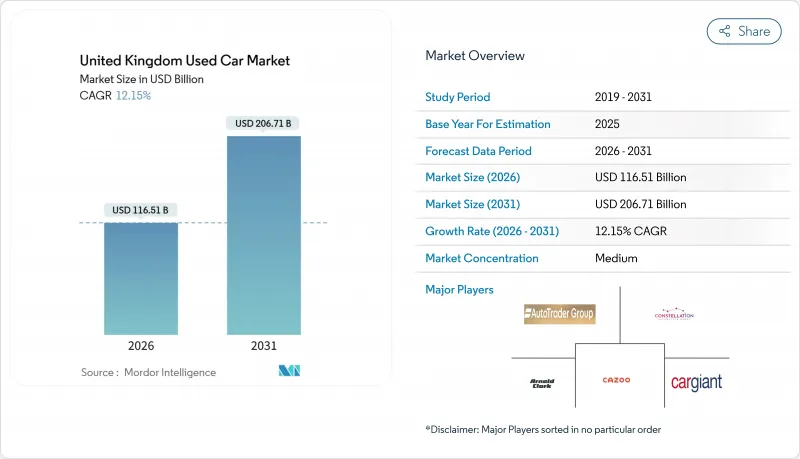
根據 Mordor Intelligence 預測,英國二手車市場規模預計將在 2026 年達到 1,165.1 億美元,到 2031 年達到 2,067.1 億美元,在預測期內複合年成長率為 12.15%。
本報告按供應商類型(正規/非正規)、車輛年份(0-2年、3-5年及以上)、燃料類型(汽油、柴油及其他)、車身類型(掀背車、轎車及其他)、銷售管道(線上及其他)、所有權類型(首次購車者及其他)、價格區間(低於7000美元及其他)和地區進行細分。市場規模和預測以價值(美元)和銷售(輛)兩種形式呈現。
英國二手車市場趨勢與洞察
純線上市場和「點擊出貨」模式的迅速普及。
Auto Trader 透過提供即時報價工具和以舊換新擔保選項,簡化了個人賣家的銷售流程,從而在市場瀏覽時間方面佔據主導地位。 Carwow 採用經銷商競標引擎,為零售庫存引入透明的競標式定價。這項策略不僅因其低申訴率而贏得了「頂級」稱號,還增強了其數位信譽。 Vertu Insights 等即時定價引擎提高了存貨周轉並提升了利潤率。以行動裝置為中心的消費者期望快速送貨上門,這正促使傳統企業也採用全通路策略。
ULEZ、ZEZ 和清潔空氣區正在加速用較新的二手車替換舊車。
倫敦的超低排放氣體區(ULEZ)現已涵蓋所有行政區,目標是在2024年中期將合規率提高到96%,並鼓勵二手車輛的車主將更換為符合歐盟6排放標準的二手車。伯明翰、曼徹斯特以及蘇格蘭的四個低排放氣體區(LEZ)也實施了類似的清潔空氣收費,對車輛收取每日費用,這削弱了車齡車齡八年的車輛的經濟效益。由此產生的需求變化導致英國二手車市場兩極化:符合排放標準的汽油和柴油車輛在都市區價格高昂,而不合規的車輛則被轉移到農村地區或報廢。這些政策的連鎖反應正在提高周轉率,並支撐相對較新車輛的殘值。預計包括計劃於2026年在卡迪夫引入的低排放區在內的區域性推廣活動,將在整個預測期內保持監管方面的利好因素。
高利率環境推高了購屋者的資金籌措成本。
英國央行已將政策利率下調至2025年5月的4.25%,但儘管優質借款人的二手仍維持在適中水平,次級借款人的利率卻可能大幅上升。因此,普通貸款的每月付款正在增加。金融租賃協會(FLA)報告稱,由於入門級購車者退出市場,二手車貸款量有所下降。為了維持銷量,經銷商正在承受降息帶來的成本壓力,這擠壓了他們的毛利率。此外,老舊內燃機車輛的負股權也使得置換交易更加困難。
細分市場分析
獨立、非正規的二手車賣家傳統上在本地市場和低價位區間佔據主導地位,預計到2025年將佔英國二手車市場規模的58.23%。然而,由於合規壓力不斷增加,他們的市場佔有率正在穩步下降。英國競爭與市場管理局(CMA)對Constellation收購衛星群 Berkeley的第二階段調查凸顯了監管機構對競標業整合的審查力度加大。大型企業正在利用數據分析、內部融資和物流方面的規模經濟優勢,這增加了小規模、分散的參與者失去市場佔有率的風險。
到2025年,英國二手車市場中,正規經銷商的佔有率為41.77%,預計到2031年,隨著認證二手車項目和全國性線上商城的普及,其市場佔有率將以12.82%的複合年成長率成長,這主要得益於認證二手車項目和全國性線上商城的推廣,提升了二手車的可靠性和便利性。這些結構性利多因素使得正規經銷商能夠以低於小規模競爭對手的價格出售準新車,同時也能透過金融和服務等增值方式來獲利。
到2025年,車車齡3-5年的車輛將佔英國二手車市場佔有率的34.28%,這反映了傳統折舊免稅額的「最佳時機」。然而,受短期車隊報廢和試駕車供應過剩的推動,預計到2031年,車齡0-2年的車型需求將在英國二手車市場成長最快,複合年成長率將達到12.43%。
新車享有原廠保固和認證計劃,因此售價更高,週轉更快。相較之下,車齡超過八年的車輛面臨不斷上漲的都市區通行費和飆升的保險費用,儘管它們對城市以外的現金買家很有吸引力,但其轉售價值卻因此下降。經銷商擴大將高里程和不合規的車輛出口到海外市場,從而保護其在國內的殘值。
即使到了2025年,汽油動力汽車仍然佔據英國二手車市場53.34%的佔有率。然而,隨著基礎設施的改善和電池狀況報告的完善,購車者的擔憂逐漸消除,純電動車(BEV)正以19.23%的複合年成長率快速成長。預計到2031年,英國二手電動動力傳動系統市場規模將成長三倍以上。
清潔空氣區(CAZ)收費體係正在加速柴油車的衰落,而混合動力汽車則因其能夠彌補續航里程和加油方面的不足而日益普及。出口到監管較少地區的柴油車需求在一定程度上緩解了國內價格的下跌,但長期趨勢依然是下降的。
其他好處:
- Excel格式的市場預測(ME)表
- 3個月的分析師支持
目錄
第1章:引言
- 研究假設和市場定義
- 調查範圍
第2章:調查方法
第3章執行摘要
第4章 市場狀況
- 市場概覽
- 市場促進因素
- ULEZ、ZEZ 和清潔空氣區正在加速用較新的二手車替換舊車。
- 廠商支援的認證二手車專案正在提升買家信心和價格。
- 英國純線上市場和點擊配送模式的快速普及
- 基於訂閱的二手車服務正在擴大重複需求的循環。
- 為二手純電動車和混合動力汽車。
- 保險遠端資訊處理技術正在降低老舊車輛的競爭力。
- 市場限制因素
- 高利率推高了二手車買家的資金籌措成本。
- 隨著新車生產趨於緊張,二手車價格飆升。
- 在汽油和柴油車輛被禁之前,ICE面臨著殘值的不確定性。
- 聯網汽車所有權轉移引發的資料隱私問題
- 價值供應鏈分析
- 監理展望
- 技術展望
- 波特五力模型
第5章 市場規模與成長預測
- 依供應商類型
- 分類
- 雜亂無章
- 按車輛年份
- 0-2歲
- 3-5年
- 6-8歲
- 8年以上
- 按燃料類型
- 汽油
- 柴油引擎
- 混合
- 電池式電動車
- 插電式混合動力
- 其他替代燃料(壓縮天然氣/液化石油氣)
- 依體型
- 掀背車
- 轎車
- 運動型多用途車(SUV)
- 多用途汽車(MPV)
- 按銷售管道
- 線上
- 線下 - 加盟店
- 線下 - 獨立零售商
- 個人對個人的交易
- 依所有權類型
- 第一任車主
- 第二任車主
- 第三及後續所有者
- 按價格範圍
- 不到7000美元
- 7,001 美元至 15,000 美元
- 15,000 美元至 30,000 美元
- 超過30,000
- 按地區
- 英格蘭
- 蘇格蘭
- 威爾斯
- 北愛爾蘭
第6章 競爭情勢
- 市場集中度
- 策略趨勢
- 市佔率分析
- 公司簡介
- Auto Trader Group plc
- Constellation Automotive Group Ltd
- Arnold Clark Automobiles Ltd
- Cazoo Group Ltd
- Car Giant Ltd
- Lookers plc
- Pendragon plc(CarStore)
- Vertu Motors plc
- Motorpoint Group plc
- Manheim(Cox Automotive UK)
- Sytner Group Ltd
- Inchcape plc
- TrustFord(Ford Retail Ltd)
- Jardine Motors Group UK Ltd
- AvailableCar Ltd
- Carwow Ltd
- Motors.co.uk Ltd
- Aramis Group
- Peter Vardy Ltd
第7章 市場機會與未來展望
According to Mordor Intelligence, the United Kingdom used car market size stands at USD 116.51 billion in 2026 and is projected to reach USD 206.71 billion by 2031, translating into a 12.15% CAGR over the forecast period.
This report is Segmented by Vendor Type (Organized and Unorganized), Vehicle Age (0-2 Years, 3-5 Years, and More), Fuel Type (Petrol, Diesel, and More), Body Type (Hatchback, Sedan, and More), and Sales Channel (Online, and More), Ownership (First-Owner, and More), Price Band (Less Than USD 7, 000, and More) and Geography. The Market Sizes and Forecasts are Provided in Terms of Value (USD) and Volume (Units).
United Kingdom Used Car Market Trends and Insights
Rapid Uptake of Online-Only Marketplaces and Click-and-Deliver Models
Auto Trader dominates marketplace browsing time, leveraging instant-offer tools and guaranteed part-exchange options to streamline sales for private sellers. Carwow uses a dealer-bidding engine, introducing transparent auction-style pricing to its retail inventory. This strategy not only earns recognition through Top-Rated badges for low complaint rates but also strengthens digital trust. Real-time pricing engines, such as Vertu Insights, enhance stock turnover and increase profit margins. Mobile-centric buyers now expect home delivery within a short timeframe, prompting even traditional groups to embrace an omnichannel approach.
ULEZ, ZEZ and Clean-Air Zones Accelerating Fleet Turnover Toward Newer Used Cars
London's Ultra-Low Emission Zone now covers every borough, raising compliance to 96% by mid-2024 and pushing owners of older engines to trade into Euro 6-compliant used stock. Similar clean-air charging schemes in Birmingham, Manchester, and Scotland's four Low Emission Zones levy daily fees that erode the economics of running vehicles aged eight years or more. The resulting demand shifts split the United Kingdom's used car market, with compliant petrol and diesel cars attracting urban premiums. At the same time, non-compliant stock is either relocated to rural areas or scrapped. The policy cascade lifts transaction velocity and underpins residual values for younger vehicles. Regional rollouts, including Cardiff's planned 2026 zone, are expected to maintain the regulatory tailwind through the forecast horizon.
High Interest-Rate Environment Raising Finance Costs for Buyers
Although the Bank of England eased the base rate to 4.25% by May 2025, for prime borrowers, used-car APRs hover at moderate levels, while subprime rates can reach significantly higher percentages . This results in an increase in monthly costs on standard loans. The Finance & Leasing Association has reported a decline in used-car finance volumes, citing the exit of entry-level buyers from the market. To sustain sales, dealers are absorbing rate buy-downs, which in turn pressures their gross margins. Additionally, negative equity on older ICE vehicles is making trade-ins more challenging.
Other drivers and restraints analyzed in the detailed report include:
- OEM-Backed Certified Pre-Owned Programs Boost Buyer Trust and Prices
- Attractive Residual-Value Guarantees on Used BEVs and Hybrids
- Used-Car Prices Surge as New-Car Output Faces Crunch
For complete list of drivers and restraints, kindly check the Table Of Contents.
Segment Analysis
Independent, unorganized vendors, traditionally dominant in rural catchments and lower price bands, accounted for 58.23% of the United Kingdom's used car market size in 2025. However, their market share is steadily declining due to increasing compliance pressures. The CMA's Phase 2 investigation into Constellation's acquisition of Aston Barclay underscores the increasing regulatory scrutiny of auction consolidations. Larger players leverage scale advantages in data analytics, captive finance, and logistics, leaving smaller, fragmented traders increasingly at risk of losing market share.
Organized dealers captured 41.77% of the United Kingdom's used car market share in 2025; yet, the group is expected to add volume at a 12.82% CAGR through 2031, as certified-pre-owned schemes and nationwide digital storefronts build trust and convenience. This structural tailwind positions organized operators to undercut smaller rivals on nearly-new stock while monetizing finance and service add-ons.
Vehicles aged 3-5 years accounted for 34.28% of the United Kingdom used car market share in 2025, reflecting the traditional depreciation "sweet spot." However, the United Kingdom used car market demand for 0-2 year models is rising fastest at a 12.43% CAGR through 2031, driven by short-cycle fleet returns and demonstrator oversupply.
Younger inventory benefits from full OEM warranty and eligibility for certified programs, supporting premium pricing and faster turns. In contrast, cars older than eight years face mounting urban access fees and higher insurance costs, which suppress their resale values despite their appeal to cash buyers outside city centers. Dealers are increasingly channeling high-mileage or non-compliant stock to export markets, thereby protecting domestic residuals.
Petrol cars still led the United Kingdom's used car market share in 2025, with 53.34%. Yet, BEVs are sprinting ahead with a 19.23% CAGR as infrastructure improves and warranty-supported battery health reports reduce buyer anxiety. The United Kingdom used car market size tied to electrified powertrains is expected to more than triple by 2031.
Diesel's retreat quickens under Clean-Air Zone charges, while hybrids enjoy a hedge against range and refueling constraints. Export demand for diesel units to less-regulated regions partly cushions domestic price falls, but the long-term trajectory remains downward.
Complete Report Scope:
- By Vendor Type
- Organized
- Unorganized
- By Vehicle Age
- 0 - 2 Years
- 3 - 5 Years
- 6 - 8 Years
- More than 8 Years
- By Fuel Type
- Petrol
- Diesel
- Hybrid
- Battery Electric
- Plug-in Hybrid
- Other Alt-Fuels (CNG/LPG)
- By Body Type
- Hatchback
- Sedan
- Sport Utility Vehicle (SUV)
- Multi-Purpose Vehicle (MPV)
- By Sales Channel
- Online
- Offline - Franchised Dealers
- Offline - Independent Dealers
- Private-to-Private
- By Ownership Type
- First-Owner
- Second-Owner
- Third-or-More Owners
- By Price Band
- Less than USD 7,000
- USD 7,001 - USD 15,000
- USD 15,000 - USD 30,000
- More than 30,000
- By Region
- England
- Scotland
- Wales
- Northern Ireland
List of Companies Covered in this Report:
- Auto Trader Group plc
- Constellation Automotive Group Ltd
- Arnold Clark Automobiles Ltd
- Cazoo Group Ltd
- Car Giant Ltd
- Lookers plc
- Pendragon plc (CarStore)
- Vertu Motors plc
- Motorpoint Group plc
- Manheim (Cox Automotive U.K.)
- Sytner Group Ltd
- Inchcape plc
- TrustFord (Ford Retail Ltd)
- Jardine Motors Group U.K. Ltd
- AvailableCar Ltd
- Carwow Ltd
- Motors.co.uk Ltd
- Aramis Group
- Peter Vardy Ltd
Additional Benefits:
- The market estimate (ME) sheet in Excel format
- 3 months of analyst support
TABLE OF CONTENTS
1 Introduction
- 1.1 Study Assumptions & Market Definition
- 1.2 Scope of the Study
2 Research Methodology
3 Executive Summary
4 Market Landscape
- 4.1 Market Overview
- 4.2 Market Drivers
- 4.2.1 ULEZ, ZEZ and Clean-Air Zones Accelerating Fleet Turnover Toward Newer Used Cars
- 4.2.2 OEM-Backed Certified-Pre-Owned Programs Boosting Buyer Trust and Prices
- 4.2.3 Rapid Uptake of Online-Only Marketplaces and Click-and-Deliver Models in the U.K.
- 4.2.4 Subscription-Based Used-Car Schemes Increasing Repeat Demand Cycles
- 4.2.5 Attractive Residual-Value Guarantees on Used BEVs and Hybrids
- 4.2.6 Insurance Telematics Making Older Vehicles Less Cost-Competitive
- 4.3 Market Restraints
- 4.3.1 High Interest-Rate Environment Raising Finance Costs for Used-Car Buyers
- 4.3.2 Used-Car Prices Surge as New-Car Output Faces Crunch
- 4.3.3 ICE Faces Residual-Value Uncertainty Ahead of Upcoming Petrol/Diesel Ban
- 4.3.4 Data-Privacy Concerns Around Connected-Car Ownership Transfers
- 4.4 Value / Supply-Chain Analysis
- 4.5 Regulatory Outlook
- 4.6 Technological Outlook
- 4.7 Porter's Five Forces
- 4.7.1 Threat of New Entrants
- 4.7.2 Bargaining Power of Buyers
- 4.7.3 Bargaining Power of Suppliers
- 4.7.4 Threat of Substitutes
- 4.7.5 Competitive Rivalry
5 Market Size and Growth Forecasts (Value (USD), Volume (Units))
- 5.1 By Vendor Type
- 5.1.1 Organized
- 5.1.2 Unorganized
- 5.2 By Vehicle Age
- 5.2.1 0 - 2 Years
- 5.2.2 3 - 5 Years
- 5.2.3 6 - 8 Years
- 5.2.4 More than 8 Years
- 5.3 By Fuel Type
- 5.3.1 Petrol
- 5.3.2 Diesel
- 5.3.3 Hybrid
- 5.3.4 Battery Electric
- 5.3.5 Plug-in Hybrid
- 5.3.6 Other Alt-Fuels (CNG/LPG)
- 5.4 By Body Type
- 5.4.1 Hatchback
- 5.4.2 Sedan
- 5.4.3 Sport Utility Vehicle (SUV)
- 5.4.4 Multi-Purpose Vehicle (MPV)
- 5.5 By Sales Channel
- 5.5.1 Online
- 5.5.2 Offline - Franchised Dealers
- 5.5.3 Offline - Independent Dealers
- 5.5.4 Private-to-Private
- 5.6 By Ownership Type
- 5.6.1 First-Owner
- 5.6.2 Second-Owner
- 5.6.3 Third-or-More Owners
- 5.7 By Price Band
- 5.7.1 Less than USD 7,000
- 5.7.2 USD 7,001 - USD 15,000
- 5.7.3 USD 15,000 - USD 30,000
- 5.7.4 More than 30,000
- 5.8 By Region
- 5.8.1 England
- 5.8.2 Scotland
- 5.8.3 Wales
- 5.8.4 Northern Ireland
6 Competitive Landscape
- 6.1 Market Concentration
- 6.2 Strategic Moves
- 6.3 Market Share Analysis
- 6.4 Company Profiles (Includes Global-level Overview, Market-level Overview, Core Segments, Financials as available, Strategic Information, Market Rank/Share, Products & Services, Recent Developments)
- 6.4.1 Auto Trader Group plc
- 6.4.2 Constellation Automotive Group Ltd
- 6.4.3 Arnold Clark Automobiles Ltd
- 6.4.4 Cazoo Group Ltd
- 6.4.5 Car Giant Ltd
- 6.4.6 Lookers plc
- 6.4.7 Pendragon plc (CarStore)
- 6.4.8 Vertu Motors plc
- 6.4.9 Motorpoint Group plc
- 6.4.10 Manheim (Cox Automotive U.K.)
- 6.4.11 Sytner Group Ltd
- 6.4.12 Inchcape plc
- 6.4.13 TrustFord (Ford Retail Ltd)
- 6.4.14 Jardine Motors Group U.K. Ltd
- 6.4.15 AvailableCar Ltd
- 6.4.16 Carwow Ltd
- 6.4.17 Motors.co.uk Ltd
- 6.4.18 Aramis Group
- 6.4.19 Peter Vardy Ltd
7 Market Opportunities & Future Outlook

 中國二手車市場:市場佔有率分析、產業趨勢與統計及成長預測(2026-2031)印尼二手車金融:市場佔有率分析、產業趨勢與統計及成長預測(2026-2031)中東和非洲二手車市場:市場佔有率分析、行業趨勢和統計數據以及成長預測(2026-2031 年)印尼二手車市場:市佔率分析、產業趨勢與統計及成長預測(2026-2031)新加坡二手車市場:市佔率分析、產業趨勢與統計及成長預測(2026-2031)法國二手車市場:市場佔有率分析、產業趨勢與統計及成長預測(2026-2031)義大利二手車市場:市佔率分析、產業趨勢與統計及成長預測(2026-2031)西班牙二手車市場:市佔率分析、產業趨勢與統計及成長預測(2026-2031)馬來西亞二手車市場:市場佔有率分析、產業趨勢與統計及成長預測(2026-2031)東南亞二手車市場:市場佔有率分析、產業趨勢與統計及成長預測(2026-2031)