


 |
市場調查報告書
商品編碼
2116656
新加坡二手車市場:市佔率分析、產業趨勢與統計及成長預測(2026-2031)Singapore Used Car - Market Share Analysis, Industry Trends & Statistics, Growth Forecasts (2026 - 2031) |
||||||

※ 本網頁內容可能與最新版本有所差異。詳細情況請與我們聯繫。
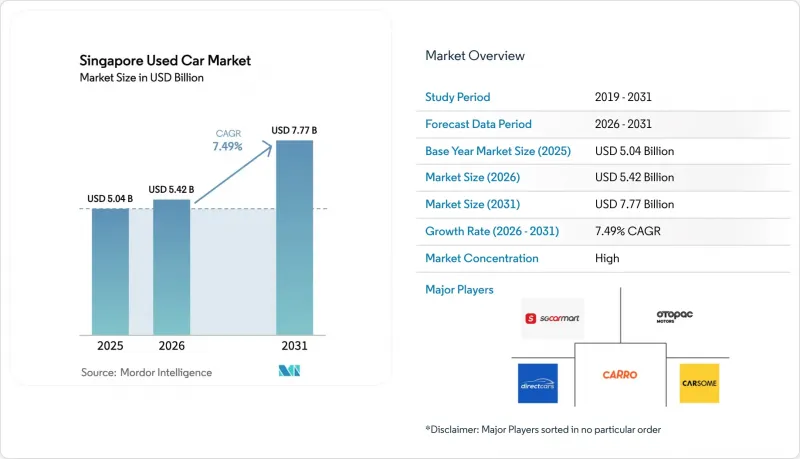
根據 Mordor Intelligence 預測,新加坡二手車市場規模將從 2025 年的 50.4 億美元成長到 2026 年的 54.2 億美元,然後在 2031 年達到 77.7 億美元,2026 年至 2031 年的複合年成長率為 7.49%。
本報告按車輛類型(掀背車、轎車、運動型多用途車 (SUV)、多用途車 (MPV))、銷售商(授權經銷商平台和非授權經銷商)、購買方式(線上和線下)以及燃料類型(汽油、柴油等)進行細分。所有細分市場的規模和預測均以價值(美元)和銷售(輛)兩種形式呈現。
新加坡二手車市場趨勢與洞察
人工智慧驅動的信用評分正在刺激次級貸款借款人的需求。
傳統銀行因文件不足或收入不穩定而拒絕了約30%的二手車貸款申請。然而,人工智慧驅動的信用評估會分析公用事業收費支付記錄、租屋記錄和行動電話預付充值記錄等替代數據,並在幾分鐘內計算出風險評分。 SgCarMart的「智慧貸款」支援全數位化流程,包括透過MyInfo提交申請和快速批准。大華銀行也採用了類似的策略推出了數位汽車貸款,其交易量年增約40%。這種趨勢在新加坡東北部地區尤為顯著,當地月收入低於8,000新元的年輕家庭會貸款6萬至8萬新元購買一輛車齡7年的日本轎車。風險模型的擴展擴大了合格借款人的範圍,並增強了新加坡二手車市場的流動性。
線上線下(O2O)市場的快速擴張
SgCarMart每月龐大的車輛掛牌量鞏固了其流動性“護城河”,迫使個人賣家也需付費才能確保曝光率。 Carsome提供175項檢測,而Carro的160項檢測則採用了專有的電腦視覺技術,能夠檢測出小於1毫米的油漆厚度差異。這使得糾紛減少了約35%,並吸引了那些關注潛在事故傷害的高所得買家。中西部和東部地區的居住者,主要是專業,佔線上預訂量的60%,而西部和北部地區的買家仍然傾向於線下洽談。提供車輛稅更新、保險比較和貸款經紀等輔助服務的聚合平台正在提高用戶參與度,並將獲利模式擴展到基本掛牌之外。
地鐵網路的延伸抑制了需求。
湯申-東海岸線第四期(TEL4)於2024年6月開通,在丹戎路站和海灣站之間新增了七個車站,縮短了乘客的通勤時間。這使得方圓500公尺內的私家車登記數量大幅減少。目前,公共交通在尖峰時段的出行佔有率已超過60%,隨著在建的跨島線開通,這一趨勢預計將進一步增強。與全國平均相比,東北部城鎮的家庭汽車擁有率相對較低。訂閱服務在這群人中很受歡迎,但也蠶食了二手車市場,二手車通常在車齡七年後進入二手車市場。隨著地鐵網路密度的增加,預計對二手車的額外需求將會放緩。
細分市場分析
預計到2025年,轎車將佔新加坡二手車市場最大細分市場的地位。轎車的緊湊尺寸使其在多層停車場和電子道路收費站(ERP)中行駛時更加靈活,非常適合高密度的城市基礎設施。雖然豐田CorollaAltis和本田思域車型佔據了轎車市場的大部分佔有率,但由於早期電池式電動車(BEV)採用者因排放交易計劃(ETS)的獎勵而清理了內燃機(ICE)車輛,轎車價格已從2023年的水平有所下降。掀背車則受到追求燃油經濟性和較低路稅的都市區單身人士的青睞。 SUV和MPV正以7.81%的複合年成長率(CAGR)保持成長勢頭,這主要得益於越來越多的家庭優先考慮第三排座椅和更高安全性的需求。
Carro公司開創性的電腦視覺車輛偵測技術顯著減少了SUV的售後問題,減輕了買家對越野損壞和淹水風險的擔憂。雖然車輛排放氣體課稅(VES)對大型SUV徵收2萬新元的附加稅,但這項法規透過限制新車交付量,間接提升了新加坡二手車市場的殘值。掀背車和轎車受到的VES處罰較小,但其供應充足,加劇了二手車轉售速度的壓力。中部地區的公寓居住者需求均衡,而北部和西部地區的買家由於預算限制,往往更傾向於轎車,老舊組屋停車場的買家則更青睞小型車。
到2025年,授權經銷商和平台將佔據新加坡二手車市場63.78%的佔有率,年複合成長率達6.51%。 SgCarMart擁有超過8萬條車輛訊息,其「按費用收費」的模式吸引了眾多個人賣家,確保了車輛供應密度和價格發現機制。 Carro整合了檢驗、融資和保固服務,並將輔助服務貨幣化,從而將交易週期縮短了高達25%。 Carsome運用175項電腦視覺協議,為其高於未經驗證的競爭對手的價格提供依據。
非正規經銷商透過提供高達 8% 的折扣,維持著 36.22% 的市場佔有率,但他們的銷售週期明顯更長。中東地區的高收入購車者重視保固和售後支持,這促使他們更傾向於選擇正規經銷商。 Motorist.sg 提供的保險比較、貸款經紀和汽車稅續繳等配套服務,凸顯了生態系統體驗的轉變。原廠認證二手車 (OEM CPO) 專案雖然僅佔授權經銷商銷售額的一小部分,但在將品牌保固視為降低殘值風險的居住者和富裕人群中,其市場佔有率正以穩定的複合年成長率成長。
其他好處:
- Excel格式的市場預測(ME)表
- 3個月的分析師支持
目錄
第1章:引言
- 研究假設和市場定義
- 調查範圍
第2章:調查方法
第3章執行摘要
第4章 市場狀況
- 市場概覽
- 市場促進因素
- 人工智慧驅動的信用評分正在打開次級貸款購房者市場。
- 線上線下(O2O)市場的快速擴張
- 原廠配套認證二手車(CPO)專案的興起
- 電動車早期採用者的獎勵正在促進內燃機汽車的置換。
- 新車擁有成本(擁車證、附加道路稅)上升,推二手手車需求
- 高折舊免稅額率促使人們儘早出售。
- 市場限制因素
- 地鐵網路的延伸正在抑制人們對私家車的需求。
- 按需出行和汽車訂閱服務的興起
- 嚴格的進口和排放法規
- 國內熱門車款的供應越來越緊張。
- 價值供應鏈分析
- 監理情勢
- 科技趨勢(數位零售、人工智慧定價引擎)
- 波特五力模型
第5章 市場規模與成長預測
- 車輛類型
- 掀背車
- 轎車
- 運動型多用途車(SUV)和多用途車(MPV)
- 依供應商類型
- 有組織的經銷商和平台
- 非組織性(個人/小批量)
- 按預訂類型
- 線上
- 離線
- 按燃料類型
- 汽油
- 柴油引擎
- 混合動力電動車(HEV)
- 插電式混合動力車(PHEV)
- 電池式電動車(BEV)
- 其他燃料類型
第6章 競爭情勢
- 市場集中度
- 策略趨勢
- 市佔率分析
- 公司簡介
- Carro
- Carsome Sdn. Bhd.
- Sgcarmart
- Otopac Motors Pte. Ltd.
- Motorist Pte. Ltd.
- Vincar Pte. Ltd.
- Platinum Motoring
- Cosmo Automobiles
- Republic Auto
- SG Car Choice
- Borneo Motors(Pre-Owned)
- Wearnes Automotive(Pre-Owned)
- Performance Motors(BMW Approved)
- Cycle & Carriage Certified Pre-Owned
- Eurokars Pre-Owned
- AutoInc
- Komoco Certified Pre-Owned
- Prime Pre-Owned
第7章 市場機會與未來展望
According to Mordor Intelligence, the Singapore used car market size is expected to grow from USD 5.04 billion in 2025 to USD 5.42 billion in 2026 and is forecast to reach USD 7.77 billion by 2031 at a 7.49% CAGR over 2026-2031.
This report is Segmented by Vehicle Type (Hatchback, Sedan, Sports Utility Vehicle (SUVs), and Multi-Purpose Vehicle (MPVs)), Vendor Type (Organised Dealers & Platforms and Unorganised), Booking Type (Online and Offline), and Fuel Type (Gasoline, Diesel, and More). The Market Sizes and Forecasts are Provided in Terms of Value (USD) and Volume (Units) for all the Above Segments.
Singapore Used Car Market Trends and Insights
AI-Based Credit-Scoring Unlocks Sub-Prime Demand
Traditional banks declined roughly 30% of used-car loan applications due to thin files or irregular income. Still, AI-driven underwriting parses alternative data-such as utility payments, rental history, and mobile top-ups-to issue risk scores in minutes. SgCarMart's Smart Loan supports a fully digital process, including application via MyInfo and quick approval. United Overseas Bank mirrored this strategy with digital auto loans, which grew by around 40% year-over-year. Uptake is especially strong in the North-East Region, where younger households earning below SGD 8,000 monthly finance seven-year-old Japanese sedans for SGD 60,000-80,000. Wider risk modeling is broadening the eligible borrower pool and reinforcing liquidity for the Singapore used car market.
Rapid Expansion of Online-to-Offline Marketplaces
SgCarMart's monthly listings cement a liquidity moat that obliges even individual sellers to pay commissions for visibility. Carsome markets a 175-point inspection; Carro's 160-point inspection references proprietary technology, including computer visioning to detect sub-millimeter paint thickness variations, reducing disputes by approximately 35% and converting premium shoppers who fear latent accident damage. Central and East residents, dominated by tech-savvy professionals, make up 60% of digital bookings, while buyers in the West and North cling to offline negotiations. Aggregators that bundle ancillary services-road-tax renewal, insurance comparison, loan brokerage-are driving engagement and extending monetization beyond basic listings.
MRT Network Extensions Curtailing Demand
Thomson-East Coast Line Stage 4 (TEL4) opened in June 2024, adding seven stations from Tanjong Rhu to Bayshore and shortened commutes for riders, coinciding with a significant drop in private-car registrations inside 500-meter catchments. The public-transport modal share reached over 60% of peak trips, and ongoing Cross Island Line construction will further deepen this shift. Households in North-East towns show comparatively lower car ownership than the national mean. Subscription services appeal to this demographic but also cannibalize used-car purchases that typically enter the secondary pool after seven years. As the MRT network densifies, incremental demand for pre-owned vehicles will moderate.
Other drivers and restraints analyzed in the detailed report include:
- Rise of OEM-Backed Certified Pre-Owned Programs
- EV Early-Adopter Incentives Spurring ICE Trade-ins
- Rise of On-Demand Mobility & Car-Subscription Services
For complete list of drivers and restraints, kindly check the Table Of Contents.
Segment Analysis
Sedans captured 52.64% of the market size in 2025, solidifying their position as the largest slice of the Singapore used car market. Compact footprints ease navigation through multi-story carparks and Electronic Road Pricing gantries, aligning with dense urban infrastructure. Toyota Corolla Altis and Honda Civic models account for the majority of sedan listings and have slid off 2023 values as early BEV adopters liquidate ICE inventory under ETS incentives. Hatchbacks serve urban singles seeking fuel economy and lower road-tax bands. SUVs and MPVs are on a 7.81% CAGR trajectory as family-formation demographics prioritize third-row seating and perceived safety.
Computer-vision inspection, pioneered by Carro, has significantly reduced SUV post-sale disputes, alleviating buyer concerns about off-road abuse and water damage. Vehicle Emissions Scheme surcharges penalize large SUVs with USD 20,000 levies, yet the constraint suppresses new-car deliveries, indirectly lifting residual values in the Singapore used car market. Hatchbacks and sedans attract minimal VES penalties but face higher resale velocity pressure because of abundant supply. The Central Region's condominium dwellers display balanced demand, while North and West buyers lean toward sedans as budget priorities and older HDB carparks favor smaller dimensions.
Organized dealers and platforms commanded 63.78% share of the Singapore used car market in 2025, expanding at a 6.51% CAGR. SgCarMart's lattice of 80,000 listings delivers network effects that funnel even private sellers into its pay-to-list model, ensuring supply density and price discovery. Carro integrates inspection, financing, and warranties to slash transaction cycles by up to 25% and monetize ancillary services. Carsome uses 175-point computer-vision protocols to justify price premiums over unverified rivals.
Unorganized sellers retain a 36.22% share by discounting up to 8% but suffer significantly longer days-to-sale. Higher-income Central and East buyers prefer warranties and post-sale support, driving an organized-dealer bias. Motorist.sg's insurance comparison, loan brokerage, and road-tax renewal bundle underscores the movement toward ecosystem experiences. OEM CPO programs occupy a subtle portion of organized-dealer throughput and are scaling at a robust CAGR among expatriates and high-net-worth individuals who equate brand warranties with lower residual-value risk.
Complete Report Scope:
- By Vehicle Type
- Hatchbacks
- Sedans
- Sports Utility Vehicles (SUVs) and Multi-purpose Vehicles (MPVs)
- By Vendor Type
- Organized Dealers and Platforms
- Unorganized (Individual/Small Lots)
- By Booking Type
- Online
- Offline
- By Fuel Type
- Gasoline
- Diesel
- Hybrid Electric Vehicles (HEV)
- Plug-in Hybrid Electric Vehicles (PHEV)
- Battery Electric Vehicles (BEV)
- Other Fuel Types
List of Companies Covered in this Report:
- Carro
- Carsome Sdn. Bhd.
- Sgcarmart
- Otopac Motors Pte. Ltd.
- Motorist Pte. Ltd.
- Vincar Pte. Ltd.
- Platinum Motoring
- Cosmo Automobiles
- Republic Auto
- SG Car Choice
- Borneo Motors (Pre-Owned)
- Wearnes Automotive (Pre-Owned)
- Performance Motors (BMW Approved)
- Cycle & Carriage Certified Pre-Owned
- Eurokars Pre-Owned
- AutoInc
- Komoco Certified Pre-Owned
- Prime Pre-Owned
Additional Benefits:
- The market estimate (ME) sheet in Excel format
- 3 months of analyst support
TABLE OF CONTENTS
1 Introduction
- 1.1 Study Assumptions and Market Definition
- 1.2 Scope of the Study
2 Research Methodology
3 Executive Summary
4 Market Landscape
- 4.1 Market Overview
- 4.2 Market Drivers
- 4.2.1 AI-Based Credit-Scoring Unlocks Sub-Prime Buyer Segment
- 4.2.2 Rapid Expansion of Online-to-Offline (O2O) Marketplaces
- 4.2.3 Rise of OEM-backed Certified Pre-Owned (CPO) Programs
- 4.2.4 EV Early-Adopter Incentives Spurring ICE Trade-ins
- 4.2.5 Escalating Cost of New-Car Ownership (COE, ARF) - Fuels Demand for Used Units
- 4.2.6 High Depreciation Rates Encourage Earlier Disposals
- 4.3 Market Restraints
- 4.3.1 MRT Network Extensions Curtailing Private-Car Demand
- 4.3.2 Rise of On-Demand Mobility and Car-Subscription Services
- 4.3.3 Stringent Import and Emission Regulations
- 4.3.4 Tight Domestic Supply of Popular Models
- 4.4 Value / Supply-Chain Analysis
- 4.5 Regulatory Landscape
- 4.6 Technological Outlook (Digital Retailing, AI Pricing Engines)
- 4.7 Porter's Five Forces
- 4.7.1 Threat of New Entrants
- 4.7.2 Bargaining Power of Buyers/Consumers
- 4.7.3 Bargaining Power of Suppliers
- 4.7.4 Threat of Substitute Products
- 4.7.5 Intensity of Competitive Rivalry
5 Market Size and Growth Forecasts (Value, Volume)
- 5.1 By Vehicle Type
- 5.1.1 Hatchbacks
- 5.1.2 Sedans
- 5.1.3 Sports Utility Vehicles (SUVs) and Multi-purpose Vehicles (MPVs)
- 5.2 By Vendor Type
- 5.2.1 Organized Dealers and Platforms
- 5.2.2 Unorganized (Individual/Small Lots)
- 5.3 By Booking Type
- 5.3.1 Online
- 5.3.2 Offline
- 5.4 By Fuel Type
- 5.4.1 Gasoline
- 5.4.2 Diesel
- 5.4.3 Hybrid Electric Vehicles (HEV)
- 5.4.4 Plug-in Hybrid Electric Vehicles (PHEV)
- 5.4.5 Battery Electric Vehicles (BEV)
- 5.4.6 Other Fuel Types
6 Competitive Landscape
- 6.1 Market Concentration
- 6.2 Strategic Moves
- 6.3 Market Share Analysis
- 6.4 Company Profiles (Includes Global level Overview, Market level overview, Core Segments, Financials as available, Strategic Information, Market Rank/Share for key companies, Products and Services, and Recent Developments)
- 6.4.1 Carro
- 6.4.2 Carsome Sdn. Bhd.
- 6.4.3 Sgcarmart
- 6.4.4 Otopac Motors Pte. Ltd.
- 6.4.5 Motorist Pte. Ltd.
- 6.4.6 Vincar Pte. Ltd.
- 6.4.7 Platinum Motoring
- 6.4.8 Cosmo Automobiles
- 6.4.9 Republic Auto
- 6.4.10 SG Car Choice
- 6.4.11 Borneo Motors (Pre-Owned)
- 6.4.12 Wearnes Automotive (Pre-Owned)
- 6.4.13 Performance Motors (BMW Approved)
- 6.4.14 Cycle & Carriage Certified Pre-Owned
- 6.4.15 Eurokars Pre-Owned
- 6.4.16 AutoInc
- 6.4.17 Komoco Certified Pre-Owned
- 6.4.18 Prime Pre-Owned
7 Market Opportunities and Future Outlook
- 7.1 White-Space and Unmet-Need Assessment

 中國二手車市場:市場佔有率分析、產業趨勢與統計及成長預測(2026-2031)印尼二手車金融:市場佔有率分析、產業趨勢與統計及成長預測(2026-2031)中東和非洲二手車市場:市場佔有率分析、行業趨勢和統計數據以及成長預測(2026-2031 年)印尼二手車市場:市佔率分析、產業趨勢與統計及成長預測(2026-2031)法國二手車市場:市場佔有率分析、產業趨勢與統計及成長預測(2026-2031)義大利二手車市場:市佔率分析、產業趨勢與統計及成長預測(2026-2031)英國二手車市場:市佔率分析、產業趨勢與統計及成長預測(2026-2031)西班牙二手車市場:市佔率分析、產業趨勢與統計及成長預測(2026-2031)馬來西亞二手車市場:市場佔有率分析、產業趨勢與統計及成長預測(2026-2031)東南亞二手車市場:市場佔有率分析、產業趨勢與統計及成長預測(2026-2031)