


 |
市場調查報告書
商品編碼
2121628
菲律賓太陽能:市場佔有率分析、產業趨勢與統計及成長預測(2026-2031 年)Philippines Solar Energy - Market Share Analysis, Industry Trends & Statistics, Growth Forecasts (2026 - 2031) |
||||||

※ 本網頁內容可能與最新版本有所差異。詳細情況請與我們聯繫。
根據 Mordor Intelligence 預測,菲律賓太陽能市場規模預計將從 2025 年的 4.25 吉瓦擴大到 2026 年的 5.43 吉瓦,然後從 2026 年到 2031 年以 27.78% 的複合年成長率成長,到 2031 年達到 18.49 吉瓦。
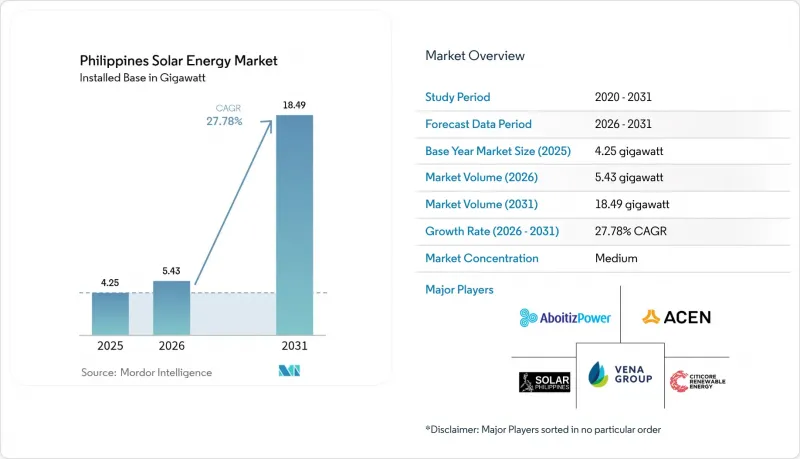
本報告按技術(太陽能和聚光太陽能)、併網類型(併網和離網)以及最終用戶(大型發電、商業和工業以及住宅)進行分類。市場規模和預測以裝置容量(GW)為單位。
菲律賓太陽能市場趨勢與洞察
太陽能模組和BOS成本快速下降
2023年,全球公用事業規模太陽能發電的平準化電力成本降至0.044美元/度時,較2010年下降90%。這顯著降低了菲律賓項目的資本支出。當地企業目前預計一級組件的成本低於0.19美元/瓦,擴大了專案利潤空間,並促使Sol-Go在菲律賓建立組裝線。系統相關成本(BOS)傳統上佔亞洲太陽能預算的75%,如今正成為國內價值創造的新來源,金屬框架、逆變器和電纜製造商正在調整業務以轉向出口。這些成本趨勢使菲律賓太陽能市場在與進口液化天然氣和傳統燃煤發電的競爭中更具優勢,加速了電力公司的採購和購電協議(PPA)的簽署。中期來看,這將進一步加強供應鏈,支持新興的本地製造基地,該基地到2030年預計每年供應3-5吉瓦的組件。
綠色能源競標(GEAP)預計將從 2025 年起刺激 1 吉瓦或以上的太陽能專案。
能源部採用競爭性競標模式,以價格發現機制取代上網電價補貼制度。首輪招標選定了一個1吉瓦的太陽能項目,並在第四輪競標中設定了9378兆瓦的目標,其中包括太陽能和儲能相結合的混合系統。開發商的熱情仍然高漲,第三輪全球能源拍賣(GEA-3)吸引了7500兆瓦的競標,超過了4650兆瓦的上限,從而確保了更低的購電價格和20年的穩定電力供應。與競標掛鉤的購電協議(PPA)降低了資金籌措風險,使貸款機構能夠縮小利差,並使開發商能夠透過增加儲能設施來提高產能利用率。第四輪及後續輪次強制納入電池儲能系統,顯示了相關政策在促進電網友善可再生能源發展方面的成熟度,這些政策能夠解決白天的棄電問題。總體而言,競標正在引導菲律賓太陽能市場走向可預測的建設週期和透明的成本標準。
維薩亞斯-棉蘭老島走廊電力傳輸能力不足
截至2023年,16個優先輸電項目中僅有6個完工,導致價值520億菲律賓披索的棉蘭老島-維薩亞斯主輸電網路建設工期延誤三年。這些瓶頸限制了呂宋島以南地區太陽能的開發,迫使開發商將專案集中在可併網的地區,導致豐富的太陽輻射資源未能充分利用。儘管「2022-2040年輸電發展規劃」概述了擴建計劃,但其實施速度遠不及輸電網路的需求。在高壓輸電線路建設滿足需求之前,工程儲備仍將高度集中在呂宋島。
細分市場分析
到2025年,太陽能將佔菲律賓太陽能裝置總量的100%,市佔率達100%。高效n型i-TOPCon和雙面組件的出現,提高了發電量並減少了土地面積,推動菲律賓太陽能市場以27.78%的複合年成長率快速成長。由於土地稀缺和颱風的影響,聚光太陽能發電(CSP)在商業性仍然不可行,能源部(DOE)的總體規劃中也沒有包含這項技術的具體目標。
市場正朝著使用串列型逆變器的設施和太陽能與儲能混合系統轉變,這將提高運轉率,並使企業能夠滿足其購電協議 (PPA) 中規定的全天候 (24/7) 採購要求。 Terra Solar 的 3.5 吉瓦太陽能發電和 4.5 吉瓦時儲能專案凸顯了這一混合趨勢,並鞏固了其與超大規模資料中心業者企業簽訂的長期供電合約。
其他好處:
- Excel格式的市場預測(ME)表
- 3個月的分析師支持
目錄
第1章:引言
- 研究假設和市場定義
- 調查範圍
第2章:調查方法
第3章執行摘要
第4章 市場狀況
- 市場概覽
- 市場促進因素
- 太陽能模組和BOS成本快速下降
- 透過綠色能源競標(GEAP),預計從 2025 年起將實現超過 1 吉瓦的太陽能計畫。
- 超大規模資料中心業者和業務流程外包 (BPO) 企業透過公司間購電協議 (PPA) 要求全天候 (24/7) 提供清潔電力。
- 美國能源部淨計量系統改革將把上限從 100 千瓦提高到 1 兆瓦(2024 年)。
- 在灌溉水庫引入漂浮式太陽能(與國家灌溉管理局的合作備忘錄)
- 東協各國出口商面臨調整碳排放邊界的壓力。
- 市場限制因素
- 維薩亞斯-棉蘭老島走廊電網容量不足
- 與越南和馬來西亞相比,資金籌措成本更高(加權平均資本成本超過9%)
- 根據《綜合土地改革法》農業用地法規,土地徵用引發爭議
- 由於颱風造成的營運和維護中斷,平準化能源成本增加了約 4%。
- 供應鏈分析
- 監理情勢
- 技術展望
- 波特五力模型
- PESTLE分析
第5章 市場規模與成長預測
- 透過技術
- 太陽能(光伏)
- 聚光型太陽熱能發電(CSP)
- 按電網連接類型
- 併網
- 離網
- 最終用戶
- 公用事業規模
- 商業和工業(C&I)
- 住宅
- 按成分(定性分析)
- 太陽能模組/面板
- 逆變器(組串式、集中式、微型)
- 安裝和追蹤系統
- 系統平衡和電氣設備
- 儲能和混合整合
第6章 競爭情勢
- 市場集中度
- 策略趨勢(併購、聯盟、購電協議)
- 市場佔有率分析(主要公司的市場排名和佔有率)
- 公司簡介
- Solar Philippines Power Project Holdings
- ACEN Corp.
- Vena Energy
- Citicore Power Inc.
- Aboitiz Power Corp.
- Solenergy Systems Inc.
- SunAsia Energy
- Helios Solar Energy Corp.
- Cleantech Global Renewables
- Trina Solar Ltd.
- Canadian Solar
- JinkoSolar
- First Gen Corp.
- Meralco PowerGen(MGen)
- Shell Pilipinas-Solar
- TotalEnergies-Solar
- NextGen Power
- Enfinity Global
- Rizal Wind-Solar Energy Corp.
- Greenergy Holdings
第7章 市場機會與未來展望
According to Mordor Intelligence, the Philippines solar energy market size is expected to grow from 4.25 gigawatt in 2025 to 5.43 gigawatt in 2026 and is forecast to reach 18.49 gigawatt by 2031 at 27.78% CAGR over 2026-2031.
This report is Segmented by Technology (Solar Photovoltaic and Concentrated Solar Power), Grid Type (On-Grid and Off-Grid), and End-User (Utility-Scale, Commercial and Industrial, and Residential). The Market Sizes and Forecasts are Provided in Terms of Installed Capacity (GW).
Philippines Solar Energy Market Trends and Insights
Rapid Decline in PV Module & BOS Costs
Global utility-scale solar leveledized costs fell to USD 0.044 /kWh in 2023, a 90% drop since 2010, slashing capital outlays for every Philippine project.Local firms now receive price quotes under USD 0.19 /W for Tier-1 modules, widening project margins and spurring Sol-Go to locate assembly lines in the country. Balance-of-system spending, historically 75% of Asian solar budgets, is becoming a new domestic value-add avenue, with metal frame, inverter, and cable manufacturers repositioning for export. This cost trajectory raises the competitive standing of the Philippines' solar energy market against imported LNG and legacy coal, accelerating utility procurement and corporate PPAs. Over the medium term, it also underpins a nascent local manufacturing base that could supply 3-5 GW of modules annually by 2030, further anchoring the supply chain.
Green Energy Auctions (GEAP) Unlocking >=1 GW Solar Pipeline from 2025
The Department of Energy's competitive tender model replaces static feed-in tariffs with price discovery, awarding 1 GW of solar in its inaugural round and setting a 9,378 MW target for the fourth auction that includes solar-storage hybrids. Developer appetite remains robust, GEA-3 drew 7,500 MW of solar bids for a 4,650 MW cap, compressing tariffs and ensuring 20-year off-take certainty. Auction-linked PPAs lower financing risk, enabling lenders to trim spreads and developers to stretch capacity factors with storage add-ons. The integration of mandatory battery systems from GEA-4 onwards signals policy maturation toward grid-friendly renewables that can address midday curtailment. Collectively, auctions move the Philippines' solar energy market toward predictable build-out cycles and transparent cost benchmarks.
Weak Grid Capacity in Visayas-Mindanao Corridor
Only 6 of 16 priority transmission projects were completed by 2023, delaying the PHP 52 billion Mindanao-Visayas backbone by three years.Bottlenecks restrict solar additions south of Luzon, compelling developers to cluster where interconnection is available and leaving ample irradiance unexploited. The Transmission Development Plan 2022-2040 maps expansions, but execution lags grid demand. Until high-voltage lines catch up, project pipelines will stay skewed toward Luzon.
Other drivers and restraints analyzed in the detailed report include:
- Corporate PPAs by Hyperscalers & BPOs Demanding 24/7 Clean Power
- DOE Net-Metering Reform Lifting 100 kW Cap to 1 MW (2024)
- High Financing Costs vs Vietnam & Malaysia (>=9% WACC)
For complete list of drivers and restraints, kindly check the Table Of Contents.
Segment Analysis
Solar photovoltaic accounted for the entire 2025 installation base, reinforcing a Philippines solar energy market share of 100.00%. High-efficiency n-type i-TOPCon and bifacial modules lift output and cut land needs, helping the Philippines' solar energy market size for PV rise at a 27.78% CAGR. CSP remains commercially non-viable due to land scarcity and typhoons, and the DOE master plan allocates no targets for the technology.
The market's equipment shift toward string inverters and hybrid PV-plus-storage architectures improves uptime and meets 24/7 procurement clauses in corporate PPAs. Terra Solar's 3.5 GW PV and 4.5 GWh storage confirm this hybrid trend, locking in long-duration supply contracts with hyperscalers.
Complete Report Scope:
- By Technology
- Solar Photovoltaic (PV)
- Concentrated Solar Power (CSP)
- By Grid Type
- On-Grid
- Off-Grid
- By End-User
- Utility-Scale
- Commercial and Industrial (C&I)
- Residential
- By Component (Qualitative Analysis)
- Solar Modules/Panels
- Inverters (String, Central, Micro)
- Mounting and Tracking Systems
- Balance-of-System and Electricals
- Energy Storage and Hybrid Integration
List of Companies Covered in this Report:
- Solar Philippines Power Project Holdings
- ACEN Corp.
- Vena Energy
- Citicore Power Inc.
- Aboitiz Power Corp.
- Solenergy Systems Inc.
- SunAsia Energy
- Helios Solar Energy Corp.
- Cleantech Global Renewables
- Trina Solar Ltd.
- Canadian Solar
- JinkoSolar
- First Gen Corp.
- Meralco PowerGen (MGen)
- Shell Pilipinas - Solar
- TotalEnergies - Solar
- NextGen Power
- Enfinity Global
- Rizal Wind-Solar Energy Corp.
- Greenergy Holdings
Additional Benefits:
- The market estimate (ME) sheet in Excel format
- 3 months of analyst support
TABLE OF CONTENTS
1 Introduction
- 1.1 Study Assumptions & Market Definition
- 1.2 Scope of the Study
2 Research Methodology
3 Executive Summary
4 Market Landscape
- 4.1 Market Overview
- 4.2 Market Drivers
- 4.2.1 Rapid decline in PV module & BOS costs
- 4.2.2 Green energy auctions (GEAP) unlocking >=1 GW solar pipeline from 2025
- 4.2.3 Corporate PPAs by hyperscalers & BPOs demanding 24/7 clean power
- 4.2.4 DOE net-metering reform lifting 100 kW cap to 1 MW (2024)
- 4.2.5 Floating-solar deployment on irrigation reservoirs (National Irrigation Admin MoU)
- 4.2.6 ASEAN-wide carbon border adjustment pressure on export manufacturers
- 4.3 Market Restraints
- 4.3.1 Weak grid capacity in Visayas-Mindanao corridor
- 4.3.2 High financing costs vs. Vietnam & Malaysia (>=9 % WACC)
- 4.3.3 Land-acquisition disputes under CARP agrarian rules
- 4.3.4 Typhoon-related O&M disruptions raising LCOE by ~4 %
- 4.4 Supply-Chain Analysis
- 4.5 Regulatory Landscape
- 4.6 Technological Outlook
- 4.7 Porter's Five Forces
- 4.7.1 Threat of New Entrants
- 4.7.2 Bargaining Power of Buyers
- 4.7.3 Bargaining Power of Suppliers
- 4.7.4 Threat of Substitutes
- 4.7.5 Competitive Rivalry
- 4.8 PESTLE Analysis
5 Market Size & Growth Forecasts
- 5.1 By Technology
- 5.1.1 Solar Photovoltaic (PV)
- 5.1.2 Concentrated Solar Power (CSP)
- 5.2 By Grid Type
- 5.2.1 On-Grid
- 5.2.2 Off-Grid
- 5.3 By End-User
- 5.3.1 Utility-Scale
- 5.3.2 Commercial and Industrial (C&I)
- 5.3.3 Residential
- 5.4 By Component (Qualitative Analysis)
- 5.4.1 Solar Modules/Panels
- 5.4.2 Inverters (String, Central, Micro)
- 5.4.3 Mounting and Tracking Systems
- 5.4.4 Balance-of-System and Electricals
- 5.4.5 Energy Storage and Hybrid Integration
6 Competitive Landscape
- 6.1 Market Concentration
- 6.2 Strategic Moves (M&A, Partnerships, PPAs)
- 6.3 Market Share Analysis (Market Rank/Share for key companies)
- 6.4 Company Profiles (includes Global level Overview, Market level overview, Core Segments, Financials as available, Strategic Information, Products & Services, and Recent Developments)
- 6.4.1 Solar Philippines Power Project Holdings
- 6.4.2 ACEN Corp.
- 6.4.3 Vena Energy
- 6.4.4 Citicore Power Inc.
- 6.4.5 Aboitiz Power Corp.
- 6.4.6 Solenergy Systems Inc.
- 6.4.7 SunAsia Energy
- 6.4.8 Helios Solar Energy Corp.
- 6.4.9 Cleantech Global Renewables
- 6.4.10 Trina Solar Ltd.
- 6.4.11 Canadian Solar
- 6.4.12 JinkoSolar
- 6.4.13 First Gen Corp.
- 6.4.14 Meralco PowerGen (MGen)
- 6.4.15 Shell Pilipinas - Solar
- 6.4.16 TotalEnergies - Solar
- 6.4.17 NextGen Power
- 6.4.18 Enfinity Global
- 6.4.19 Rizal Wind-Solar Energy Corp.
- 6.4.20 Greenergy Holdings
7 Market Opportunities & Future Outlook
- 7.1 White-space & Unmet-Need Assessment

 印度太陽能:市場佔有率分析、產業趨勢與統計及成長預測(2026-2031)太陽能:市場佔有率分析、產業趨勢與統計、成長預測(2026-2031)義大利太陽能市場:市場佔有率分析、產業趨勢與統計及成長預測(2026-2031)印尼太陽能市場:市場佔有率分析、產業趨勢與統計及成長預測(2026-2031)中國太陽能市場:市場佔有率分析、產業趨勢與統計及成長預測(2026-2031年)德國太陽能市場:市場佔有率分析、產業趨勢與統計及成長預測(2026-2031)日本太陽能市場:市場佔有率分析、產業趨勢與統計及成長預測(2026-2031年)法國太陽能:市場佔有率分析、產業趨勢與統計及成長預測(2026-2031)泰國太陽能市場:市場佔有率分析、產業趨勢與統計及成長預測(2026-2031)西班牙太陽能:市場佔有率分析、產業趨勢與統計及成長預測(2026-2031)