


 |
市場調查報告書
商品編碼
2121823
義大利太陽能市場:市場佔有率分析、產業趨勢與統計及成長預測(2026-2031)Italy Solar Energy - Market Share Analysis, Industry Trends & Statistics, Growth Forecasts (2026 - 2031) |
||||||

※ 本網頁內容可能與最新版本有所差異。詳細情況請與我們聯繫。
根據 Mordor Intelligence 的數據,2025 年義大利太陽能市場規模(以裝置容量計算)為 43.5 吉瓦,預計到 2031 年將從 2026 年的 49.37 吉瓦成長至 93.06 吉瓦,在預測期(2026-2031 年)複合年成長率為 13.9%。
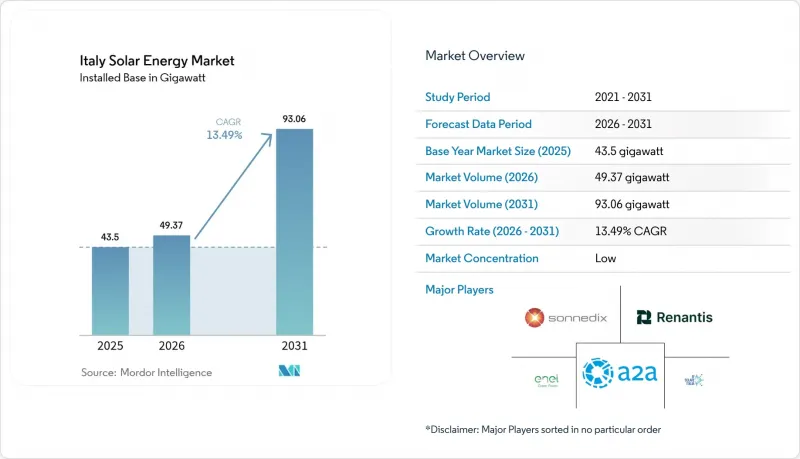
本報告按技術(光伏發電 (PV) 和聚光型太陽熱能發電(CSP))、電網類型(併網和離網)以及最終用戶(公用事業規模、工商業 (C&I)和住宅)進行分類。市場規模和預測以裝置容量(吉瓦,GW)表示。
義大利太陽能市場趨勢與洞察
太陽能發電的平準化電成本下降
2024年,義大利太陽能發電的平均低度電成本(LCOE)降至0.045歐元/千瓦時,首次在無補貼的情況下與傳統發電方式實現成本持平。主流晶體矽太陽能板的組件效率達22.5%,標準化的安裝系統進一步降低了系統外成本。在義大利南部,電力公司專案的LCOE已低至0.040歐元/千瓦時,使得燃氣調峰電廠僅扮演輔助角色。義大利本土逆變器製造商Fimer推出了一款效率高達99.2%的組串式逆變器,有效降低了轉換損耗,預計到2027年,成本將進一步降低。
歐盟的「REPowerEU」計畫和PNIEC的2030年目標
布魯塞爾已將義大利2030年的太陽能發電目標提高至85吉瓦,幾乎是先前義大利國家太陽能規劃(PNIEC)目標的兩倍,並引入季度合規性審查機制以保持政治關注。羅馬已從國家再生能源儲備基金(PNRR)中撥款69億歐元,其中60%用於南部地區的太陽能開發。該地區的「綠色走廊」已將50兆瓦以上電廠的授權期從24個月縮短至約8個月。此外,新建面積超過1000平方公尺的商業建築現在必須安裝屋頂太陽能發電系統,從而形成強勁的需求。
電網飽和冗長的授權程序
在北部電網,總裝置容量達23吉瓦的項目仍在等待核准,這可能導致併網時間延遲長達兩年,並在高需求地區將併網費用提高至每兆瓦8萬歐元。 Terna公司180億歐元的擴建計畫仍在如火如荼地進行中。開發商必須經過14項核准程序,光是環境影響評估一項就可能需要長達12個月的時間。雖然針對10兆瓦以下電廠的快速核准規則減輕了開發商的負擔,但這些規則對佔新增發電容量絕大部分的大型電廠幾乎沒有影響。
細分市場分析
到2025年,太陽能發電將佔新增太陽能發電裝置總量的99.97%。這主要得益於成熟的供應鏈和屋頂安裝的便利性。聚光型太陽熱能發電(CSP)目前裝置容量僅0.02吉瓦,但其年複合成長率高達104.7%,並有望透過利用6小時熔鹽儲熱系統來滿足晚間用電高峰需求。在西西里島,由於年均直射太陽輻射量超過2000千瓦時/平方米,CSP可以以與燃氣發電廠相當的固定費率發電,歐盟的分類標準也重視其電網穩定性。義大利國家電力公司(Enel)的綠色電力混合發電方案結合了CSP和太陽能發電,利用白天的太陽能發電和日落後的儲熱輸出,這種模式有望改變基本負載可再生能源的供應方式。
儘管義大利的聚光太陽能發電(CSP)市場規模仍然小規模,但綠色債券提供的優惠借貸條件正在降低資本成本。獨立發電商(IPP)已獲得為期25年的運作補貼(FIT)契約,涵蓋電力銷售和「容量等效」的營運擔保費,從而提高了風險調整後的盈利。強制要求50兆瓦以上專案提供電網支援服務的政策,實際上鼓勵了儲熱技術的發展,引導開發商轉向具有可調輸出特性的聚光太陽能發電專案。因此,中期成長更取決於組件供應商擴大專用接收器和鹽的生產規模的速度,而非技術風險。
其他好處
- Excel格式的市場預測(ME)表
- 3個月的分析師支持
目錄
第1章:引言
- 研究假設和市場定義
- 調查範圍
第2章:調查方法
第3章執行摘要
第4章 市場狀況
- 市場概覽
- 市場促進因素
- 太陽能發電的平準化電成本下降
- 歐盟的「REPowerEU」計畫和PNIEC的2030年目標
- 義大利製造業企業間購電協議(PPA)的蓬勃發展
- 住宅「超級獎勵」和稅額扣抵制度
- 農業用地提升了多用途土地的價值。
- 「用戶端」儲能成本與太陽能發電(PV)成本持平
- 市場限制因素
- 電網飽和冗長的授權程序
- 逐步減少超級獎金優惠待遇
- 關於農地地面太陽能發電的規定
- 當地居民的反對意見和有關景觀保護的法規
- 供應鏈分析
- 監理展望
- 技術展望
- 波特五力模型
- PESTLE分析
第5章 市場規模與成長預測
- 透過技術
- 太陽能發電(PV)
- 聚光型太陽熱能發電(CSP)
- 按網格類型
- 併網
- 離網
- 最終用戶
- 實用規模
- 商業和工業(C&I)
- 住宅
- 按成分(定性分析)
- 太陽能組件和麵板
- 逆變器(組串式、集中式、微型)
- 安裝和追蹤系統
- 系統平衡 - 電氣設備
- 儲能和混合整合
第6章 競爭情勢
- 市場集中度
- 策略趨勢(併購、聯盟、購電協議)
- 市場佔有率分析(主要公司的市場排名和佔有率)
- 公司簡介
- Enel Green Power SpA
- EF Solare Italia SpA
- Sonnedix Power Holdings Ltd
- Renantis SpA(前身為 Falck Renewables)
- A2A SpA
- Acea SpA
- Gruppo STG Srl
- Peimar Srl
- SunPower Corporation
- SunEdison Inc.
- Canadian Solar Inc.
- JinkoSolar Holding Co., Ltd.
- Trina Solar Co., Ltd.
- SMA Solar Technology AG
- Fimer SpA
- TerniEnergia SpA
- Sorgenia SpA
- Saras SpA(Sardeolica)
- NextEnergy Capital Group
- Engie Italia SpA
第7章 市場機會與未來展望
According to Mordor Intelligence, the Italy solar energy market size in terms of installed base was valued at 43.5 gigawatt in 2025 and estimated to grow from 49.37 gigawatt in 2026 to reach 93.06 gigawatt by 2031, at a CAGR of 13.49% during the forecast period (2026-2031).
This report is Segmented by Technology (Solar Photovoltaic and Concentrated Solar Power), Grid Type (On-Grid and Off-Grid), and End-User (Utility-Scale, Commercial and Industrial, and Residential). The Market Sizes and Forecasts are Provided in Terms of Installed Capacity (GW).
Italy Solar Energy Market Trends and Insights
Declining LCOE of PV Electricity
Italy's average solar LCOE fell to EUR 0.045/kWh in 2024, marking the first instance of subsidy-free parity with conventional generation. Module efficiencies reached 22.5% for mainstream crystalline panels, and standardized racking further trimmed balance-of-system expenses. Southern utility projects now deliver LCOE as low as EUR 0.040/kWh, pushing gas peakers into residual duty. Domestic inverter maker Fimer introduced 99.2% efficiency string models that reduce conversion losses, locking in cost reductions that are likely to deepen through 2027.
EU REPowerEU & PNIEC 2030 Targets
Brussels raised Italy's 2030 solar obligation to 85 GW, nearly doubling the earlier PNIEC figure and incorporating quarterly compliance reviews that maintain political focus. Rome earmarked EUR 6.9 billion in PNRR funds, with 60% dedicated to southern solar build-out. Regional "green corridors" have reduced permit cycles for sites exceeding 50 MW from 24 months to approximately 8 months, while new commercial buildings over 1,000 m2 are required to install rooftop systems, creating an assured demand pipeline.
Grid Saturation & Lengthy Permitting
Northern grids face 23 GW of queued projects, which delays connections by up to two years and increases interconnection fees to EUR 80,000/MW in hotspots. Terna's EUR 18 billion expansion plan is still ramping. Developers must navigate 14 approvals; environmental impact assessments alone can take up to 12 months. Fast-track rules for sub-10 MW plants ease pressure but do little for the large farms that dominate new capacity.
Other drivers and restraints analyzed in the detailed report include:
- Corporate-PPA Boom Among Italian Industrials
- Residential "Superbonus" & Tax-Credit Schemes
- Phase-down of Superbonus Incentives
For complete list of drivers and restraints, kindly check the Table Of Contents.
Segment Analysis
PV installations accounted for 99.97% of total additions in 2025, driven by mature supply chains and the ease of rooftop siting. Concentrated solar power, though scarcely 0.02 GW today, is accelerating at a 104.7% CAGR and could supply evening peaks with six-hour molten-salt storage. Sicily's high direct normal irradiance, exceeding 2,000 kWh/m2/year, enables CSP to dispatch at fixed tariffs that rival those of gas units, and the EU taxonomy favors its grid-firming traits. Enel Green Power's hybrid CSP-PV blueprint pairs up-front PV yields with stored thermal output after dusk, a template that could reshape baseload renewables.
The Italy solar energy market size for CSP remains modest, yet favorable debt terms under green bonds lower capital cost. Independent power producers secure 25-year feed-in contracts that cover both electricity and "capacity-like" availability payments, improving risk-adjusted returns. A policy requiring >=50 MW projects to demonstrate grid-support services implicitly rewards thermal storage, nudging developers toward CSPs' dispatchable profile. Medium-term growth thus hinges less on technology risk than on how quickly component suppliers can scale specialized receivers and salts.
Complete Report Scope:
- By Technology
- Solar Photovoltaic (PV)
- Concentrated Solar Power (CSP)
- By Grid Type
- On-Grid
- Off-Grid
- By End-User
- Utility-Scale
- Commercial and Industrial (C&I)
- Residential
- By Component (Qualitative Analysis)
- Solar Modules/Panels
- Inverters (String, Central, Micro)
- Mounting and Tracking Systems
- Balance-of-System and Electricals
- Energy Storage and Hybrid Integration
List of Companies Covered in this Report:
- Enel Green Power S.p.A.
- EF Solare Italia S.p.A.
- Sonnedix Power Holdings Ltd
- Renantis S.p.A. (ex-Falck Renewables)
- A2A S.p.A.
- Acea S.p.A.
- Gruppo STG S.r.l.
- Peimar S.r.l.
- SunPower Corporation
- SunEdison Inc.
- Canadian Solar Inc.
- JinkoSolar Holding Co., Ltd.
- Trina Solar Co., Ltd.
- SMA Solar Technology AG
- Fimer S.p.A.
- TerniEnergia S.p.A.
- Sorgenia S.p.A.
- Saras S.p.A. (Sardeolica)
- NextEnergy Capital Group
- Engie Italia S.p.A.
Additional Benefits:
- The market estimate (ME) sheet in Excel format
- 3 months of analyst support
TABLE OF CONTENTS
1 Introduction
- 1.1 Study Assumptions & Market Definition
- 1.2 Scope of the Study
2 Research Methodology
3 Executive Summary
4 Market Landscape
- 4.1 Market Overview
- 4.2 Market Drivers
- 4.2.1 Declining LCOE of PV Electricity
- 4.2.2 EU REPowerEU & PNIEC 2030 Targets
- 4.2.3 Corporate-PPA Boom Among Italian Industrials
- 4.2.4 Residential "Superbonus" & Tax-credit Schemes
- 4.2.5 Agrivoltaics Enhancing Dual-Use Land Value
- 4.2.6 Behind-the-Meter Storage Cost Parity with PV
- 4.3 Market Restraints
- 4.3.1 Grid Saturation & Lengthy Permitting
- 4.3.2 Phase-down of Superbonus Incentives
- 4.3.3 Restrictions on Ground-mount PV on Farmland
- 4.3.4 Local Opposition & Landscape-Protection Rules
- 4.4 Supply-Chain Analysis
- 4.5 Regulatory Outlook
- 4.6 Technological Outlook
- 4.7 Porter's Five Forces
- 4.7.1 Threat of New Entrants
- 4.7.2 Bargaining Power of Suppliers
- 4.7.3 Bargaining Power of Buyers
- 4.7.4 Threat of Substitutes
- 4.7.5 Competitive Rivalry
- 4.8 PESTLE Analysis
5 Market Size & Growth Forecast
- 5.1 By Technology
- 5.1.1 Solar Photovoltaic (PV)
- 5.1.2 Concentrated Solar Power (CSP)
- 5.2 By Grid Type
- 5.2.1 On-Grid
- 5.2.2 Off-Grid
- 5.3 By End-User
- 5.3.1 Utility-Scale
- 5.3.2 Commercial and Industrial (C&I)
- 5.3.3 Residential
- 5.4 By Component (Qualitative Analysis)
- 5.4.1 Solar Modules/Panels
- 5.4.2 Inverters (String, Central, Micro)
- 5.4.3 Mounting and Tracking Systems
- 5.4.4 Balance-of-System and Electricals
- 5.4.5 Energy Storage and Hybrid Integration
6 Competitive Landscape
- 6.1 Market Concentration
- 6.2 Strategic Moves (M&A, Partnerships, PPAs)
- 6.3 Market Share Analysis (Market Rank/Share for key companies)
- 6.4 Company Profiles (includes Global level Overview, Market level overview, Core Segments, Financials as available, Strategic Information, Products & Services, and Recent Developments)
- 6.4.1 Enel Green Power S.p.A.
- 6.4.2 EF Solare Italia S.p.A.
- 6.4.3 Sonnedix Power Holdings Ltd
- 6.4.4 Renantis S.p.A. (ex-Falck Renewables)
- 6.4.5 A2A S.p.A.
- 6.4.6 Acea S.p.A.
- 6.4.7 Gruppo STG S.r.l.
- 6.4.8 Peimar S.r.l.
- 6.4.9 SunPower Corporation
- 6.4.10 SunEdison Inc.
- 6.4.11 Canadian Solar Inc.
- 6.4.12 JinkoSolar Holding Co., Ltd.
- 6.4.13 Trina Solar Co., Ltd.
- 6.4.14 SMA Solar Technology AG
- 6.4.15 Fimer S.p.A.
- 6.4.16 TerniEnergia S.p.A.
- 6.4.17 Sorgenia S.p.A.
- 6.4.18 Saras S.p.A. (Sardeolica)
- 6.4.19 NextEnergy Capital Group
- 6.4.20 Engie Italia S.p.A.
7 Market Opportunities & Future Outlook
- 7.1 White-space & Unmet-need Assessment

 印度太陽能:市場佔有率分析、產業趨勢與統計及成長預測(2026-2031)太陽能:市場佔有率分析、產業趨勢與統計、成長預測(2026-2031)菲律賓太陽能:市場佔有率分析、產業趨勢與統計及成長預測(2026-2031 年)印尼太陽能市場:市場佔有率分析、產業趨勢與統計及成長預測(2026-2031)中國太陽能市場:市場佔有率分析、產業趨勢與統計及成長預測(2026-2031年)德國太陽能市場:市場佔有率分析、產業趨勢與統計及成長預測(2026-2031)日本太陽能市場:市場佔有率分析、產業趨勢與統計及成長預測(2026-2031年)法國太陽能:市場佔有率分析、產業趨勢與統計及成長預測(2026-2031)泰國太陽能市場:市場佔有率分析、產業趨勢與統計及成長預測(2026-2031)西班牙太陽能:市場佔有率分析、產業趨勢與統計及成長預測(2026-2031)