


 |
市場調查報告書
商品編碼
2120272
中國太陽能市場:市場佔有率分析、產業趨勢與統計及成長預測(2026-2031年)China Solar Energy - Market Share Analysis, Industry Trends & Statistics, Growth Forecasts (2026 - 2031) |
||||||

※ 本網頁內容可能與最新版本有所差異。詳細情況請與我們聯繫。
根據 Mordor Intelligence 預測,中國太陽能市場規模預計到 2026 年將達到 1410 吉瓦,高於 2025 年的 1230 吉瓦,預計到 2031 年將達到 2850 吉瓦,2026 年至 2031 年的複合年成長率為 15.03%。
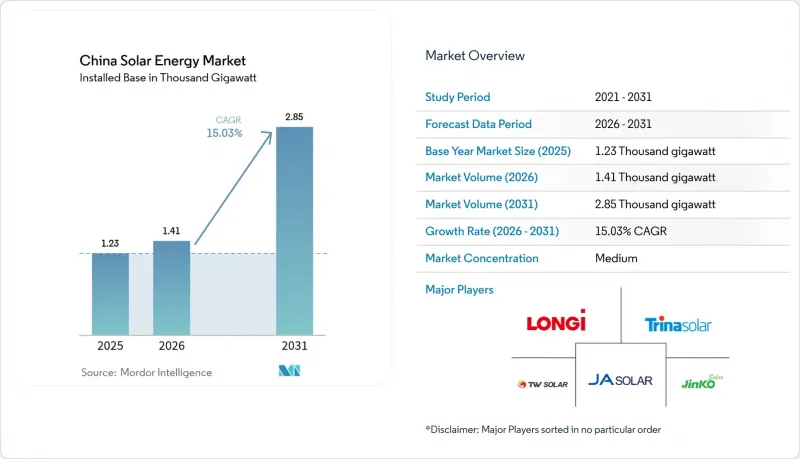
本報告按技術(太陽能和聚光太陽能)、連接類型(併網和離網)以及最終用戶(公用事業規模、商業和工業以及住宅)進行細分。市場規模和預測以裝置容量(GW)表示。
中國太陽能市場趨勢與洞察
歷史最低的組件價格正在提昇平準化度電成本的競爭力。
隨著全球需求達到600吉瓦,而中國產能飆升至861吉瓦,到2024年初,組件價格將降至0.75元/瓦。這項成本優勢使得太陽能的平準化度電成本(LCOE)在超過25個省份低於燃煤發電,從而使開發商能夠在無需補貼的情況下加快吉瓦級專案的建設。儘管產業結構調整不可避免,像隆基和晶科能源這樣的主要企業正受益於拓普康(TOPCon)的N型生產線,得以維持利潤率。
「十四五」規劃的目標是加速擴大裝置容量。
「十四五」規劃設定了2025年可再生能源裝置容量達到1,200吉瓦的目標,其中太陽能發電預計佔超過600吉瓦。這促使各省分別設定了50吉瓦、40吉瓦和35吉瓦的太陽能配額目標。 「商品搭售」規定要求每安裝1吉瓦太陽能發電設施,就必須配套建設200兆瓦的燃煤電廠或100兆瓦的儲能設施,這使得項目資本成本增加了高達20%,市場佔有率也集中在能夠自行採購關鍵投入的垂直一體化開發商手中。
西北地區電網擁塞限制了電力容量的運轉率。
儘管全國的發電限制正在逐步放寬,但在新疆和甘肅的部分地區,發電限制仍超過5%。青海至河南之間的±800千伏特高壓直流輸電線路在投產第一年輸送了8吉瓦的清潔電力,但由於非尖峰時段受電電網飽和,其平均利用率僅為60%。強制每新增10兆瓦發電容量配備兩小時儲能容量,將使成本增加每千瓦時0.015美元,這給中午批發電價低於每千瓦時0.03美元的地區的項目盈利帶來了壓力。
細分市場分析
預計2025年,中國太陽能市場裝置容量將達到1,223.24吉瓦,佔總裝置容量的99.45%。其中,聚光太陽能發電(CSP)裝置容量將達到6,760.76兆瓦。受隆基半導體27.09%和天合光能26.5%等突破性成果的推動,N型電池、拓普康(TOPCon)電池和異質結電池的國內市場佔有率將從2023年的25%成長到2024年的45%。在每千瓦時1.5元人民幣(約0.21美元)的上網電價補貼的支撐下,聚光太陽能發電預計將以18.95%的複合年成長率成長。該補貼有效降低了聚光太陽能發電的資本投資成本,其成本是傳統太陽能發電的三倍。
鈣鈦礦矽疊層電池在2024年實現了33.9%的實驗室效率,隨著一條旨在2027年實現量產的中試生產線的運作,預計未來其成本將與目前的單晶矽電池持平。青海正在建造的混合式聚光型太陽熱能發電(CSP)和光伏發電(PV)項目,將200兆瓦的熱能儲存系統與1吉瓦的太陽能發電相結合,可在日落後提供4小時的電力,預計其內部收益率(IRR)比單獨使用太陽能高出2個百分點。離網太陽能發電量佔年度新增裝置容量的比例不到9%,但其在電信基地台和邊境監控等策略性細分市場中作為柴油發電的替代方案的優勢,足以證明其較高價格的合理性。
其他好處:
- Excel格式的市場預測(ME)表
- 3個月的分析師支持
目錄
第1章:引言
- 研究假設和市場定義
- 調查範圍
第2章:調查方法
第3章執行摘要
第4章 市場狀況
- 市場概覽
- 市場促進因素
- 歷史最低的組件價格降低了平準化度電成本。
- 「十四五」計畫產能目標
- 企業購電協議(PPA)/綠色電力交易的蓬勃發展
- 新建公共建築必須強制安裝屋頂太陽能發電系統。
- 關於向併網相容逆變器維修的政策
- 聚光太陽能發電+儲能補貼計劃
- 市場限制因素
- 中國西北地區電網擁塞和發電限制
- 逐步取消固定價格採購制度及降低競標價格
- 中國模組的對外貿易壁壘
- 對新疆多晶矽供應的ESG審查
- 供應鏈分析
- 監理情勢
- 技術展望
- 波特五力模型
- PESTLE分析
第5章 市場規模與成長預測
- 透過技術
- 太陽能(光伏)
- 聚光型太陽熱能發電(CSP)
- 按連線類型
- 併網
- 離網
- 最終用戶
- 公用事業規模
- 商業和工業(C&I)
- 住宅
- 按組件
- 太陽能模組/面板
- 逆變器(組串式、集中式、微型)
- 安裝和追蹤系統
- 系統平衡和電氣設備
- 儲能和混合整合
第6章 競爭情勢
- 市場集中度
- 策略趨勢(併購、聯盟、購電協議)
- 市場佔有率分析(主要公司的市場排名和佔有率)
- 公司簡介
- LONGi Green Energy Technology Co Ltd
- Trina Solar Co Ltd
- JA Solar Technology Co Ltd
- JinkoSolar Holding Co Ltd
- Tongwei Solar Co Ltd
- Zhejiang Chint Electrics Co Ltd
- Hanwha Q CELLS Co Ltd
- Yingli Green Energy Holding Co Ltd
- Huasun Energy Co Ltd
- Drinda New Energy Technology Co Ltd
- GCL-Poly Energy Holdings Ltd
- Risen Energy Co Ltd
- Suntech Power Co Ltd
- Seraphim Solar System Co Ltd
- GoodWe Technologies Co Ltd
- Sungrow Power Supply Co Ltd
- Huawei Digital Power Technologies Co Ltd
- Tianjin Zhonghuan Semiconductor Co Ltd
- Aiko Solar Energy Co Ltd
- Shunfeng International Clean Energy Ltd
- Envision Energy Ltd
第7章 市場機會與未來展望
According to Mordor Intelligence, China solar energy market size in 2026 is estimated at 1.41 Thousand gigawatt, growing from 2025 value of 1.23 Thousand gigawatt with 2031 projections showing 2.85 Thousand gigawatt, growing at 15.03% CAGR over 2026-2031.
This report is Segmented by Technology (Solar Photovoltaic and Concentrated Solar Power), Grid Type (On-Grid and Off-Grid), and End-User (Utility-Scale, Commercial and Industrial, and Residential). The Market Sizes and Forecasts are Provided in Terms of Installed Capacity (GW).
China Solar Energy Market Trends and Insights
Record-Low Module Prices Drive LCOE Competitiveness
Module prices fell to RMB 0.75/W in early 2024 after China's manufacturing capacity ballooned to 861 GW against global demand of 600 GW. Cost leadership pushed solar LCOE below coal in more than 25 provinces, prompting developers to accelerate gigawatt-scale projects without subsidies. Industry consolidation is inevitable, yet leading firms such as LONGi and JinkoSolar benefit from N-type TOPCon lines that preserve margins.
14th Five-Year Plan Targets Accelerate Capacity Expansion
The 14th Five-Year Plan set a 1,200 GW renewable goal by 2025, with solar expected to add more than 600 GW, spurring provincial quotas of 50 GW in Shandong, 40 GW in Henan, and 35 GW in Jiangsu. Bundling mandates that pair every 1 GW of solar with 200 MW of coal or 100 MW of storage raise project capital costs by up to 20%, channeling market share toward vertically integrated developers able to internalize key inputs.
Grid Congestion Constrains Northwestern Capacity Utilization
Curtailment has subsided nationally but remains above 5% in parts of Xinjiang and Gansu. The Qinghai-Henan +-800 kV UHVDC corridor evacuated 8 GW of clean power in its first year but averaged only 60% utilization because receiving grids saturate during off-peak demand. Mandatory two-hour storage for every 10 MW of new capacity adds USD 0.015 per kWh, squeezing project returns in regions where midday wholesale prices drop below USD 0.03 per kWh.
Other drivers and restraints analyzed in the detailed report include:
- Corporate PPA Market Transforms Energy Procurement
- Mandatory Rooftop PV Policies Drive Distributed Growth
- Overseas Trade Barriers to Chinese Modules
For complete list of drivers and restraints, kindly check the Table Of Contents.
Segment Analysis
China's solar energy market size for photovoltaic technology stood at 1,223.24 GW in 2025, equaling 99.45% of total installed capacity, while CSP reached 6,760.76 MW. N-type variants, TOPCon, and heterojunction expanded their domestic shipment share from 25% in 2023 to 45% in 2024, encouraged by LONGi's world-leading 27.09% cell efficiency and Trina's 26.5% milestone. CSP is slated to grow at a 18.95% CAGR, buoyed by a feed-in premium of CNY 1.5 (USD 0.21) per kWh that cushions its three-times-higher capex compared with.
Perovskite-silicon tandems touched 33.9% laboratory efficiency in 2024, and pilot lines targeting mass production by 2027 suggest future cost parity with current mono-crystalline units. Hybrid CSP-PV projects under construction in Qinghai, pairing 200 MW of thermal storage with 1 GW of PV, promise four-hour post-sunset dispatch and 2 percentage-point higher IRRs versus standalone PV. Off-grid PV remains below 9% of yearly additions but serves strategic niches such as telecom base stations and border surveillance, where diesel displacement justifies premium pricing
Complete Report Scope:
- By Technology
- Solar Photovoltaic (PV)
- Concentrated Solar Power (CSP)
- By Connection Type
- On-Grid
- Off-Grid
- By End-User
- Utility-Scale
- Commercial and Industrial (C&I)
- Residential
- By Component (Qualitative Analysis)
- Solar Modules/Panels
- Inverters (String, Central, Micro)
- Mounting and Tracking Systems
- Balance-of-System and Electricals
- Energy Storage and Hybrid Integration
List of Companies Covered in this Report:
- LONGi Green Energy Technology Co Ltd
- Trina Solar Co Ltd
- JA Solar Technology Co Ltd
- JinkoSolar Holding Co Ltd
- Tongwei Solar Co Ltd
- Zhejiang Chint Electrics Co Ltd
- Hanwha Q CELLS Co Ltd
- Yingli Green Energy Holding Co Ltd
- Huasun Energy Co Ltd
- Drinda New Energy Technology Co Ltd
- GCL-Poly Energy Holdings Ltd
- Risen Energy Co Ltd
- Suntech Power Co Ltd
- Seraphim Solar System Co Ltd
- GoodWe Technologies Co Ltd
- Sungrow Power Supply Co Ltd
- Huawei Digital Power Technologies Co Ltd
- Tianjin Zhonghuan Semiconductor Co Ltd
- Aiko Solar Energy Co Ltd
- Shunfeng International Clean Energy Ltd
- Envision Energy Ltd
Additional Benefits:
- The market estimate (ME) sheet in Excel format
- 3 months of analyst support
TABLE OF CONTENTS
1 Introduction
- 1.1 Study Assumptions & Market Definition
- 1.2 Scope of the Study
2 Research Methodology
3 Executive Summary
4 Market Landscape
- 4.1 Market Overview
- 4.2 Market Drivers
- 4.2.1 Record-low module prices cut LCOE
- 4.2.2 14th Five-Year Plan capacity targets
- 4.2.3 Corporate PPAs/green-power trading boom
- 4.2.4 Mandatory rooftop PV on new public buildings
- 4.2.5 Grid-friendly inverter retrofits policy
- 4.2.6 CSP-plus-storage subsidy scheme
- 4.3 Market Restraints
- 4.3.1 Grid congestion & curtailment in NW China
- 4.3.2 Feed-in-tariff phase-out & low auction prices
- 4.3.3 Overseas trade barriers to Chinese modules
- 4.3.4 ESG scrutiny of Xinjiang polysilicon supply
- 4.4 Supply-Chain Analysis
- 4.5 Regulatory Landscape
- 4.6 Technological Outlook
- 4.7 Porter's Five Forces
- 4.7.1 Competitive Rivalry
- 4.7.2 Bargaining Power of Suppliers
- 4.7.3 Bargaining Power of Buyers
- 4.7.4 Threat of Substitutes
- 4.7.5 Threat of New Entrants
- 4.8 PESTLE Analysis
5 Market Size & Growth Forecasts
- 5.1 By Technology
- 5.1.1 Solar Photovoltaic (PV)
- 5.1.2 Concentrated Solar Power (CSP)
- 5.2 By Connection Type
- 5.2.1 On-Grid
- 5.2.2 Off-Grid
- 5.3 By End-User
- 5.3.1 Utility-Scale
- 5.3.2 Commercial and Industrial (C&I)
- 5.3.3 Residential
- 5.4 By Component (Qualitative Analysis)
- 5.4.1 Solar Modules/Panels
- 5.4.2 Inverters (String, Central, Micro)
- 5.4.3 Mounting and Tracking Systems
- 5.4.4 Balance-of-System and Electricals
- 5.4.5 Energy Storage and Hybrid Integration
6 Competitive Landscape
- 6.1 Market Concentration
- 6.2 Strategic Moves (M&A, Partnerships, PPAs)
- 6.3 Market Share Analysis (Market Rank/Share for key companies)
- 6.4 Company Profiles (includes Global level Overview, Market level overview, Core Segments, Financials as available, Strategic Information, Products & Services, and Recent Developments)
- 6.4.1 LONGi Green Energy Technology Co Ltd
- 6.4.2 Trina Solar Co Ltd
- 6.4.3 JA Solar Technology Co Ltd
- 6.4.4 JinkoSolar Holding Co Ltd
- 6.4.5 Tongwei Solar Co Ltd
- 6.4.6 Zhejiang Chint Electrics Co Ltd
- 6.4.7 Hanwha Q CELLS Co Ltd
- 6.4.8 Yingli Green Energy Holding Co Ltd
- 6.4.9 Huasun Energy Co Ltd
- 6.4.10 Drinda New Energy Technology Co Ltd
- 6.4.11 GCL-Poly Energy Holdings Ltd
- 6.4.12 Risen Energy Co Ltd
- 6.4.13 Suntech Power Co Ltd
- 6.4.14 Seraphim Solar System Co Ltd
- 6.4.15 GoodWe Technologies Co Ltd
- 6.4.16 Sungrow Power Supply Co Ltd
- 6.4.17 Huawei Digital Power Technologies Co Ltd
- 6.4.18 Tianjin Zhonghuan Semiconductor Co Ltd
- 6.4.19 Aiko Solar Energy Co Ltd
- 6.4.20 Shunfeng International Clean Energy Ltd
- 6.4.21 Envision Energy Ltd
7 Market Opportunities & Future Outlook
- 7.1 White-space & Unmet-Need Assessment

 印度太陽能:市場佔有率分析、產業趨勢與統計及成長預測(2026-2031)太陽能:市場佔有率分析、產業趨勢與統計、成長預測(2026-2031)義大利太陽能市場:市場佔有率分析、產業趨勢與統計及成長預測(2026-2031)菲律賓太陽能:市場佔有率分析、產業趨勢與統計及成長預測(2026-2031 年)印尼太陽能市場:市場佔有率分析、產業趨勢與統計及成長預測(2026-2031)德國太陽能市場:市場佔有率分析、產業趨勢與統計及成長預測(2026-2031)日本太陽能市場:市場佔有率分析、產業趨勢與統計及成長預測(2026-2031年)法國太陽能:市場佔有率分析、產業趨勢與統計及成長預測(2026-2031)泰國太陽能市場:市場佔有率分析、產業趨勢與統計及成長預測(2026-2031)西班牙太陽能:市場佔有率分析、產業趨勢與統計及成長預測(2026-2031)