


 |
市場調查報告書
商品編碼
2113210
法國太陽能:市場佔有率分析、產業趨勢與統計及成長預測(2026-2031)France Solar Energy - Market Share Analysis, Industry Trends & Statistics, Growth Forecasts (2026 - 2031) |
||||||

※ 本網頁內容可能與最新版本有所差異。詳細情況請與我們聯繫。
根據 Mordor Intelligence 估計,到 2026 年,法國太陽能市場規模將達到 32.94 吉瓦,高於 2025 年的 27.72 吉瓦,預計到 2031 年將達到 78.1 吉瓦。
預計從 2026 年到 2031 年,其複合年成長率將達到 18.84%。
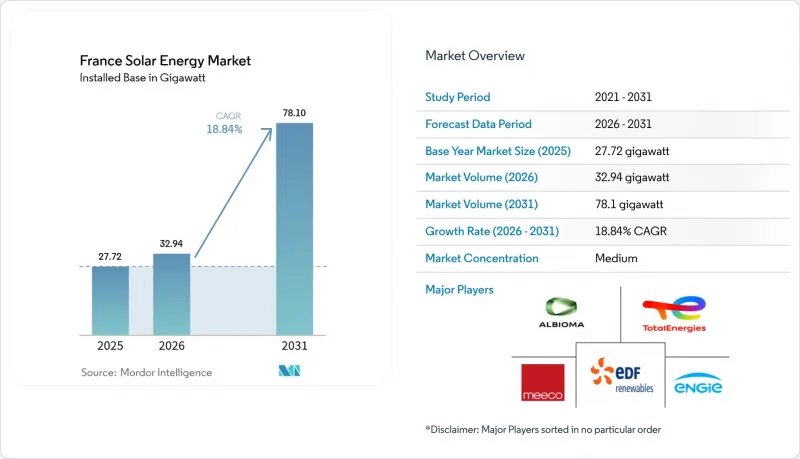
本報告按技術(光伏和聚光型太陽光電)、併網類型(併網和離網)以及最終用戶(公用事業規模、商業和工業以及住宅)進行細分。市場規模和預測以裝置容量(GW)表示。
法國太陽能市場趨勢與洞察
從固定收益融資(FIT)轉向差價合約(CfD)有助於提高投資者的內部報酬率(IRR)。
從政府強制實施的上網電價補貼(FiT)轉向競爭性差價合約(CfD)競標,減輕了納稅人的負擔,同時為開發商提供了長達20年的收益保障。儘管2024年地面安裝式太陽能競標的中標價格為54.45歐元/兆瓦時,低於前一年的63.30歐元/兆瓦時,但由於銀行擔保的是基於合約的現金流而非市場價格,因此未槓桿的內部收益率(IRR)仍保持在7-8%左右。獨立發電商(IPP)獲得了48%的中標項目,這表明差價合約正在為法國太陽能市場打開准入大門,並促進市場多元化。目前,競標擔保中的一項沒收條款要求開發商在18個月內完成融資,這鼓勵開發商儘早預訂併網並進行更嚴格的實質審查。此外,如果現貨價格超過執行價格,該機制允許政府收回超額利潤,從而維持公眾對可再生能源的支持。
降低平準化能源成本、競標結算價格
到2024年,雙面組件的效率將達到21-22%,追蹤系統的引入使發電量提高了15-20%,從而使大規模太陽能發電的平準化度電成本(LCOE)降至42-48歐元/兆瓦時。屋頂太陽能競標的競標價格也反映了這一下降趨勢,100-500千瓦系統的平均中標價格從2023年的105歐元/兆瓦時降至2024年的89歐元/兆瓦時。開發商致力於簡化供應鏈並實現設計標準化,以維持兩位數的利潤率。企業買家迅速抓住了這一機遇。道達爾能源公司於2024年簽署的為期15年的購電協議(PPA)將電價設定為52歐元/兆瓦時,低於零售電價,也低於市電平價。發電成本的下降將自用太陽能發電系統的投資回收期縮短至不到六年,加速了法國市場對分散式太陽能發電的採用。
併網等候名單及授權延誤
2024年,由於RTE變電站無法滿足激增的申請需求,平均併網週期延長至18-24個月。更嚴格的生物多樣性法規意味著環境影響評估現在需要12-18個月,加上上訴可能帶來的額外一年時間,這意味著在競標中贏得的容量中,可能有20-25%無法在截止日期前運作。 2024年,鐵路和公路沿線項目引入了快速核准程序,但由於地價飆升,進展緩慢。資金限制也是一個令人擔憂的問題。 RTE每年投資20-30億歐元,到2035年所需資金將達到1000億歐元,這將造成持續的資金瓶頸,並可能減緩法國太陽能市場的成長。
細分市場分析
光電發電佔法國太陽能裝置容量的100%,預計2025年將達到27.72吉瓦,凸顯了光電發電在法國太陽能市場的絕對主導地位。聚光型太陽熱能發電(CSP)仍未商業性,因為法國的直接標準太陽輻射強度很少超過1400千瓦時/平方米,遠低於聚光太陽能發電的實用化標準。晶體矽組件佔了95%的市場佔有率,而雙面組件目前已應用於45%的地面光伏陣列,發電量提高了10-15%。鈣鈦礦矽串聯電池在示範實驗中實現了28%的效率,預計未來效能將進一步提升。浮體式太陽能發電正在小規模發展,尤其是在土地資源有限的水庫中。整合儲能系統的混合項目在法國可再生能源署(CRE)的競標中仍然受到優先考慮。
法國太陽能市場正受益於技術的快速成熟,南部地區單軸追蹤器的滲透率高達60%,以及數位化資產管理工具的引入將性能指標提升了2-3個百分點,便是明證。政策措施也進一步增強了太陽能的優勢,80%的競標容量分配給了地面和屋頂太陽能發電,其餘部分則保留給混合型或農業光伏(農業光伏)設計。未來,包括Carbon公司3.4吉瓦異質結組件工廠在內的法國本土組件工廠可望增強供應鏈韌性,並有望在2026年前滿足在地採購要求。
其他好處:
- Excel格式的市場預測(ME)表
- 3個月的分析師支持
目錄
第1章:引言
- 研究假設和市場定義
- 調查範圍
第2章:調查方法
第3章執行摘要
第4章 市場狀況
- 市場概覽
- 市場促進因素
- 從上網電價補貼(FiT)轉向差價合約(CfD)正在提升投資者的內部報酬率(IRR)。
- 降低平準化能源成本和競標得標價格
- 2030年太陽能發電計畫:目標60吉瓦
- 強制要求在停車場和大規模屋頂上安裝太陽能發電設備。
- 在農田上開展太陽能發電試點項目,為農業用地開發鋪平了道路。
- 再生能源競標中太陽能發電和儲能的混合設計
- 市場限制因素
- 電網連接候機名單和授權程序延誤
- 關於土地利用和生物多樣性的反對意見
- 由於全球供應過剩,模組價格出現波動。
- 由於在地採購要求更加嚴格,資本投資正在增加。
- 供應鏈分析
- 監理情勢
- 技術展望
- 波特五力模型
- PESTLE分析
第5章 市場規模與成長預測
- 透過技術
- 太陽能發電(PV)
- 聚光型太陽熱能發電(CSP)
- 按網格類型
- 併網
- 離網
- 最終用戶
- 公用事業規模
- 商業和工業(C&I)
- 住宅
- 按成分(定性分析)
- 太陽能模組/面板
- 逆變器(組串式、集中式、微型)
- 安裝和追蹤系統
- 系統平衡和電氣設備
- 儲能和混合整合
第6章 競爭情勢
- 市場集中度
- 策略趨勢(併購、聯盟、購電協議)
- 市場佔有率分析(主要公司的市場排名和佔有率)
- 公司簡介
- EDF Renewables
- ENGIE SA
- TotalEnergies SE
- Neoen SA
- Voltalia SA
- Albioma SA
- Urbasolar
- Photosol
- Sonnedix
- Akuo Energy
- Cap Vert Energie
- Reden Solar
- Amarenco
- Enerparc AG
- BayWa re
- Quadran(Q Energy)
- Solairedirect
- Meeco AG
- Wagner Solar GmbH
- Arkolia Energies
第7章 市場機會與未來展望
According to Mordor Intelligence, France solar energy market size in 2026 is estimated at 32.94 gigawatt, growing from 2025 value of 27.72 gigawatt with 2031 projections showing 78.1 gigawatt, growing at 18.84% CAGR over 2026-2031.
This report is Segmented by Technology (Solar Photovoltaic and Concentrated Solar Power), Grid Type (On-Grid and Off-Grid), and End-User (Utility-Scale, Commercial and Industrial, and Residential). The Market Sizes and Forecasts are Provided in Terms of Installed Capacity (GW).
France Solar Energy Market Trends and Insights
FiT-to-CfD Transition Sustaining Investor IRR
The move from administratively set tariffs to competitive CfD auctions cut taxpayer exposure while giving developers 20-year revenue certainty. The 2024 ground-mounted tender cleared at EUR 54.45/MWh versus EUR 63.3/MWh a year earlier, yet unlevered internal rates of return held near 7-8% as banks underwrite contracted cash flows instead of merchant prices. Independent power producers captured 48% of the awarded volume, proving that CfDs democratize participation and diversify the France solar energy market. Bid-bond forfeiture clauses now oblige developers to reach financial close within 18 months, prompting early grid-connection reservations and more rigorous due diligence practices. The structure also allows the state to claw back excess revenues if spot prices exceed the strike price, preserving public support for renewables.
Declining LCOE and Auction Clearing Prices
Utility-scale LCOE fell to EUR 42-48/MWh in 2024 as bifacial efficiencies hit 21-22% and tracker adoption boosted yields by 15-20%. Rooftop auctions mirrored this decline, averaging EUR 89/MWh for 100-500 kW systems in 2024, down from EUR 105/MWh in 2023. Developers responded by streamlining supply chains and standardizing designs to protect double-digit margins. Corporate buyers quickly seized the opportunity: a 15-year PPA signed by TotalEnergies in 2024 priced power at EUR 52/MWh, which is cheaper than retail tariffs and below grid parity. Lower generation costs have shortened payback periods for behind-the-meter arrays to under six years, catalyzing distributed adoption in the France solar energy market.
Grid Connection Queue and Permitting Delays
Average connection times lengthened to 18-24 months in 2024 as RTE's substations could not keep up with the surge in applications. Environmental impact assessments now take 12-18 months under stricter biodiversity rules, while appeals add up to another year, placing 20-25% of auctioned capacity in danger of missing commissioning deadlines. Although fast-track procedures for projects along railways and highways were introduced in 2024, higher land costs have slowed uptake. Funding constraints also loom; RTE invests EUR 2-3 billion annually against a EUR 100 billion need through 2035, implying sustained bottlenecks that could dampen the France solar energy market.
Other drivers and restraints analyzed in the detailed report include:
- 2030 Solar Plan 60 GW Target
- Mandatory PV on Parking Lots and Large Roofs
- Module Price Volatility
For complete list of drivers and restraints, kindly check the Table Of Contents.
Segment Analysis
Solar photovoltaic accounted for 100.00% of installations, underscoring the absolute dominance of PV within the France solar energy market at 27.72 GW in 2025. Concentrated solar power (CSP) remains commercially absent because direct normal irradiance seldom exceeds 1,400 kWh/m2, far below the threshold for CSP viability. Crystalline-silicon modules hold 95% share, while bifacial panels now appear in 45% of ground-mounted arrays, improving yields by 10-15%. Perovskite-silicon tandem cells reached 28% efficiency in pilot settings, hinting at future upgrades. Floating PV is small but growing on reservoirs where land is scarce, and CRE tenders continue to prioritize hybrid projects that integrate storage.
The France solar energy market benefits from rapid technology maturity, evidenced by single-axis tracker penetration of 60% in southern provinces and digital asset-management tools that raise performance ratios by 2-3 percentage points. Policy levers reinforce PV's edge; 80% of auction capacity is allocated to ground-mounted and rooftop PV, with the rest reserved for hybrid or agri-PV designs. Looking ahead, domestic module factories such as Carbon's 3.4 GW heterojunction facility improve supply-chain resilience and may satisfy local-content rules by 2026.
Complete Report Scope:
- By Technology
- Solar Photovoltaic (PV)
- Concentrated Solar Power (CSP)
- By Grid Type
- On-Grid
- Off-Grid
- By End-User
- Utility-Scale
- Commercial and Industrial (C&I)
- Residential
- By Component (Qualitative Analysis)
- Solar Modules/Panels
- Inverters (String, Central, Micro)
- Mounting and Tracking Systems
- Balance-of-System and Electricals
- Energy Storage and Hybrid Integration
List of Companies Covered in this Report:
- EDF Renewables
- ENGIE SA
- TotalEnergies SE
- Neoen SA
- Voltalia SA
- Albioma SA
- Urbasolar
- Photosol
- Sonnedix
- Akuo Energy
- Cap Vert Energie
- Reden Solar
- Amarenco
- Enerparc AG
- BayWa r.e.
- Quadran (Q Energy)
- Solairedirect
- Meeco AG
- Wagner Solar GmbH
- Arkolia Energies
Additional Benefits:
- The market estimate (ME) sheet in Excel format
- 3 months of analyst support
TABLE OF CONTENTS
1 Introduction
- 1.1 Study Assumptions & Market Definition
- 1.2 Scope of the Study
2 Research Methodology
3 Executive Summary
4 Market Landscape
- 4.1 Market Overview
- 4.2 Market Drivers
- 4.2.1 FiT-to-CfD transition sustaining investor IRR
- 4.2.2 Declining LCOE & auction clearing prices
- 4.2.3 2030 Solar Plan: 60 GW target
- 4.2.4 Mandatory PV on parking lots & large roofs
- 4.2.5 Agri-PV pilots unlocking farmland pipeline
- 4.2.6 Hybrid PV-storage design in CRE tenders
- 4.3 Market Restraints
- 4.3.1 Grid connection queue & permitting delays
- 4.3.2 Land-use & biodiversity opposition
- 4.3.3 Module price volatility amid global oversupply
- 4.3.4 Rising local-content requirements raising capex
- 4.4 Supply-Chain Analysis
- 4.5 Regulatory Landscape
- 4.6 Technological Outlook
- 4.7 Porters Five Forces
- 4.7.1 Threat of New Entrants
- 4.7.2 Bargaining Power of Suppliers
- 4.7.3 Bargaining Power of Buyers
- 4.7.4 Threat of Substitutes
- 4.7.5 Competitive Rivalry
- 4.8 PESTLE Analysis
5 Market Size & Growth Forecasts
- 5.1 By Technology
- 5.1.1 Solar Photovoltaic (PV)
- 5.1.2 Concentrated Solar Power (CSP)
- 5.2 By Grid Type
- 5.2.1 On-Grid
- 5.2.2 Off-Grid
- 5.3 By End-User
- 5.3.1 Utility-Scale
- 5.3.2 Commercial and Industrial (C&I)
- 5.3.3 Residential
- 5.4 By Component (Qualitative Analysis)
- 5.4.1 Solar Modules/Panels
- 5.4.2 Inverters (String, Central, Micro)
- 5.4.3 Mounting and Tracking Systems
- 5.4.4 Balance-of-System and Electricals
- 5.4.5 Energy Storage and Hybrid Integration
6 Competitive Landscape
- 6.1 Market Concentration
- 6.2 Strategic Moves (M&A, Partnerships, PPAs)
- 6.3 Market Share Analysis (Market Rank/Share for key companies)
- 6.4 Company Profiles (includes Global level Overview, Market level overview, Core Segments, Financials as available, Strategic Information, Products & Services, and Recent Developments)
- 6.4.1 EDF Renewables
- 6.4.2 ENGIE SA
- 6.4.3 TotalEnergies SE
- 6.4.4 Neoen SA
- 6.4.5 Voltalia SA
- 6.4.6 Albioma SA
- 6.4.7 Urbasolar
- 6.4.8 Photosol
- 6.4.9 Sonnedix
- 6.4.10 Akuo Energy
- 6.4.11 Cap Vert Energie
- 6.4.12 Reden Solar
- 6.4.13 Amarenco
- 6.4.14 Enerparc AG
- 6.4.15 BayWa r.e.
- 6.4.16 Quadran (Q Energy)
- 6.4.17 Solairedirect
- 6.4.18 Meeco AG
- 6.4.19 Wagner Solar GmbH
- 6.4.20 Arkolia Energies
7 Market Opportunities & Future Outlook
- 7.1 White-Space & Unmet-Need Assessment

 2034年太陽能市場預測-全球分析(按太陽能組件類型、組件、逆變器類型、安裝和追蹤系統、專案規模、太陽能電池技術、技術、應用、最終用戶和地區分類)
 印度太陽能:市場佔有率分析、產業趨勢與統計及成長預測(2026-2031)太陽能:市場佔有率分析、產業趨勢與統計、成長預測(2026-2031)義大利太陽能市場:市場佔有率分析、產業趨勢與統計及成長預測(2026-2031)菲律賓太陽能:市場佔有率分析、產業趨勢與統計及成長預測(2026-2031 年)印尼太陽能市場:市場佔有率分析、產業趨勢與統計及成長預測(2026-2031)中國太陽能市場:市場佔有率分析、產業趨勢與統計及成長預測(2026-2031年)德國太陽能市場:市場佔有率分析、產業趨勢與統計及成長預測(2026-2031)日本太陽能市場:市場佔有率分析、產業趨勢與統計及成長預測(2026-2031年)泰國太陽能市場:市場佔有率分析、產業趨勢與統計及成長預測(2026-2031)