


 |
市場調查報告書
商品編碼
2120658
德國太陽能市場:市場佔有率分析、產業趨勢與統計及成長預測(2026-2031)Germany Solar Energy - Market Share Analysis, Industry Trends & Statistics, Growth Forecasts (2026 - 2031) |
||||||

※ 本網頁內容可能與最新版本有所差異。詳細情況請與我們聯繫。
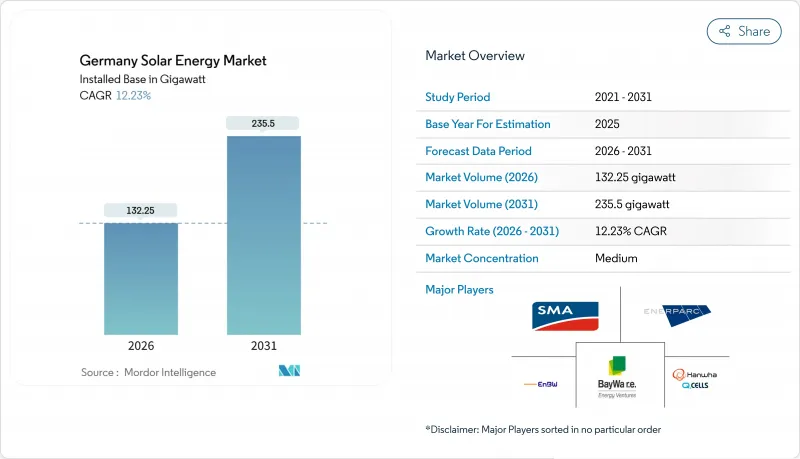
德國太陽能市場規模(以裝置容量計算)預計將從 2026 年的 132.25 吉瓦擴大到 2031 年的 235.5 吉瓦,預測期(2026-2031 年)的複合年成長率為 12.23%。
本報告按技術(光伏和聚光型太陽光電)、併網類型(併網和離網)以及最終用戶(公用事業規模、商業和工業以及住宅)進行細分。市場規模和預測以裝置容量(GW)表示。
德國太陽能市場趨勢與洞察
「太陽能方案 i」和強制在屋頂安裝太陽能電池板加快了核准流程。
2024 年推出的「太陽能第一方案」簡化了報名手續,並將陽台太陽能逆變器的輸出功率上限提高至 800 瓦,允許租戶無需房東同意即可自行安裝系統。截至 2024 年底,註冊量達到約 78 萬套,一年內新增 43.5 萬套系統,佔全國新增太陽能裝置量的 2.6%。目前,巴登-符騰堡州和巴伐利亞州已強制要求新建建築屋頂安裝太陽能板,將平均許可證核准時間從 18 個月縮短至不到 6 個月,預計成長率將提高約 2.1 個百分點。 2025 年 10 月,屋頂太陽能競標數量略有增加,以每千瓦時 9.66 美分的價格中標 281 兆瓦,證實了先前的成長動能。這一趨勢在南部各州最為顯著,但隨著其他地區遵守修訂後的《建築能源性能指令》,預計這一趨勢也將擴展到其他地區。
企業購電協議的蓬勃發展正在促進那些不依賴補貼的電力項目的發展。
面向企業的長期購電協議 (PPA) 正日益取代補貼競標。 Energiekontor 與 Currenta 簽訂的 2024 年電力供應契約,為一家化工園區供電,這表明工業需求者如何透過鎖定固定價格的太陽能電力來對沖批發電力價格波動的風險。非補貼項目也正在推動成長,因為開發商可以獲得超出競標上限的電廠資金籌措。北萊茵-威斯特法倫州和下薩克森州主導這一趨勢,這兩個州擁有大規模的工業需求、較低的限電風險以及快速併網能力。組件價格的下降使得開發商能夠提供低於 5 美分/千瓦時的購電協議價格,這將進一步加速 2028 年前的交易進程。
電力分配網路堵塞,並造成長達 24 個月的併網延遲。
在巴伐利亞州和巴登-符騰堡州,併網等待時間已接近24個月,導致專案現金流放緩,基準複合年成長率下降1.9個百分點。 2022年調整成本超過40億歐元,2024年尖峰日陸上太陽能發電棄電率超過13%,顯示電網容量有限。開發商正將項目計劃轉移到下薩克森州和北萊茵-威斯特法倫州,但即使在這些地區,變壓器位也迅速被佔用,迫使競標價格中考慮較低的收購成本。聯邦網路管理局(Bundesnetzagentur)在2024年發放了約3,800份併網許可,但許可和通電之間的差距正在逐季擴大。除非電纜升級加快,否則德國太陽能市場將面臨分階段運作的局面,這將在近期限制新的裝置容量。
細分市場分析
到2025年,光伏發電將佔德國太陽能市場佔有率的100%,預計到2031年將以每年12.2%的速度成長。弗勞恩霍夫太陽能系統研究所(Fraunhofer ISE)和韓華Q CELLS公司於2024年認證了30.8%鈣鈦礦矽疊層電池,這意味著商用組件可能在2028年問世。因此,效率的顯著提升比矽的總量更為重要。更高的功率密度可降低高達15%的安裝成本和土地成本,這至關重要,因為授權優先考慮現有用地(棕地)。在巴伐利亞州的Agri-Boldeig試點計畫中,農作物和光伏板在架高的雙面光追蹤器下共存,這不僅減少了對土地利用的反對意見,也增加了農民的收入來源。集中式光伏發電仍停滯不前,因為漫射太陽輻射會削弱其動態優勢。
儘管鈣鈦礦的耐久性仍面臨挑戰,但2010年至2020年間,德國的研究經費佔歐盟私人太陽能研發支出的64%,顯示德國國內研究機構有能力解決此問題。如果銀行融資的可行性得到證實,電力公司將能夠以每公里輸電線路輸送更多兆瓦的電力,從而緩解部分發電限制。因此,德國太陽能市場具有內在的技術提升潛力,可以透過提高面積裝機面積的發電量來緩解未來的電網壓力。
其他好處:
- Excel格式的市場預測(ME)表
- 3個月的分析師支持
目錄
第1章:引言
- 研究假設和市場定義
- 調查範圍
第2章:調查方法
第3章執行摘要
第4章 市場狀況
- 市場概覽
- 市場促進因素
- 由於「太陽能方案 i」和強制在屋頂安裝太陽能板的規定,核准流程正在加快。
- 公司間購電協議 (PPA) 的激增正在推動無補貼的公共產業項目。
- 電網連接費用的不斷上漲正在推動用戶採用太陽能發電和儲能技術。
- 在租屋居住者推廣陽台太陽能發電
- 模組價格下降了 87%,使得成本與批發價格持平。
- 新建築規範中對整合式建築整合太陽能(BIPV)的要求(自2026年起生效)
- 市場限制因素
- 電網擁塞和24個月的等待時間
- 合格電工和安裝工人短缺
- 歐盟製造的模組與中國製造的模組之間存在 60% 的成本差異,這會造成供應風險。
- 上網電價補貼 (FIT) 制度的削減和補貼計劃的突然變化正在降低住宅太陽能發電的投資回報率 (ROI)。
- 供應鏈分析
- 監理趨勢(EEG 2023、太陽能方案一、各州強制屋頂安裝)
- 技術趨勢(鈣鈦礦串聯結構、農業光伏、車輛整合太陽能發電)
- 波特五力模型
- PESTLE分析
第5章 市場規模與成長預測
- 透過技術
- 太陽能發電(PV)
- 聚光型太陽熱能發電(CSP)
- 按網格類型
- 併網
- 離網
- 最終用戶
- 公用事業規模
- 商業和工業(C&I)
- 住宅
- 按成分(定性分析)
- 太陽能模組/面板
- 逆變器(組串式、集中式、微型)
- 安裝和追蹤系統
- 系統平衡和電氣設備
- 儲能和混合整合
第6章 競爭情勢
- 市場集中度
- 策略趨勢(併購、聯盟、購電協議)
- 市場佔有率分析(主要公司的市場排名和佔有率)
- 公司簡介
- BayWa re AG
- SMA Solar Technology AG
- EnBW Energie Baden-Wurttemberg AG
- Hanwha Q CELLS GmbH
- IBC Solar AG
- Enerparc AG
- RWE Renewables GmbH
- Encavis AG
- juwi GmbH
- ABO Wind AG
- Vattenfall GmbH
- BayWa re Power Solutions GmbH
- Next2Sun GmbH
- Solnet Green Energy OY
- Axitec Energy GmbH & Co. KG
- Solarwatt GmbH
- Meyer Burger Technology AG(Freiberg)
- Tesla Germany GmbH(Powerwall & Roof)
- 1KOMMA5°GmbH
- Centrotherm International AG
第7章 市場機會與未來展望
According to Mordor Intelligence, the Germany solar energy market size in terms of installed base is expected to grow from 132.25 gigawatt in 2026 to 235.5 gigawatt by 2031, at a CAGR of 12.23% during the forecast period (2026-2031).
This report is Segmented by Technology (Solar Photovoltaic and Concentrated Solar Power), Grid Type (On-Grid and Off-Grid), and End-User (Utility-Scale, Commercial and Industrial, and Residential). The Market Sizes and Forecasts are Provided in Terms of Installed Capacity (GW).
Germany Solar Energy Market Trends and Insights
Solar Package I & Rooftop Mandates Accelerating Approvals
The 2024 Solar Package I simplified registrations and raised the balcony-PV inverter limit to 800 W, allowing tenants to self-install systems without landlord consent. Registrations reached about 780,000 units by year-end 2024, adding 435,000 systems in a single year and equaling 2.6% of national solar additions. State-level mandates now require solar on new roofs in Baden-Wurttemberg and Bavaria, cutting average permitting times from 18 months to under six and adding roughly 2.1 percentage points to forecast growth. Rooftop auction volumes ticked up in October 2025, with 281 MW awarded at 9.66 cents/kWh, confirming early traction. The driver is strongest in southern states, but uptake is expected to broaden as other regions align with the revised Energy Performance of Buildings Directive.
Corporate PPA Boom Lifting Unsubsidised Utility Projects
Long-term corporate PPAs are increasingly displacing subsidy auctions. Energiekontor's 2024 deal with Currenta to power a chemical park shows industrial buyers locking in fixed-price solar to hedge wholesale volatility. Unsubsidised projects already propel growth because developers can finance plants outside capped auction volumes. North Rhine-Westphalia and Lower Saxony lead activity thanks to large industrial loads, lower curtailment risk, and quicker grid connections. Falling module prices let developers offer PPA rates below 5 cents/kWh, supporting pipeline acceleration through 2028.
Distribution-Grid Congestion & 24-Month Queue Times
Connection backlogs near 24 months in Bavaria and Baden-Wurttemberg delay project cashflow and shave 1.9 percentage points off the baseline CAGR. Redispatch costs above EUR 4 billion in 2022 and onshore solar curtailment topping 13% on peak 2024 days illustrate the grid's limited headroom. Developers are redirecting pipelines toward Lower Saxony and North Rhine-Westphalia, yet even there, transformer slots fill fast, forcing bids to price in lower capture rates. Bundesnetzagentur still issued around 3,800 connection commitments in 2024, but the gap between commitment and energization widens every quarter. Unless accelerated cable upgrades materialize, the German solar energy market faces staggered commissioning schedules that dampen near-term additions.
Other drivers and restraints analyzed in the detailed report include:
- Rising Grid-Fee Inflation Driving Behind-the-Meter PV + Storage
- Mass Adoption of Balcony-Plug-in PV by Renters
- Skilled-Labour Shortages in Licensed Electricians & Installers
For complete list of drivers and restraints, kindly check the Table Of Contents.
Segment Analysis
Solar PV held 100% of Germany's solar energy market share in 2025 and is forecast to expand at 12.2% annually through 2031. Efficiency leaps matter more than raw silicon volume now that Fraunhofer ISE and Hanwha Q CELLS certified a 30.8% perovskite-silicon tandem cell in 2024, hinting at commercial modules by 2028. Higher power density can cut racking and land costs up to 15%, a vital lever as permitting favors brownfield sites. Agrivoltaic pilots in Bavaria show crops and panels co-existing under elevated bifacial trackers, easing land-use opposition and broadening farmer income. Concentrated solar power remains absent because diffuse irradiation weakens its thermodynamic advantage.
Perovskite durability is the remaining hurdle, but German research spending represented 64% of EU private PV R&D during 2010-2020, positioning domestic labs to solve it. Once bankability proofs emerge, utility developers can fit more megawatts per kilometer of feeder line, alleviating some curtailment. The German solar energy market, therefore, embeds a technology upside optionality that could temper future grid constraints by delivering more output per site footprint.
Complete Report Scope:
- By Technology
- Solar Photovoltaic (PV)
- Concentrated Solar Power (CSP)
- By Grid Type
- On-Grid
- Off-Grid
- By End-User
- Utility-Scale
- Commercial and Industrial (C&I)
- Residential
- By Component (Qualitative Analysis)
- Solar Modules/Panels
- Inverters (String, Central, Micro)
- Mounting and Tracking Systems
- Balance-of-System and Electricals
- Energy Storage and Hybrid Integration
List of Companies Covered in this Report:
- BayWa r.e. AG
- SMA Solar Technology AG
- EnBW Energie Baden-Wurttemberg AG
- Hanwha Q CELLS GmbH
- IBC Solar AG
- Enerparc AG
- RWE Renewables GmbH
- Encavis AG
- juwi GmbH
- ABO Wind AG
- Vattenfall GmbH
- BayWa r.e. Power Solutions GmbH
- Next2Sun GmbH
- Solnet Green Energy OY
- Axitec Energy GmbH & Co. KG
- Solarwatt GmbH
- Meyer Burger Technology AG (Freiberg)
- Tesla Germany GmbH (Powerwall & Roof)
- 1KOMMA5° GmbH
- Centrotherm International AG
Additional Benefits:
- The market estimate (ME) sheet in Excel format
- 3 months of analyst support
TABLE OF CONTENTS
1 Introduction
- 1.1 Study Assumptions & Market Definition
- 1.2 Scope of the Study
2 Research Methodology
3 Executive Summary
4 Market Landscape
- 4.1 Market Overview
- 4.2 Market Drivers
- 4.2.1 Solar Package I & Rooftop Mandates Accelerating Approvals
- 4.2.2 Corporate PPA Boom Lifting Unsubsidised Utility Projects
- 4.2.3 Rising Grid-Fee Inflation Driving Behind-the-Meter PV + Storage
- 4.2.4 Mass Adoption of Balcony-Plug-in PV by Renters
- 4.2.5 87 % Module-Price Collapse Enables Cost-Parity vs. Wholesale
- 4.2.6 Integrated BIPV Requirements in New-Build Codes (from 2026)
- 4.3 Market Restraints
- 4.3.1 Distribution-Grid Congestion & 24-Month Queue Times
- 4.3.2 Skilled-Labour Shortages in Licensed Electricians & Installers
- 4.3.3 60 % Cost Gap on EU-vs-China Modules Creating Supply-Risk
- 4.3.4 Declining FiTs & Sudden Subsidy Tweaks Eroding Residential ROI
- 4.4 Supply-Chain Analysis
- 4.5 Regulatory Outlook (EEG 2023, Solar-Paket I, State Rooftop Mandates)
- 4.6 Technological Outlook (Perovskite Tandems, Agrivoltaics, Vehicle-Integrated PV)
- 4.7 Porter's Five Forces
- 4.7.1 Competitive Rivalry
- 4.7.2 Threat of New Entrants
- 4.7.3 Bargaining Power of Buyers
- 4.7.4 Bargaining Power of Suppliers
- 4.7.5 Threat of Substitutes (Wind, Heat-Pumps, Demand Response)
- 4.8 PESTLE Analysis
5 Market Size & Growth Forecasts
- 5.1 By Technology
- 5.1.1 Solar Photovoltaic (PV)
- 5.1.2 Concentrated Solar Power (CSP)
- 5.2 By Grid Type
- 5.2.1 On-Grid
- 5.2.2 Off-Grid
- 5.3 By End-User
- 5.3.1 Utility-Scale
- 5.3.2 Commercial and Industrial (C&I)
- 5.3.3 Residential
- 5.4 By Component (Qualitative Analysis)
- 5.4.1 Solar Modules/Panels
- 5.4.2 Inverters (String, Central, Micro)
- 5.4.3 Mounting and Tracking Systems
- 5.4.4 Balance-of-System and Electricals
- 5.4.5 Energy Storage and Hybrid Integration
6 Competitive Landscape
- 6.1 Market Concentration
- 6.2 Strategic Moves (M&A, Partnerships, PPAs)
- 6.3 Market Share Analysis (Market Rank/Share for key companies)
- 6.4 Company Profiles (includes Global level Overview, Market level overview, Core Segments, Financials as available, Strategic Information, Products & Services, and Recent Developments)
- 6.4.1 BayWa r.e. AG
- 6.4.2 SMA Solar Technology AG
- 6.4.3 EnBW Energie Baden-Wurttemberg AG
- 6.4.4 Hanwha Q CELLS GmbH
- 6.4.5 IBC Solar AG
- 6.4.6 Enerparc AG
- 6.4.7 RWE Renewables GmbH
- 6.4.8 Encavis AG
- 6.4.9 juwi GmbH
- 6.4.10 ABO Wind AG
- 6.4.11 Vattenfall GmbH
- 6.4.12 BayWa r.e. Power Solutions GmbH
- 6.4.13 Next2Sun GmbH
- 6.4.14 Solnet Green Energy OY
- 6.4.15 Axitec Energy GmbH & Co. KG
- 6.4.16 Solarwatt GmbH
- 6.4.17 Meyer Burger Technology AG (Freiberg)
- 6.4.18 Tesla Germany GmbH (Powerwall & Roof)
- 6.4.19 1KOMMA5° GmbH
- 6.4.20 Centrotherm International AG
7 Market Opportunities & Future Outlook
- 7.1 White-Space & Unmet-Need Assessment (e.g., Vehicle-to-Grid PV, Industrial Heat-via-PV-Electrolysis)

 印度太陽能:市場佔有率分析、產業趨勢與統計及成長預測(2026-2031)太陽能:市場佔有率分析、產業趨勢與統計、成長預測(2026-2031)義大利太陽能市場:市場佔有率分析、產業趨勢與統計及成長預測(2026-2031)菲律賓太陽能:市場佔有率分析、產業趨勢與統計及成長預測(2026-2031 年)印尼太陽能市場:市場佔有率分析、產業趨勢與統計及成長預測(2026-2031)中國太陽能市場:市場佔有率分析、產業趨勢與統計及成長預測(2026-2031年)日本太陽能市場:市場佔有率分析、產業趨勢與統計及成長預測(2026-2031年)法國太陽能:市場佔有率分析、產業趨勢與統計及成長預測(2026-2031)泰國太陽能市場:市場佔有率分析、產業趨勢與統計及成長預測(2026-2031)西班牙太陽能:市場佔有率分析、產業趨勢與統計及成長預測(2026-2031)