

 |
市場調查報告書
商品編碼
2120557
日本太陽能市場:市場佔有率分析、產業趨勢與統計及成長預測(2026-2031年)Japan Solar Energy - Market Share Analysis, Industry Trends & Statistics, Growth Forecasts (2026 - 2031) |
||||||

※ 本網頁內容可能與最新版本有所差異。詳細情況請與我們聯繫。
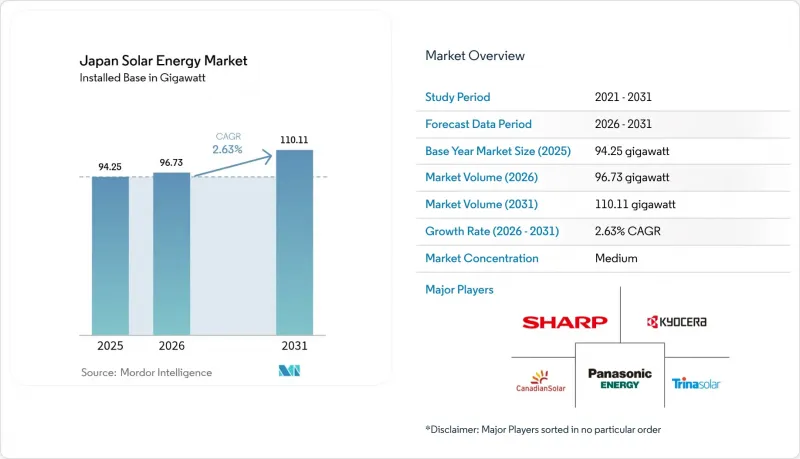
根據 Mordor Intelligence 估計,日本太陽能市場規模在 2025 年為 94.25 吉瓦,預計到 2031 年將從 2026 年的 96.73 吉瓦成長到 110.11 吉瓦,在預測期(2026-2031 年成長到 110.11 吉瓦,在預測期(2026-2031 年)內63%。
本報告按技術(光伏發電 (PV)、聚光型太陽熱能發電(CSP))、電網類型(併網、離網)和最終用戶(公用事業規模、商業/工業、住宅)進行分類。市場規模和預測以裝置容量(GW) 為單位。
日本太陽能市場趨勢與洞察
2050年實現淨零排放及從上網電價補貼(FIT)過渡到上網電價補貼計畫(FIP)的藍圖
日本太陽能市場從固定價格購電模式轉向高於批發價格的溢價模式,使其結構與標準電力市場的經濟原則相符。截至2024年2月,固定價格購電計劃(FIP)已認證1036個項目,其中包括518兆瓦的太陽能發電項目,使開發商能夠將組件和電池組合起來,以獲取尖峰時段價格差。 2025會計年度發布的政府公告確認了早期太陽能投資的新預算項目,顯示政府政策的持續進行。隨著開發商投資於可調節發電容量以對沖價格風險,專案結構現在納入了預測軟體、虛擬電廠(VPP)功能和輔助服務的收入。這些調整鞏固了日本太陽能市場的長期競爭力,同時也減輕了公共補貼的負擔。
建築規範強制安裝屋頂太陽能發電系統(東京都和神奈川縣)
東京都政府一項規定將於2025年4月生效,強制要求所有建築占地面積超過2000平方公尺的新建建築安裝太陽能電池板,此舉徹底改變了城市建設標準。該規定將合規義務轉移至建築公司而非最終業主,簡化了流程並確保了年度最低安裝量。此外,東京都政府也推出了一項配套補貼計劃,每千瓦最高補貼8萬日元,以鼓勵採用高效節能系統,進一步提升盈利。初步實地調查數據顯示,建築公司已將太陽能發電系統納入設計流程,東京都會區的現場發電模式正逐漸普及。其他幾個都道府縣也正在頒布類似的法令,預示著一系列法規將在全國範圍內產生連鎖反應,從而支撐日本太陽能市場的持續需求。
九州和北海道電網擁塞和輸出減少
2023會計年度,日本發電量削減量飆升至1.76太瓦時,九州地區削減率高達6.7%。這主要是由於各地區間聯網線路有限,以及柔軟性的基本負載核子反應爐難以吸收白天的太陽能峰值功率。電力公司正在採用人工智慧驅動的電壓調節器測試和運行技術,已成功將穩定裝置的啟動率降低了高達70%,證明了該技術能夠有效解決問題。政策制定者也已製定了負電價規則和經濟調度方案,但具體實施日期尚未確定。在基礎設施完善之前,日本太陽能市場的開發商將不得不安裝儲能電池、重新考慮電站位置,或接受在電力供應過剩時期利潤被蠶食的現實。
細分市場分析
預計到2025年,日本太陽能市場規模將達到94.25吉瓦,到2031年將維持2.63%的複合年成長率,並保持100%的市場佔有率,因為聚光型太陽光電(CSP)發電目前仍不具備商業性可行性。單晶PERC組件的平均效率為21.5%,並持續在公用事業和商業項目中取代多晶矽組件。異質結電池和背部接觸電池雖然價格較高,但由於其高效率,在屋頂空間有限的住宅維修項目中越來越受歡迎,足以彌補其成本。
鈣鈦礦疊層電池處於創新前沿,一個聯盟的目標是到2040年將國內生產線產能提升至20吉瓦,以重振製造業競爭力。試點測試表明,其效率可達15.6%,重量減輕60%,從而拓展了其可安裝的表面範圍,例如建築外牆和車身。商業性化應用將取決於其耐濕性。加速劣化測試表明,在沿海環境中,鈣鈦礦疊層電池的劣化比矽電池快15%,促使人們致力於封裝技術的研究和開發。國內製造商將這項技術視為彌補因進口海外晶體矽電池而造成的價值損失的途徑,2024年晶體矽電池佔組件進口總量的68%。
其他福利
- Excel格式的市場預測(ME)表
- 3個月的分析師支持
目錄
第1章:引言
- 研究假設和市場定義
- 調查範圍
第2章:調查方法
第3章執行摘要
第4章 市場狀況
- 市場概覽
- 市場促進因素
- 2050年實現淨零排放及從上網電價補貼(FIT)過渡到上網電價補貼計畫(FIP)的藍圖
- 建築規範強制安裝屋頂太陽能發電系統(東京都和神奈川縣)
- 由於組件和電池價格下降,項目內部收益率有所提高。
- 由於資料中心電力需求激增,企業購電協議範圍擴大
- 探索利用輕質鈣鈦礦太陽能電池打造建築外觀和汽車車體的新可能性。
- 透過訂閱模式,在一般家庭中推廣「零成本太陽能」。
- 市場限制因素
- 九州和北海道電網擁塞和輸出減少
- 土地稀缺和地上項目嚴格的規劃法規
- 負責管理太陽能發電廢棄物和不斷上漲的回收成本
- 高壓太陽能發電+儲能系統安裝領域熟練勞動力短缺
- 供應鏈分析
- 監理情勢
- 技術展望
- 波特五力模型
- PESTLE分析
第5章 市場規模與成長預測
- 透過技術
- 太陽能發電(PV)
- 聚光型太陽熱能發電(CSP)
- 按網格類型
- 併網
- 離網
- 最終用戶
- 實用規模
- 商業和工業(C&I)
- 住宅
- 按成分(定性分析)
- 太陽能組件和麵板
- 逆變器(組串式、集中式、微型)
- 安裝和追蹤系統
- 系統平衡 - 電氣設備
- 儲能和混合整合
第6章 競爭情勢
- 市場集中度
- 策略趨勢(併購、聯盟、購電協議)
- 市場佔有率分析(主要公司的市場排名和市場佔有率)
- 公司簡介
- Sharp Corporation
- Kyocera Corporation
- Panasonic Energy Co.
- Canadian Solar Inc.
- Trina Solar Co. Ltd.
- JinkoSolar Holding Co. Ltd.
- JA Solar Technology Co. Ltd.
- LONGi Green Energy Technology Co. Ltd.
- Hanwha Q CELLS
- First Solar Inc.
- Mitsubishi Electric Corporation
- Toshiba Energy Systems & Solutions
- Omron Corporation
- Nihon Techno Co. Ltd.
- SoftBank Energy(SB Power)
- Eurus Energy Holdings
- RENOVA Inc.
- Shizen Energy Inc.
- West Holdings Corporation
- Sekisui Chemical(Perovskite R&D)
第7章 市場機會與未來展望
According to Mordor Intelligence, the Japan solar energy market size was valued at 94.25 gigawatt in 2025 and estimated to grow from 96.73 gigawatt in 2026 to reach 110.11 gigawatt by 2031, at a CAGR of 2.63% during the forecast period (2026-2031).
This report is Segmented by Technology (Solar Photovoltaic and Concentrated Solar Power), Grid Type (On-Grid and Off-Grid), and End-User (Utility-Scale, Commercial and Industrial, and Residential). The Market Sizes and Forecasts are Provided in Terms of Installed Capacity (GW).
Japan Solar Energy Market Trends and Insights
Net-zero 2050 roadmap & FIT -> FIP incentives
The move from a guaranteed tariff to a premium above the wholesale price has realigned the Japanese solar energy market with standard power-market economics. By February 2024, the FIP program had accredited 1,036 projects, including 518 MW of solar, driving developers to pair modules with batteries to capture peak-price spreads. Government notices released for fiscal 2025 confirm fresh budget lines for early-stage solar investments, signaling ongoing policy commitment. As developers invest in dispatchable capacity to hedge price risk, project structures now integrate forecasting software, virtual power-plant functions, and ancillary service revenues. These adaptations anchor the long-term competitiveness of the Japanese solar energy market while easing public-subsidy exposure.
Mandatory rooftop-PV building codes (Tokyo, Kanagawa)
Tokyo's regulation that all new buildings above 2,000 m2 must include solar panels from April 2025 has changed the baseline for urban construction. Compliance obligations rest with the builder, not the end-owner, simplifying logistics and placing a floor under annual installation volumes. The city's parallel subsidy of up to JPY 80,000 per kW supports high-efficiency systems, further lifting return profiles. Early site inspection data indicate that builders now embed solar procurement into design workflows, normalizing on-site generation in the capital. Several prefectures are drafting similar ordinances, pointing toward a potential nationwide regulatory cascade that would underpin sustained demand in the Japanese solar energy market.
Grid congestion & curtailment in Kyushu/Hokkaido
Curtailment jumped to 1.76 TWh in fiscal 2023, with Kyushu hitting a 6.7% rate because limited inter-regional links and inflexible baseload reactors leave little room for midday solar peaks. Utilities are piloting AI-based voltage control that has cut stabilizer activations by up to 70%, showing a technical path forward. Policymakers also draft negative-pricing rules and economic dispatch, but timelines remain unsettled. Until infrastructure aligns, Japanese solar energy market developers must add batteries, reposition plants, or accept revenue cannibalization during oversupply events.
Other drivers and restraints analyzed in the detailed report include:
- Falling module and battery prices improve project IRRs
- Data-center electricity surge spurring corporate PPAs
- Skilled-labour gap for HV solar-plus-storage installs
For complete list of drivers and restraints, kindly check the Table Of Contents.
Segment Analysis
Japan's solar energy market size for photovoltaic technology stood at 94.25 GW in 2025, locking in a 2.63% CAGR toward 2031 and retaining a 100.00% segment share as concentrated solar power (CSP) remains commercially absent. Mono-crystalline PERC modules averaged 21.5% efficiency and continued to displace poly-silicon panels across utility and commercial projects. Heterojunction and back-contact cells, though premium-priced, gained mindshare in residential retrofits where roof space is scarce, and efficiency premiums justify higher costs.
Perovskite tandem cells sit on the innovation frontier, with a consortium targeting 20 GW of domestic line capacity by 2040 to reclaim manufacturing competitiveness. Pilot efficiencies of 15.6% and a 60% weight reduction expand viable mounting surfaces to facades and vehicular skins. Commercial uptake hinges on humidity resilience; accelerated aging tests show 15% faster degradation than silicon under coastal conditions, prompting encapsulation R&D. Domestic manufacturers view the technology as a path to recoup value lost to overseas c-Si imports, which captured 68% of the 2024 module inflow.
Complete Report Scope:
- By Technology
- Solar Photovoltaic (PV)
- Concentrated Solar Power (CSP)
- By Grid Type
- On-Grid
- Off-Grid
- By End-User
- Utility-Scale
- Commercial and Industrial (C&I)
- Residential
- By Component (Qualitative Analysis)
- Solar Modules/Panels
- Inverters (String, Central, Micro)
- Mounting and Tracking Systems
- Balance-of-System and Electricals
- Energy Storage and Hybrid Integration
List of Companies Covered in this Report:
- Sharp Corporation
- Kyocera Corporation
- Panasonic Energy Co.
- Canadian Solar Inc.
- Trina Solar Co. Ltd.
- JinkoSolar Holding Co. Ltd.
- JA Solar Technology Co. Ltd.
- LONGi Green Energy Technology Co. Ltd.
- Hanwha Q CELLS
- First Solar Inc.
- Mitsubishi Electric Corporation
- Toshiba Energy Systems & Solutions
- Omron Corporation
- Nihon Techno Co. Ltd.
- SoftBank Energy (SB Power)
- Eurus Energy Holdings
- RENOVA Inc.
- Shizen Energy Inc.
- West Holdings Corporation
- Sekisui Chemical (Perovskite R&D)
Additional Benefits:
- The market estimate (ME) sheet in Excel format
- 3 months of analyst support
TABLE OF CONTENTS
1 Introduction
- 1.1 Study Assumptions & Market Definition
- 1.2 Scope of the Study
2 Research Methodology
3 Executive Summary
4 Market Landscape
- 4.1 Market Overview
- 4.2 Market Drivers
- 4.2.1 Net-zero 2050 roadmap & FIT -> FIP incentives
- 4.2.2 Mandatory rooftop-PV building codes (Tokyo, Kanagawa)
- 4.2.3 Falling module + battery prices improve project IRRs
- 4.2.4 Data-center electricity surge spurring corporate PPAs
- 4.2.5 Lightweight perovskite PV opens facade & vehicle skins
- 4.2.6 "Zero-Yen Solar" subscription model unlocks households
- 4.3 Market Restraints
- 4.3.1 Grid congestion & curtailment in Kyushu/Hokkaido
- 4.3.2 Scarce land / strict zoning for ground-mount projects
- 4.3.3 PV waste-management liability & recycling cost spike
- 4.3.4 Skilled-labour gap for HV solar-plus-storage installs
- 4.4 Supply-Chain Analysis
- 4.5 Regulatory Landscape
- 4.6 Technological Outlook
- 4.7 Porter's Five Forces
- 4.7.1 Bargaining Power of Suppliers
- 4.7.2 Bargaining Power of Buyers
- 4.7.3 Threat of New Entrants
- 4.7.4 Threat of Substitutes
- 4.7.5 Competitive Rivalry
- 4.8 PESTLE Analysis
5 Market Size & Growth Forecasts
- 5.1 By Technology
- 5.1.1 Solar Photovoltaic (PV)
- 5.1.2 Concentrated Solar Power (CSP)
- 5.2 By Grid Type
- 5.2.1 On-Grid
- 5.2.2 Off-Grid
- 5.3 By End-User
- 5.3.1 Utility-Scale
- 5.3.2 Commercial and Industrial (C&I)
- 5.3.3 Residential
- 5.4 By Component (Qualitative Analysis)
- 5.4.1 Solar Modules/Panels
- 5.4.2 Inverters (String, Central, Micro)
- 5.4.3 Mounting and Tracking Systems
- 5.4.4 Balance-of-System and Electricals
- 5.4.5 Energy Storage and Hybrid Integration
6 Competitive Landscape
- 6.1 Market Concentration
- 6.2 Strategic Moves (M&A, Partnerships, PPAs)
- 6.3 Market Share Analysis (Market Rank/Share for key companies)
- 6.4 Company Profiles (includes Global level Overview, Market level overview, Core Segments, Financials as available, Strategic Information, Products & Services, and Recent Developments)
- 6.4.1 Sharp Corporation
- 6.4.2 Kyocera Corporation
- 6.4.3 Panasonic Energy Co.
- 6.4.4 Canadian Solar Inc.
- 6.4.5 Trina Solar Co. Ltd.
- 6.4.6 JinkoSolar Holding Co. Ltd.
- 6.4.7 JA Solar Technology Co. Ltd.
- 6.4.8 LONGi Green Energy Technology Co. Ltd.
- 6.4.9 Hanwha Q CELLS
- 6.4.10 First Solar Inc.
- 6.4.11 Mitsubishi Electric Corporation
- 6.4.12 Toshiba Energy Systems & Solutions
- 6.4.13 Omron Corporation
- 6.4.14 Nihon Techno Co. Ltd.
- 6.4.15 SoftBank Energy (SB Power)
- 6.4.16 Eurus Energy Holdings
- 6.4.17 RENOVA Inc.
- 6.4.18 Shizen Energy Inc.
- 6.4.19 West Holdings Corporation
- 6.4.20 Sekisui Chemical (Perovskite R&D)
7 Market Opportunities & Future Outlook
- 7.1 White-space & Unmet-need Assessment

 印度太陽能:市場佔有率分析、產業趨勢與統計及成長預測(2026-2031)太陽能:市場佔有率分析、產業趨勢與統計、成長預測(2026-2031)義大利太陽能市場:市場佔有率分析、產業趨勢與統計及成長預測(2026-2031)菲律賓太陽能:市場佔有率分析、產業趨勢與統計及成長預測(2026-2031 年)印尼太陽能市場:市場佔有率分析、產業趨勢與統計及成長預測(2026-2031)中國太陽能市場:市場佔有率分析、產業趨勢與統計及成長預測(2026-2031年)德國太陽能市場:市場佔有率分析、產業趨勢與統計及成長預測(2026-2031)法國太陽能:市場佔有率分析、產業趨勢與統計及成長預測(2026-2031)泰國太陽能市場:市場佔有率分析、產業趨勢與統計及成長預測(2026-2031)西班牙太陽能:市場佔有率分析、產業趨勢與統計及成長預測(2026-2031)