


 |
市場調查報告書
商品編碼
2120369
泰國太陽能市場:市場佔有率分析、產業趨勢與統計及成長預測(2026-2031)Thailand Solar Energy - Market Share Analysis, Industry Trends & Statistics, Growth Forecasts (2026 - 2031) |
||||||

※ 本網頁內容可能與最新版本有所差異。詳細情況請與我們聯繫。
根據 Mordor Intelligence 預測,泰國太陽能市場將從 2025 年的 5.20 吉瓦成長到 2026 年的 5.55 吉瓦,然後從 2026 年到 2031 年以 6.78% 的複合年成長率成長,到 2031 年達到 7.71 吉瓦吉瓦。
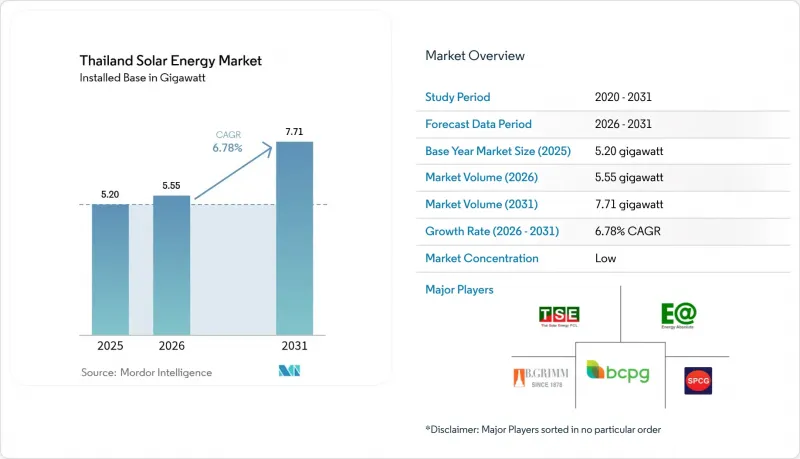
本報告按技術(太陽能和聚光太陽能)、併網類型(併網和離網)以及最終用戶(公用事業規模、商業和工業以及住宅)進行細分。市場規模和預測以裝置容量(GW)表示。
泰國太陽能市場趨勢與洞察
零售電價上漲與電價波動
2024年泰國零售電費預計在每千瓦時4.15至4.18泰銖之間,但泰國電力局(EGAT)報告累計虧損約980億泰銖,預計到2025年底電價將上漲8%至12%。東部經濟走廊(EEC)的製造商目前將屋頂太陽能視為對沖天然氣價格波動風險的手段,因為典型的1兆瓦太陽能裝置可在七年內收回成本。根據能源政策與規劃部的數據,燃氣發電廠仍供應電網約60%的電力,導致電費與液化天然氣(LNG)現貨進口價格掛鉤。受歐盟碳邊境調節稅約束的商業買家正在加速採用太陽能,以確保其出口利潤。由此產生的需求為泰國太陽能市場注入了新的活力,無論是現場安裝系統還是第三方資金籌措系統。
雙面和拓普康太陽能組件成本快速下降
到2024年,雙面組件的平均價格已降至每瓦0.10至0.12美元,而拓普康電池的效率達到了24%至25%,成本僅略有上升。開發商目前正在洽談多年期供應契約,以鎖定組件價格至2027年,並穩定平準化發電成本。資本密集度的降低使得即使是小規模屋頂光電系統,在淨計費模式下也能在五年內收回投資。中國工廠的產能過剩導致產品流入東南亞,進一步壓低了當地價格。 2024年,美國對泰國組裝的光伏組件徵收反傾銷稅,重組了出口路線,但國內產能過剩導致當地項目的價格普遍下降。
併網核准時間過長以及輸出限制的風險
開發商報告稱,電力公司核准併網項目需要6至18個月的時間,因為他們必須在批准前進行電壓穩定性調查和變電站容量評估。超過10兆瓦的項目還需要進行環境影響評估並獲得國家能源政策委員會的批准,這將延長建設前期並增加持有成本。 2024年,太陽能利用率超過日間需求18%的電網共經歷了50小時的限電。如果沒有即時定價和強制性儲能,過剩的發電量將導致強制停機,從而損害專案獲利能力。這些障礙已使預期成長率下降了近一個百分點。
細分市場分析
到2025年,太陽能系統將佔泰國裝置容量的100%,預計到2031年將以每年6.72%的速度成長。泰國太陽能市場規模預計2025年達到5.20吉瓦,到2031年達到7.71吉瓦。由於聚光太陽能發電在泰國潮濕的氣候條件下經濟效益不佳,預計太陽能技術將保持較高的市場佔有率。雙面組件能夠捕捉反射的太陽輻射,正迅速成為浮體式太陽能發電競標的標準配置。烏汶叻差計畫(Ubolratana project)的發電量比單面陣列高出5-8%。 TOPCon電池的轉換效率高達24-25%,在大型電站的競標中,由於土地限制導致價格較高,其性能優於PERC組件。
由於成本持續下降,太陽能和聚光太陽能之間的經濟差距正在擴大。這是因為聚光太陽能需要「直射陽光」才能發電,而季風季節很難達到這種條件。能源部2024年的上網電價補貼(FIT)方案將聚光型太陽熱能發電排除在外,實際上鞏固了太陽能的壟斷地位。展望未來,國際能源總署(IEA)的數據預測,到2027年,組件價格將再下降15-20%,預計這將確保太陽能技術仍然是泰國唯一具有商業性可行性的太陽能選擇。
其他好處:
- Excel格式的市場預測(ME)表
- 3個月的分析師支持
目錄
第1章:引言
- 研究假設和市場定義
- 調查範圍
第2章:調查方法
第3章執行摘要
第4章 市場狀況
- 市場概覽
- 市場促進因素
- 零售電價上漲與電價波動
- 雙面和拓普康太陽能組件成本的快速下降。
- 直接購電協議試點計畫的啟動將為工商業需求打開一扇寬廣的大門。
- 政府正在推廣一個2.7吉瓦的浮體式太陽能混合發電系統。
- 農業光電專案降低了土地徵用風險。
- 出口導向企業對綠色再生能源證書的需求不斷成長
- 市場限制因素
- 長期併網核准及輸出限制風險
- 曼谷和東部經濟走廊的支線航線飽和
- 美國和歐盟市場提高了泰國製造的模組的進口關稅。
- 國內用於建築節能(BESS)的鋰離子電池單體產量有限。
- 供應鏈分析
- 監理情勢
- 技術展望
- 波特五力模型
- PESTLE分析
第5章 市場規模與成長預測
- 透過技術
- 太陽能(光伏)
- 聚光型太陽熱能發電(CSP)
- 按電網連接類型
- 併網
- 離網
- 最終用戶
- 公用事業規模
- 商業和工業(C&I)
- 住宅
- 按組件
- 太陽能模組/面板
- 逆變器(組串式、集中式、微型)
- 安裝和追蹤系統
- 系統平衡和電氣設備
- 儲能和混合整合
第6章 競爭情勢
- 市場集中度
- 策略趨勢(併購、聯盟、購電協議)
- 市場佔有率分析(主要公司的市場排名和佔有率)
- 公司簡介
- SPCG PLC
- BCPG PLC
- Thai Solar Energy PLC
- B.Grimm Power PLC
- Energy Absolute PLC
- Solartron PLC
- Delta Electronics(Thailand)PLC
- Huawei Technologies Co. Ltd.
- Sungrow Power Supply Co. Ltd.
- JinkoSolar Holding Co. Ltd.
- Trina Solar Co. Ltd.
- LONGi Green Energy Co. Ltd.
- Canadian Solar Inc.
- First Solar Inc.
- Risen Energy Co. Ltd.
- Seraphim Solar Group
- Sharp Energy Solutions Corp.
- Hitachi Energy Thailand
- Black & Veatch Holding Co.
- Marubeni Corp.
第7章 市場機會與未來展望
According to Mordor Intelligence, the Thailand solar energy market size is expected to grow from 5.20 gigawatt in 2025 to 5.55 gigawatt in 2026 and is forecast to reach 7.71 gigawatt by 2031 at 6.78% CAGR over 2026-2031.
This report is Segmented by Technology (Solar Photovoltaic and Concentrated Solar Power), Grid Type (On-Grid and Off-Grid), and End-User (Utility-Scale, Commercial and Industrial, and Residential). The Market Sizes and Forecasts are Provided in Terms of Installed Capacity (GW).
Thailand Solar Energy Market Trends and Insights
Rising Retail-Grid Tariffs and Electricity-Price Volatility
Retail tariffs remained at THB 4.15-4.18 per kWh in 2024; however, the Electricity Generating Authority of Thailand reported cumulative losses of nearly THB 98 billion, suggesting an 8-12% tariff hike by late 2025 is likely. Manufacturers in the Eastern Economic Corridor now view rooftop solar as a hedge against gas price swings, as a typical 1 MW installation pays for itself within seven years. Data from the Energy Policy and Planning Office show that gas-fired units still supply about 60% of the grid's electricity, linking tariffs to spot LNG imports. Commercial buyers facing European Union carbon-border fees have accelerated solar procurement to protect export margins. The resulting demand is giving the Thai solar energy market fresh momentum across both on-site and third-party financed systems.
Rapid Cost Decline of Bifacial and TOPCon PV Modules
Average bifacial module prices declined to USD 0.10-0.12 per watt in 2024, while TOPCon cells achieved 24-25% efficiencies at only marginally higher costs. Developers now negotiate multi-year supply contracts, locking in component prices to 2027 and stabilizing levelized energy costs. Lower capital intensity has enabled smaller rooftops to achieve five-year paybacks even under net-billing. Oversupply in Chinese factories diverted products to Southeast Asia, further pushing down local prices. Although United States antidumping tariffs on Thai-assembled panels reshuffled export channels in 2024, domestic oversupply created broader price relief for local projects.
Long-Cycle Grid-Connection Approvals and Curtailment Risks
Developers report approval times of six to eighteen months because utilities must conduct voltage-stability studies and substation-capacity reviews before granting interconnection. Projects larger than 10 MW also require environmental impact assessments and National Energy Policy Council sign-offs, which extend pre-construction periods and increase holding costs. In 2024, curtailment events totaled up to fifty hours in feeders where solar penetration exceeded 18% of daytime demand. Absent real-time pricing or mandatory storage, over-generation causes forced shutdowns that undermine project revenue. These obstacles shave nearly one percentage point off forecast growth.
Other drivers and restraints analyzed in the detailed report include:
- Direct PPA Pilot Opening Commercial and Industrial Demand
- Government Push for 2.7 GW Floating-Solar Hybrids
- Saturated Feeders in Bangkok and Eastern Economic Corridor
For complete list of drivers and restraints, kindly check the Table Of Contents.
Segment Analysis
Photovoltaic systems accounted for 100.00% of the installed capacity in 2025 and are expected to expand at a 6.72% growth rate through 2031. The Thailand solar energy market size for photovoltaic technology reached 5.20 GW in 2025 and is expected to reach 7.71 GW by 2031, maintaining a significant share, as concentrated solar power remains economically impractical under Thailand's humid climate. Bifacial modules that capture reflected irradiance are quickly becoming standard in floating-solar tenders, with the Ubolratana project registering 5-8% higher output than monofacial arrays. TOPCon cells, which offer 24-25% conversion efficiency, are overtaking PERC modules in utility-scale bids where land constraints justify premium pricing.
Continuous cost declines widen the economic gap between photovoltaic and concentrated solar power, which needs direct-normal-irradiance levels rarely achieved in the monsoon season. The Ministry of Energy's 2024 feed-in-tariff schedule excludes concentrated solar power, effectively cementing photovoltaics' monopoly. Looking forward, International Energy Agency data project module prices dropping another 15-20% by 2027, ensuring photovoltaic technologies remain the only commercially viable solar option in Thailand.
Complete Report Scope:
- By Technology
- Solar Photovoltaic (PV)
- Concentrated Solar Power (CSP)
- By Grid Type
- On-Grid
- Off-Grid
- By End-User
- Utility-Scale
- Commercial and Industrial (C&I)
- Residential
- By Component (Qualitative Analysis)
- Solar Modules/Panels
- Inverters (String, Central, Micro)
- Mounting and Tracking Systems
- Balance-of-System and Electricals
- Energy Storage and Hybrid Integration
List of Companies Covered in this Report:
- SPCG PLC
- BCPG PLC
- Thai Solar Energy PLC
- B.Grimm Power PLC
- Energy Absolute PLC
- Solartron PLC
- Delta Electronics (Thailand) PLC
- Huawei Technologies Co. Ltd.
- Sungrow Power Supply Co. Ltd.
- JinkoSolar Holding Co. Ltd.
- Trina Solar Co. Ltd.
- LONGi Green Energy Co. Ltd.
- Canadian Solar Inc.
- First Solar Inc.
- Risen Energy Co. Ltd.
- Seraphim Solar Group
- Sharp Energy Solutions Corp.
- Hitachi Energy Thailand
- Black & Veatch Holding Co.
- Marubeni Corp.
Additional Benefits:
- The market estimate (ME) sheet in Excel format
- 3 months of analyst support
TABLE OF CONTENTS
1 Introduction
- 1.1 Study Assumptions & Market Definition
- 1.2 Scope of the Study
2 Research Methodology
3 Executive Summary
4 Market Landscape
- 4.1 Market Overview
- 4.2 Market Drivers
- 4.2.1 Rising retail-grid tariffs & electricity-price volatility
- 4.2.2 Rapid cost decline of bifacial & TOPCon PV modules
- 4.2.3 Direct-PPA pilot opening C&I demand flood-gates
- 4.2.4 Government push for 2.7 GW floating-solar hybrids
- 4.2.5 Agro-PV programs easing land-acquisition risks
- 4.2.6 Growing demand for green RECs from export-oriented firms
- 4.3 Market Restraints
- 4.3.1 Long-cycle grid-connection approvals & curtailment risks
- 4.3.2 Saturated feeders in Bangkok & Eastern Economic Corridor
- 4.3.3 Rising import tariffs on Thai modules in US/EU markets
- 4.3.4 Limited domestic Li-ion cell production for BESS
- 4.4 Supply-Chain Analysis
- 4.5 Regulatory Landscape
- 4.6 Technological Outlook
- 4.7 Porter's Five Forces
- 4.7.1 Threat of New Entrants
- 4.7.2 Bargaining Power of Suppliers
- 4.7.3 Bargaining Power of Buyers
- 4.7.4 Threat of Substitutes
- 4.7.5 Industry Rivalry
- 4.8 PESTLE Analysis
5 Market Size & Growth Forecasts
- 5.1 By Technology
- 5.1.1 Solar Photovoltaic (PV)
- 5.1.2 Concentrated Solar Power (CSP)
- 5.2 By Grid Type
- 5.2.1 On-Grid
- 5.2.2 Off-Grid
- 5.3 By End-User
- 5.3.1 Utility-Scale
- 5.3.2 Commercial and Industrial (C&I)
- 5.3.3 Residential
- 5.4 By Component (Qualitative Analysis)
- 5.4.1 Solar Modules/Panels
- 5.4.2 Inverters (String, Central, Micro)
- 5.4.3 Mounting and Tracking Systems
- 5.4.4 Balance-of-System and Electricals
- 5.4.5 Energy Storage and Hybrid Integration
6 Competitive Landscape
- 6.1 Market Concentration
- 6.2 Strategic Moves (M&A, Partnerships, PPAs)
- 6.3 Market Share Analysis (Market Rank/Share for key companies)
- 6.4 Company Profiles (includes Global level Overview, Market level overview, Core Segments, Financials as available, Strategic Information, Products & Services, and Recent Developments)
- 6.4.1 SPCG PLC
- 6.4.2 BCPG PLC
- 6.4.3 Thai Solar Energy PLC
- 6.4.4 B.Grimm Power PLC
- 6.4.5 Energy Absolute PLC
- 6.4.6 Solartron PLC
- 6.4.7 Delta Electronics (Thailand) PLC
- 6.4.8 Huawei Technologies Co. Ltd.
- 6.4.9 Sungrow Power Supply Co. Ltd.
- 6.4.10 JinkoSolar Holding Co. Ltd.
- 6.4.11 Trina Solar Co. Ltd.
- 6.4.12 LONGi Green Energy Co. Ltd.
- 6.4.13 Canadian Solar Inc.
- 6.4.14 First Solar Inc.
- 6.4.15 Risen Energy Co. Ltd.
- 6.4.16 Seraphim Solar Group
- 6.4.17 Sharp Energy Solutions Corp.
- 6.4.18 Hitachi Energy Thailand
- 6.4.19 Black & Veatch Holding Co.
- 6.4.20 Marubeni Corp.
7 Market Opportunities & Future Outlook
- 7.1 White-space & Unmet-Need Assessment

 印度太陽能:市場佔有率分析、產業趨勢與統計及成長預測(2026-2031)太陽能:市場佔有率分析、產業趨勢與統計、成長預測(2026-2031)義大利太陽能市場:市場佔有率分析、產業趨勢與統計及成長預測(2026-2031)菲律賓太陽能:市場佔有率分析、產業趨勢與統計及成長預測(2026-2031 年)印尼太陽能市場:市場佔有率分析、產業趨勢與統計及成長預測(2026-2031)中國太陽能市場:市場佔有率分析、產業趨勢與統計及成長預測(2026-2031年)德國太陽能市場:市場佔有率分析、產業趨勢與統計及成長預測(2026-2031)日本太陽能市場:市場佔有率分析、產業趨勢與統計及成長預測(2026-2031年)法國太陽能:市場佔有率分析、產業趨勢與統計及成長預測(2026-2031)西班牙太陽能:市場佔有率分析、產業趨勢與統計及成長預測(2026-2031)