


 |
市場調查報告書
商品編碼
2119600
新澤西州資料中心:市場佔有率分析、行業趨勢和統計數據以及成長預測(2026-2031 年)New Jersey Data Center - Market Share Analysis, Industry Trends & Statistics, Growth Forecasts (2026 - 2031) |
||||||

※ 本網頁內容可能與最新版本有所差異。詳細情況請與我們聯繫。
根據 Mordor Intelligence 預測,新澤西州的資料中心市場預計將從 2025 年的 1.0 GW 成長到 2026 年的 1.04 GW,然後從 2026 年到 2031 年以 3.55% 的複合年成長率成長,到 2031 年達到 1.23 GW。
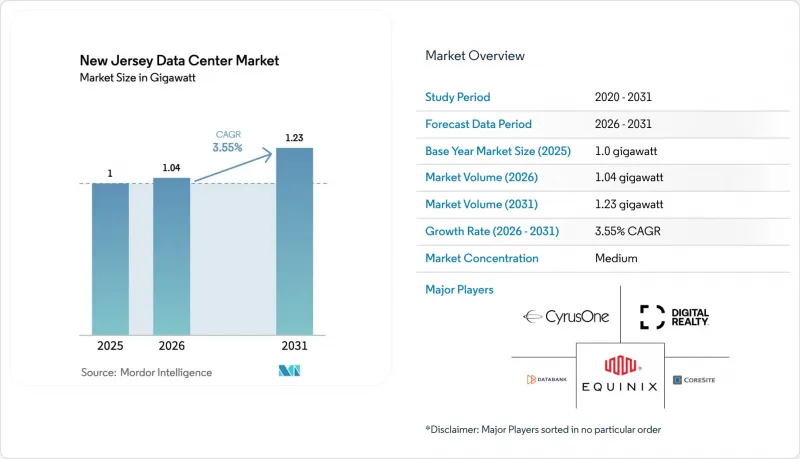
本報告按資料中心規模(小規模、中型、大型、超大型、巨型)、層級(Tier 1 & 2、Tier 3、Tier 4)和資料中心類型(託管、雲端服務供應商(CSP)、企業級、模組化、邊緣運算)進行分類。市場預測以美元計價。
新澤西州資料中心市場趨勢與洞察
超過 20 兆瓦的 AI主導預租專案正在迅速增加。
CoreWeave斥資12億美元打造的肯尼爾沃思項目,正是當前GPU雲端服務供應商在施工前就鎖定整棟大樓的典型例證,這種做法推動了由長期購電合約支撐的投機性建設熱潮。由於典型的AI機架功率超過40kW,開發商提前購買變電站和液冷歧管,並比傳統做法提前四分之三完成電氣和機械設計。這種資本投資的快速成長正推動新澤西州資料中心市場走向垂直整合的位置模式,在這種模式下,電網連接在評估中比房地產成本更為重要。超過60MW的預租規模也使得超大規模資料超大規模資料中心業者的談判優勢日益增強,他們要求可再生,並與沃爾鎮的登陸站建立直接的光纖連接。這種影響會波及到各個分包層級,增加對試運行工程師、液冷供應商和大容量開關設備的需求。
新澤西州正在卸載大西洋海底電纜
NJFX園區提供營運商中立的HAVFRUE/AEC-2和WALL-LI路由接入,消除了紐約都會區的交叉連接費用,並將跨大西洋往返延遲降低毫秒。園區海拔64英尺,遠離洪水區,增強了業務永續營運的可靠性,吸引金融機構將其用作災害復原基地。 Telxius和Windstream的回程傳輸線路目前正在向南擴展至維吉尼亞海灘,將新澤西州的資料中心整合到冗餘的跨大西洋網狀拓撲結構中。從觀點來看,禁止數據通過特定司法管轄區路由的數據主權條款預計將提升美國境內不同著陸點的價值。因此,新澤西州資料中心市場擁有內陸競爭對手難以複製的結構性連接優勢。
PJM的電力隊列中有超過4.7 GW的未處理訂單。
截至2024年底,PJM的備用發電項目清單中包含268吉瓦的發電申請,但預計近期內只有個位數百分比的項目能夠投入運作,導致資料中心需求與可用容量不匹配。僅來自資料中心客戶的大容量併網諮詢量就高達4.7吉瓦,這造成了調查期間的堵塞和許可核准流程的延誤。 60吉瓦火力發電廠的退役加劇了這一局面,因為同樣在備用項目清單上的間歇性可再生能源需要額外的電網服務容量。因此,未與PJM簽訂合約的開發商被迫安裝成本高昂的現場燃氣渦輪機或帶電池的後表計量太陽能發電系統。這一瓶頸使原本強勁的新澤西州資料中心市場成長率下降了近兩個百分點。
細分市場分析
2025年,大型資料中心在新澤西州資料中心市場收入中佔比高達54.70%。超大規模資料中心業者大規模資料中心整合了多層機房,總合供電量達80兆瓦,並實現了小規模設施無法企及的冷卻效率。這類資料中心在米德爾塞克斯縣和默瑟縣佔據了大片土地,因為當地的規劃許可允許建造多棟建築組成的園區。預計大型資料中心的複合年成長率將達到5.25%,從2026年到2031年,新澤西州的資料中心市場預計將轉向數量更少但密度更高的園區模式。
小規模設施在中型企業的邊緣聚合、內容快取和災害復原拓撲結構中仍然發揮著至關重要的作用。然而,每兆瓦資本支出(CAPEX)的差異使得大規模建設項目更具優勢,尤其是在功率密度超過 40 千瓦時。 CoreWeave 的 Kenilworth 綜合體表明,單一人工智慧租戶即可保障整個區域的開發價值,加快授權流程,並確保獲得大規模可再生能源購電協議(PPA)。因此,開發商只有在電網連接已經到位的情況下才會將棕地倉庫改建為多租戶設施,這限制了小規模場地類型的擴展途徑。
其他好處:
- Excel格式的市場預測(ME)表
- 3個月的分析師支持
目錄
第1章:引言
- 研究假設和市場定義
- 調查範圍
第2章:調查方法
第3章執行摘要
第4章 市場狀況
- 市場概覽
- 市場促進因素
- 人工智慧驅動的預租協議數量激增,超過20兆瓦
- 新澤西州正在卸載大西洋海底電纜
- 金融科技領域的低延遲競爭(紐約↔新澤西:小於1毫秒)
- 需求者側安裝的可再生能源購電協議(PPA)
- 新澤西州經濟發展局州稅減免計劃
- 高密度客製化GPU,單機架功耗超過40千瓦
- 市場限制因素
- PJM的電力隊列中有超過4.7吉瓦的未處理電力。
- 變壓器交付需要 12 至 24 個月。
- Hudson縣房地產供不應求
- 用水限制(帕賽克河流域)
- 價值供應鏈分析
- 監理情勢
- 技術展望
- 波特五力分析
- 數位基礎設施指標
- 智慧型手機用戶數量
- 每部智慧型手機的資料通訊
- 行動資料通訊速度
- 寬頻資料通訊速度
- 市場宏觀經濟趨勢的評估
第5章 市場規模及成長預測(兆瓦)
- 按資料中心規模
- 小規模
- 中號
- 大規模
- 超大規模
- 超大型
- 層級類型
- 一級和二級
- 三級
- 第四級
- 依資料中心類型
- 雲端服務供應商(CSP)
- 企業級、模組化、邊緣運算
- 搭配
- 用過的
- 託管類型
- 零售
- 批發的
- 超大規模
- 最終用戶
- 雲端IT
- 溝通
- 媒體與娛樂
- 政府
- BFSI
- 製造業
- 電子商務
- 其他
- 託管類型
- 用過的
第6章 競爭情勢
- 市場集中度
- 策略趨勢
- 市佔率分析
- 公司簡介
- Digital Realty Trust Inc.
- Equinix Inc.
- CoreSite Realty Corp.
- DataBank Holdings Ltd.
- CyrusOne LLC
- Cyxtera Technologies Inc.
- Iron Mountain Inc.
- QTS Realty Trust LLC
- Cologix Inc.
- H5 Data Centers LLC
- Flexential Corp.
- CoreWeave Inc.
- CenterSquare DC LLC
- 165 Halsey Street LLC
- EdgeConneX Inc.
- Switch Inc.
- Internap Holding LLC
- Zenlayer Inc.
- Agile DataSites LLC
- Volta Data Centers USA Inc.
第7章 市場機會與未來展望
According to Mordor Intelligence, the new jersey data center market size is expected to grow from 1.0 GW in 2025 to 1.04 GW in 2026 and is forecast to reach 1.23 GW by 2031 at 3.55% CAGR over 2026-2031.
This report is Segmented by Data Center Size (Small, Medium, Large, Massive, Mega), Tier Type (Tier 1&2, Tier 3, Tier 4), Data Center Type(Colocation, Cloud Service Providers (CSPs), Enterprise, Modular, and Edge). The Market Forecasts are Provided in Terms of Value (USD).
New Jersey Data Center Market Trends and Insights
AI-driven 20 MW+ pre-leasing surge
CoreWeave's USD 1.2 billion Kenilworth project illustrates how GPU cloud providers now secure entire buildings before the first shovel breaks ground, underpinning a wave of speculative construction backed by long-term offtake contracts.Typical AI racks exceed 40 kW, so developers pre-buy substations and liquid-cooling manifolds, locking in electrical and mechanical designs three quarters earlier than historical norms. This sudden front-loading of capex pushes the New Jersey data center market toward vertically integrated site-selection, where grid-interconnection status carries more valuation weight than real-estate cost. Pre-lease volumes above 60 MW also transfer bargaining power to hyperscalers that demand renewable guarantees or direct fiber into Wall Township's landing station. The effect cascades into subcontracting tiers, lifting demand for commissioning engineers, immersion-cooling vendors and high-capacity switchgear.
Sub-Atlantic subsea cables landing in NJ
The NJFX campus offers carrier-neutral access to HAVFRUE/AEC-2 and WALL-LI routes, eliminating New York metro cross-connect fees and shaving milliseconds on trans-Atlantic round-trip latency. Elevation 64 ft above sea level and flood-zone clearance enhance business-continuity credentials, attracting disaster-recovery footprints from financial institutions. Telxius and Windstream backhaul spurs now extend capacity south toward Virginia Beach, weaving New Jersey space into redundant Atlantic mesh topologies. In the longer horizon, data-sovereignty clauses that prohibit data routing through certain jurisdictions are expected to inflate value for diverse U.S. landing points. Consequently, the New Jersey data center market benefits from a structural connectivity moat difficult for land-locked rivals to replicate.
PJM power-queue backlog greater than 4.7 GW
PJM's queue included 268 GW of generation requests by year-end 2024, yet only a single-digit percentage will reach operation in the near term, creating a mismatch between data-center demand and available capacity. Public Service Electric & Gas recorded 4.7 GW of large-load interconnection inquiries from data-center clients alone, clogging study windows and delaying permits. Retirements of 60 GW of thermal generation exacerbate the crunch because intermittent renewables in the same queue require extra grid-services headroom. Developers that lack executed PJM agreements are therefore forced toward costly on-site gas turbines or battery-backed behind-the-meter solar arrays. This bottleneck shaves nearly two percentage points off the otherwise robust growth slope of the New Jersey data center market.
Other drivers and restraints analyzed in the detailed report include:
- Fin-tech latency arms-race (NY ↔ NJ <= 1 ms)
- Build-to-suit GPU densification greater than 40 kW/rack
- 12-24 month transformer lead-times
For complete list of drivers and restraints, kindly check the Table Of Contents.
Segment Analysis
The massive category delivered 54.70% of 2025 revenue in the New Jersey data center market. Hyperscalers cluster multi-story halls and aggregate 80 MW utility feeds, attaining cooling economies that small sites cannot reproduce. This class enjoys ample land parcels in Middlesex and Mercer counties where zoning approvals accommodate multi-building campuses. Mega facilities are projected to record a 5.25% CAGR and will likely tilt the New Jersey data center market size toward fewer but denser campuses between 2026 and 2031.
Smaller footprints still play roles in edge aggregation, content caching and disaster-recovery topologies for mid-market enterprises. However, capex-per-MW spreads favor large-scale builds, especially as power densities rise above 40 kW. CoreWeave's Kenilworth complex highlights how a single AI tenant can underwrite full-parcel development value, expediting entitlements and locking in renewable-energy PPAs at scale. Consequently, developers redeploy brownfield warehouses into multi-tenant suites only when grid access is pre-existing, limiting expansion pathways for the smallest site classes.
Complete Report Scope:
- By Data Center Size
- Small
- Medium
- Large
- Massive
- Mega
- By Tier Type
- Tier 1 and 2
- Tier 3
- Tier 4
- By Data Center Type
- Cloud Service Providers (CSPs)
- Enterprise, Modular and Edge
- Colocation
- Utilized
- Colocation Type
- Retail
- Wholesale
- Hyperscale
- End User
- Cloud and IT
- Telecom
- Media and Entertainment
- Government
- BFSI
- Manufacturing
- E-Commerce
- Other End User
- Colocation Type
- Utilized
List of Companies Covered in this Report:
- Digital Realty Trust Inc.
- Equinix Inc.
- CoreSite Realty Corp.
- DataBank Holdings Ltd.
- CyrusOne LLC
- Cyxtera Technologies Inc.
- Iron Mountain Inc.
- QTS Realty Trust LLC
- Cologix Inc.
- H5 Data Centers LLC
- Flexential Corp.
- CoreWeave Inc.
- CenterSquare DC LLC
- 165 Halsey Street LLC
- EdgeConneX Inc.
- Switch Inc.
- Internap Holding LLC
- Zenlayer Inc.
- Agile DataSites LLC
- Volta Data Centers USA Inc.
Additional Benefits:
- The market estimate (ME) sheet in Excel format
- 3 months of analyst support
TABLE OF CONTENTS
1 INTRODUCTION
- 1.1 Study Assumptions and Market Definition
- 1.2 Scope of the Study
2 RESEARCH METHODOLOGY
3 EXECUTIVE SUMMARY
4 MARKET LANDSCAPE
- 4.1 Market Overview
- 4.2 Market Drivers
- 4.2.1 AI-driven 20-MW+ pre-leasing surge
- 4.2.2 Sub-Atlantic subsea cables landing in NJ
- 4.2.3 Fin-tech latency arms-race (NY ↔ NJ <= 1 ms)
- 4.2.4 Renewable "behind-the-meter" PPAs
- 4.2.5 State tax-abatement program NJEDA
- 4.2.6 Build-to-suit GPU densification greater than 40 kW/rack
- 4.3 Market Restraints
- 4.3.1 PJM power-queue backlog greater than 4.7 GW
- 4.3.2 12--24 month transformer lead-times
- 4.3.3 Real-estate scarcity in Hudson Co.
- 4.3.4 Water-use restrictions (Passaic basin)
- 4.4 Value/Supply-Chain Analysis
- 4.5 Regulatory Landscape
- 4.6 Technological Outlook
- 4.7 Porter's Five Forces Analysis
- 4.7.1 Threat of New Entrants
- 4.7.2 Bargaining Power of Suppliers
- 4.7.3 Bargaining Power of Customers
- 4.7.4 Threat of Substitutes
- 4.7.5 Competitive Rivalry
- 4.8 Digital-Infrastructure Indicators
- 4.8.1 Smartphone Users
- 4.8.2 Data Traffic per Smartphone
- 4.8.3 Mobile Data Speed
- 4.8.4 Broadband Data Speed
- 4.9 Assessment of Macro Economic Trends on the Market
5 MARKET SIZE AND GROWTH FORECASTS (MW)
- 5.1 By Data Center Size
- 5.1.1 Small
- 5.1.2 Medium
- 5.1.3 Large
- 5.1.4 Massive
- 5.1.5 Mega
- 5.2 By Tier Type
- 5.2.1 Tier 1 and 2
- 5.2.2 Tier 3
- 5.2.3 Tier 4
- 5.3 By Data Center Type
- 5.3.1 Cloud Service Providers (CSPs)
- 5.3.2 Enterprise, Modular and Edge
- 5.3.3 Colocation
- 5.3.3.1 Utilized
- 5.3.3.1.1 Colocation Type
- 5.3.3.1.1.1 Retail
- 5.3.3.1.1.2 Wholesale
- 5.3.3.1.1.3 Hyperscale
- 5.3.3.1.2 End User
- 5.3.3.1.2.1 Cloud and IT
- 5.3.3.1.2.2 Telecom
- 5.3.3.1.2.3 Media and Entertainment
- 5.3.3.1.2.4 Government
- 5.3.3.1.2.5 BFSI
- 5.3.3.1.2.6 Manufacturing
- 5.3.3.1.2.7 E-Commerce
- 5.3.3.1.2.8 Other End User
- 5.3.3.1.1 Colocation Type
- 5.3.3.1 Utilized
6 COMPETITIVE LANDSCAPE
- 6.1 Market Concentration
- 6.2 Strategic Moves
- 6.3 Market Share Analysis
- 6.4 Company Profiles (includes Global level Overview, Market level overview, Core Segments, Financials as available, Strategic Information, Market Rank/Share for key companies, Products and Services, and Recent Developments)
- 6.4.1 Digital Realty Trust Inc.
- 6.4.2 Equinix Inc.
- 6.4.3 CoreSite Realty Corp.
- 6.4.4 DataBank Holdings Ltd.
- 6.4.5 CyrusOne LLC
- 6.4.6 Cyxtera Technologies Inc.
- 6.4.7 Iron Mountain Inc.
- 6.4.8 QTS Realty Trust LLC
- 6.4.9 Cologix Inc.
- 6.4.10 H5 Data Centers LLC
- 6.4.11 Flexential Corp.
- 6.4.12 CoreWeave Inc.
- 6.4.13 CenterSquare DC LLC
- 6.4.14 165 Halsey Street LLC
- 6.4.15 EdgeConneX Inc.
- 6.4.16 Switch Inc.
- 6.4.17 Internap Holding LLC
- 6.4.18 Zenlayer Inc.
- 6.4.19 Agile DataSites LLC
- 6.4.20 Volta Data Centers USA Inc.
7 MARKET OPPORTUNITIES and FUTURE OUTLOOK
- 7.1 White-space and Unmet-Need Assessment

 亞特蘭大資料中心:市場佔有率分析、產業趨勢與統計及成長預測(2026-2031 年)倫敦資料中心:市場佔有率分析、產業趨勢與統計及成長預測(2026-2031 年)北加州資料中心:市佔率分析、產業趨勢與統計及成長預測(2026-2031 年)北維吉尼亞資料中心:市場佔有率分析、產業趨勢與統計及成長預測(2026-2031 年)奧斯汀資料中心:市場佔有率分析、產業趨勢與統計及成長預測(2026-2031 年)奧斯陸資料中心:市場佔有率分析、產業趨勢與統計資料、成長預測(2026-2031 年)清奈資料中心:市場佔有率分析、產業趨勢與統計及成長預測(2026-2032)紐約資料中心:市場佔有率分析、產業趨勢與統計及成長預測(2025-2031 年)芝加哥資料中心:市場佔有率分析、產業趨勢與統計及成長預測(2026-2031 年)達拉斯資料中心:市場佔有率分析、產業趨勢與統計及成長預測(2026-2031 年)