


 |
市場調查報告書
商品編碼
2119593
倫敦資料中心:市場佔有率分析、產業趨勢與統計及成長預測(2026-2031 年)London Data Center - Market Share Analysis, Industry Trends & Statistics, Growth Forecasts (2026 - 2031) |
||||||

※ 本網頁內容可能與最新版本有所差異。詳細情況請與我們聯繫。
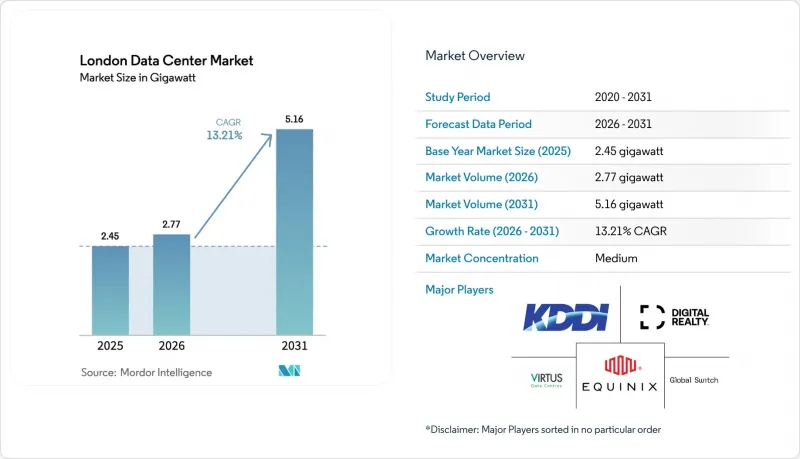
根據 Mordor Intelligence 估計,到 2026 年,倫敦資料中心市場規模將達到 2.77 GW,高於 2025 年的 2.45 GW,預計到 2031 年將達到 5.16 GW。
預計從 2026 年到 2031 年,其複合年成長率將達到 13.21%。
本報告按資料中心規模(小規模、中型、大型、超大型、巨型)、層級(Tier 1 & 2、Tier 3、Tier 4)和資料中心類型(雲端服務供應商(CSP)、託管等)進行分類。市場預測以貨幣價值(美元)表示。
倫敦資料中心市場的趨勢與洞察
超大規模資料中心業者推動雲端擴張,進而推動市場成長。
超大規模資料中心超大規模資料中心業者持續推動倫敦資料中心市場的發展,斥資數十億英鎊用於新建設和維修項目,以打造人工智慧就緒的基礎設施。 2025年1月,英國政府宣布了一項價值140億英鎊的資料中心項目,旨在發展人工智慧基礎設施,並明確表示將新增容量重新分配到指定的人工智慧成長區。 CoreWeave 的10億英鎊投資凸顯了支持GPU加速環境所需的充足資金。由於電力上限限制了新應用的開發,斯勞地區的領先地位正在減弱。 Ada Infrastructure位於皇家碼頭的210兆瓦園區清晰地展現了這種向東部轉移的趨勢。社區參與措施——包括現場技能培訓學院、公共綠地以及與區域供熱系統的整合——正逐漸成為標準做法,以加快開發商的核准流程。
人工智慧主導的運算密度正在改變設施設計。
40-140千瓦機架的引入重新定義了倫敦資料中心市場的設計標準。 Kao Data於2025年3月部署的Nvidia H200 GPU,透過整合封閉回路型後門熱交換器和100%可再生能源供應,實現了營運效率的顯著提升。人工智慧伺服器的功耗是傳統工作負載的四到五倍,因此,整合電力、空間和冷卻指標的新型收入模式變得至關重要。嚴重依賴GPU叢集進行演算法交易和風險模擬的金融服務租戶,為了確保在倫敦金融城附近擁有對延遲高度敏感的運算環境,願意支付更高的託管費用。設施設計擴大採用超過6米的樓板間淨空高度、132千伏雙電源以及可在空氣冷卻和液體冷卻之間無縫切換的模組化冷卻模組,從而避免長時間停機。
電網中的電力分配是發展中的一個主要瓶頸。
由於超過400吉瓦的併網申請積壓,西倫敦的新併網申請已被暫時中止,迫使開發商要么承擔變電站升級的成本,要么將項目遷至東倫敦。一些提案因電力供給能力不足而被立即駁回,迫使營運商轉向混合式現場發電或電池儲能方案。儘管併網等待名單的改革以及政府考慮從泰晤士河上的船舶向電網供電的試點項目預計在短期內緩解電力短缺,但對於那些計劃在電力嚴重短缺的行政區建設100兆瓦或以上裝機容量的項目而言,風險依然存在。
細分市場分析
到2025年,容量在10兆瓦至20兆瓦之間的大型資料中心將佔據主導地位,貢獻倫敦資料中心市場44.95%的佔有率。這種主導地位反映了其優越的地理位置,兼顧了建造成本和接近性主要光纖線路的優勢。然而,發展動能正轉向容量超過40兆瓦的巨型園區,預計從2026年到2031年,其複合年成長率將達到27.60%。 Ada Infrastructure公司位於皇家碼頭的210兆瓦專案正是此一趨勢的典範。該專案包含三個70兆瓦的機房,配置了水冷式GPU叢集,並連接了區域供冷系統。此類專案利用了電力採購和現場變電站建設的規模經濟,使營運商在與電網營運商的談判中佔據優勢。容量低於5兆瓦的小規模設施正在改造為邊緣節點,以降低物聯網和金融科技應用的延遲,從而將倫敦資料中心市場的版圖擴展到郊區交換器和地下光纖儲存區域。
這種成長趨勢進一步加劇了產業的整合壓力。大型資料中心園區的投資者透過將多個資料中心整合到統一的規劃框架中,降低了每兆瓦的資本支出,並縮短了獲利時間。企業紛紛湧向這些大型設施,尋求可預測的擴展路徑和強大的互連基礎設施。同時,中型資料中心被迫進行資本密集升級,以適應不斷成長的機架密度。無法維修到 30 千瓦機架的營運商可能會面臨運轉率下降的問題,因為人工智慧工作負載會繞過它們,這可能迫使他們進行合併或出售資產。在倫敦資料中心市場,預計到本十年末,大型資料中心市場規模將加倍,並佔總收入的三分之一以上。
其他好處:
- Excel格式的市場預測(ME)表
- 3個月的分析師支持
目錄
第1章:引言
- 研究假設和市場定義
- 調查範圍
第2章:調查方法
第3章執行摘要
第4章 市場狀況
- 市場概覽
- 市場促進因素
- 超大規模資料中心業者推動了對雲端擴展的需求
- 利用人工智慧/GPU進行高密度運算的需求
- 海底電纜和都市區光纖生態系統的深度
- 可再生能源購電協議(PPA)和淨零排放義務
- 為倫敦地鐵邊緣資料中心鋪設光纖電纜的權利
- 泰晤士河流域的區域供冷項目
- 市場限制因素
- 倫敦西部電網電力分配短缺
- 高昂的地價和企業稅負 + 專案延誤
- 強制回收廢熱抑制了資本投資。
- 高壓試運行工程師短缺(由於 Crossrail 2 號線需求增加)
- 價值供應鏈分析
- 監理情勢
- 技術趨勢(液冷、小型模組化反應器(SMR)、燃料電池)
- 連接性和數據使用趨勢
- IT負載能力分析
- 高架空間分析
- 貨架密度和貨架數量分析
- 波特五力模型
第5章 市場規模及成長預測(兆瓦)
- 按資料中心規模
- 小規模
- 中號
- 大規模
- 超大規模
- 超大型
- 層級類型
- 一級和二級
- 三級
- 第四級
- 依資料中心類型
- 超大規模資料中心業者雲端服務供應商/雲端服務供應商
- 企業邊緣
- 搭配
- 用過的
- 搭配形式
- 零售
- 批發的
- 超大規模
- 最終用戶
- 雲端IT
- 溝通
- 媒體與娛樂
- 政府
- BFSI
- 製造業
- 電子商務
- 其他
- 搭配形式
- 用過的
- 未使用的
第6章 競爭情勢
- 市場集中度
- 策略趨勢
- 公司簡介
- Colt Technology Services Group Limited
- Digital Realty Trust, Inc.
- Equinix, Inc.
- NTT Ltd
- Kao Data Ltd
- Telehouse(KDDI Corp.)
- VIRTUS Data Centres(STT GDC)
- 4D Data Centres(Redcentric plc)
- Pulsant Ltd
- Iron Mountain Inc.
- Cyxtera Technologies, Inc.
- Rackspace Technology Inc.
- Vantage Data Centers
- Serverfarm LLC
- CyrusOne Inc.
- Global Switch
- Ark Data Centres
- Yondr Group
- STACK Infrastructure
- Echelon Data Centres
- 市佔率分析
第7章 市場機會與未來展望
According to Mordor Intelligence, london data center market size in 2026 is estimated at 2.77 GW, growing from 2025 value of 2.45 GW with 2031 projections showing 5.16 GW, growing at 13.21% CAGR over 2026-2031.
This report is Segmented by Data Center Size (Small, Medium, Large, Massive, Mega), Tier Type (Tier 1&2, Tier 3, Tier 4), and Data Center Type (Cloud Service Providers (CSPs), Colocation Type, and More). The Market Forecasts are Provided in Terms of Value (USD).
London Data Center Market Trends and Insights
Hyperscaler Cloud Expansion Driving Market Growth
Hyperscalers continue to underwrite the London data center market, committing multi-billion-pound budgets to AI-ready builds and retrofit programs. January 2025 saw a UK government announcement of GBP 14 billion in data-center projects aimed at AI infrastructure, redirecting new capacity toward designated AI Growth Zones. CoreWeave's GBP 1 billion entry underscores the capital depth backing GPU-accelerated environments. Slough's historic dominance is waning as power caps squeeze new requests; Ada Infrastructure's 210 MW Royal Docks campus illustrates the eastward realignment. Community benefit packages-on-site skills academies, public green space, and district-heating interfaces-have become standard as developers secure faster approvals.
AI-Driven Compute Density Transforming Facility Design
The arrival of 40-140 kW racks has reset design norms across the London data center market. Kao Data's deployment of Nvidia H200 GPUs in March 2025 demonstrated the operational leap, integrating closed-loop rear-door heat exchangers and 100% renewable energy feeds. Power draw per AI server now runs 4-5 times that of legacy workloads, forcing new revenue models that blend power, space, and cooling metrics. Financial-services tenants-whose algorithmic trading and risk simulations thrive on GPU clusters-accept higher colocation rates in exchange for latency-sensitive compute near the City. Facility blueprints increasingly adopt slab-to-slab clear heights above 6 m, dual 132 kV feeds, and modular cooling blocks that can swing from air-to-liquid without extended downtime.
Grid-Power Allocation Creating Critical Development Bottleneck
Pending grid requests topping 400 GW in West London have triggered a pause on new connections, compelling developers to fund sub-station upgrades or migrate projects east of the city. Some proposals have been rejected outright on power-availability grounds, pushing operators toward hybrid on-site generation and battery solutions. Government deliberations on connection-queue reform and vessel-to-grid pilots on the Thames hint at near-term relief, yet risk persists for schemes banking on 100 MW-plus blocks in constrained boroughs.
Other drivers and restraints analyzed in the detailed report include:
- Sub-sea Cable Ecosystem Enhancing London's Connectivity Value
- Renewable Energy PPAs Becoming Operational Imperative
- High Land Costs and Planning Complexities Impeding Growth
For complete list of drivers and restraints, kindly check the Table Of Contents.
Segment Analysis
Large sites between 10 MW and 20 MW led capacity in 2025, contributing 44.95% to the London data center market. The dominance reflected their sweet spot in balancing build costs and proximity to key fiber routes. Momentum is shifting, however, toward Mega campuses exceeding 40 MW, projected to gallop ahead at a 27.60% CAGR between 2026 and 2031. Ada Infrastructure's 210 MW Royal Docks project illustrates the blueprint: three 70 MW halls configured for liquid-cooled GPU clusters and supplemented by district-cooling tie-ins. Such projects exploit economies of scale in power procurement and on-site sub-station build-outs, giving operators tariff leverage with distribution network operators. Smaller facilities under 5 MW are repurposed into edge nodes that trim latency for IoT and fintech applications, extending the London data center market footprint into suburban exchange buildings and underground fiber vaults.
The growth trajectory reinforces consolidation pressures. Mega campus investors bundle multiple data halls into a single planning envelope, reducing per-MW capital expenditure and shortening time-to-revenue. Enterprises gravitate toward these scale facilities for predictable expansion paths and richer interconnection fabrics. Conversely, medium-sized assets now face capex upgrades to chase rising rack densities. Operators unable to retrofit to 30 kW racks may see occupancy taper as AI workloads bypass them, driving mergers or asset sales. The London data center market size for Mega facilities is forecast to double, lifting their revenue contribution above one-third of the total by decade's end.
Complete Report Scope:
- By Data Center Size
- Small
- Medium
- Large
- Massive
- Mega
- By Tier Type
- Tier 1 and 2
- Tier 3
- Tier 4
- By Data Center Type
- Hyperscalers/Cloud Service Providers
- Enterprise and Edge
- Colocation
- Utilized
- Colocation Type
- Retail
- Wholesale
- Hyperscale
- End User
- Cloud and IT
- Telecom
- Media and Entertainment
- Government
- BFSI
- Manufacturing
- E-Commerce
- Other End User
- Colocation Type
- Utilized
- Non-Utilized
List of Companies Covered in this Report:
- Colt Technology Services Group Limited
- Digital Realty Trust, Inc.
- Equinix, Inc.
- NTT Ltd
- Kao Data Ltd
- Telehouse (KDDI Corp.)
- VIRTUS Data Centres (STT GDC)
- 4D Data Centres (Redcentric plc)
- Pulsant Ltd
- Iron Mountain Inc.
- Cyxtera Technologies, Inc.
- Rackspace Technology Inc.
- Vantage Data Centers
- Serverfarm LLC
- CyrusOne Inc.
- Global Switch
- Ark Data Centres
- Yondr Group
- STACK Infrastructure
- Echelon Data Centres
Additional Benefits:
- The market estimate (ME) sheet in Excel format
- 3 months of analyst support
TABLE OF CONTENTS
1 INTRODUCTION
- 1.1 Study Assumptions and Market Definition
- 1.2 Scope of the Study
2 RESEARCH METHODOLOGY
3 EXECUTIVE SUMMARY
4 MARKET LANDSCAPE
- 4.1 Market Overview
- 4.2 Market Drivers
- 4.2.1 Hyperscaler cloud expansion demand
- 4.2.2 AI / GPU-driven high-density compute requirements
- 4.2.3 Sub-sea cable and metro-fiber ecosystem depth
- 4.2.4 Renewable-energy PPAs and net-zero mandates
- 4.2.5 London Underground fiber right-of-way for edge DCs
- 4.2.6 Thames River district-cooling schemes
- 4.3 Market Restraints
- 4.3.1 Grid-power allocation shortages in West London
- 4.3.2 High land and business-rate costs + planning delays
- 4.3.3 Waste-heat reuse obligations tightening CAPEX
- 4.3.4 HV commissioning-engineer scarcity (Crossrail-2 pull)
- 4.4 Value / Supply-Chain Analysis
- 4.5 Regulatory Landscape
- 4.6 Technological Outlook (Liquid cooling, SMRs, fuel-cells)
- 4.7 Connectivity and Data-Consumption Trends
- 4.8 IT Load Capacity Analysis
- 4.9 Raised Floor Space Analysis
- 4.10 Rack Density and Number-of-Racks Analysis
- 4.11 Porter's Five Forces
- 4.11.1 Threat of New Entrants
- 4.11.2 Bargaining Power of Suppliers
- 4.11.3 Bargaining Power of Buyers
- 4.11.4 Threat of Substitutes
- 4.11.5 Industry Rivalry
5 MARKET SIZE AND GROWTH FORECASTS (MW)
- 5.1 By Data Center Size
- 5.1.1 Small
- 5.1.2 Medium
- 5.1.3 Large
- 5.1.4 Massive
- 5.1.5 Mega
- 5.2 By Tier Type
- 5.2.1 Tier 1 and 2
- 5.2.2 Tier 3
- 5.2.3 Tier 4
- 5.3 By Data Center Type
- 5.3.1 Hyperscalers/Cloud Service Providers
- 5.3.2 Enterprise and Edge
- 5.3.3 Colocation
- 5.3.3.1 Utilized
- 5.3.3.1.1 Colocation Type
- 5.3.3.1.1.1 Retail
- 5.3.3.1.1.2 Wholesale
- 5.3.3.1.1.3 Hyperscale
- 5.3.3.1.2 End User
- 5.3.3.1.2.1 Cloud and IT
- 5.3.3.1.2.2 Telecom
- 5.3.3.1.2.3 Media and Entertainment
- 5.3.3.1.2.4 Government
- 5.3.3.1.2.5 BFSI
- 5.3.3.1.2.6 Manufacturing
- 5.3.3.1.2.7 E-Commerce
- 5.3.3.1.2.8 Other End User
- 5.3.3.1.1 Colocation Type
- 5.3.3.1 Utilized
- 5.3.4 Non-Utilized
6 COMPETITIVE LANDSCAPE
- 6.1 Market Concentration
- 6.2 Strategic Moves
- 6.3 Company Profiles (includes Global level Overview, Market level overview, Core Segments, Financials as available, Strategic Information, Market Rank/Share for key companies, Products and Services, and Recent Developments)
- 6.3.1 Colt Technology Services Group Limited
- 6.3.2 Digital Realty Trust, Inc.
- 6.3.3 Equinix, Inc.
- 6.3.4 NTT Ltd
- 6.3.5 Kao Data Ltd
- 6.3.6 Telehouse (KDDI Corp.)
- 6.3.7 VIRTUS Data Centres (STT GDC)
- 6.3.8 4D Data Centres (Redcentric plc)
- 6.3.9 Pulsant Ltd
- 6.3.10 Iron Mountain Inc.
- 6.3.11 Cyxtera Technologies, Inc.
- 6.3.12 Rackspace Technology Inc.
- 6.3.13 Vantage Data Centers
- 6.3.14 Serverfarm LLC
- 6.3.15 CyrusOne Inc.
- 6.3.16 Global Switch
- 6.3.17 Ark Data Centres
- 6.3.18 Yondr Group
- 6.3.19 STACK Infrastructure
- 6.3.20 Echelon Data Centres
- 6.4 Market Share Analysis
7 MARKET OPPORTUNITIES AND FUTURE OUTLOOK
- 7.1 White-space and Unmet-Need Assessment

 資料中心:研究訂閱
 全快閃資料中心市場:全球市場預測(2026-2032)
 人工智慧資料中心的光纖檢測、清洗和認證系統的市場規模、佔有率和成長預測(2026-2032 年)面向人工智慧資料中心的高密度光纖連接基礎設施的市場規模、佔有率和成長預測(2026-2032 年)
 2026年全球資料中心市場報告資料中心匯流排市場:依產品類型、應用、資料中心類型、最終用戶、國家及地區分類-全球產業分析、市場規模、市場佔有率及2026年至2033年預測
 資料中心發展—日本版,2026
 全球資料中心匯流排市場:依導體類型、空間類型、額定電流、IT負載、電源、資料中心類型和地區分類-預測至2032年
 亞特蘭大資料中心:市場佔有率分析、產業趨勢與統計及成長預測(2026-2031 年)北加州資料中心:市佔率分析、產業趨勢與統計及成長預測(2026-2031 年)