

 |
市場調查報告書
商品編碼
2119591
奧斯陸資料中心:市場佔有率分析、產業趨勢與統計資料、成長預測(2026-2031 年)Oslo Data Center - Market Share Analysis, Industry Trends & Statistics, Growth Forecasts (2026 - 2031) |
||||||

※ 本網頁內容可能與最新版本有所差異。詳細情況請與我們聯繫。
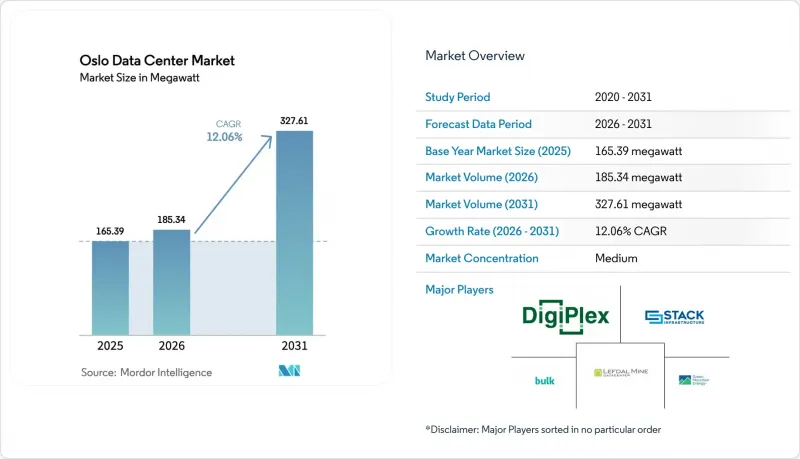
根據 Mordor Intelligence 預測,奧斯陸資料中心市場預計將從 2025 年的 165.39 兆瓦成長到 2026 年的 185.34 兆瓦,然後從 2026 年到 2031 年以 12.06% 的複合年成長,到 2031 年達到 327.6 兆瓦。
本報告按規模(小規模、中型、大型、超大型、巨型)、等級(Tier 1 & 2、Tier 3、Tier 4)和資料中心類型(雲端服務供應商(CSP)、託管等)對資料中心進行分類。市場預測以美元計價。
奧斯陸資料中心市場趨勢及洞察。
有利的氣候條件和100%可再生能源的能源結構。
在挪威,資料中心100%採用可再生水力發電,營運排放量接近零,電力成本比歐洲主要競爭對手降低高達40%。涼爽的氣候使得自然冷卻得以廣泛應用,從而實現了約1.1的PUE值,遠低於1.57的全球基準水準。 2025年2月,挪威政府提高了具備熱永續性和成本優勢的結合,正在推動奧斯陸資料中心市場的長期成長。
人工智慧驅動的超大規模需求激增(2025-2030 年)
人工智慧工作負載的激增正在推動機架密度的提高和兆瓦級容量的擴張。 2030年,預計北歐地區70%的總容量將由人工智慧機房承擔。谷歌位於希恩、耗資6億歐元的資料中心計劃於2026年投入運作,光是這一項就可能消耗挪威5%的電力。硬體供應商正透過高頻寬智慧網卡和液冷解決方案來應對這項挑戰,這些方案旨在處理200-400 Gbps的流量。在奧斯陸,對超大規模資料中心日益成長的需求正在催生大規模的園區、創新的冷卻技術以及對大規模電網連接的需求,這些都促使人們重新思考電力規劃。這股以人工智慧為中心的浪潮是奧斯陸資料中心市場的核心成長引擎。
奧斯陸大都會圈土地用途暫停令
2025年7月,「資料中心」被列為獨立的土地用途類別,分區審查力道也隨之加強。奧斯陸市的「2024年氣候預算」設定了2030年減排95%的目標,並收緊了住宅附近開發案的核准標準。經濟分析顯示,靠近農田和住宅的地塊開發障礙日益增多,迫使開發商轉向高層建築設計和郊區地塊。這些規劃障礙暫時減緩了環城公路內的擴張速度,影響了奧斯陸資料中心市場的整體專案儲備。
細分市場分析
到2025年,大型資料中心將佔奧斯陸資料中心市場佔有率的52.02%,這反映了5-20兆瓦資料中心長期以來的主導地位。 「超大型」資料中心(定義為45兆瓦以上的資料中心)預計到2031年將實現14.93%的複合年成長率,是所有規模類別中成長率最高的。這項擴張是由人工智慧和雲端運算的規模經濟驅動的,營運商將容量整合到園區式資料中心中,並透過分階段擴建,使容量翻倍甚至三倍。位於Green Mountain的90-150兆瓦TikTok專案和Bulk的OS-IX擴建計畫就是典型的例子。
超大規模建設正在推動供應鏈物流、模組化變電站設計以及多級液冷系統應用的創新。儘管奧斯陸土地資源稀缺導致部分工程遷至周邊地區,但核心光纖延遲仍維持在3毫秒以下。營運商正在維護中型設施以滿足企業客製化部署的需求,而小規模站點則轉向邊緣運算應用場景。這種重新平衡鞏固了巨型園區作為奧斯陸資料中心市場成長核心的地位。
三級冗餘因其在 N+1 冗餘和成本控制方面的平衡而備受青睞,即使到 2025 年仍保持 70.65% 的市場佔有率。然而,隨著金融和政府工作負載對 2N 拓撲結構和容錯架構的需求日益成長,四級冗餘正以 19.05% 的複合年成長率迅速崛起。旨在獲得四級認證的設施強調雙路主動電源路徑、並行維護和故障隔離冷卻迴路。
像DigiPlex Fetsund這樣的專案旨在利用間接蒸發冷卻系統實現1.1的PUE值,同時滿足Tier 4標準。達到Tier 4標準將提昇在監管日益嚴格的歐盟環境下資料主權的可信度。隨著運作要求的日益嚴格,奧斯陸資料中心市場中Tier 4設施的規模將穩步擴大,而Tier 1/2設施則將僅限於滿足特定需求。
其他好處:
- Excel格式的市場預測(ME)表
- 3個月的分析師支持
目錄
第1章:引言
- 研究假設和市場定義
- 調查範圍
第2章:調查方法
第3章執行摘要
第4章 市場狀況
- 市場概覽
- 市場促進因素
- 有利的氣候條件和基於100%可再生能源的電網配置。
- 政府為資料中心電費提供稅收優惠
- 人工智慧驅動的超大規模需求激增(2025-2030 年)
- 新建的跨大西洋和跨北極「連接」電纜在奧斯陸峽灣卸載。
- 鮮為人知的一點是:區域供熱合約可以將廢熱貨幣化。
- 鮮為人知的是:歐盟「綠色數據」分類法的資金正在吸引低成本資本。
- 市場限制因素
- 奧斯陸大都會圈土地用途暫停令
- 電網連接費用上漲(Statnett設備升級延誤)
- 鮮為人知的問題:高密度液體冷卻領域技術純熟勞工短缺。
- 通報不足的領域:當地居民反對高壓變電所(鄰避效應)
- 價值供應鏈分析
- 監理情勢
- 技術展望
- 波特五力模型
- 評估宏觀經濟趨勢對市場的影響
- 新進入者的威脅
- 供應商的議價能力
- 買方的議價能力
- 替代品的威脅
- 產業競爭
- 其他市場指標
- IT負載能力分析
- 高架結構占地面積分析
- 貨架數量分析
第5章 市場規模及成長預測(兆瓦)
- 按資料中心規模
- 小規模
- 中號
- 大規模
- 超大規模
- 超大型
- 層級特定
- 一級和二級
- 三級
- 第四級
- 依資料中心類型
- 雲端服務供應商(CSP)
- 企業級、模組化、邊緣運算
- 搭配
- 用過的
- 搭配類型
- 零售
- 批發的
- 超大規模
- 最終用戶
- 雲端運算和資訊技術
- 溝通
- 媒體與娛樂
- 政府
- BFSI
- 製造業
- 電子商務
- 其他最終用戶
- 搭配類型
- 未使用的
- 用過的
第6章 競爭情勢
- 市場集中度
- 策略趨勢
- 市佔率分析
- 公司簡介
- Stack Infrastructure
- Bulk Infrastructure Group
- Green Mountain
- DigiPlex(Stack EMEA)
- Lefdal Mine Datacenter
- AQ Compute
- atNorth
- Orange Business Services(Basefarm)
- Blix Solutions
- Nordic Hub Data Centers
- Webspesialisten
- Equinix
- Verdane(ServeTheWorld DC)
- Atea Datacenters
- Itera
- Evry(Tietoevry)DC Services
- Capgemini Data Centre Oslo
- IBM Cloud Oslo
- Microsoft Azure Norway East(Oslo)
- Google Cloud Region Norway
第7章 市場機會與未來展望
According to Mordor Intelligence, the oslo data center market size is expected to grow from 165.39 MW in 2025 to 185.34 MW in 2026 and is forecast to reach 327.61 MW by 2031 at 12.06% CAGR over 2026-2031.
This report is Segmented by Data Center Size (Small, Medium, Large, Massive, Mega), Tier Type (Tier 1&2, Tier 3, Tier 4), and Data Center Type (Cloud Service Providers (CSPs), Colocation Type, and More). The Market Forecasts are Provided in Terms of Value (USD).
Oslo Data Center Market Trends and Insights
Favourable Climate and 100% Renewable Grid Mix
Norway supplies data centers with fully renewable hydro power, cutting operational emissions to near zero and lowering electricity costs by up to 40% versus key European peers. A cool ambient climate supports extensive free cooling, enabling typical PUE readings around 1.1, well below the 1.57 global benchmark. In February 2025 the government raised grid-allocation priority for sites with heat-recovery, rewarding operators that integrate with Oslo's district-heating grid.These factors attract global firms aligning infrastructure with corporate ESG targets while protecting margins. The combined sustainability and cost edge is a long-run catalyst for the Oslo data center market.
AI-Driven Hyperscale Demand Spike (2025-2030)
Surging AI workloads increase rack densities and push multi-megawatt expansions. By 2030, AI-ready halls are expected to represent 70% of Nordic capacity. Google's EUR 600 million facility in Skien alone could draw 5% of Norway's total power when live in 2026. Hardware vendors respond with high-bandwidth SmartNICs and liquid-cooling solutions designed for 200-400 Gbps traffic. For Oslo, hyperscale appetite means larger campuses, innovative cooling and substantial grid-connection requests that reshape power-planning discussions. This AI-centric wave is a core growth engine for the Oslo data center market.
Land-Use Moratoriums in Greater Oslo
In July 2025 "data center" became a standalone land-use category, adding scrutiny to zoning reviews. The city's Climate Budget 2024 sets a 95% emission-reduction target by 2030, tightening approval for developments near residential zones. Economic analyses show heightened friction for plots on farmland or close to housing, prompting operators to shift toward vertical designs or suburban sites. These planning obstacles temporarily slow expansions inside the beltway and influence project pipelines across the Oslo data center market.
Other drivers and restraints analyzed in the detailed report include:
- New Trans-Atlantic and Arctic Connect Cables Landing in Oslofjord
- District-Heating Off-Take Agreements Monetising Waste Heat
- Rising Grid-Connection Fees (Statnett Upgrade Backlog)
For complete list of drivers and restraints, kindly check the Table Of Contents.
Segment Analysis
Large facilities controlled 52.02% of the Oslo data center market share in 2025, reflecting the long-term prevalence of 5-20 MW builds. The mega class, defined at 45 MW and above, is projected to log a 14.93% CAGR to 2031, the fastest among all size bands. This escalation is anchored in AI and cloud scale economies, with operators consolidating capacity on campus-style estates that can double or triple through phased halls. Green Mountain's 90-150 MW TikTok project and Bulk's OS-IX expansion exemplify the path.
Mega builds stimulate innovation in supply-chain logistics, modular substation design and multi-stage liquid-cooling deployments. Land scarcity within Oslo pushes some projects to peripheral counties while keeping backbone fiber latency under 3 ms. Operators maintain medium facilities for custom enterprise deployments, and small sites increasingly migrate toward edge use cases. This rebalancing positions mega campuses as the growth nucleus of the Oslo data center market.
Tier 3 retained 70.65% share in 2025 thanks to its balance of N+1 redundancy and cost discipline. Yet Tier 4 is rising with a 19.05% CAGR as finance and government workloads demand 2N topology and fault-tolerant architecture. Facilities chasing Tier 4 certification emphasize dual active power paths, concurrent maintenance and fault-isolated cooling loops.
Projects like DigiPlex Fetsund target PUE 1.1 via indirect-evaporative air systems while meeting Tier 4 requirements. Achieving Tier 4 bolsters data-sovereignty credentials in an increasingly regulated EU context. With stricter uptime obligations, the Oslo data center market size for Tier 4 builds will grow steadily, while Tier 1/2 footprints shrink to niche requirements.
Complete Report Scope:
- By Data Center Size
- Small
- Medium
- Large
- Massive
- Mega
- By Tier Type
- Tier 1 and 2
- Tier 3
- Tier 4
- By Data Center Type
- Cloud Service Providers (CSPs)
- Enterprise, Modular and Edge
- Colocation
- Utilized
- Colocation Type
- Retail
- Wholesale
- Hyperscale
- End User
- Cloud and IT
- Telecom
- Media and Entertainment
- Government
- BFSI
- Manufacturing
- E-Commerce
- Other End User
- Colocation Type
- Non-Utilized
- Utilized
List of Companies Covered in this Report:
- Stack Infrastructure
- Bulk Infrastructure Group
- Green Mountain
- DigiPlex (Stack EMEA)
- Lefdal Mine Datacenter
- AQ Compute
- atNorth
- Orange Business Services (Basefarm)
- Blix Solutions
- Nordic Hub Data Centers
- Webspesialisten
- Equinix
- Verdane (ServeTheWorld DC)
- Atea Datacenters
- Itera
- Evry (Tietoevry) DC Services
- Capgemini Data Centre Oslo
- IBM Cloud Oslo
- Microsoft Azure Norway East (Oslo)
- Google Cloud Region Norway
Additional Benefits:
- The market estimate (ME) sheet in Excel format
- 3 months of analyst support
TABLE OF CONTENTS
1 INTRODUCTION
- 1.1 Study Assumptions and Market Definition
- 1.2 Scope of the Study
2 RESEARCH METHODOLOGY
3 EXECUTIVE SUMMARY
4 MARKET LANDSCAPE
- 4.1 Market Overview
- 4.2 Market Drivers
- 4.2.1 Favourable climate and 100 % renewable grid mix
- 4.2.2 Government tax relief on electricity for DCs
- 4.2.3 AI-driven hyperscale demand spike (2025-2030)
- 4.2.4 New trans-Atlantic and Arctic Connect cables landing in Oslofjord
- 4.2.5 Under-reported: District-heating off-take agreements monetising waste-heat
- 4.2.6 Under-reported: EU Data-for-Green taxonomy funding unlocking low-cost capital
- 4.3 Market Restraints
- 4.3.1 Land-use moratoriums in Greater Oslo
- 4.3.2 Rising grid-connection fees (statnett upgrade backlog)
- 4.3.3 Under-reported: Skilled-labour scarcity for high-density liquid cooling
- 4.3.4 Under-reported: Local opposition to high-voltage transformer yards (NIMBY)
- 4.4 Value / Supply-Chain Analysis
- 4.5 Regulatory Landscape
- 4.6 Technological Outlook
- 4.7 Porter's Five Forces
- 4.8 Assessment of the impact of Macro Economic Trends on the Market
- 4.8.1 Threat of New Entrants
- 4.8.2 Bargaining Power of Suppliers
- 4.8.3 Bargaining Power of Buyers
- 4.8.4 Threat of Substitutes
- 4.8.5 Industry Rivalry
- 4.9 Other Market Metrics
- 4.9.1 IT Load Capacity Analysis
- 4.9.2 Raised Floor Space Analysis
- 4.9.3 Rack Count Analysis
5 MARKET SIZE AND GROWTH FORECASTS (MW)
- 5.1 By Data Center Size
- 5.1.1 Small
- 5.1.2 Medium
- 5.1.3 Large
- 5.1.4 Massive
- 5.1.5 Mega
- 5.2 By Tier Type
- 5.2.1 Tier 1 and 2
- 5.2.2 Tier 3
- 5.2.3 Tier 4
- 5.3 By Data Center Type
- 5.3.1 Cloud Service Providers (CSPs)
- 5.3.2 Enterprise, Modular and Edge
- 5.3.3 Colocation
- 5.3.3.1 Utilized
- 5.3.3.1.1 Colocation Type
- 5.3.3.1.1.1 Retail
- 5.3.3.1.1.2 Wholesale
- 5.3.3.1.1.3 Hyperscale
- 5.3.3.1.2 End User
- 5.3.3.1.2.1 Cloud and IT
- 5.3.3.1.2.2 Telecom
- 5.3.3.1.2.3 Media and Entertainment
- 5.3.3.1.2.4 Government
- 5.3.3.1.2.5 BFSI
- 5.3.3.1.2.6 Manufacturing
- 5.3.3.1.2.7 E-Commerce
- 5.3.3.1.2.8 Other End User
- 5.3.3.1.1 Colocation Type
- 5.3.3.2 Non-Utilized
- 5.3.3.1 Utilized
6 COMPETITIVE LANDSCAPE
- 6.1 Market Concentration
- 6.2 Strategic Moves
- 6.3 Market Share Analysis
- 6.4 Company Profiles (includes Global level Overview, Market level overview, Core Segments, Financials as available, Strategic Information, Market Rank/Share for key companies, Products and Services, and Recent Developments)
- 6.4.1 Stack Infrastructure
- 6.4.2 Bulk Infrastructure Group
- 6.4.3 Green Mountain
- 6.4.4 DigiPlex (Stack EMEA)
- 6.4.5 Lefdal Mine Datacenter
- 6.4.6 AQ Compute
- 6.4.7 atNorth
- 6.4.8 Orange Business Services (Basefarm)
- 6.4.9 Blix Solutions
- 6.4.10 Nordic Hub Data Centers
- 6.4.11 Webspesialisten
- 6.4.12 Equinix
- 6.4.13 Verdane (ServeTheWorld DC)
- 6.4.14 Atea Datacenters
- 6.4.15 Itera
- 6.4.16 Evry (Tietoevry) DC Services
- 6.4.17 Capgemini Data Centre Oslo
- 6.4.18 IBM Cloud Oslo
- 6.4.19 Microsoft Azure Norway East (Oslo)
- 6.4.20 Google Cloud Region Norway
7 MARKET OPPORTUNITIES and FUTURE OUTLOOK
- 7.1 White-space and Unmet-need Assessment

 亞特蘭大資料中心:市場佔有率分析、產業趨勢與統計及成長預測(2026-2031 年)倫敦資料中心:市場佔有率分析、產業趨勢與統計及成長預測(2026-2031 年)北加州資料中心:市佔率分析、產業趨勢與統計及成長預測(2026-2031 年)北維吉尼亞資料中心:市場佔有率分析、產業趨勢與統計及成長預測(2026-2031 年)奧斯汀資料中心:市場佔有率分析、產業趨勢與統計及成長預測(2026-2031 年)新澤西州資料中心:市場佔有率分析、行業趨勢和統計數據以及成長預測(2026-2031 年)清奈資料中心:市場佔有率分析、產業趨勢與統計及成長預測(2026-2032)紐約資料中心:市場佔有率分析、產業趨勢與統計及成長預測(2025-2031 年)芝加哥資料中心:市場佔有率分析、產業趨勢與統計及成長預測(2026-2031 年)達拉斯資料中心:市場佔有率分析、產業趨勢與統計及成長預測(2026-2031 年)