

 |
市場調查報告書
商品編碼
2072781
日本紙板市場:市場佔有率分析、產業趨勢與統計、成長預測(2026-2031)Japan Cartonboard - Market Share Analysis, Industry Trends & Statistics, Growth Forecasts (2026 - 2031) |
||||||

※ 本網頁內容可能與最新版本有所差異。詳細情況請與我們聯繫。
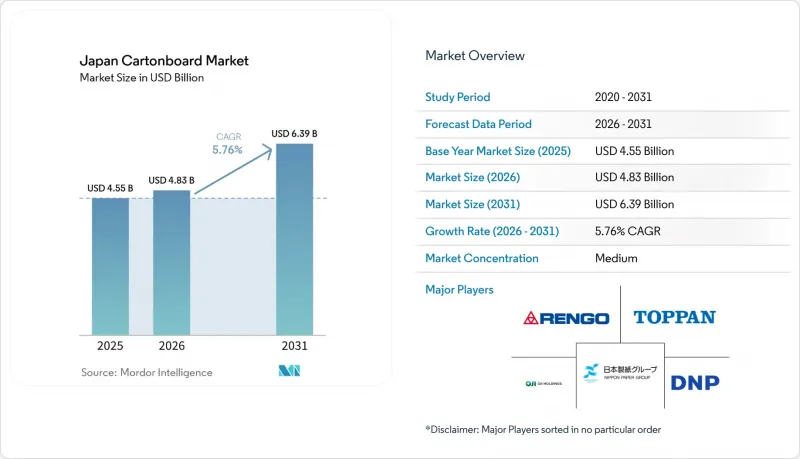
根據 Mordor Intelligence 預測,日本紙板市場規模將從 2025 年的 45.5 億美元和 2026 年的 48.3 億美元成長到 2031 年的 63.9 億美元,2026 年至 2031 年的複合年成長率為 5.76%。
本報告按產品等級(實心漂白紙板、實心未漂白紙板、折疊盒用紙板、白襯紙板、液體包裝用紙板、食品服務用紙板)、包裝形式(折疊盒、液體包裝、紙套和托盤等)以及最終用戶行業(食品、飲料、醫藥保健、煙草等)進行細分。市場預測以美元計價。
日本紙板市場趨勢與洞察
由於塑膠減量法規的實施,日常消費品包裝正在轉向紙板包裝。
日本的包裝框架將強制性紙質包裝回收與《塑膠資源回收法》結合,這項政策組合將進一步強化2026年日本紙板市場以合規主導的需求基礎。由於包裝使用量高的企業對減量和報告的要求更加明確,這些法規的影響比塑膠監管政策初期更為顯著。此外,2026年石腦油供應趨緊將導致塑膠包裝供應緊張,而日本零售通路對紡織品替代品的迫切需求將進一步增強需求驅動力。零售業的舉措,例如將食品服務中的塑膠蓋和容器替換為紙質替代品,表明日本紙板市場的替代進程正從政策意圖轉向商業性實施階段。因此,能夠提供食品接觸級紙板、擁有檢驗的回收管道以及能夠採購可靠紡織品的加工商,將最有可能在合規風險和供應風險趨於一致的情況下,獲得短期收益。
食品飲料用可折疊瓦楞紙箱需求強勁。
食品飲料產業仍然是日本紙板市場最可靠的需求來源。這是因為在日常補貨過程中,消費者更傾向於選擇兼具印刷品質、結構穩定性和貨架可見性的硬質包裝。日本便利商店網路密集,整體蒸餾食品、糖果甜點和即飲飲料的瓦楞紙板需求旺盛。在貨架周轉率率高、零售商反應迅速的大都會圈,這一趨勢尤其明顯。高階食品的定位也是其銷售超過銷售量的重要因素。這是因為高附加價值包裝需要更高的印刷品質、更強的紙板規格以及更高的單件加工成本。 Rengo公司「紙板及紙張加工」業務股在2026會計年度前三個季度累計銷售額3,971.63億日圓(約26.5億美元),較去年同期成長1.1%。這表明,即使在成本高昂的環境下,定價和產品組合管理策略仍然有效。這一趨勢對日本紙板市場來說是一個支撐因素,因為食品包裝不僅是銷售的基礎,也是在不損害其在基本消費品類別中的重要性的前提下,將不斷上漲的投入成本轉嫁到價格上的切實可行的手段。
原生紙漿和能源成本波動
原生紙漿和能源仍然是日本紙板市場最緊迫的成本風險,因為許多生產商都面臨進口紙漿和能源成本波動的雙重壓力。 2026年,由於石腦油供應中斷,不僅增加了塑膠的成本負擔,也增加了用於阻隔紙板製造的塗料和黏合劑的成本,使得應對這一壓力變得更加困難。雖然這導致利潤率承壓,但大型集團比小型加工商更容易承受這種壓力。這是因為大型集團擁有更強的採購能力、更廣泛的產品系列以及更好的內部定價優勢。這些不平衡的壓力已經促使投資環境更加謹慎,日本紙板市場優先考慮能源效率、製程穩定性以及對高價值等級產品的投資,而不是大規模的產能擴張。因此,中型企業面臨最大的壓力,因為它們與大型企業一樣面臨永續發展和設備升級的需求,但卻缺乏同等的財務基礎和採購柔軟性。
細分市場分析
2025年,折疊盒用紙板在日本紙板市場仍佔38.13%的佔有率,持續成為食品、化妝品和藥品瓦楞紙箱的主要產品等級。這一主導地位源自於品牌所有者在初級包裝瓦楞紙板中對亮度、印刷一致性和加工可靠性的嚴格要求,這些要求對品質公差要求極高。這一地位在日本紙板市場尤其重要,因為高價值終端應用對紙板的剛性要求遠不止於基本強度,兼具美觀性和功能性的紙板越來越受到重視。未漂白固態紙板在高階和受監管應用領域也保持著強勁的地位,在這些領域,食品接觸的可靠性和表面品質比纖維成本效益更為重要。同時,未漂白固態紙板在多件裝和快餐飲料包裝中也繼續發揮著至關重要的作用,在這些包裝中,結構強度比外觀光澤更為重要。
預計到2031年,白面塑合板將以7.26%的複合年成長率成長,成為日本紙板市場成長最快的產品等級。其吸引力在於其再生纖維含量、適用於零售包裝以及良好的印刷性能,足以滿足電商和自有品牌應用的需求,尤其適用於對光澤度要求不高的場合。由於人們逐漸減少一次性塑膠的使用,餐飲服務業的紙板需求也不斷成長。王子製紙與快餐店合作夥伴開展的回收項目表明,循環基礎設施如何能夠超越最初的包裝銷售,進一步增強未來對紙板的需求。隨著日本國內企業開發小批量紙質飲料包裝,液體包裝用紙板的作用也日益凸顯。凸版印刷將於2026年5月推出的「Cartocan」便是其在客製化纖維基液體包裝領域努力的例證。因此,阻隔塗層和客製化結構正在模糊日本紙板行業產品等級之間的界限,使得曾經僅限於特定用途的紙板等級能夠滿足零售和餐飲服務行業的廣泛需求。
其他好處:
- Excel格式的市場預測(ME)表
- 3個月的分析師支持
目錄
第1章:引言
- 研究假設和市場定義
- 調查範圍
第2章:調查方法
第3章執行摘要
第4章 市場狀況
- 市場概覽
- 宏觀經濟因素對市場的影響
- 市場促進因素
- 由於塑膠減量法規的實施,快速消費品包裝正在轉向紙板包裝。
- 食品和飲料用折疊紙盒的需求韌性
- 電子商務和自有品牌小批量印刷需求
- 高品質的紙盒對於高級化妝品和保健品至關重要。
- 政府強制回收液態和油基紙盒
- 國內液體紙盒的在地化和阻隔紙的創新
- 市場限制因素
- 原生紙漿和能源成本波動
- 零食和簡便食品中軟包裝袋的替代品
- 油脂和液體應用中阻隔性和再漿性能之間的權衡
- 人口下降給可選購買套餐的出貨量帶來了壓力。
- 產業價值鏈分析
- 監理情勢
- 技術展望
- 波特五力分析
第5章 市場規模與成長預測
- 按產品等級
- 實心漂白板
- 未漂白飾面
- 折疊紙板
- 白色襯裡塑合板
- 液體包裝板
- 餐飲服務業的董事會
- 按包裝類型
- 折疊紙箱
- 液體包裝
- 袖套和托盤
- 其他包裝形式(杯子、食品服務業的容器)
- 按最終用戶行業分類
- 食物
- 飲料
- 藥品和醫療保健
- 菸草
- 化妝品和盥洗用品
- 其他終端用戶產業(玩具、服飾、汽車、家居用品、電器、餐飲服務業)
第6章 競爭情勢
- 市場集中度
- 策略趨勢
- 市佔率分析
- 公司簡介
- Rengo Co., Ltd.
- Oji Holdings Corporation
- Nippon Paper Industries Co., Ltd.
- TOPPAN Inc.
- Dai Nippon Printing Co., Ltd.
- Hokuetsu Corporation
- TOMOKU Co., Ltd.
- THE PACK CORPORATION
- Tokan Kogyo Co., Ltd.
- Kanae Co., Ltd.
- OSAKA SEALING PRINTING CO., LTD.
- Marubeni-FLX Co., Ltd.
- TAISEI Co., Ltd.
- ARC Corporation
- K-PAC Co., Ltd.
- Mitsu-bishi Co., Ltd.
- Graphic Packaging International, LLC
- Stora Enso Oyj
第7章 市場機會與未來展望
According to Mordor Intelligence, the japan cartonboard market size is projected to expand from USD 4.55 billion in 2025 and USD 4.83 billion in 2026 to USD 6.39 billion by 2031, registering a CAGR of 5.76% between 2026 to 2031.
This report is Segmented by Product Grade (Solid Bleached Board, Solid Unbleached Board, Folding Boxboard, White-Lined Chipboard, Liquid Packaging Board, Food Service Board), Packaging Format (Folding Cartons, Liquid Packaging, Sleeve and Tray, and More), End-User Industry (Food, Beverage, Pharmaceutical and Healthcare, Tobacco, and More). The Market Forecasts are Provided in Terms of Value (USD).
Japan Cartonboard Market Trends and Insights
Plastic-Reduction Regulation Shifting FMCG Packs To Board
Japan's packaging framework combines recycling obligations for paper packs with the Plastic Resource Circulation Act, and that policy mix is giving the Japan cartonboard market a stronger compliance-led demand base in 2026. The regulatory effect is stronger now because businesses using large packaging volumes face clearer reduction and reporting expectations than they did in the early phase of plastic-control policy. The demand pull also intensified when the 2026 naphtha supply disruption tightened plastic packaging availability and raised urgency around fiber substitution in Japanese retail channels. Retail actions such as the shift from plastic food-service lids and containers toward paper alternatives show that substitution is moving from policy intent into commercial execution across the Japan cartonboard market. Converters that can supply food-contact grades, verified recycling routes, and reliable fiber sourcing are therefore in the best position to capture near-term gains as compliance and supply risk start working in the same direction.
Food And Beverage Folding Carton Demand Resilience
Food and beverage remains the most dependable demand base in the Japan cartonboard market because daily replenishment cycles favor rigid packs that combine print quality, structural stability, and shelf visibility. Japan's dense convenience store network keeps carton demand active across ready meals, confectionery, and ready-to-drink products, especially in large metro areas where shelf turnover is high and retail response times are short. Premium food positioning is also helping revenue hold up better than volume, since higher-value packs carry better print requirements, stronger board specifications, and more finishing work per unit. Rengo's Paperboard and Paper Processing segment posted JPY 397,163 million in net sales, equivalent to USD 2.65 billion, in the first 3 quarters of FY2026, with 1.1% year-over-year growth, which shows that pricing and mix management remained effective in a cost-heavy environment. That pattern supports the Japan cartonboard market because food packs are not only a volume anchor, they are also a practical route for passing through higher input costs without losing relevance in essential consumer categories.
Virgin Pulp And Energy Cost Volatility
Virgin pulp and energy remain the most immediate cost risk in the Japan cartonboard market because many producers are exposed to imported fiber and volatile utility costs at the same time. That pressure became harder to manage in 2026 when the naphtha disruption raised the cost burden not only on plastics, but also on coatings and adhesives used in barrier board structures. The result is a margin squeeze that large integrated groups can absorb more easily than smaller converters, since the former have stronger procurement, broader product portfolios, and better internal pricing leverage. This uneven pressure is already supporting a more selective investment environment, where spending goes first to energy efficiency, process stability, and high-value grades rather than to broad-based capacity expansion in the Japan cartonboard market. Mid-tier operators are therefore under the greatest strain, because they face the same sustainability and upgrading demands as larger players without matching balance-sheet strength or sourcing flexibility.
Other drivers and restraints analyzed in the detailed report include:
- E-Commerce And Private-Label Short-Run Print Demand
- Premium Cosmetics And Health Products Need High-Graphics Cartons
- Flexible Pouch Substitution In Snacks And Convenience Formats
For complete list of drivers and restraints, kindly check the Table Of Contents.
Segment Analysis
Folding boxboard retained 38.13% of the Japan cartonboard market share in 2025, which kept it as the leading product grade across food, cosmetics, and pharmaceutical cartons. Its lead comes from the combination of brightness, print consistency, and converting reliability that brand owners need in primary cartons with tight quality tolerances. That position is especially important in the Japan cartonboard market because higher-value end uses are demanding more than basic stiffness, and they increasingly reward boards that combine appearance with functional performance. Solid bleached board also holds a firm place in premium and regulated applications, where food-contact confidence and surface quality remain more important than fiber-cost efficiency. Solid unbleached board stays relevant in beverage multipacks and quick-service formats, where structural strength matters more than a bright outer appearance.
White-lined chipboard is forecast to expand at a 7.26% CAGR through 2031, making it the fastest-growing product grade in the Japan cartonboard market. Its appeal comes from recycled-fiber content, fit with retail-ready packaging, and acceptable print performance for e-commerce and private-label applications that do not require the highest optical finish. Food service board is also gaining from the shift away from single-use plastics, and Oji's recycling work with quick-service restaurant partners shows how circular infrastructure can reinforce future board demand beyond the initial sale of the pack. Liquid packaging board is moving into a broader role as domestic players develop short-run paper beverage formats, and TOPPAN's Cartocan launch in May 2026 is an example of that push into customized fiber-based liquid packs. The Japan cartonboard industry is therefore seeing product-grade boundaries soften, because barrier coatings and customized structures are allowing grades once tied to narrow end uses to serve a wider set of retail and food-service needs.
Complete Report Scope:
- By Product Grade
- Solid Bleached Board
- Solid Unbleached Board
- Folding Boxboard
- White-Lined Chipboard
- Liquid Packaging Board
- Food Service Board
- By Packaging Format
- Folding Cartons
- Liquid Packaging
- Sleeve and Tray
- Other Packaging Formats (Cups, Foodservice Containers)
- By End-User Industry
- Food
- Beverage
- Pharmaceutical and Healthcare
- Tobacco
- Cosmetics and Toiletries
- Other End-User Industries (Toy, Apparel, Automotive, Household, Electrical, Foodservice)
List of Companies Covered in this Report:
- Rengo Co., Ltd.
- Oji Holdings Corporation
- Nippon Paper Industries Co., Ltd.
- TOPPAN Inc.
- Dai Nippon Printing Co., Ltd.
- Hokuetsu Corporation
- TOMOKU Co., Ltd.
- THE PACK CORPORATION
- Tokan Kogyo Co., Ltd.
- Kanae Co., Ltd.
- OSAKA SEALING PRINTING CO., LTD.
- Marubeni-FLX Co., Ltd.
- TAISEI Co., Ltd.
- ARC Corporation
- K-PAC Co., Ltd.
- Mitsu-bishi Co., Ltd.
- Graphic Packaging International, LLC
- Stora Enso Oyj
Additional Benefits:
- The market estimate (ME) sheet in Excel format
- 3 months of analyst support
TABLE OF CONTENTS
1 INTRODUCTION
- 1.1 Study Assumptions and Market Definition
- 1.2 Scope of the Study
2 RESEARCH METHODOLOGY
3 EXECUTIVE SUMMARY
4 MARKET LANDSCAPE
- 4.1 Market Overview
- 4.2 Impact of Macroeconomic Factors on the Market
- 4.3 Market Drivers
- 4.3.1 Plastic-Reduction Regulation Shifting FMCG Packs to Board
- 4.3.2 Food and Beverage Folding Carton Demand Resilience
- 4.3.3 E-Commerce and Private-Label Short-Run Print Demand
- 4.3.4 Premium Cosmetics and Health Products Need High-Graphics Cartons
- 4.3.5 Administrative Recycling of Liquid and Oil Paper Packs
- 4.3.6 Domestic Liquid Carton Localization and Barrier Paper Innovation
- 4.4 Market Restraints
- 4.4.1 Virgin Pulp and Energy Cost Volatility
- 4.4.2 Flexible Pouch Substitution in Snacks and Convenience Formats
- 4.4.3 Barrier and Repulpability Trade-Off in Grease and Liquid Uses
- 4.4.4 Shrinking Population Pressuring Discretionary Pack Volumes
- 4.5 Industry Value Chain Analysis
- 4.6 Regulatory Landscape
- 4.7 Technological Outlook
- 4.8 Porter's Five Forces Analysis
- 4.8.1 Bargaining Power of Buyers
- 4.8.2 Bargaining Power of Suppliers
- 4.8.3 Threat of New Entrants
- 4.8.4 Threat of Substitutes
- 4.8.5 Intensity of Competitive Rivalry
5 MARKET SIZE AND GROWTH FORECASTS (VALUE)
- 5.1 By Product Grade
- 5.1.1 Solid Bleached Board
- 5.1.2 Solid Unbleached Board
- 5.1.3 Folding Boxboard
- 5.1.4 White-Lined Chipboard
- 5.1.5 Liquid Packaging Board
- 5.1.6 Food Service Board
- 5.2 By Packaging Format
- 5.2.1 Folding Cartons
- 5.2.2 Liquid Packaging
- 5.2.3 Sleeve and Tray
- 5.2.4 Other Packaging Formats (Cups, Foodservice Containers)
- 5.3 By End-User Industry
- 5.3.1 Food
- 5.3.2 Beverage
- 5.3.3 Pharmaceutical and Healthcare
- 5.3.4 Tobacco
- 5.3.5 Cosmetics and Toiletries
- 5.3.6 Other End-User Industries (Toy, Apparel, Automotive, Household, Electrical, Foodservice)
6 COMPETITIVE LANDSCAPE
- 6.1 Market Concentration
- 6.2 Strategic Moves
- 6.3 Market Share Analysis
- 6.4 Company Profiles (includes Global Level Overview, Market Level Overview, Core Segments, Financials as available, Strategic Information, Market Rank/Share, Products and Services, Recent Developments)
- 6.4.1 Rengo Co., Ltd.
- 6.4.2 Oji Holdings Corporation
- 6.4.3 Nippon Paper Industries Co., Ltd.
- 6.4.4 TOPPAN Inc.
- 6.4.5 Dai Nippon Printing Co., Ltd.
- 6.4.6 Hokuetsu Corporation
- 6.4.7 TOMOKU Co., Ltd.
- 6.4.8 THE PACK CORPORATION
- 6.4.9 Tokan Kogyo Co., Ltd.
- 6.4.10 Kanae Co., Ltd.
- 6.4.11 OSAKA SEALING PRINTING CO., LTD.
- 6.4.12 Marubeni-FLX Co., Ltd.
- 6.4.13 TAISEI Co., Ltd.
- 6.4.14 ARC Corporation
- 6.4.15 K-PAC Co., Ltd.
- 6.4.16 Mitsu-bishi Co., Ltd.
- 6.4.17 Graphic Packaging International, LLC
- 6.4.18 Stora Enso Oyj
7 MARKET OPPORTUNITIES AND FUTURE OUTLOOK
- 7.1 White-Space and Unmet-Need Assessment

 瓦楞紙板市場:全球預測,2026-2032年
 層狀焊盤市場規模、佔有率和成長分析:按材料、應用、最終用途、通路和地區分類-2026-2033年產業預測
 貨架襯墊市場規模、佔有率和成長分析:按材料、產品類型、應用、最終用戶、分銷管道、厚度和地區分類-2026-2033年產業預測
 中東和非洲紙板市場:市場佔有率分析、行業趨勢和統計數據以及成長預測(2026-2031 年)亞太地區紙板市場:市場佔有率分析、產業趨勢與統計及成長預測(2026-2031)印度紙板市場:市場佔有率分析、行業趨勢和統計數據以及成長預測(2026-2031 年)德國紙板:市場佔有率分析、產業趨勢與統計、成長預測(2026-2031)新加坡紙板市場:市場佔有率分析、產業趨勢與統計、成長預測(2026-2031)法國紙板:市場佔有率分析、產業趨勢與統計、成長預測(2026-2031)美國紙板市場:市場佔有率分析、產業趨勢與統計、成長預測(2026-2031)