


 |
市場調查報告書
商品編碼
2072664
亞太地區紙板市場:市場佔有率分析、產業趨勢與統計及成長預測(2026-2031)Asia-Pacific Cartonboard - Market Share Analysis, Industry Trends & Statistics, Growth Forecasts (2026 - 2031) |
||||||

※ 本網頁內容可能與最新版本有所差異。詳細情況請與我們聯繫。
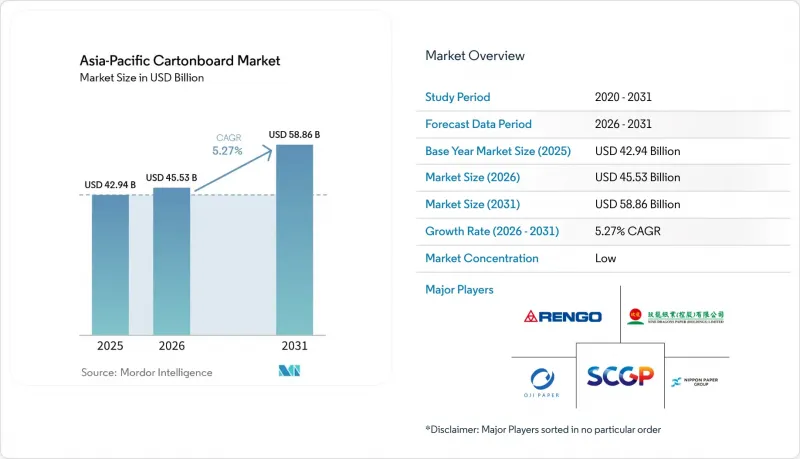
根據 Mordor Intelligence 預測,亞太地區瓦楞紙板市場規模預計將從 2025 年的 429.4 億美元成長到 2026 年的 455.3 億美元,到 2031 年將達到 588.6 億美元,2026 年至 2031 年的複合年成長率為 5.27%。
本報告按產品等級(實心漂白紙板、實心未漂白紙板、折疊紙盒用紙板等)、包裝形式(折疊紙盒、液體包裝、紙套、托盤等)、終端用戶行業(食品、飲料等)和地區(中國、印度、日本、韓國、印尼及其他亞太地區)進行細分。市場預測以美元計價。
亞太地區紙板市場趨勢及洞察。
強制性塑膠替代品和品牌永續性目標
印度修訂後的《塑膠廢棄物管理條例》於2026年4月生效,該條例對不可回收的包裝材料徵收生產者責任延伸(EPR)費用。這使得瓦楞紙板在更廣泛的產品類型中比軟包裝薄膜更具成本競爭力。中國的《綠色包裝方法》規定,到2027年底,宅配包裝的75%必須可回收或可重複使用,為加工商和品牌所有者提供了明確的合規時間表。在中國部分地區,執法工作已經開始,浙江省對每次違規行為處以5萬元人民幣(約7000美元)的罰款,這加速了採購政策的變革,而不是將其推遲到最後期限。品牌也在推動類似的轉變;聯合利華中國計劃在2027年將個人保健產品90%的二級包裝替換為紙質包裝,預計每年可減少1.2萬噸軟質塑膠的使用。此外,韓國也從2026年1月起加強了其生產者延伸責任制(EPR)框架,提高了對無標籤包裝和再生材料含量的要求。這促進了整個亞太地區紙板市場對可印刷和可回收折疊紙板的投資。
包裝食品的需求與零售業的現代化
印度食品加工業預計在2025年成長8.7%,這將擴大品牌零售包裝的市場基礎,而這些包裝主要依賴可折疊紙盒和塗佈紙板,而非簡單的運輸包裝。隨著印度、印尼和越南的零售模式從普通零售轉向有組織的零售,品牌所有者需要更高的展示效果、更清晰的印刷品質以及更嚴格的食品接觸法規合規性,從而推動了對高附加價值紙板的需求。這種轉變也影響著包裝設計,因為越來越多的產品正從簡單的二級包裝轉向結構化、可直接用於展示的紙盒,這些紙盒可以容納圖形、可追溯資訊和零售商專屬標籤。印尼飲料產業預計在2025年成長6.3%,這將增加對品牌零售包裝的需求,因為銷售管道越來越重視產品外觀和運輸效率。在中國,美團已設定目標,使其80%的包裝獲得生態認證,顯示大規模數位零售和食品配送平台正在塑造亞太地區瓦楞紙板市場的採購標準。
原生紙漿和再生纖維的成本波動
對於全部區域的紙板生產商而言,紙漿價格仍然是短期內利潤率面臨的最明顯壓力。 2024年,硬木漿價格上漲了30%,這推高了依賴外購紙漿而非自有纖維系統的造紙廠的生產成本。亞洲造紙廠對此的回應是,在2025年初將紙漿價格提高了每噸31.50美元,這表明原料價格的波動會迅速波及加工商的採購和客戶合約。缺乏種植園管理或完善的再生纖維網路的造紙廠更容易受到現貨市場波動和貨幣對進口紙漿貶值的影響。雖然中國正在透過推進紙漿與造紙一體化來降低部分風險,但日本和韓國在紙板生產方面仍然高度依賴進口纖維,這使得亞太地區紙板市場的成本預測變得困難。
細分市場分析
到2025年,可折疊瓦楞紙板將佔據亞太地區瓦楞紙板市場33.12%的銷售佔有率,並繼續保持其市場主導地位。其主導地位源自於其在食品、化妝品和藥品等行業的二次包裝中的廣泛應用,在這些行業中,印刷品質、剛性和良好的加工性能比最低的材料成本更為重要。此外,由於中國、日本和印度擁有完善的紙廠和加工商網路,可折疊瓦楞紙板在亞太地區供應充足,確保了主流應用的相對穩定供應。未漂白瓦楞紙板在菸草和保健品包裝等高階細分市場仍然很受歡迎,而白背紙板在日本和韓國等擁有成熟再生纖維體系的市場中,繼續在對成本敏感的二次包裝領域發揮著重要作用。
預計到2031年,液體包裝紙板的複合年成長率將達到5.51%,成為亞太地區紙板產業成長最快的品類,也是成長前景最為明朗的領域之一。這一成長與印度和東南亞地區新建的無菌冷藏乳製品基礎設施密切相關,這些基礎設施擴大了當地的紙盒產量,降低了對進口的依賴,並提高了供應的柔軟性。利樂公司於2026年2月在其亞洲高速A3/Speed生產線上引入了紙基阻隔技術,而韓國Mail Dairies公司則在全球範圍內率先採用了該技術,這表明基材創新正在擴大目標紙板的適用範圍,同時又不影響加工能力。此外,隨著快餐和外帶行業轉向使用不含PFAS的杯子和托盤,餐飲服務業對紙板的需求也不斷成長。未漂白固態板保持著穩定的構成比,儘管佔有率較小,尤其是在那些優先考慮強度和成本平衡而非高級表面外觀的地區。
其他好處:
- Excel格式的市場預測(ME)表
- 3個月的分析師支持
目錄
第1章:引言
- 研究假設和市場定義
- 調查範圍
第2章:調查方法
第3章執行摘要
第4章 市場狀況
- 市場概覽
- 宏觀經濟因素對市場的影響
- 市場促進因素
- 強制性塑膠替代品和品牌永續性目標
- 包裝食品的需求與零售業的現代化
- 對用於飲料和乳製品的無菌冷藏紙盒的需求
- 符合可追溯性和衛生要求的藥品和醫療保健包裝的需求。
- 不含 PFAS 且具有阻隔性的板材的創新正在加速向食品服務業的轉型。
- 美容、保健和香菸紙盒對優質化和防偽印刷的需求日益成長。
- 市場限制因素
- 原生紙漿和再生纖維的成本波動
- 來自軟塑膠和輕質替代形式的競爭
- 多層液體包裝不完全回收再利用的經濟效益
- 在精密應用中,食品接觸法規的合規性和阻隔性能之間的權衡。
- 產業價值鏈分析
- 監理情勢
- 技術展望
- 波特五力分析
第5章 市場規模與成長預測
- 按產品等級
- 固體漂白紙板
- 固體未漂白紙板
- 折疊紙板
- 球場用球的白色底面
- 用於液體包裝的紙板
- 食品服務用紙板
- 按包裝類型
- 折疊紙箱
- 液體包裝
- 袖套和托盤
- 其他包裝形式(杯子、食品服務容器)
- 按最終用戶行業分類
- 食物
- 飲料
- 藥品和醫療保健
- 菸草
- 化妝品和盥洗用品
- 其他終端用戶產業(玩具、服飾、汽車、家居用品、電器、餐飲服務業)
- 按地區
- 中國
- 印度
- 日本
- 韓國
- 印尼
- 其他亞太國家
第6章 競爭情勢
- 市場集中度
- 策略趨勢
- 市佔率分析
- 公司簡介
- Oji Holdings Corporation
- Nippon Paper Industries Co., Ltd.
- Nine Dragons Paper(Holdings)Limited
- SCG Packaging Public Company Limited
- Rengo Co., Ltd.
- ITC Limited
- JK Paper Limited
- Toyo Seikan Group Holdings, Ltd.
- SIG Group AG
- Tetra Pak International SA
- Graphic Packaging Holding Company
- Huhtamaki Oyj
- Smurfit Westrock plc
- Mayr-Melnhof Karton AG
- Stora Enso Oyj
- Metsa Board Corporation
- Billerud Aktiebolag(publ)
- Lee & Man Paper Manufacturing Ltd.
- Greatview Aseptic Packaging Company Limited
- Sonoco Products Company
第7章 市場機會與未來展望
According to Mordor Intelligence, the asia-Pacific cartonboard market size is expected to increase from USD 42.94 billion in 2025 to USD 45.53 billion in 2026 and reach USD 58.86 billion by 2031, growing at a CAGR of 5.27% over 2026-2031.
This report is Segmented by Product Grade (Solid Bleached Board, Solid Unbleached Board, Folding Boxboard, and More), Packaging Format (Folding Cartons, Liquid Packaging, Sleeve and Tray, and More), End-User Industry (Food, Beverage, and More), and Geography (China, India, Japan, South Korea, Indonesia, and Rest of Asia-Pacific). The Market Forecasts are Provided in Terms of Value (USD).
Asia-Pacific Cartonboard Market Trends and Insights
Plastic Substitution Mandates And Brand Sustainability Targets
India's Plastic Waste Management Amendment Rules took effect from April 2026 and attached EPR fees to non-recyclable packaging, which improves cartonboard's cost position against flexible film in more product categories. China's Green Packaging Law requires 75% of express packaging to be recyclable or reusable by end-2027, which gives converters and brand owners a clear compliance timeline. Enforcement has already become more tangible in parts of China, with Zhejiang using penalties of CNY 50,000, USD 7,000, per violation, which pushes procurement changes forward rather than leaving them to the deadline year. Brand commitments are reinforcing the same shift, and Unilever China stated a goal of moving 90% of personal-care secondary packaging to paper by 2027, removing an estimated 12,000 metric tonnes of flexible plastic each year. South Korea also tightened its EPR framework from January 2026 with stronger label-free and recycled-content requirements, which supports investment in printable and recyclable folding boxboard across the Asia-Pacific cartonboard market.
Packaged Food Demand And Retail Modernization
India's food processing sector expanded 8.7% in 2025, which widened the base for branded retail packaging that depends on folding cartons and coated boxboard rather than plain transit formats. As general trade shifts toward organized retail in India, Indonesia, and Vietnam, brand owners need better shelf appearance, clearer print quality, and more consistent food-contact compliance, which raises demand for higher-value board grades. This change also affects pack design, because more products are moving from simple secondary wrapping toward structured, shelf-ready cartons that hold graphics, traceability elements, and retailer-specific labeling. Indonesia's beverage sector expanded 6.3% in 2025, and that added to demand for branded retail packaging in channels that increasingly value presentation and transport efficiency. In China, Meituan targeted 80% of packaging to be eco-certified, which shows that large digital retail and food delivery platforms are already shaping procurement standards in the Asia-Pacific cartonboard market.
Virgin Pulp And Recovered Fiber Cost Volatility
Fiber remains the clearest near-term margin pressure point for cartonboard producers across the region. Hardwood pulp prices recorded 30% inflation during 2024, and that raised production costs for mills that depend on purchased pulp rather than captive fiber systems. Asian mills responded with price hikes of USD 31.50 per tonne for early 2025, which shows how quickly raw material swings pass through to converter procurement and customer contracts. Mills that lack plantation control or deep recovered fiber networks remain more exposed to spot cycles and currency weakness on imported pulp. China is reducing part of that exposure through greater pulp-paper integration, but Japan and South Korea still face a more structural dependence on imported board-grade fiber, which keeps costs less predictable in the Asia-Pacific cartonboard market.
Other drivers and restraints analyzed in the detailed report include:
- Beverage And Dairy Carton Demand In Aseptic And Chilled Formats
- Pharmaceutical And Healthcare Packaging Demand With Traceability And Hygiene Needs
- Competition From Flexible Plastic And Lightweight Alternative Formats
For complete list of drivers and restraints, kindly check the Table Of Contents.
Segment Analysis
Folding boxboard commanded a 33.12% revenue share in 2025 and remained the largest product grade in the Asia-Pacific cartonboard market. Its lead came from its wide use in food, cosmetics, and pharmaceutical secondary packaging, where print quality, stiffness, and good converting behavior matter more than the lowest possible material cost. The grade also benefits from broad regional availability, because integrated mill and converter networks in China, Japan, and India keep supply relatively steady for mainstream applications. Solid bleached board still serves premium niches in tobacco and healthcare packaging, while white-lined chipboard stays relevant in cost-sensitive secondary packs in markets with mature recovered fiber systems such as Japan and South Korea.
Liquid packaging board is projected to grow at 5.51% CAGR through 2031, making it the fastest-growing grade and one of the clearest expansion pockets within the Asia-Pacific cartonboard industry. That rise is tied to new aseptic and chilled dairy infrastructure in India and Southeast Asia, where more local carton production is reducing import dependence and improving supply flexibility. Tetra Pak's February 2026 rollout of paper-based barrier technology on high-speed A3/Speed lines in Asia, with Maeil Dairies in South Korea as the first producer globally to implement it, shows how substrate innovation is widening the addressable board base without giving up throughput. Food service board is also adding incremental demand as quick-service and takeaway formats move toward PFAS-free cups and trays. Solid unbleached board remains a smaller but steady part of the mix, especially where strength and cost balance matter more than premium surface appearance.
Complete Report Scope:
- By Product Grade
- Solid Bleached Board
- Solid Unbleached Board
- Folding Boxboard
- White-Lined Chipboard
- Liquid Packaging Board
- Food Service Board
- By Packaging Format
- Folding Cartons
- Liquid Packaging
- Sleeve and Tray
- Other Packaging Formats (Cups, Foodservice Containers)
- By End-User Industry
- Food
- Beverage
- Pharmaceutical and Healthcare
- Tobacco
- Cosmetics and Toiletries
- Other End-User Industries (Toy, Apparel, Automotive, Household, Electrical, Foodservice)
- By Geography
- China
- India
- Japan
- South Korea
- Indonesia
- Rest of Asia-Pacific
List of Companies Covered in this Report:
- Oji Holdings Corporation
- Nippon Paper Industries Co., Ltd.
- Nine Dragons Paper (Holdings) Limited
- SCG Packaging Public Company Limited
- Rengo Co., Ltd.
- ITC Limited
- JK Paper Limited
- Toyo Seikan Group Holdings, Ltd.
- SIG Group AG
- Tetra Pak International S.A.
- Graphic Packaging Holding Company
- Huhtamaki Oyj
- Smurfit Westrock plc
- Mayr-Melnhof Karton AG
- Stora Enso Oyj
- Metsa Board Corporation
- Billerud Aktiebolag (publ)
- Lee & Man Paper Manufacturing Ltd.
- Greatview Aseptic Packaging Company Limited
- Sonoco Products Company
Additional Benefits:
- The market estimate (ME) sheet in Excel format
- 3 months of analyst support
TABLE OF CONTENTS
1 INTRODUCTION
- 1.1 Study Assumptions and Market Definition
- 1.2 Scope of the Study
2 RESEARCH METHODOLOGY
3 EXECUTIVE SUMMARY
4 MARKET LANDSCAPE
- 4.1 Market Overview
- 4.2 Impact of Macroeconomic Factors on the Market
- 4.3 Market Drivers
- 4.3.1 Plastic Substitution Mandates and Brand Sustainability Targets
- 4.3.2 Packaged Food Demand and Retail Modernization
- 4.3.3 Beverage and Dairy Carton Demand in Aseptic and Chilled Formats
- 4.3.4 Pharmaceutical and Healthcare Packaging Demand With Traceability and Hygiene Needs
- 4.3.5 PFAS-Free and High-Barrier Board Innovation Unlocking Foodservice Conversion
- 4.3.6 Premiumization and Anti-Counterfeit Print Demand in Beauty, Healthcare, and Tobacco Cartons
- 4.4 Market Restraints
- 4.4.1 Virgin Pulp and Recovered Fiber Cost Volatility
- 4.4.2 Competition From Flexible Plastic and Lightweight Alternative Formats
- 4.4.3 Incomplete Collection and Recycling Economics for Multilayer Liquid Cartons
- 4.4.4 Food-Contact Compliance and Barrier-Performance Trade-Offs in Sensitive Uses
- 4.5 Industry Value Chain Analysis
- 4.6 Regulatory Landscape
- 4.7 Technological Outlook
- 4.8 Porter's Five Forces Analysis
- 4.8.1 Threat of New Entrants
- 4.8.2 Bargaining Power of Suppliers
- 4.8.3 Bargaining Power of Buyers
- 4.8.4 Threat of Substitutes
- 4.8.5 Competitive Rivalry
5 MARKET SIZE AND GROWTH FORECASTS (VALUE)
- 5.1 By Product Grade
- 5.1.1 Solid Bleached Board
- 5.1.2 Solid Unbleached Board
- 5.1.3 Folding Boxboard
- 5.1.4 White-Lined Chipboard
- 5.1.5 Liquid Packaging Board
- 5.1.6 Food Service Board
- 5.2 By Packaging Format
- 5.2.1 Folding Cartons
- 5.2.2 Liquid Packaging
- 5.2.3 Sleeve and Tray
- 5.2.4 Other Packaging Formats (Cups, Foodservice Containers)
- 5.3 By End-User Industry
- 5.3.1 Food
- 5.3.2 Beverage
- 5.3.3 Pharmaceutical and Healthcare
- 5.3.4 Tobacco
- 5.3.5 Cosmetics and Toiletries
- 5.3.6 Other End-User Industries (Toy, Apparel, Automotive, Household, Electrical, Foodservice)
- 5.4 By Geography
- 5.4.1 China
- 5.4.2 India
- 5.4.3 Japan
- 5.4.4 South Korea
- 5.4.5 Indonesia
- 5.4.6 Rest of Asia-Pacific
6 COMPETITIVE LANDSCAPE
- 6.1 Market Concentration
- 6.2 Strategic Moves
- 6.3 Market Share Analysis
- 6.4 Company Profiles (includes Global Level Overview, Market Level Overview, Core Segments, Financials as available, Strategic Information, Market Rank/Share, Products and Services, Recent Developments)
- 6.4.1 Oji Holdings Corporation
- 6.4.2 Nippon Paper Industries Co., Ltd.
- 6.4.3 Nine Dragons Paper (Holdings) Limited
- 6.4.4 SCG Packaging Public Company Limited
- 6.4.5 Rengo Co., Ltd.
- 6.4.6 ITC Limited
- 6.4.7 JK Paper Limited
- 6.4.8 Toyo Seikan Group Holdings, Ltd.
- 6.4.9 SIG Group AG
- 6.4.10 Tetra Pak International S.A.
- 6.4.11 Graphic Packaging Holding Company
- 6.4.12 Huhtamaki Oyj
- 6.4.13 Smurfit Westrock plc
- 6.4.14 Mayr-Melnhof Karton AG
- 6.4.15 Stora Enso Oyj
- 6.4.16 Metsa Board Corporation
- 6.4.17 Billerud Aktiebolag (publ)
- 6.4.18 Lee & Man Paper Manufacturing Ltd.
- 6.4.19 Greatview Aseptic Packaging Company Limited
- 6.4.20 Sonoco Products Company
7 MARKET OPPORTUNITIES AND FUTURE OUTLOOK
- 7.1 White-Space and Unmet-Need Assessment

 瓦楞紙板市場:全球預測,2026-2032年
 層狀焊盤市場規模、佔有率和成長分析:按材料、應用、最終用途、通路和地區分類-2026-2033年產業預測
 貨架襯墊市場規模、佔有率和成長分析:按材料、產品類型、應用、最終用戶、分銷管道、厚度和地區分類-2026-2033年產業預測
 中東和非洲紙板市場:市場佔有率分析、行業趨勢和統計數據以及成長預測(2026-2031 年)印度紙板市場:市場佔有率分析、行業趨勢和統計數據以及成長預測(2026-2031 年)德國紙板:市場佔有率分析、產業趨勢與統計、成長預測(2026-2031)新加坡紙板市場:市場佔有率分析、產業趨勢與統計、成長預測(2026-2031)日本紙板市場:市場佔有率分析、產業趨勢與統計、成長預測(2026-2031)法國紙板:市場佔有率分析、產業趨勢與統計、成長預測(2026-2031)美國紙板市場:市場佔有率分析、產業趨勢與統計、成長預測(2026-2031)