


 |
市場調查報告書
商品編碼
2072769
美國紙板市場:市場佔有率分析、產業趨勢與統計、成長預測(2026-2031)United States Cartonboard - Market Share Analysis, Industry Trends & Statistics, Growth Forecasts (2026 - 2031) |
||||||

※ 本網頁內容可能與最新版本有所差異。詳細情況請與我們聯繫。
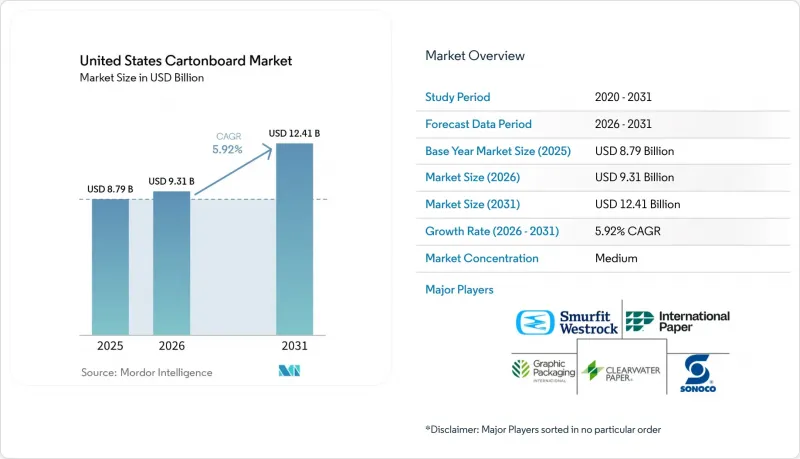
據 Mordor Intelligence 稱,2025 年美國瓦楞紙板市場價值 87.9 億美元,預計到 2031 年將從 2026 年的 93.1 億美元成長至 124.1 億美元,預測期(2026-2031 年)複合年成長率為 5.92%。
本報告按產品等級(實心漂白紙板、實心未漂白紙板、折疊盒用紙板、白襯紙板、液體包裝用紙板、食品服務用紙板)、包裝形式(折疊盒、液體包裝、紙套和托盤等)以及最終用戶行業(食品、飲料、醫藥保健、煙草等)進行細分。市場預測以美元計價。
美國瓦楞紙板市場趨勢與洞察
包裝食品和新鮮/簡便食品。
食品仍是美國瓦楞紙板市場最廣泛的需求來源,預計到2025年將佔總需求的38.14%,其中包括乾貨、冷凍食品、冷藏產品和便利型產品。食品領域的需求也轉向了品牌紙板,強調原料透明度、保存期限以及在高階健康食品、食材自煮包和自有品牌食品系列中提升商店展示效果。紙板包裝委員會與Fastmarkets RISI合作,將食品列為預計到2029年年成長率超過1%的七大終端用戶市場之一,為紙板消費提供了穩定的基礎。這種需求模式有利於滿足特定性能要求的紙板等級,例如防潮性、耐油性以及符合FDA 21 CFR關於食品接觸應用的要求。因此,美國瓦楞紙板市場越來越重視能夠滿足特定規格要求的供應商,而不是那些在廣泛的商品管道中大量銷售無差異化產品的供應商。這種轉變導致買家更多地根據產品的功能、合規性和品牌價值來選擇產品,而不是簡單地批量採購,從而提高了收入品質。
健康美容產品包裝優質化和商店影響力需求。
醫療保健、美容和個人護理品牌將紙板包裝作為價格定位的重要視覺元素,尤其是在印刷品質和包裝工藝影響零售購買決策的情況下。根據 Circana 預測,到 2025 年,美國高階美容產品的零售額預計將達到 360 億美元,年增 4%;而大眾市場美容產品的零售額預計將達到 727 億美元,年增 5%,這表明市場對高階和經濟型紙板包裝的需求都很強勁。高階品牌傾向於選擇高光澤的素面漂白紙板和精緻的可折疊瓦楞紙板。另一方面,大眾市場品牌則透過升級包裝的圖案和結構來提高商店可見度,而無需完全採用奢侈品級規格。此外,加州、科羅拉多、緬因州、馬裡蘭州、明尼蘇達州、奧勒岡州和華盛頓州從 2026 年到 2027 年繼續實施州級包裝生產者責任召回 (EPR) 法規,進一步推動了可回收纖維基包裝的普及。這種政策環境使得紡織品包裝在合規方面比複雜的多材料包裝更具優勢,後者難以回收,且更容易面臨未來的費用負擔。在美國瓦楞紙板市場,這意味著美觀性和法規遵從性之間的聯繫日益緊密,從而支撐了美容產品領域對可折疊瓦楞紙板的持續需求。
原生紙漿、能源和運輸成本波動
2026年,投入成本通膨仍是美國紙板市場面臨的最緊迫阻礙因素因素,紙漿、能源和運輸成本同時上漲。索諾科宣布,自2026年4月起,未塗佈再生紙板價格每噸上漲70美元,隨後加工紙板產品價格上漲8%。這顯示成本上漲正迅速向下游轉嫁。斯莫菲特·韋斯特洛克公司自2026年6月起,箱板紙價格每噸上漲50美元,國際紙業公司也因能源和運輸成本飆升,在同一時期宣布每噸上漲70美元。美國紙業聯合會(AF)和美國紙業協會(PA)的數據顯示,2026年第一季北美箱板紙產量年減超過8%,顯示供應緊張增強了生產商的定價權。俄亥俄州立大學也引述一項分析指出,美國的紙漿生產成本比南美高出40%,限制了美國國內製造商自行消化突發成本衝擊的能力。對於中小加工商而言,這種壓力最為嚴重,因為他們的購買力有限,採購柔軟性較差,而且透過廣泛的產品系列來分散通貨膨脹影響的能力也較弱。
細分市場分析
到2025年,液體包裝紙板將占美國紙板市場29.31%的佔有率,成為美國最大的產品等級。其主導地位得益於乳製品、果汁、植物來源飲料和無菌食品等領域的強勁需求,在這些領域,阻隔性能、印刷適性和保存期限等特性難以用更簡單的替代品替代。漂白紙板在藥品和化妝品等高階可折疊紙盒應用中保持著重要地位,其白度、印刷適性和符合食品藥品接觸要求等特性在受監管的應用中具有明顯的商業性價值。固態漂白紙板在飲料多包裝和其他對強度要求較高的應用中扮演著較為狹窄但穩定的角色,在這些應用中,剛性比外觀更重要。可折疊紙盒在醫療保健、美容和食品領域與未漂白紙板展開競爭,但像斯道拉恩索公司(Stora Enso Oyj)和美特薩紙板公司(Metsa Board Corporation)這樣的歐洲供應商在2026年向美國加工商供貨時面臨著關稅相關的阻力。
在美國瓦楞紙板市場中,食品服務紙板是成長最快的產品等級,預計從2026年到2031年,其複合年成長率將達到6.18%,這主要得益於PFAS配方的變化以及塑膠替代品的廣泛應用。 Sappi北美公司在其位於緬因州薩默塞特的工廠推出了「LusterFSB OGR」瓦楞紙板。此等級的紙板無需聚乙烯塗層即可實現耐油耐脂性能,滿足了食品加工行業對配方改進的迫切需求。 Clearwater Paper公司於2026年3月推出了「Velora」瓦楞紙板,這是一款符合FDA 21 CFR要求的輕量可折疊瓦楞紙板。該產品的目標客戶是那些尋求經濟實惠且國產的優質SBS替代品的加工商。隨著緬因州於2026年5月實施關於含有植物纖維衍生PFAS的食品包裝材料的法規,監管壓力進一步增加。與此同時,華盛頓州和加州在食品接觸包裝合規方面繼續發揮主導作用。
其他好處:
- Excel格式的市場預測(ME)表
- 3個月的分析師支持
目錄
第1章:引言
- 研究假設和市場定義
- 調查範圍
第2章:調查方法
第3章執行摘要
第4章 市場狀況
- 市場概覽
- 市場促進因素
- 包裝食品和便利商店新鮮食品的需求不斷成長。
- 健康美容產品對優質化和貨架展示的需求日益成長。
- 藥品序列化和防篡改包裝盒的需求
- 從塑膠環包裝到紙質飲料多包裝的過渡
- 高紙含量無菌紙盒的創新
- 零售商對食品服務業所需的不含 PFAS 的紡織包裝材料的需求。
- 市場限制因素
- 未使用的光纖、能源和貨運費率的波動
- 再生紙和阻隔塗層紙板的食品接觸適用性限制
- PFAS重組和重新認證的相關成本
- 條碼、序列化和生產線升級所帶來的負擔。
- 宏觀經濟因素對市場的影響
- 產業價值鏈分析
- 監理情勢
- 技術展望
- 波特五力分析
第5章 市場規模與成長預測
- 按產品等級
- 實心漂白板
- 未漂白飾面
- 折疊紙板
- 白色襯裡塑合板
- 液體包裝板
- 餐飲服務業的董事會
- 按包裝類型
- 折疊紙箱
- 液體包裝
- 袖套和托盤
- 其他包裝形式(杯子、食品服務業的容器)
- 按最終用戶行業分類
- 食物
- 飲料
- 藥品和醫療保健
- 菸草
- 化妝品和盥洗用品
- 其他終端用戶產業(玩具、服飾、汽車、家居用品、電器、餐飲服務業)
第6章 競爭情勢
- 市場集中度
- 策略趨勢
- 市佔率分析
- 公司簡介
- Smurfit Westrock plc
- Graphic Packaging International, LLC
- Clearwater Paper Corporation
- Sonoco Products Company
- International Paper Company
- Huhtamaki Oyj
- Tetra Pak International SA
- SIG Group AG
- Elopak ASA
- Carton Service CSI, LLC
- Oliver Inc.
- Nosco, Inc.
- JohnsByrne Company
- Metsa Board Corporation
- Stora Enso Oyj
- Sappi North America, Inc.
- Billerud Aktiebolag(publ)
- Pactiv Evergreen Inc.
- Evergreen Packaging LLC
第7章 市場機會與未來展望
According to Mordor Intelligence, the united states cartonboard market size was valued at USD 8.79 billion in 2025 and estimated to grow from USD 9.31 billion in 2026 to reach USD 12.41 billion by 2031, at a CAGR of 5.92% during the forecast period (2026-2031).
This report is Segmented by Product Grade (Solid Bleached Board, Solid Unbleached Board, Folding Boxboard, White-Lined Chipboard, Liquid Packaging Board, and Food Service Board), Packaging Format (Folding Cartons, Liquid Packaging, Sleeve and Tray, and More), and End-User Industry (Food, Beverage, Pharma and Healthcare, Tobacco, and More). The Market Forecasts are Provided in Terms of Value (USD).
United States Cartonboard Market Trends and Insights
Rising Packaged Food And Fresh Convenience Demand
Food remained the broadest demand base for the United States cartonboard market, accounting for 38.14% of total demand in 2025 across dry grocery, frozen meals, refrigerated products, and convenience-led formats. The food mix also shifted toward branded cartons that signaled ingredient clarity, storage integrity, and stronger shelf presence in premium health food, meal kit, and private-label grocery lines. The Paperboard Packaging Council's 2025-26 outlook, prepared with Fastmarkets RISI, identified food as one of 7 end-use markets expected to expand by more than 1% annually through 2029, and that supported a steady floor for board consumption. That demand pattern favored grades with specific performance requirements, including moisture resistance, grease resistance, and compliance with 21 CFR FDA requirements for food-contact uses. As a result, the United States cartonboard market increasingly rewarded suppliers that could qualify targeted specifications rather than sell undifferentiated tonnage into broad commodity channels. That shift also improved revenue quality because more buyers were selecting based on function, compliance, and branding value rather than on simple volume procurement.
Premiumization And Shelf-Impact Requirements In Health And Beauty Packaging
Health, beauty, and personal care brands used cartonboard as a visible part of price positioning, especially where print quality and pack finish influenced retail conversion. Circana reported that United States prestige beauty retail sales reached USD 36 billion in 2025, up 4% year over year, while mass beauty sales rose 5% to USD 72.7 billion, keeping demand active across both premium and value carton formats. Prestige brands leaned toward higher-brightness solid bleached board and refined folding carton finishes, while mass-market brands upgraded graphics and structure to improve shelf visibility without moving fully into luxury-grade specifications. State packaging EPR laws also strengthened the case for recyclable fiber formats because implementation continued in California, Colorado, Maine, Maryland, Minnesota, Oregon, and Washington during 2026 and 2027. That policy setting gave fiber-based packs a practical compliance edge over complex multi-material formats that were harder to recover and more exposed to future fee pressure. In the United States cartonboard market, this meant aesthetic value and regulatory fit increasingly moved together, which supported durable demand for folding cartons in beauty aisles.
Virgin Fiber, Energy, And Freight Cost Volatility
Input cost inflation remained the most immediate restraint on the United States cartonboard market because fiber, energy, and freight pressures rose simultaneously in 2026. Sonoco announced a USD 70 per ton price increase for uncoated recycled paperboard, effective in April 2026, followed by an 8% increase on converted paperboard products, showing how quickly higher costs were being passed downstream. Smurfit Westrock moved on a USD 50 per ton increase in containerboard, effective in June 2026, and International Paper announced USD 70 per ton hikes for the same period as energy and freight costs rose. AF and PA data for Q1 2026 showed North American containerboard production fell by more than 8% year over year, and that tightening supply conditions strengthened producer pricing power. The Ohio State University also cited analysis showing that United States pulp production costs were 40% higher than in South America, leaving domestic producers with less room to absorb sudden cost shocks internally. The pressure was most severe for smaller converters because they had limited buying leverage, narrower sourcing flexibility, and weaker ability to spread inflation across a broad product portfolio.
Other drivers and restraints analyzed in the detailed report include:
- Pharmaceutical Serialization And Tamper-Evident Carton Demand
- Shift From Plastic Rings To Paperboard Beverage Multipacks
- Food-Contact Compliance Constraints On Recycled And Barrier-Coated Board
For complete list of drivers and restraints, kindly check the Table Of Contents.
Segment Analysis
Liquid packaging board accounted for 29.31% of the United States cartonboard market in 2025, making it the largest product grade in the country. Its lead position came from durable demand across dairy, juice, plant-based beverages, and aseptic food formats, where barrier performance, printability, and shelf life remained difficult to replicate with simpler substitutes. Solid bleached board stayed important in premium folding carton applications for pharmaceuticals and beauty because brightness, print surface, and food or drug contact compliance carried clear commercial value in regulated uses. Solid unbleached board served a narrower but stable role in beverage multipacks and other strength-led applications where rigidity mattered more than premium surface appearance. Folding boxboard competed with SBB in health, beauty, and food grocery segments, although European suppliers such as Stora Enso Oyj and Metsa Board Corporation faced tariff-related headwinds in 2026 when serving United States converters.
Food service board was the fastest-growing product grade in the United States cartonboard market and was projected to advance at a 6.18% CAGR from 2026 to 2031 as PFAS reformulation and plastic substitution moved into commercial execution. Sappi North America introduced LusterFSB OGR at its Somerset Mill in Maine, and the grade was designed to deliver oil- and grease-resistance without polyethylene coatings, addressing an immediate reformulation need in foodservice converting. Clearwater Paper launched Velora in March 2026 as a lightweight folding carton paperboard that met FDA 21 CFR requirements and was targeted at converters seeking a cost-conscious domestic alternative to premium SBS. The regulatory pull grew stronger as Maine's plant-fiber PFAS food packaging restriction took effect in May 2026, while Washington and California continued to set the pace on food-contact packaging compliance.
Complete Report Scope:
- By Product Grade
- Solid Bleached Board
- Solid Unbleached Board
- Folding Boxboard
- White-Lined Chipboard
- Liquid Packaging Board
- Food Service Board
- By Packaging Format
- Folding Cartons
- Liquid Packaging
- Sleeve and Tray
- Other Packaging Formats (Cups, Foodservice Containers)
- By End-User Industry
- Food
- Beverage
- Pharmaceutical and Healthcare
- Tobacco
- Cosmetics and Toiletries
- Other End-User Industries (Toy, Apparel, Automotive, Household, Electrical, Foodservice)
List of Companies Covered in this Report:
- Smurfit Westrock plc
- Graphic Packaging International, LLC
- Clearwater Paper Corporation
- Sonoco Products Company
- International Paper Company
- Huhtamaki Oyj
- Tetra Pak International S.A.
- SIG Group AG
- Elopak ASA
- Carton Service CSI, LLC
- Oliver Inc.
- Nosco, Inc.
- JohnsByrne Company
- Metsa Board Corporation
- Stora Enso Oyj
- Sappi North America, Inc.
- Billerud Aktiebolag (publ)
- Pactiv Evergreen Inc.
- Evergreen Packaging LLC
Additional Benefits:
- The market estimate (ME) sheet in Excel format
- 3 months of analyst support
TABLE OF CONTENTS
1 INTRODUCTION
- 1.1 Study Assumptions and Market Definition
- 1.2 Scope of the Study
2 RESEARCH METHODOLOGY
3 EXECUTIVE SUMMARY
4 MARKET LANDSCAPE
- 4.1 Market Overview
- 4.2 Market Drivers
- 4.2.1 Rising Packaged Food and Fresh Convenience Demand
- 4.2.2 Premiumization and Shelf-Impact Requirements in Health and Beauty Packaging
- 4.2.3 Pharmaceutical Serialization and Tamper-Evident Carton Demand
- 4.2.4 Shift From Plastic Rings to Paperboard Beverage Multipacks
- 4.2.5 Higher-Paper-Content Aseptic Carton Innovation
- 4.2.6 Retailer Pull for PFAS-Free Fiber Foodservice Packaging
- 4.3 Market Restraints
- 4.3.1 Virgin Fiber, Energy, and Freight Cost Volatility
- 4.3.2 Food-Contact Compliance Constraints on Recycled and Barrier-Coated Board
- 4.3.3 PFAS Reformulation and Requalification Costs
- 4.3.4 Barcode, Serialization, and Converting-Line Upgrade Burdens
- 4.4 Impact of Macroeconomic Factors on the Market
- 4.5 Industry Value Chain Analysis
- 4.6 Regulatory Landscape
- 4.7 Technological Outlook
- 4.8 Porter's Five Forces Analysis
- 4.8.1 Threat of New Entrants
- 4.8.2 Bargaining Power of Suppliers
- 4.8.3 Bargaining Power of Buyers
- 4.8.4 Threat of Substitutes
- 4.8.5 Intensity of Competitive Rivalry
5 MARKET SIZE AND GROWTH FORECASTS (VALUE)
- 5.1 By Product Grade
- 5.1.1 Solid Bleached Board
- 5.1.2 Solid Unbleached Board
- 5.1.3 Folding Boxboard
- 5.1.4 White-Lined Chipboard
- 5.1.5 Liquid Packaging Board
- 5.1.6 Food Service Board
- 5.2 By Packaging Format
- 5.2.1 Folding Cartons
- 5.2.2 Liquid Packaging
- 5.2.3 Sleeve and Tray
- 5.2.4 Other Packaging Formats (Cups, Foodservice Containers)
- 5.3 By End-User Industry
- 5.3.1 Food
- 5.3.2 Beverage
- 5.3.3 Pharmaceutical and Healthcare
- 5.3.4 Tobacco
- 5.3.5 Cosmetics and Toiletries
- 5.3.6 Other End-User Industries (Toy, Apparel, Automotive, Household, Electrical, Foodservice)
6 COMPETITIVE LANDSCAPE
- 6.1 Market Concentration
- 6.2 Strategic Moves
- 6.3 Market Share Analysis
- 6.4 Company Profiles (includes Global Level Overview, Market Level Overview, Core Segments, Financials as available, Strategic Information, Market Rank/Share, Products and Services, Recent Developments)
- 6.4.1 Smurfit Westrock plc
- 6.4.2 Graphic Packaging International, LLC
- 6.4.3 Clearwater Paper Corporation
- 6.4.4 Sonoco Products Company
- 6.4.5 International Paper Company
- 6.4.6 Huhtamaki Oyj
- 6.4.7 Tetra Pak International S.A.
- 6.4.8 SIG Group AG
- 6.4.9 Elopak ASA
- 6.4.10 Carton Service CSI, LLC
- 6.4.11 Oliver Inc.
- 6.4.12 Nosco, Inc.
- 6.4.13 JohnsByrne Company
- 6.4.14 Metsa Board Corporation
- 6.4.15 Stora Enso Oyj
- 6.4.16 Sappi North America, Inc.
- 6.4.17 Billerud Aktiebolag (publ)
- 6.4.18 Pactiv Evergreen Inc.
- 6.4.19 Evergreen Packaging LLC
7 MARKET OPPORTUNITIES AND FUTURE OUTLOOK
- 7.1 White-Space and Unmet-Need Assessment

 瓦楞紙板市場:全球預測,2026-2032年
 層狀焊盤市場規模、佔有率和成長分析:按材料、應用、最終用途、通路和地區分類-2026-2033年產業預測
 貨架襯墊市場規模、佔有率和成長分析:按材料、產品類型、應用、最終用戶、分銷管道、厚度和地區分類-2026-2033年產業預測
 中東和非洲紙板市場:市場佔有率分析、行業趨勢和統計數據以及成長預測(2026-2031 年)亞太地區紙板市場:市場佔有率分析、產業趨勢與統計及成長預測(2026-2031)印度紙板市場:市場佔有率分析、行業趨勢和統計數據以及成長預測(2026-2031 年)德國紙板:市場佔有率分析、產業趨勢與統計、成長預測(2026-2031)新加坡紙板市場:市場佔有率分析、產業趨勢與統計、成長預測(2026-2031)日本紙板市場:市場佔有率分析、產業趨勢與統計、成長預測(2026-2031)法國紙板:市場佔有率分析、產業趨勢與統計、成長預測(2026-2031)