


 |
市場調查報告書
商品編碼
2064445
新加坡瓦楞紙板原紙:市佔率分析、產業趨勢與統計及成長預測(2026-2031)Singapore Containerboard - Market Share Analysis, Industry Trends & Statistics, Growth Forecasts (2026 - 2031) |
||||||

※ 本網頁內容可能與最新版本有所差異。詳細情況請與我們聯繫。
據 Mordor Intelligence 稱,新加坡瓦楞紙板原紙市場在 2025 年的價值為 24.7 億美元,預計到 2031 年將從 2026 年的 25.6 億美元成長到 30.6 億美元,在預測期(2026-2031 年成長率為 3.64%。
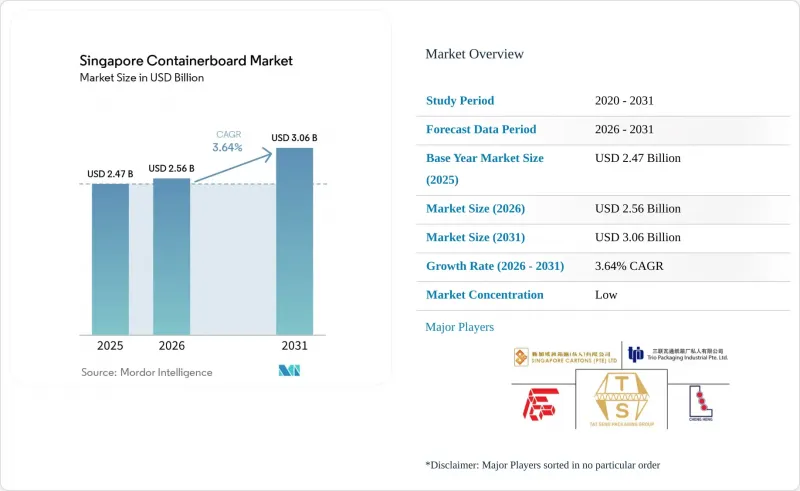
本報告按材料(原生纖維和再生纖維)、產品類型(工藝襯墊、測試襯墊、瓦楞紙板)和最終用戶行業(食品飲料、消費品、工業等)進行細分。市場預測以美元計價。
新加坡箱板紙市場趨勢與洞察
電子商務履約和最後一公里小包裹的成長
新加坡的箱板紙市場受到小包裹密度不斷成長的驅動,因為包裝需求受貨運量、處理頻率、配送速度以及線上銷售額的影響。 2025年3月,新加坡郵政投資3,000萬新元(約2,220萬美元),計畫將其區域電商物流中心的小包裹處理能力從每日10萬件提升至2026年中期的30萬件。這項投資表明,物流供應商正在為小包裹的持續成長做好準備,而不僅僅是應對短期的季節性高峰。跨境B2C貨運,例如電子產品、化妝品和保健品等,由於其處理環節比純粹的國內配送更多,因此往往依賴瓦楞紙包裝材料。這一趨勢正在推動物流供應商、區域履約服務商以及為新加坡箱板紙市場提供小批量電商包裝服務的加工商的重複訂單。此外,由於小包裹主導的需求比傳統零售補貨更不穩定,因此能夠快速回應不斷變化的訂單模式的供應商也從中受益。
永續性法規鼓勵使用可回收的紡織品包裝。
新加坡的箱板紙市場也受益於法律規範穩步提升了可回收和可追溯包裝形式的價值。新加坡國家環境局(NEA)根據2019年《永續性資源法》實施的「包裝報告強制令」要求年銷售額達1,000萬新元(740萬美元)或以上的包裝產品供應商提交年度包裝資料和3R計畫。此強制令鼓勵企業選擇能夠清楚展示再生材料使用、可回收性和合規目標的包裝。隨後,新加坡於2026年4月1日推出了“飲料容器回收強制令”,安裝了超過1070台自動回收機,並對符合條件的塑膠和金屬飲料容器收取0.10新元(0.07美元)的可退還押金。雖然該強制令主要針對飲料容器,但它也提高了包裝設計、標籤和生產者責任等方面的整體合規標準。從長遠來看,此政策方向將鼓勵採用比混合材料包裝更適合回收系統的紡織品包裝形式,以強化新加坡箱板紙市場的營商環境。
進口紙漿和紙板的成本波動
新加坡的箱板紙市場仍極易受到原物料價格波動的影響,因為當地加工業者完全依賴進口再生纖維和成品箱板紙。 2025年1月,進口到東南亞的美國OCC 11價格為每噸175-180美元,較去年同期下降20.2%。同期,歐洲OCC 95/5的價格為每噸145-150美元,顯示再生紙價格的下降並非局部,而是普遍存在。然而,再生紙價格的下降並不一定能保障加工業者的利潤率,因為成品紙板的價格和運輸成本在同一時期可能會出現劇烈波動。根據Fastmarkets的一份報告,2024年中,亞洲部分航線的貨櫃運費翻了三倍,美國至東南亞航線的運費也出現了顯著上漲。因此,沒有長期合約或多元化採購安排的加工商將面臨更大的到貨成本波動,從而阻礙整個新加坡箱板紙市場的價格穩定。
細分市場分析
至2025年,再生纖維將佔新加坡瓦楞紙板原紙市場佔有率的65.14%,鞏固其在標準瓦楞紙板應用材料組成中的核心地位。本地加工商與馬來西亞、韓國和中國的造紙企業建立了長期採購合作關係,這些合作持續為成本敏感型紙箱製造項目提供再生測試襯紙和瓦楞芯紙。日常需求主要集中在食品配送、工業包裝和國內消費品運輸領域,加工商在這些領域優先考慮穩定的供應和合理的價格,而非高階的表面處理。此外,新加坡國家環境局(NEA)的包裝報告法規也提升了那些能夠在包裝應用和減量計畫中得到清楚記錄的材料的價值。這些因素共同確保了再生紙板在新加坡箱板紙市場中繼續佔據重要的結構性地位,而不是僅僅作為應對價格週期的臨時措施。
預計2026年至2031年間,原生纖維將以3.98%的複合年成長率成長,成為新加坡箱板紙市場成長最快的材料類別。這項需求主要由半導體、航太維修和製藥業的出口商推動,他們需要牛皮紙襯裡紙板,以確保在嚴格監管的運輸環境中具備耐破強度、更清晰的印刷效果和卓越的均勻性。新加坡以出口為導向的製造業特徵正在推動這一轉變,因為高附加價值產品通常需要標準再生紙板無法滿足的包裝性能。美光公司在新加坡投資70億美元的先進包裝工廠就是一個典型的例子,其客戶群能夠支撐對優質紙板的長期需求。因此,新加坡箱板紙產業正呈現日益兩極化的趨勢,再生紙板推動大眾市場需求,而原生紙板則選擇性地在出口導向應用領域擴張。
其他好處:
- Excel格式的市場預測(ME)表
- 3個月的分析師支持
目錄
第1章:引言
- 研究假設和市場定義
- 調查範圍
第2章:調查方法
第3章執行摘要
第4章 市場狀況
- 市場概覽
- 市場促進因素
- 電子商務履約和最後一公里小包裹的成長
- 支持可再生紡織包裝的永續性法規
- 來自出口導向先進製造業的需求
- 食品配送及加工食品運輸量的成長
- 永續電子商務包裝指南建議採用合適的紙箱設計。
- 創紀錄的港口吞吐量支撐了對再出口包裝的需求。
- 市場限制因素
- 進口紡織品和紙板的成本波動
- 柔軟性與可重複使用包裝之間的競爭。
- 國內紙張回收業務獲利能力低。
- 包裝報告規則旨在促進材料減少
- 宏觀經濟因素對市場的影響
- 產業價值鏈分析
- 貿易和進口依賴度分析
- 監理情勢
- 技術展望
- 波特五力分析
第5章 市場規模與成長預測
- 材料
- 原生光纖
- 再生纖維
- 依產品類型
- Craftliner
- 測試線
- 凹槽
- 按最終用戶行業分類
- 食品/飲料
- 消費品
- 產業
- 其他終端用戶產業
第6章 競爭情勢
- 市場集中度
- 策略趨勢
- 市佔率分析
- 公司簡介
- Tat Seng Packaging Group Ltd.
- Far East Packaging Industrial Pte Ltd.
- Trio Packaging Industrial Pte Ltd.
- Cheng Heng Paper Products Co(Pte)Ltd.
- Singapore Cartons Pte Ltd.
- Interpak Industries Pte Ltd.
- Union Containers(Pte)Limited
- Stanpack Industries Pte Ltd.
- Federal Packaging Industries Pte Ltd.
- Hi-Rise Paper Products Pte. Ltd.
- Apac Packaging Pte Ltd.
- Asia Enviropak Pte. Ltd.
- Sankawa Packaging(S)Pte Ltd.
- Atlas Paper Products Pte Ltd.
- Advance Carton Pte Ltd.
- Paper Carpenter Pte. Ltd.
- Nippon Kompo Shizai Singapore Pte Ltd.
- Acepac International(S)Pte Ltd.
- AMB Packaging Pte Ltd.
第7章 市場機會與未來展望
According to Mordor Intelligence, the singapore containerboard market size was valued at USD 2.47 billion in 2025 and estimated to grow from USD 2.56 billion in 2026 to reach USD 3.06 billion by 2031, at a CAGR of 3.64% during the forecast period (2026-2031).
This report is Segmented by Material (Virgin Fibers, and Recycled Fibers), Product Type (Kraftliners, Testliners, and Flutings), and End-User Industry (Food and Beverage, Consumer Goods, Industrial, and More). The Market Forecasts are Provided in Terms of Value (USD).
Singapore Containerboard Market Trends and Insights
E-Commerce Fulfillment And Last-Mile Parcel Growth
The Singapore containerboard market is supported by rising parcel density because packaging demand responds to shipment counts, handling frequency, and delivery speed as much as to headline online sales values. In March 2025, SingPost committed SGD 30 million (USD 22.2 million) to expand small-parcel processing capacity at its Regional eCommerce Logistics Hub from 100,000 to 300,000 parcels per day by mid-2026. That investment showed that logistics operators were planning for sustained parcel growth rather than only for short seasonal peaks. Cross-border B2C shipments in categories such as electronics, cosmetics, and health-related goods tend to rely on corrugated transport packaging because they move through more handling points than purely domestic deliveries. This pattern supports repeat ordering from converters that serve logistics providers, regional fulfillment programs, and short-run e-commerce packaging needs across the Singapore containerboard market. It also favors suppliers that can respond quickly to changing order profiles, because parcel-led demand is more dynamic than conventional retail replenishment.
Sustainability Regulations Favoring Recyclable Fiber Packaging
The Singapore containerboard market is also benefiting from a regulatory framework that steadily increases the value of recyclable and traceable packaging formats. NEA's Mandatory Packaging Reporting framework, in force under the Resource Sustainability Act 2019, requires companies with annual turnover above SGD 10 million (USD 7.4 million) that supply packaged goods to submit annual packaging data and 3R plans. That system rewards packaging choices that can show recycled-content pathways, recovery potential, and clearer documentation for compliance purposes. Singapore then launched the Beverage Container Return Scheme on April 1, 2026, with more than 1,070 reverse vending machines and a SGD 0.10 (USD 0.07) refundable deposit on eligible plastic and metal beverage containers. The scheme is focused on beverage containers, yet it still raises the overall compliance baseline for packaging design, labeling, and producer accountability. Over time, that policy direction supports fiber-based packaging formats that fit recycling systems more easily than mixed-material formats, which strengthens the operating backdrop for the Singapore containerboard market.
Imported Fiber And Board Cost Volatility
The Singapore containerboard market remains exposed to input volatility because local converters depend entirely on imported recovered fiber and finished containerboard. US OCC 11 imported into Southeast Asia stood at USD 175-180 per tonne in January 2025, down 20.2% year over year. European OCC 95/5 was assessed at USD 145-150 per tonne during the same period, indicating that lower recovered paper prices were widespread rather than isolated. Lower fiber prices do not always protect converter margins because finished board prices and freight costs can move sharply over the same period. Fastmarkets reported that intra-Asia container shipping rates tripled on some route pairs in mid-2024, and routes from the United States to Southeast Asia also saw steep increases. Converters that lack long-term contracts or multi-origin sourcing, therefore, face sharper landed-cost swings, which limit pricing stability across the Singapore containerboard market.
Other drivers and restraints analyzed in the detailed report include:
- Export-Oriented Advanced Manufacturing Demand
- Food Delivery And Processed Food Shipment Growth
- Competition From Flexible And Reusable Packaging Formats
For complete list of drivers and restraints, kindly check the Table Of Contents.
Segment Analysis
Recycled fibers held 65.14% of the Singapore containerboard market share in 2025, which kept them firmly at the center of the material mix for standard corrugated applications. Local converters have built long-running procurement relationships with mills in Malaysia, South Korea, and China, and those links continue to support recycled testliner and fluting supply for cost-sensitive box programs. The everyday demand base comes from food distribution, industrial packaging, and domestic consumer-goods movement, where converters prioritize consistent supply and workable price points over premium finish. NEA's packaging reporting rules also reinforce the value of materials that can be documented clearly in packaging submissions and reduction plans. That combination keeps recycled grades structurally important to the Singapore containerboard market rather than treating them as a temporary response to pricing cycles.
Virgin fibers are projected to grow at a 3.98% CAGR from 2026 to 2031, making them the fastest-growing material segment within the Singapore containerboard market. Demand is tied to exporters in semiconductors, aerospace maintenance, and pharmaceuticals that need kraftliner-faced board for burst strength, cleaner printing, and better consistency in regulated shipping environments. Singapore's export manufacturing profile supports that shift because high-value goods often require packaging performance that standard recycled board does not always provide. Micron's new USD 7 billion advanced packaging facility in Singapore gives a clear example of the type of customer base that can sustain premium board demand over time. The result is a split structure in the Singapore containerboard industry, with recycled grades carrying volume demand and virgin grades expanding selectively in export-focused applications.
List of Companies Covered in this Report:
- Tat Seng Packaging Group Ltd.
- Far East Packaging Industrial Pte Ltd.
- Trio Packaging Industrial Pte Ltd.
- Cheng Heng Paper Products Co (Pte) Ltd.
- Singapore Cartons Pte Ltd.
- Interpak Industries Pte Ltd.
- Union Containers (Pte) Limited
- Stanpack Industries Pte Ltd.
- Federal Packaging Industries Pte Ltd.
- Hi-Rise Paper Products Pte. Ltd.
- Apac Packaging Pte Ltd.
- Asia Enviropak Pte. Ltd.
- Sankawa Packaging (S) Pte Ltd.
- Atlas Paper Products Pte Ltd.
- Advance Carton Pte Ltd.
- Paper Carpenter Pte. Ltd.
- Nippon Kompo Shizai Singapore Pte Ltd.
- Acepac International (S) Pte Ltd.
- AMB Packaging Pte Ltd.
Additional Benefits:
- The market estimate (ME) sheet in Excel format
- 3 months of analyst support
TABLE OF CONTENTS
1 INTRODUCTION
- 1.1 Study Assumptions and Market Definition
- 1.2 Scope of the Study
2 RESEARCH METHODOLOGY
3 EXECUTIVE SUMMARY
4 MARKET LANDSCAPE
- 4.1 Market Overview
- 4.2 Market Drivers
- 4.2.1 E-Commerce Fulfillment and Last-Mile Parcel Growth
- 4.2.2 Sustainability Regulations Favoring Recyclable Fiber Packaging
- 4.2.3 Export-Oriented Advanced Manufacturing Demand
- 4.2.4 Food Delivery and Processed Food Shipment Growth
- 4.2.5 Sustainable E-Commerce Packaging Guidelines Encouraging Right-Sized Corrugated Designs
- 4.2.6 Record Port Throughput Supporting Re-Export Packaging Demand
- 4.3 Market Restraints
- 4.3.1 Imported Fiber and Board Cost Volatility
- 4.3.2 Competition From Flexible and Reusable Packaging Formats
- 4.3.3 Weak Domestic Paper Recycling Economics
- 4.3.4 Packaging Reporting Rules Incentivizing Material Reduction
- 4.4 Impact of Macroeconomic Factors on the Market
- 4.5 Industry Value Chain Analysis
- 4.6 Trade and Import Dependence Analysis
- 4.7 Regulatory Landscape
- 4.8 Technological Outlook
- 4.9 Porter's Five Forces Analysis
- 4.9.1 Threat of New Entrants
- 4.9.2 Bargaining Power of Suppliers
- 4.9.3 Bargaining Power of Buyers
- 4.9.4 Threat of Substitutes
- 4.9.5 Intensity of Competitive Rivalry
5 MARKET SIZE AND GROWTH FORECASTS (VALUE)
- 5.1 By Material
- 5.1.1 Virgin Fibers
- 5.1.2 Recycled Fibers
- 5.2 By Product Type
- 5.2.1 Kraftliners
- 5.2.2 Testliners
- 5.2.3 Flutings
- 5.3 By End-User Industry
- 5.3.1 Food and Beverage
- 5.3.2 Consumer Goods
- 5.3.3 Industrial
- 5.3.4 Other End-User Industries
6 COMPETITIVE LANDSCAPE
- 6.1 Market Concentration
- 6.2 Strategic Moves
- 6.3 Market Share Analysis
- 6.4 Company Profiles (includes Global Level Overview, Market Level Overview, Core Segments, Financials as available, Strategic Information, Market Rank/Share, Products and Services, Recent Developments)
- 6.4.1 Tat Seng Packaging Group Ltd.
- 6.4.2 Far East Packaging Industrial Pte Ltd.
- 6.4.3 Trio Packaging Industrial Pte Ltd.
- 6.4.4 Cheng Heng Paper Products Co (Pte) Ltd.
- 6.4.5 Singapore Cartons Pte Ltd.
- 6.4.6 Interpak Industries Pte Ltd.
- 6.4.7 Union Containers (Pte) Limited
- 6.4.8 Stanpack Industries Pte Ltd.
- 6.4.9 Federal Packaging Industries Pte Ltd.
- 6.4.10 Hi-Rise Paper Products Pte. Ltd.
- 6.4.11 Apac Packaging Pte Ltd.
- 6.4.12 Asia Enviropak Pte. Ltd.
- 6.4.13 Sankawa Packaging (S) Pte Ltd.
- 6.4.14 Atlas Paper Products Pte Ltd.
- 6.4.15 Advance Carton Pte Ltd.
- 6.4.16 Paper Carpenter Pte. Ltd.
- 6.4.17 Nippon Kompo Shizai Singapore Pte Ltd.
- 6.4.18 Acepac International (S) Pte Ltd.
- 6.4.19 AMB Packaging Pte Ltd.
7 MARKET OPPORTUNITIES AND FUTURE OUTLOOK
- 7.1 White-Space and Unmet-Need Assessment

 菲律賓貨櫃紙板市場:市場佔有率分析、產業趨勢與統計、成長預測(2026-2031)越南貨櫃板材:市場佔有率分析、產業趨勢與統計、成長預測(2026-2031)馬來西亞箱板:市場佔有率分析、產業趨勢與統計、成長預測(2026-2031)中國瓦楞紙板原紙:市場佔有率分析、產業趨勢與統計及成長預測(2026-2031年)印度貨櫃紙板市場:市場佔有率分析、產業趨勢與統計、成長預測(2026-2031)日本瓦楞紙板原紙:市佔率分析、產業趨勢與統計及成長預測(2026-2031年)法國貨櫃紙板:市場佔有率分析、產業趨勢與統計、成長預測(2026-2031)義大利貨櫃紙板:市場佔有率分析、產業趨勢與統計數據、成長預測(2026-2031)西班牙瓦楞紙板原紙:市場佔有率分析、行業趨勢和統計數據以及成長預測(2026-2031 年)亞太地區箱板市場:市場佔有率分析、產業趨勢與統計及成長預測(2026-2031)