

 |
市場調查報告書
商品編碼
2064393
日本瓦楞紙板原紙:市佔率分析、產業趨勢與統計及成長預測(2026-2031年)Japan Containerboard - Market Share Analysis, Industry Trends & Statistics, Growth Forecasts (2026 - 2031) |
||||||

※ 本網頁內容可能與最新版本有所差異。詳細情況請與我們聯繫。
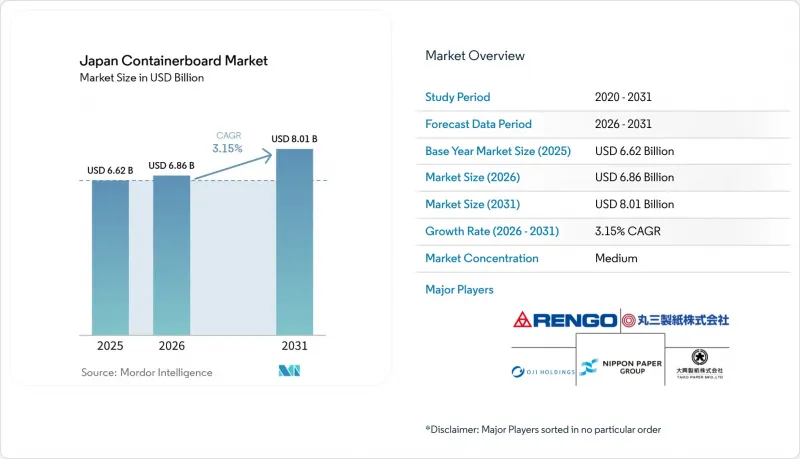
根據 Mordor Intelligence 預測,日本瓦楞紙板原紙市場預計將從 2025 年的 66.2 億美元成長到 2026 年的 68.6 億美元,到 2031 年達到 80.1 億美元,2026 年至 2031 年的複合年成長率為 3.15%。
本報告按材料(原生纖維和再生纖維)、產品類型(工藝襯墊、測試襯墊、瓦楞紙板)和最終用戶行業(食品飲料、消費品、工業等)進行細分。市場預測以美元計價。
日本瓦楞紙板市場的趨勢與洞察
重點關注塑膠替代品和可回收性
日本逐步淘汰化石基塑膠的法律義務正在擴大日本瓦楞紙板市場的潛在需求基礎。食品接觸用合成包裝材料的正面表列制度將於2025年6月1日全面實施,將提高食品相關應用中非紙質包裝的合規要求。此外,《容器及包裝回收法》規定的回收義務正在提升單一材料瓦楞紙板產品相對於結構複雜的塑膠容器的成本競爭力。這意味著,即使終端消費者沒有主動選擇永續包裝形式,包裝使用者也可以過渡到紙製品,因為經濟因素和合規負擔正在向上游工程轉移。王子製紙公司已將這一方向量化,並設定目標,到2030年透過用永續材料替代包裝,每年減少5,000噸塑膠用量,高於2024會計年度實現的3,000噸。這將為日本瓦楞紙板市場創造一個由政策支援的需求管道,無論短期消費者情緒如何,該管道都可能在食品、零售和運輸包裝的決策中保持重要地位。
電子商務和小包裹遞送需求
日本的數位化零售經濟正在改變日本瓦楞紙板市場的使用量和所需紙箱規格。 2024會計年度,日本B2C電子商務市場規模達到26.1兆日圓(約1,864億美元),年增5.1%。跨境購買日本商品總合5.78兆日圓(約413億美元)。食品飲料電子商務市場規模達到3.12兆日圓(約206億美元),推動了對用於冷藏和生鮮食品配送的保溫防潮瓦楞紙箱的需求。此外,2024年卡車駕駛人加班時間限制的實施也促使履約公司轉向使用更薄、尺寸更精確的紙箱,以降低體積重量費用並提高裝載效率。 Rengo公司於2025年1月推出的J-RexS自動化包裝機,展現了設備創新如何幫助物流中心大規模生產尺寸合適的瓦楞紙箱。這些變化共同表明,日本瓦楞紙市場不僅受益於小包裹數量的成長,也受益於包裝設計的革新,這種革新強調速度、效率和自動化履約。
OCC、能源和燃料成本的波動
原料成本波動仍是日本瓦楞紙板市場生產商獲利能力面臨的最直接壓力。日本瓦楞紙板(OCC)出口東南亞的價格從2024年8月的每噸195-205美元跌至2026年1月的每噸145-150美元。這顯示區域再生紙價格變化之快。截至2025年12月底,日本國內再生紙庫存年增61%,這暫時緩解了原物料採購壓力,但也預示著供需不穩定。能源是第二個風險因素,因為造紙廠消耗大量燃料。作為降低成本和減少排放的整體轉型計劃的一部分,Rengo公司於2025會計年度完成了其金津工廠從煤炭到液化天然氣(LNG)的轉換。即使長期效率提高,在銷售價格完全恢復之前,原料和燃料價格的波動仍可能對利潤率造成壓力。因此,採購管理和價格轉嫁仍然是日本國內瓦楞紙板原紙市場製造商面臨的持續挑戰,特別是那些受內陸運輸和與出口相關的廢紙流動高度波動影響的製造商。
細分市場分析
到2025年,再生纖維將佔日本瓦楞紙板市場佔有率的67.48%,成為該市場的主要原料。這一主導地位反映了日本長期以來在標準運輸、零售物流和日常分銷等環節對再生紙的偏好,在這些環節中,供應穩定性和成本控制至關重要。日本國內造紙企業大量依賴再生纖維作為測試襯紙和再生瓦楞紙板的原料,因為這些等級的瓦楞紙板能夠滿足國內廣泛的瓦楞紙板需求,且無需高昂的纖維成本。完善的回收流程和嚴格的分類也有助於確保再生材料的大規模供應,從而支持大眾市場包裝應用的穩定生產。因此,在價格穩定、本地供應和性能可預測性比絕對最大強度更重要的領域,再生纖維仍然是首選。
預計2026年至2031年間,原生纖維的複合年成長率將達到4.32%,顯示日本瓦楞紙板市場的部分需求正轉向高性能包裝領域。這一成長與出口導向工業包裝和電子產品運輸密切相關,這些產品對環壓強度和抗破強度的要求遠高於再生襯紙在嚴苛應用中的持續表現。 2025年7月,大王製紙在三島市投產了一座年產2,000噸的纖維素奈米纖維商業工廠,規模較先前的工廠擴大了20倍。這項投資表明,隨著生產商為物流和包裝應用開發出更薄、更強的紙板結構,材料缺口可能會逐漸縮小。日本瓦楞紙板原紙市場的趨勢十分清晰:雖然再生纖維仍佔大部分需求,但原生纖維的成長主要來自那些技術性能要求更高的應用領域。
其他好處:
- Excel格式的市場預測(ME)表
- 3個月的分析師支持
目錄
第1章:引言
- 研究假設和市場定義
- 調查範圍
第2章:調查方法
第3章執行摘要
第4章 市場狀況
- 市場概覽
- 市場促進因素
- 塑膠替代品及對可回收性的偏好
- 電子商務和小包裹遞送需求
- 食品和飲料用穩定紙板的消耗
- 對電子產品、半導體和工業產品的出口包裝需求。
- 瓦楞紙板緩衝材料可取代EPS用於保護性包裝
- 物流改革帶動了對輕量化和自動化電路基板的需求
- 市場限制因素
- OCC、能源和燃料成本波動
- 與可重複使用的塑膠箱和替代包裝形式的競爭
- 2024年物流法規的變化將對配送成本帶來更大的壓力。
- 再生紙品質和雜質容忍度的上限
- 產業價值鏈分析
- 宏觀經濟因素對市場的影響
- 供應鏈分析
- 監理情勢
- 技術展望
- 波特五力分析
第5章 市場規模與成長預測
- 材料
- 原生光纖
- 再生纖維
- 依產品類型
- Craftliner
- 測試線
- 凹槽
- 按最終用戶行業分類
- 食品/飲料
- 消費品
- 產業
- 其他終端用戶產業
第6章 競爭情勢
- 市場集中度
- 策略趨勢
- 市佔率分析
- 公司簡介
- Oji Holdings Corporation
- Morishigyo Co., Ltd.
- Rengo Co., Ltd.
- Marusan Paper Mfg. Co., Ltd.
- Taiko Paper Mfg., Ltd.
- Osaka Paper Co., Ltd.
- Nippon Paper Industries Co., Ltd.
- Daio Paper Corporation
- Iwaki Daio Paper Corporation
- OTSU PAPER BOARD CO. LTD.
- Uemura Shiko Corporation
- Yoshizawa Kogyo Corporation
- Hokuetsu Corporation
- Tokushu Tokai Paper Co., Ltd.
- Shin Tokai Paper Co., Ltd.
- Mitsubishi Corporation Packaging Ltd.
第7章 市場機會與未來展望
According to Mordor Intelligence, the japan containerboard market size is expected to increase from USD 6.62 billion in 2025 to USD 6.86 billion in 2026 and reach USD 8.01 billion by 2031, growing at a CAGR of 3.15% over 2026-2031.
This report is Segmented by Material (Virgin Fibers, and Recycled Fibers), Product Type (Kraftliners, Testliners, and Flutings), and End-User Industry (Food and Beverage, Consumer Goods, Industrial, and More). The Market Forecasts are Provided in Terms of Value (USD).
Japan Containerboard Market Trends and Insights
Plastic Substitution And Recyclability Preferences
Japan's mandated move away from fossil-derived plastics is widening the addressable demand base for the Japan containerboard market. The positive-list system for synthetic food-contact packaging became fully effective on June 1, 2025, raising compliance requirements for non-paper formats in food-related applications. Recycling obligations under the Container and Packaging Recycling Law also improve the relative cost position of mono-material corrugated formats when compared with more complex plastic structures. This means packaging users can move toward paper even when end buyers are not actively selecting sustainable formats, because the economics and compliance burden are shifting upstream. Oji has already quantified that direction by targeting a reduction of 5,000 tonnes of plastic annually through sustainable packaging substitution by FY2030, up from 3,000 tonnes achieved in FY2024. This gives the Japan containerboard market a policy-backed demand channel that does not rely on short-term consumer sentiment and is likely to remain relevant across food, retail, and transport packaging decisions.
E-Commerce And Parcel Delivery Demand
Japan's digital retail economy is changing both how much board is used and what box specifications are needed in the Japanese containerboard market. Japan's B2C e-commerce market reached JPY 26.1 trillion (USD 186.4 billion) in FY2024, up 5.1% year on year, and cross-border purchases of Japanese products totaled JPY 5.78 trillion (USD 41.3 billion). Food and beverage e-commerce reached JPY 3.12 trillion (USD 20.6 billion), driving demand for insulated, moisture-resistant corrugated shippers used in cold and fresh delivery formats. The 2024 overtime cap for truck drivers is also pushing fulfillment operators toward thinner and more exact-fit boxes that reduce dimensional-weight charges and improve loading efficiency. Rengo's J-RexS automatic packaging machine, launched in January 2025, shows how equipment innovation is helping distribution centers produce right-sized corrugated cases at scale. Together, these shifts show that the Japan containerboard market is benefiting not only from more parcels but also from a redesign of packaging around speed, cube efficiency, and automated fulfillment.
OCC, Energy, And Fuel Cost Volatility
Input cost swings remain the most direct earnings pressure for producers in the Japan containerboard market. Japanese OCC export prices to Southeast Asia moved from USD 195-205 per tonne in August 2024 to USD 145-150 per tonne in January 2026, which shows how quickly regional recovered-paper values can shift. Domestic recovered-paper inventories also rose 61% year on year by the end of December 2025, which temporarily eased feedstock pressure but also signaled unstable supply-demand conditions. Energy adds a second layer of risk because mills are heavy fuel users, and Rengo completed its coal-to-LNG conversion at Kanazu Mill in FY2025 as part of a broader cost and emissions transition. Even when long-term efficiency improves, these swings in raw materials and fuel prices can compress margins before selling prices fully catch up. This makes procurement discipline and price pass-through a persistent issue across the Japan containerboard market, especially for producers exposed to inland transport and volatile export-linked recovered-paper flows.
Other drivers and restraints analyzed in the detailed report include:
- Stable Food And Beverage Corrugated Consumption
- Electronics, Semiconductor, And Industrial Export Packaging Demand
- Competition From Reusable Plastic Crates And Alternative Packaging Formats
For complete list of drivers and restraints, kindly check the Table Of Contents.
Segment Analysis
Recycled fibers held 67.48% of the Japan containerboard market share in 2025, making them the clear base material across the market. That lead reflects Japan's long-established preference for recovered paper in standard shipping, retail transit, and everyday distribution formats where availability and cost control matter most. Domestic mills rely heavily on recycled inputs for testliners and recycled fluting because these grades fit the needs of broad domestic box demand without requiring premium fiber costs. Established collection habits and disciplined sorting also help keep recycled inputs usable at scale, which supports stable output for mass-market packaging applications. As a result, recycled fibers remain the default choice where price stability, local availability, and predictable performance matter more than the absolute highest strength profile.
Virgin fibers are projected to expand at a 4.32% CAGR from 2026 to 2031, indicating that a portion of the Japan containerboard market is shifting toward higher-performance packaging. This growth is tied to export-grade industrial packaging and electronics shipments that require better ring-crush strength and burst resistance than recycled liners can consistently deliver in demanding applications. Daio started operations at its commercial cellulose nanofiber plant in Mishima in July 2025, with an annual capacity of 2,000 tonnes, 20 times its earlier scale. That investment suggests the material gap may narrow over time as producers develop thinner but stronger board structures for logistics and packaging uses. The direction of travel is clear in the Japan containerboard market; recycled fibers still anchor broad volume demand, while virgin-fiber growth is being pulled by applications where technical performance justifies a higher input profile.
List of Companies Covered in this Report:
- Oji Holdings Corporation
- Morishigyo Co., Ltd.
- Rengo Co., Ltd.
- Marusan Paper Mfg. Co., Ltd.
- Taiko Paper Mfg., Ltd.
- Osaka Paper Co., Ltd.
- Nippon Paper Industries Co., Ltd.
- Daio Paper Corporation
- Iwaki Daio Paper Corporation
- OTSU PAPER BOARD CO. LTD.
- Uemura Shiko Corporation
- Yoshizawa Kogyo Corporation
- Hokuetsu Corporation
- Tokushu Tokai Paper Co., Ltd.
- Shin Tokai Paper Co., Ltd.
- Mitsubishi Corporation Packaging Ltd.
Additional Benefits:
- The market estimate (ME) sheet in Excel format
- 3 months of analyst support
TABLE OF CONTENTS
1 INTRODUCTION
- 1.1 Study Assumptions and Market Definition
- 1.2 Scope of the Study
2 RESEARCH METHODOLOGY
3 EXECUTIVE SUMMARY
4 MARKET LANDSCAPE
- 4.1 Market Overview
- 4.2 Market Drivers
- 4.2.1 Plastic Substitution and Recyclability Preferences
- 4.2.2 E-Commerce and Parcel Delivery Demand
- 4.2.3 Stable Food and Beverage Corrugated Consumption
- 4.2.4 Electronics, Semiconductor, and Industrial Export Packaging Demand
- 4.2.5 Cardboard Cushioning Replacing EPS in Protective Packaging
- 4.2.6 Lightweight and Automation-Ready Board Demand From Logistics Reform
- 4.3 Market Restraints
- 4.3.1 OCC, Energy, and Fuel Cost Volatility
- 4.3.2 Competition From Reusable Plastic Crates and Alternative Packaging Formats
- 4.3.3 Logistics 2024 Rule Changes Raising Delivered-Cost Pressure
- 4.3.4 Recovered-Paper Quality Ceiling and Contamination Limits
- 4.4 Industry Value Chain Analysis
- 4.5 Impact of Macroeconomic Factors on the Market
- 4.6 Supply-Chain Analysis
- 4.7 Regulatory Landscape
- 4.8 Technological Outlook
- 4.9 Porter's Five Forces Analysis
- 4.9.1 Threat of New Entrants
- 4.9.2 Bargaining Power of Suppliers
- 4.9.3 Bargaining Power of Buyers
- 4.9.4 Threat of Substitutes
- 4.9.5 Competitive Rivalry
5 MARKET SIZE AND GROWTH FORECASTS (VALUE)
- 5.1 By Material
- 5.1.1 Virgin Fibers
- 5.1.2 Recycled Fibers
- 5.2 By Product Type
- 5.2.1 Kraftliners
- 5.2.2 Testliners
- 5.2.3 Flutings
- 5.3 By End-User Industry
- 5.3.1 Food and Beverage
- 5.3.2 Consumer Goods
- 5.3.3 Industrial
- 5.3.4 Other End-User Industries
6 COMPETITIVE LANDSCAPE
- 6.1 Market Concentration
- 6.2 Strategic Moves
- 6.3 Market Share Analysis
- 6.4 Company Profiles (includes Global Level Overview, Market Level Overview, Core Segments, Financials as available, Strategic Information, Market Rank/Share, Products and Services, Recent Developments)
- 6.4.1 Oji Holdings Corporation
- 6.4.2 Morishigyo Co., Ltd.
- 6.4.3 Rengo Co., Ltd.
- 6.4.4 Marusan Paper Mfg. Co., Ltd.
- 6.4.5 Taiko Paper Mfg., Ltd.
- 6.4.6 Osaka Paper Co., Ltd.
- 6.4.7 Nippon Paper Industries Co., Ltd.
- 6.4.8 Daio Paper Corporation
- 6.4.9 Iwaki Daio Paper Corporation
- 6.4.10 OTSU PAPER BOARD CO. LTD.
- 6.4.11 Uemura Shiko Corporation
- 6.4.12 Yoshizawa Kogyo Corporation
- 6.4.13 Hokuetsu Corporation
- 6.4.14 Tokushu Tokai Paper Co., Ltd.
- 6.4.15 Shin Tokai Paper Co., Ltd.
- 6.4.16 Mitsubishi Corporation Packaging Ltd.
7 MARKET OPPORTUNITIES AND FUTURE OUTLOOK
- 7.1 White-Space and Unmet-Need Assessment

 菲律賓貨櫃紙板市場:市場佔有率分析、產業趨勢與統計、成長預測(2026-2031)越南貨櫃板材:市場佔有率分析、產業趨勢與統計、成長預測(2026-2031)馬來西亞箱板:市場佔有率分析、產業趨勢與統計、成長預測(2026-2031)中國瓦楞紙板原紙:市場佔有率分析、產業趨勢與統計及成長預測(2026-2031年)新加坡瓦楞紙板原紙:市佔率分析、產業趨勢與統計及成長預測(2026-2031)印度貨櫃紙板市場:市場佔有率分析、產業趨勢與統計、成長預測(2026-2031)法國貨櫃紙板:市場佔有率分析、產業趨勢與統計、成長預測(2026-2031)義大利貨櫃紙板:市場佔有率分析、產業趨勢與統計數據、成長預測(2026-2031)西班牙瓦楞紙板原紙:市場佔有率分析、行業趨勢和統計數據以及成長預測(2026-2031 年)亞太地區箱板市場:市場佔有率分析、產業趨勢與統計及成長預測(2026-2031)