


 |
市場調查報告書
商品編碼
2063920
亞太地區箱板市場:市場佔有率分析、產業趨勢與統計及成長預測(2026-2031)Asia-Pacific Containerboard - Market Share Analysis, Industry Trends & Statistics, Growth Forecasts (2026 - 2031) |
||||||

※ 本網頁內容可能與最新版本有所差異。詳細情況請與我們聯繫。
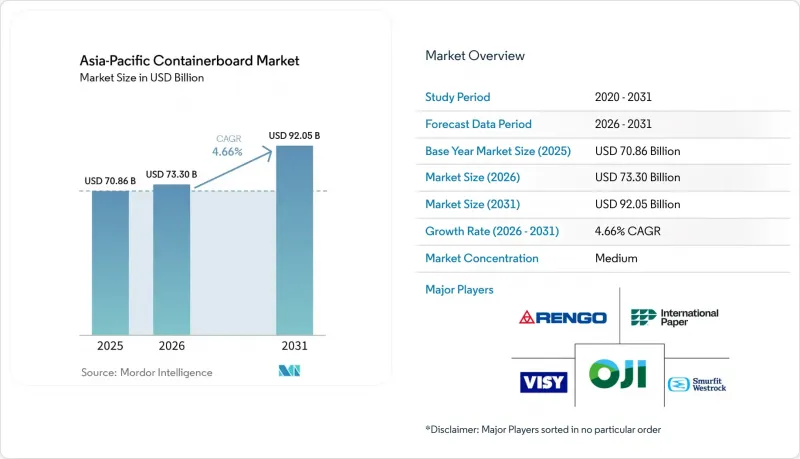
根據 Mordor Intelligence 預測,亞太地區箱板紙市場規模將從 2025 年的 708.6 億美元成長到 2026 年的 733 億美元,到 2031 年將達到 920.5 億美元,2026 年至 2031 年的複合年成長率為 4.6%。
本報告按材料(原生纖維和再生纖維)、產品類型(工藝襯墊、測試襯墊、瓦楞紙板)、最終用戶(食品飲料、消費品、工業及其他)和地區(中國、印度、日本、韓國、印尼及其他亞太地區)進行細分。市場預測以美元計價。
亞太地區箱板紙市場趨勢與洞察
電子商務包裝需求不斷成長
電子商務的蓬勃發展仍然是亞太地區箱板紙市場最強勁的直接驅動力。這是因為在主要區域經濟體中,瓦楞紙板產品已承載了約80%的電商小包裹。此外,消費者對產品品質的需求也在不斷變化,演算法主導的包裝最佳化系統可將每次出貨的瓦楞紙板用量減少高達30%,同時推動了對更輕、性能更穩定的紙板等級的需求。這一趨勢正推動亞太地區箱板紙市場發展到適用於自動化履約、高速分類和高密度小包裹網路的瓦楞紙板和麵紙紙板。這也有利於那些能夠在物流樞紐附近快速生產短週期產品的加工商,因為在這些樞紐附近,服務速度和紙板成本如今都至關重要。由於小包裹遞送是一種持續的物流需求,而非暫時的零售趨勢,因此與其他許多類型的紙張相比,亞太地區箱板紙市場擁有更強勁的需求基礎。
政府對一次性塑膠製品的監管
隨著塑膠逐步淘汰,亞太地區箱板紙市場的潛在需求正穩步擴展至餐飲服務業、生鮮食品、藥品分銷和水產品運輸等領域。在澳大利亞,南澳大利亞州正積極推動2025年9月前進一步禁止使用一次性塑膠,這將促進食品相關應用領域向紙質替代品的轉變。在整個全部區域,法令遵循的日益嚴格使得可追溯性、再生材料含量和食品安全認證在採購決策中的重要性日益凸顯,從而支撐了亞太地區瓦楞紙板基材市場高附加價值產品的供應。這正在改變市場競爭格局,因為即使造紙商能夠在通用等級產品中保持成本競爭力,缺乏認證系統的造紙商也難以進入受監管的類別。此外,與傳統瓦楞紙板需求相比,亞太地區瓦楞紙板基材市場的需求來源受貿易波動和消費者支出週期的影響較小。
二手紙箱的價格波動很大。
二手瓦楞紙箱價格波動仍是亞太地區箱板紙市場利潤率面臨的直接風險。這是因為該地區的瓦楞紙供應以再生紙為主,許多造紙商仍然依賴外購纖維。當再生纖維成本波動速度超過成品瓦楞紙板價格時,小型生產商會失去定價柔軟性,其營運資金很快就會變得緊張。大規模、一體化的集團則擁有更強的防禦能力,因為它們可以透過回收系統、紙漿垂直整合或更廣泛的業務基礎來抵消外部價格波動的影響。九龍紙業2025會計年度的獲利報告顯示,儘管平均售價有所下降,但原物料成本的效率提升支撐了利潤,凸顯了在原物料價格波動環境下規模經濟的優勢。因此,亞太地區瓦楞紙板原紙市場仍存在結構性不平衡,這使得大型一體化生產商比依賴進口的大宗商品生產商更容易保護其利潤率。
細分市場分析
到2025年,再生纖維將佔亞太地區箱板紙市場佔有率的67.83%,這反映出該地區在標準瓦楞紙板生產中對再生纖維的依賴程度。這種情況使亞太地區箱板紙市場具有成本優勢,尤其是在電子商務和日用消費品等對紙箱需求量大、價格競爭依然激烈的領域。再生紙等級也符合該地區不斷擴展的循環包裝體系,這得益於小包裹數量的成長以及零售通路對可回收瓦楞紙板的穩定供應。然而,亞太地區瓦楞紙板產業仍面臨一些挑戰,例如纖維品質不穩定、部分市場依賴進口紙漿以及再生紙規格不一致導致的營運中斷。
預計2026年至2031年間,原生紙漿將以5.37%的複合年成長率成長,成為亞太地區箱板紙市場成長最快的材料類別。這一成長主要反映在品質的提升上,而非完全取代再生材料的經濟性,因為食品接觸應用、醫藥和高階包裝形式等行業對紙張純度、印刷適性和強度均勻性提出了更高的要求。 2025年,九龍紙業在其荊州和北海工廠運作了新的漂白紙板生產線。此舉使其業務從以再生瓦楞紙漿為主轉向其他產品,並使其高價值原生紙漿的年產能增加了120萬噸。因此,亞太地區箱板紙市場呈現兩極分化的格局:再生纖維在銷售方面繼續主導,而原生紙漿在高階和高監管應用領域則經歷了更快速的成長。
其他好處
- Excel格式的市場預測(ME)表
- 3個月的分析師支持
目錄
第1章:引言
- 研究假設和市場定義
- 調查範圍
第2章:調查方法
第3章執行摘要
第4章 市場狀況
- 市場概覽
- 市場促進因素
- 電子商務包裝需求不斷成長
- 低溫運輸物流基礎設施的擴建
- 政府對一次性塑膠製品的監管
- 消費者對永續包裝的偏好日益成長
- 將智慧包裝感測器整合到瓦楞紙箱
- 區域造紙企業擴大產能
- 市場限制因素
- 舊紙板(OCC)的價格波動很大。
- 中國新建巨型造紙廠導致供應過剩
- 嚴格的廢水排放法規導致合規成本增加。
- 來自軟包裝的競爭加劇
- 產業價值鏈分析
- 監理情勢
- 技術展望
- 波特五力分析
第5章 市場規模與成長預測
- 材料
- 原生光纖
- 再生纖維
- 依產品類型
- Craftliner
- 測試線
- 凹槽
- 最終用戶
- 飲食
- 消費品
- 工業的
- 其他
- 按地區
- 中國
- 印度
- 日本
- 韓國
- 印尼
- 其他亞太地區
第6章 競爭情勢
- 市場集中度
- 策略趨勢
- 市佔率分析
- 公司簡介
- Smurfit Westrock plc
- International Paper Company
- Nine Dragons Paper(Holdings)Limited
- Lee & Man Paper Manufacturing Ltd.
- Oji Holdings Corporation
- Rengo Co., Ltd.
- SCG Packaging Public Company Limited
- Shandong Sun Paper Industry Joint Stock Co., Ltd.
- Anhui Shanying Paper Industry Co., Ltd.
- Asia Pulp & Paper(APP)
- Visy Industries Holdings Pty Ltd.
- Nippon Paper Industries Co., Ltd.
- Mondi plc
- Daio Paper Corporation
- ITC Limited
- JK Paper Ltd.
- Marubeni Corporation
第7章 市場機會與未來展望
According to Mordor Intelligence, the asia-Pacific containerboard market size is expected to grow from USD 70.86 billion in 2025 to USD 73.3 billion in 2026 and is forecast to reach USD 92.05 billion by 2031 at 4.66% CAGR over 2026-2031.
This report is Segmented by Material (Virgin Fibers, and Recycled Fibers), Product Type (Kraftliners, Testliners, and Flutings), End User (Food and Beverage, Consumer Goods, Industrial, and More), and Geography (China, India, Japan, South Korea, Indonesia, and Rest of Asia-Pacific). The Market Forecasts are Provided in Terms of Value (USD).
Asia-Pacific Containerboard Market Trends and Insights
Growing E-Commerce Packaging Demand
Growing e-commerce activity remains the strongest immediate driver of the Asia-Pacific containerboard market, as corrugated formats already handle an estimated 80% of e-commerce parcels in major regional economies. The demand pattern is also changing in quality terms because algorithm-led packaging fitment systems can reduce corrugated board use per shipment by up to 30%, yet they increase the need for lighter and more consistent performance grades. This is pushing the Asia-Pacific containerboard market toward fluting and liner grades that can perform reliably in automated fulfillment, high-speed sortation, and dense parcel networks. It also favors converters that can turn short runs quickly near logistics clusters, where service speed now matters as much as board cost. Because parcel shipping remains a recurring logistics need rather than a one-time retail trend, the Asia-Pacific containerboard market keeps a firmer demand base than many other paper grades.
Government Bans on Single-Use Plastics
Plastic phase-out policies are steadily expanding the addressable demand base for the Asia-Pacific containerboard market into food service, fresh produce, pharmaceutical distribution, and seafood transport. In Australia, South Australia moved ahead with bans on additional single-use plastic items in September 2025, which strengthened the shift toward paper-based alternatives in food-related applications. Across the region, compliance rules are making traceability, recycled content, and food-safety certification more important in procurement decisions, which supports higher-value supply in the Asia-Pacific containerboard market. That changes competition because mills without certification infrastructure struggle to access regulated categories even if they remain cost-competitive in commodity grades. It also gives the Asia-Pacific containerboard market a source of demand that is less tied to trade swings or consumer spending cycles than traditional box demand.
Volatile Old Corrugated Container Prices
Old corrugated container price swings remain a direct margin risk for the Asia-Pacific containerboard market because recycled grades dominate regional supply and many mills still depend on purchased fiber. When recovered fiber costs move faster than finished board prices, smaller producers lose pricing flexibility, and working capital tightens quickly. Larger integrated groups are better protected because they can offset external price swings through collection systems, pulp integration, or a broader operating base. Nine Dragons Paper's FY2025 results showed that raw-material cost efficiency supported profits even as average selling prices declined, highlighting the advantage of scale during volatile input cycles. This keeps the Asia-Pacific containerboard market structurally uneven, with integrated leaders more able to defend margins than import-dependent commodity mills.
Other drivers and restraints analyzed in the detailed report include:
- Expansion of Cold-Chain Logistics Infrastructure
- Rising Consumer Preference for Sustainable Packaging
- Supply Overhang from New Mega-Mills in China
For complete list of drivers and restraints, kindly check the Table Of Contents.
Segment Analysis
Recycled fibers led with 67.83% of the Asia-Pacific containerboard market share in 2025, which reflects the region's dependence on secondary fiber for standard corrugated production. This position gives the Asia-Pacific containerboard market a cost advantage in large-volume box demand, especially in e-commerce and consumer staples, where price discipline remains important. Recycled grades also align with the region's growing circular packaging systems, as rising parcel volumes and retail distribution create a steady stream of recoverable board. At the same time, the Asia-Pacific containerboard industry still faces uneven fiber quality, exposure to imported pulp in several markets, and operating disruptions when recovered paper specifications are inconsistent.
Virgin fibers are forecast to grow at a 5.37% CAGR from 2026 to 2031, the fastest pace among material categories in the Asia-Pacific containerboard market. That growth reflects a quality upgrade rather than a broad replacement of recycled economics, with food-contact, pharmaceutical, and premium shipping formats demanding higher purity, printability, and consistency in strength. Nine Dragons Paper started production at new bleached folding boxboard lines at Jingzhou and Beihai in 2025, adding 1.2 million tonnes per annum of higher-value virgin-grade capacity as it diversified beyond its recycled corrugating base. The result is a two-track Asia-Pacific containerboard market where recycled fiber keeps volume leadership, while virgin grades capture the faster growth in premium and compliance-heavy uses.
List of Companies Covered in this Report:
- Smurfit Westrock plc
- International Paper Company
- Nine Dragons Paper (Holdings) Limited
- Lee & Man Paper Manufacturing Ltd.
- Oji Holdings Corporation
- Rengo Co., Ltd.
- SCG Packaging Public Company Limited
- Shandong Sun Paper Industry Joint Stock Co., Ltd.
- Anhui Shanying Paper Industry Co., Ltd.
- Asia Pulp & Paper (APP)
- Visy Industries Holdings Pty Ltd.
- Nippon Paper Industries Co., Ltd.
- Mondi plc
- Daio Paper Corporation
- ITC Limited
- JK Paper Ltd.
- Marubeni Corporation
Additional Benefits:
- The market estimate (ME) sheet in Excel format
- 3 months of analyst support
TABLE OF CONTENTS
1 INTRODUCTION
- 1.1 Study Assumptions and Market Definition
- 1.2 Scope of the Study
2 RESEARCH METHODOLOGY
3 EXECUTIVE SUMMARY
4 MARKET LANDSCAPE
- 4.1 Market Overview
- 4.2 Market Drivers
- 4.2.1 Growing E-commerce Packaging Demand
- 4.2.2 Expansion of Cold-Chain Logistics Infrastructure
- 4.2.3 Government Bans on Single-Use Plastics
- 4.2.4 Rising Consumer Preference for Sustainable Packaging
- 4.2.5 Integration of Smart Packaging Sensors in Corrugated Boxes
- 4.2.6 Capacity Expansion by Regional Mill Owners
- 4.3 Market Restraints
- 4.3.1 Volatile Old Corrugated Container (OCC) Prices
- 4.3.2 Supply Overhang From New Mega-Mills in China
- 4.3.3 Stringent Effluent Regulations Increasing Compliance Costs
- 4.3.4 Intensifying Competition From Flexible Packaging Formats
- 4.4 Industry Value Chain Analysis
- 4.5 Regulatory Landscape
- 4.6 Technological Outlook
- 4.7 Porter's Five Forces Analysis
- 4.7.1 Threat of New Entrants
- 4.7.2 Bargaining Power of Suppliers
- 4.7.3 Bargaining Power of Buyers
- 4.7.4 Threat of Substitutes
- 4.7.5 Competitive Rivalry
5 MARKET SIZE AND GROWTH FORECASTS (VALUE)
- 5.1 By Material
- 5.1.1 Virgin Fibers
- 5.1.2 Recycled Fibers
- 5.2 By Product Type
- 5.2.1 Kraftliners
- 5.2.2 Testliners
- 5.2.3 Flutings
- 5.3 By End User
- 5.3.1 Food and Beverage
- 5.3.2 Consumer Goods
- 5.3.3 Industrial
- 5.3.4 Other End Users
- 5.4 By Geography
- 5.4.1 China
- 5.4.2 India
- 5.4.3 Japan
- 5.4.4 South Korea
- 5.4.5 Indonesia
- 5.4.6 Rest of Asia-Pacific
6 COMPETITIVE LANDSCAPE
- 6.1 Market Concentration
- 6.2 Strategic Moves
- 6.3 Market Share Analysis
- 6.4 Company Profiles (includes Global level Overview, Market level overview, Core Segments, Financials as available, Strategic Information, Market Rank/Share for key companies, Products and Services, and Recent Developments)
- 6.4.1 Smurfit Westrock plc
- 6.4.2 International Paper Company
- 6.4.3 Nine Dragons Paper (Holdings) Limited
- 6.4.4 Lee & Man Paper Manufacturing Ltd.
- 6.4.5 Oji Holdings Corporation
- 6.4.6 Rengo Co., Ltd.
- 6.4.7 SCG Packaging Public Company Limited
- 6.4.8 Shandong Sun Paper Industry Joint Stock Co., Ltd.
- 6.4.9 Anhui Shanying Paper Industry Co., Ltd.
- 6.4.10 Asia Pulp & Paper (APP)
- 6.4.11 Visy Industries Holdings Pty Ltd.
- 6.4.12 Nippon Paper Industries Co., Ltd.
- 6.4.13 Mondi plc
- 6.4.14 Daio Paper Corporation
- 6.4.15 ITC Limited
- 6.4.16 JK Paper Ltd.
- 6.4.17 Marubeni Corporation
7 MARKET OPPORTUNITIES AND FUTURE OUTLOOK
- 7.1 White-Space and Unmet-Need Assessment

 菲律賓貨櫃紙板市場:市場佔有率分析、產業趨勢與統計、成長預測(2026-2031)越南貨櫃板材:市場佔有率分析、產業趨勢與統計、成長預測(2026-2031)馬來西亞箱板:市場佔有率分析、產業趨勢與統計、成長預測(2026-2031)中國瓦楞紙板原紙:市場佔有率分析、產業趨勢與統計及成長預測(2026-2031年)新加坡瓦楞紙板原紙:市佔率分析、產業趨勢與統計及成長預測(2026-2031)印度貨櫃紙板市場:市場佔有率分析、產業趨勢與統計、成長預測(2026-2031)日本瓦楞紙板原紙:市佔率分析、產業趨勢與統計及成長預測(2026-2031年)法國貨櫃紙板:市場佔有率分析、產業趨勢與統計、成長預測(2026-2031)義大利貨櫃紙板:市場佔有率分析、產業趨勢與統計數據、成長預測(2026-2031)西班牙瓦楞紙板原紙:市場佔有率分析、行業趨勢和統計數據以及成長預測(2026-2031 年)