

 |
市場調查報告書
商品編碼
2063903
北美貨櫃紙板:市場佔有率分析、行業趨勢和統計數據、成長預測(2026-2031 年)North America Containerboard - Market Share Analysis, Industry Trends & Statistics, Growth Forecasts (2026 - 2031) |
||||||

※ 本網頁內容可能與最新版本有所差異。詳細情況請與我們聯繫。
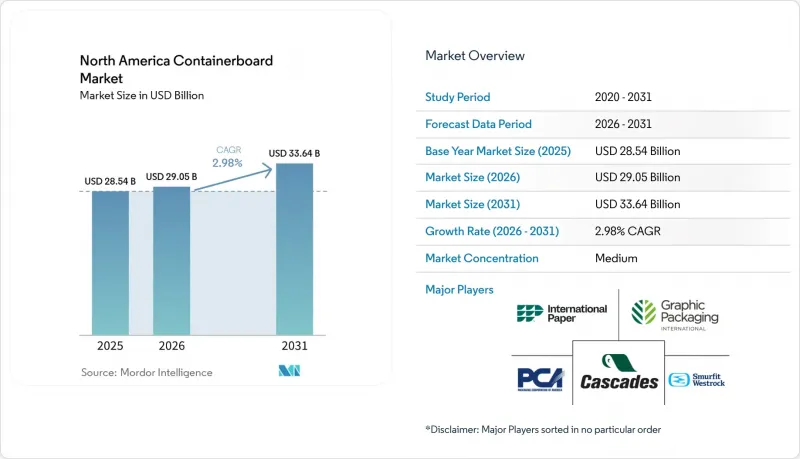
根據 Mordor Intelligence 預測,北美瓦楞紙板市場規模將從 2025 年的 285.4 億美元和 2026 年的 290.5 億美元成長到 2031 年的 336.4 億美元,2026 年至 2031 年的年複合成長率(CAGR)為 2.98%。
本報告按材料(原生纖維和再生纖維)、產品類型(工藝襯墊、測試襯墊、瓦楞紙板)、最終用戶(食品飲料、消費品、工業等)和地區(美國、加拿大、墨西哥)進行細分。市場預測以美元計價。
北美箱板紙市場趨勢與洞察
電子商務包裝需求不斷成長
電子商務仍然是北美瓦楞紙板市場需求最持續的驅動力,因為其在整個履約、分類和最後一公里配送過程中都需要瓦楞紙箱的保護。根據美國包裝公司(Packaging Corporation of America)的報告,2026年1月瓦楞紙箱的日均出貨量年增4.5%,截至2月中旬的累計出貨量成長3%,顯示紙箱需求的復甦速度快於許多整體零售指標。這種需求的驅動力源於包裝強度帶來的優勢,因為送貨上門的商品通常比在商店貨架上銷售的商品每單消耗更多的纖維。 Smurfit Westrock公司將其在2026年第一季新增的600多家瓦楞紙箱客戶歸功於電子商務和加值包裝形式。這表明,北美瓦楞紙板市場不僅受益於出貨量的成長,也受益於產品組合的改善。此趨勢在食品雜貨和生鮮食品的配送領域更為顯著。在這些領域,製造商需要更厚、更防潮的板材來保護在運輸過程中對溫度變化敏感的重型產品。
對永續包裝解決方案的需求日益成長
在北美箱板紙市場,永續性不再是少數客戶追求的高階特性,而是基本的採購要求。瓦楞紙包裝聯盟和纖維盒協會報告稱,到2025年,在標準的美國條件下,瓦楞紙箱在多項環境指標上將優於可重複使用的塑膠包裝箱,這為品牌所有者提供了更清晰的轉向二次包裝的理由。在同一評估期間內,美國箱板紙的平均再生纖維含量達到31.8%,顯示再生材料不再侷限於特殊等級,而是被納入標準等級的規格。這具有重要的商業性意義,因為能夠將再生材料融入標準箱板紙和中型紙的造紙商可以在不增加產品複雜性的前提下,滿足更廣泛客戶的採購目標。隨著州和國家層級監管的日益嚴格,北美箱板紙市場可能會更青睞那些擁有再生材料、完善的加工供應鏈以及在主流包裝應用中表現穩定的製造商。
再生紙價格波動
在北美瓦楞紙板市場,再生紙價格仍然是再生纖維生產商面臨的最主要原料風險,因為瓦楞紙箱是許多瓦楞紙板等級的主要原料。由於原料供應取決於回收率和廢舊瓦楞紙板重新進入回收流程的速度,如果紙板回收量無法滿足造紙廠的需求,市場價格就會出現劇烈波動。夥伴關係)估計,到2024年,美國所有可回收材料的住宅回收率將僅為20%,這意味著存在顯著的結構性回收缺口,一旦需求復甦,就可能導致原料短缺。這一缺口之所以重要,是因為只要各城市和各州的回收率仍然不一致,僅靠產能管理無法解決原料短缺問題。因此,在回收系統和回收品質得到顯著改善之前,北美瓦楞紙板市場的利潤率和價格波動性可能會持續面臨壓力。
細分市場分析
到2025年,原生紙漿將佔北美箱板紙市場佔有率的32.15%,預計到2031年將以3.62%的複合年成長率成長。這將確保原生紙漿在材料組合中保持領先地位,並成為成長最快的產品。這種主導地位反映了牛皮紙漿基箱板紙的卓越性能,其驅動力在於應用領域對更高耐破強度、更佳印刷品質和更一致性的需求,而不僅僅是降低成本。北美箱板紙產業仍高度依賴原生紙漿,在出口包裝、食品接觸應用和重型運輸包裝等領域,替代產品的空間有限。這種需求結構使得原生紙漿產品能夠維持更強的價格優勢,即使顧客不斷提高各種包裝產品中再生紙漿的含量目標。
同時,隨著主要生產商在擴大原生紙漿資產的同時,也擴大再生紙漿的產能,原料組成正變得更加平衡。國際紙業公司(International Paper)於2026年4月達成協議,收購NORPAC位於朗維尤(Longview)的工廠。該廠年產100萬噸箱板紙,專注於生產輕量高性能再生紙漿。這表明,即使是主要的原生紙漿生產商也在調整其營運結構,以滿足美國西海岸對再生材料的需求。目前,美國箱板紙中再生纖維的平均含量已達31.8%,這表明再生材料不再是例外,而是主流產品設計的核心。從長遠來看,北美紙張重量箱板紙市場中原生紙漿和再生紙漿之間的差距將會縮小,而原生纖維在高階、高耐久性應用領域仍將保持其優勢。
其他好處:
- Excel格式的市場預測(ME)表
- 3個月的分析師支持
目錄
第1章:引言
- 研究假設和市場定義
- 調查範圍
第2章:調查方法
第3章執行摘要
第4章 市場狀況
- 市場概覽
- 市場促進因素
- 電子商務包裝需求不斷成長
- 對永續包裝解決方案的需求日益成長
- 食品和飲料外帶及配送服務的激增
- 導致塑膠包裝被替代的法規
- 高性能輕量瓦楞紙板基紙的進步
- 圍繞區域物流中心進行生產能力的策略性擴張
- 市場限制因素
- 再生紙價格波動
- 能源成本波動對生產經濟的影響
- 鐵路車輛短缺正在擾亂區域供應鏈。
- 農產品領域來自模塑纖維包裝的競爭日益激烈。
- 產業價值鏈分析
- 監理情勢
- 技術展望
- 波特五力分析
第5章 市場規模與成長預測
- 材料
- 原生光纖
- 再生纖維
- 依產品類型
- Craftliner
- 測試線
- 凹槽
- 最終用戶
- 食品/飲料
- 消費品
- 產業
- 其他最終用戶
- 按地區
- 美國
- 加拿大
- 墨西哥
第6章 競爭情勢
- 市場集中度
- 策略趨勢
- 市佔率分析
- 公司簡介
- Smurfit Westrock plc
- International Paper Company
- Packaging Corporation of America
- Georgia-Pacific LLC
- Cascades Inc.
- Domtar Corporation
- Kruger Inc.
- Pratt Industries Inc.
- Green Bay Packaging Inc.
- Sonoco Products Company
- Graphic Packaging Holding Company
- ND Paper LLC
- Mondi plc
- Kruger Packaging LP
第7章 市場機會與未來展望
According to Mordor Intelligence, the north america containerboard market size is projected to expand from USD 28.54 billion in 2025 and USD 29.05 billion in 2026 to USD 33.64 billion by 2031, registering a CAGR of 2.98% between 2026 and 2031.
This report is Segmented by Material (Virgin Fibers, and Recycled Fibers), Product Type (Kraftliners, Testliners, and Flutings), End User (Food and Beverage, Consumer Goods, Industrial, and More), and Geography (United States, Canada, and Mexico). The Market Forecasts are Provided in Terms of Value (USD).
North America Containerboard Market Trends and Insights
Growth In E-Commerce Packaging Demand
E-commerce remains the most durable volume driver for the North America containerboard market because direct shipment models require corrugated protection across fulfillment, sorting, and last-mile delivery. Packaging Corporation of America reported that corrugated shipments per shipping day were up 4.5% year over year in January 2026 and up 3% through mid-February, indicating that box demand was recovering faster than many broad retail indicators. This demand carries a built-in packaging intensity advantage because goods shipped to homes usually need more fiber per order than goods moved through store shelves. Smurfit Westrock said its addition of more than 600 new corrugated customers in Q1 2026 was driven by e-commerce and value-added formats, indicating that the North America containerboard market is benefiting from mix improvement as much as from simple shipment growth. The effect is stronger in grocery and fresh food delivery, where producers need thicker, more moisture-resistant board formats to protect temperature-sensitive, heavier products during transport.
Increasing Demand for Sustainable Packaging Solutions
Sustainability has become a basic buying requirement in the North America containerboard market rather than a premium feature that only a small set of customers seeks out. The Corrugated Packaging Alliance and Fiber Box Association reported in 2025 that corrugated containers outperformed reusable plastic containers across several environmental indicators under baseline US conditions, providing brand owners with a clearer basis for switching secondary packaging formats. The same assessment period showed that the average recycled fiber content in US containerboard reached 31.8%, indicating that recycled content is now built into regular-grade specifications rather than sitting in a narrow specialty tier. This matters commercially because mills that can blend recycled content into standard linerboard and medium grades can meet procurement targets across a wider customer base without expanding product complexity. As compliance rules tighten across states and provinces, the North America containerboard market is likely to reward producers that combine recycled furnish access, converting reach, and stable performance across mainstream packaging applications.
Volatility In Recovered Paper Prices
Recovered paper pricing remains the most visible input risk for recycled fiber producers in the North America containerboard market because old corrugated containers are the core furnish for many board grades. The market is exposed to abrupt price movement when supply from box recovery does not keep up with mill demand, since furnish availability depends on collection behavior and the pace at which used boxes return to the recycling stream. The Recycling Partnership estimated US residential curbside recovery rates for all recyclable materials at 20% in 2024, indicating a significant structural recovery gap that could tighten feedstock availability when demand improves. This gap matters because capacity management alone cannot solve furnish stress if recovered volumes remain inconsistent across cities and states. As a result, the North America containerboard market is likely to continue to see margin pressure and uneven pricing discipline until collection systems and recovery quality improve materially.
Other drivers and restraints analyzed in the detailed report include:
- Surge In Food and Beverage Takeaway and Delivery Services
- Replacement of Plastic Packaging Due to Regulatory Bans
- Energy Cost Fluctuations Impacting Production Economics
For complete list of drivers and restraints, kindly check the Table Of Contents.
Segment Analysis
Virgin fibers held 32.15% of the North America containerboard market share in 2025 and are projected to grow at a 3.62% CAGR through 2031, keeping this grade in both the leading and fastest-growing positions within the material split. This lead reflects the stronger performance of kraft pulp-based linerboard, with higher burst strength, better print quality, and applications where consistency matters more than simple cost reduction. The North America containerboard industry still relies on virgin fiber, where export packaging, food contact needs, and heavier-duty transport formats leave limited room for substitution. That demand profile gives virgin grades a firmer pricing position, even as customers continue to expand recycled-content targets across broader packaging portfolios.
At the same time, the material picture is becoming more balanced as leading producers expand their recycled-grade capabilities alongside their virgin fiber assets. International Paper's April 2026 agreement to acquire NORPAC's Longview mill, which produces 1 million tons of containerboard annually and focuses on lightweight, high-performance recycled grades, shows that even large virgin fiber players are repositioning to meet recycled demand on the West Coast. The 31.8% average recycled fiber content already documented in US containerboard indicates that recycled furnish is now central to mainstream product design, not an edge case. Over time, that means the gap between virgin and recycled grades in the North America containerboard market may narrow at lower basis weights, while premium heavy duty applications continue to defend a clearer virgin fiber advantage.
List of Companies Covered in this Report:
- Smurfit Westrock plc
- International Paper Company
- Packaging Corporation of America
- Georgia-Pacific LLC
- Cascades Inc.
- Domtar Corporation
- Kruger Inc.
- Pratt Industries Inc.
- Green Bay Packaging Inc.
- Sonoco Products Company
- Graphic Packaging Holding Company
- ND Paper LLC
- Mondi plc
- Kruger Packaging L.P.
Additional Benefits:
- The market estimate (ME) sheet in Excel format
- 3 months of analyst support
TABLE OF CONTENTS
1 INTRODUCTION
- 1.1 Study Assumptions and Market Definition
- 1.2 Scope of the Study
2 RESEARCH METHODOLOGY
3 EXECUTIVE SUMMARY
4 MARKET LANDSCAPE
- 4.1 Market Overview
- 4.2 Market Drivers
- 4.2.1 Growth in E-commerce Packaging Demand
- 4.2.2 Increasing Demand for Sustainable Packaging Solutions
- 4.2.3 Surge in Food and Beverage Takeaway and Delivery Services
- 4.2.4 Replacement of Plastic Packaging Due to Regulatory Bans
- 4.2.5 Advancements in High-Performance Lightweight Containerboard Grades
- 4.2.6 Strategic Capacity Expansions Near Regional Distribution Hubs
- 4.3 Market Restraints
- 4.3.1 Volatility in Recovered Paper Prices
- 4.3.2 Energy Cost Fluctuations Impacting Production Economics
- 4.3.3 Limited Railcar Availability Disrupting Intra-Regional Supply Chains
- 4.3.4 Growing Competition From Molded Fiber Packaging in Produce Sector
- 4.4 Industry Value Chain Analysis
- 4.5 Regulatory Landscape
- 4.6 Technological Outlook
- 4.7 Porter's Five Forces Analysis
- 4.7.1 Threat of New Entrants
- 4.7.2 Bargaining Power of Suppliers
- 4.7.3 Bargaining Power of Buyers
- 4.7.4 Threat of Substitutes
- 4.7.5 Competitive Rivalry
5 MARKET SIZE AND GROWTH FORECASTS (VALUE)
- 5.1 By Material
- 5.1.1 Virgin Fibers
- 5.1.2 Recycled Fibers
- 5.2 By Product Type
- 5.2.1 Kraftliners
- 5.2.2 Testliners
- 5.2.3 Flutings
- 5.3 By End User
- 5.3.1 Food and Beverage
- 5.3.2 Consumer Goods
- 5.3.3 Industrial
- 5.3.4 Other End Users
- 5.4 By Geography
- 5.4.1 United States
- 5.4.2 Canada
- 5.4.3 Mexico
6 COMPETITIVE LANDSCAPE
- 6.1 Market Concentration
- 6.2 Strategic Moves
- 6.3 Market Share Analysis
- 6.4 Company Profiles (includes Global level Overview, Market level overview, Core Segments, Financials as available, Strategic Information, Market Rank/Share for key companies, Products and Services, and Recent Developments)
- 6.4.1 Smurfit Westrock plc
- 6.4.2 International Paper Company
- 6.4.3 Packaging Corporation of America
- 6.4.4 Georgia-Pacific LLC
- 6.4.5 Cascades Inc.
- 6.4.6 Domtar Corporation
- 6.4.7 Kruger Inc.
- 6.4.8 Pratt Industries Inc.
- 6.4.9 Green Bay Packaging Inc.
- 6.4.10 Sonoco Products Company
- 6.4.11 Graphic Packaging Holding Company
- 6.4.12 ND Paper LLC
- 6.4.13 Mondi plc
- 6.4.14 Kruger Packaging L.P.
7 MARKET OPPORTUNITIES AND FUTURE OUTLOOK
- 7.1 White-Space and Unmet-Need Assessment

 新加坡瓦楞紙板原紙:市佔率分析、產業趨勢與統計及成長預測(2026-2031)印度貨櫃紙板市場:市場佔有率分析、產業趨勢與統計、成長預測(2026-2031)日本瓦楞紙板原紙:市佔率分析、產業趨勢與統計及成長預測(2026-2031年)法國貨櫃紙板:市場佔有率分析、產業趨勢與統計、成長預測(2026-2031)義大利貨櫃紙板:市場佔有率分析、產業趨勢與統計數據、成長預測(2026-2031)西班牙瓦楞紙板原紙:市場佔有率分析、行業趨勢和統計數據以及成長預測(2026-2031 年)亞太地區箱板市場:市場佔有率分析、產業趨勢與統計及成長預測(2026-2031)南美洲瓦楞紙板原紙:市場佔有率分析、行業趨勢和統計數據以及成長預測(2026-2031 年)歐洲瓦楞紙板原紙:市場佔有率分析、行業趨勢和統計數據、成長預測(2026-2031 年)中東和非洲瓦楞紙板原紙:市場佔有率分析、行業趨勢和統計數據以及成長預測(2026-2031 年)