


 |
市場調查報告書
商品編碼
2063331
法國化學品倉儲產業:市場佔有率分析、產業趨勢與統計、成長預測(2026-2031)France Chemical Warehousing - Market Share Analysis, Industry Trends & Statistics, Growth Forecasts (2026 - 2031) |
||||||

※ 本網頁內容可能與最新版本有所差異。詳細情況請與我們聯繫。
根據 Mordor Intelligence 預測,法國化學品倉庫市場規模將從 2025 年的 31.7 億美元成長到 2026 年的 33 億美元,到 2030 年將達到 39.9 億美元,預計 2026 年至 2030 年的複合年成長率為 3.85%。
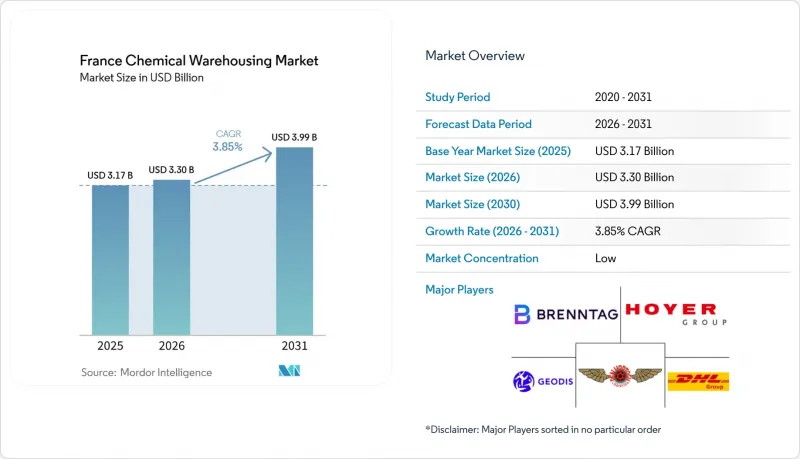
本報告按倉庫類型(普通倉庫、專用倉庫、危險品倉庫、溫控倉庫)、化學品類型(易燃液體、腐蝕性物質、有毒物質、氧化劑及其他)、終端用戶行業(基礎化學品、特種化學品、藥品、農業化學品、油漆和塗料、食品添加劑、石油和天然氣及其他)以及地區進行細分。市場預測以以金額為準(美元)表示。
法國化學品倉庫市場的趨勢與洞察
定位為歐洲戰略物流樞紐
法國位於大西洋和地中海沿岸,與六個歐盟成員國接壤,是重要的物流樞紐,擁有許多海上門戶和內陸樞紐。目前,法國正受惠於新工業用地的購買和多模態項目的推進。 2024年3月公佈的一項政府計畫概述了一項政策,即到2030年投資15億歐元,在三大主要港口區域購置1500公頃土地,以擴大化學品倉儲、混合和配送的共享位置選擇,並配合綠色燃料、電池和石化項目。國家物流策略中的舉措也強調永續供應鏈和更最佳化的空間規劃,這些規劃符合土地利用和零環境設施(ZFE)的限制,並促進鐵路和水路多模態樞紐新增運力。加強羅納-索恩軸線和內陸碼頭建設將有助於散裝液體和槽式貨櫃從駁船轉運至倉庫,從而減少對卡車運輸的依賴,並提高ADR合規性。法國化學品倉儲市場正受益於這種協調擴張。營運商可以整合港口設施、鐵路支線和共用安保基礎設施,從而降低集中叢集的單位營運成本。因此,新建設的決策正逐步轉向這些走廊地帶,進一步強化了以沿海港口和里昂為中心的國內配送中心輻射模式。
製藥和化妝品行業的優勢
法國的製藥和化妝品企業對高規格倉儲設施的需求持續旺盛,這些設施包括低溫運輸、潔淨區以及符合GDP和ISO品質要求的驗證流程。目前,法國的製藥生產遍及271個地點,反映了法國對醫療自主的承諾。同時,賽諾菲和EUROAPI的新型原料藥(API)和生物製藥項目也推動了對配備高效空氣過濾器(HEPA)、分區供暖通風系統(HVAC)和批次追溯驗證系統的附近倉庫的需求。賽諾菲在生物製劑生產方面的投資(包括維特里-蘇爾-塞納和勒特雷工廠的產能擴張)正在建構依賴嚴格倉儲控制和清晰記錄的作業流程的專業物流系統。 EUROAPI的Med4Cure專案進一步擴大了皮質類固醇、大環內酯類抗生素和先進顆粒工程材料的國內生產,這需要在符合SEVESO法規的高級設施中實現安全隔離和受控環境。諸如CEVA位於斯特拉斯堡的新基地和Cryoport位於巴黎的區域中心等專用物流設施,體現了法國生命科學領域處理貨物時已成為標準的多層品管和溫度控制系統。在法國化學品倉儲市場,隨著醫療保健領域專案的成熟,以及對需要合規儲存的輔助化學品和包裝材料庫存量的成長,高階市場正在擴大。
冷藏倉庫能源成本不斷上漲
法國雇主的負擔依然沉重,近期社會安全繳費閾值的調整收緊了低額繳費的資格標準,實際上增加了許多倉儲企業的用工成本。 2025年生效的修正案提高了部分社會安全繳費的工資門檻,給那些依賴經ADR認證、工資處於新閾值內的員工的企業帶來了額外的負擔。年度社會安全繳費上限已於2025年提高,並計劃於2026年再次提高,這將增加基於這些門檻的繳費額,並提高企業的絕對人事費用。能源成本也依然波動不定,2024年的工業能源價格仍高於2019年的水平,擠壓了利潤空間,並降低了企業應對薪資上漲的能力。市場範圍內的工資談判帶來的工資成長,加上生產力成長緩慢,進一步加劇了企業維持與合約價格相符的單位成本的挑戰。因此,法國化學品倉儲市場,特別是低溫運輸領域,需要繼續投資自動化和節能技術,以抵消不斷上漲的人事費用並維持服務水準。
細分市場分析
到2025年,特種化學品倉庫將佔據43.74%的市場。這主要得益於高價值中間體和需要惰性處理、溫度控制和嚴格可追溯性的批次式儲存庫存,這些因素構成了法國化學品倉庫市場溢價的基礎。預計到2031年,溫控化學品倉庫將以4.65%的複合年成長率(CAGR)實現最高成長。這是因為新的生物製藥和原料藥(API)項目正在擴大生產基地附近符合良好儲存標準(GDP)的儲存範圍和嚴格程度,從而擴大了對最高規格要求的法國化學品倉庫市場規模。 CEVA位於斯特拉斯堡的工廠和Cryoport位於巴黎的區域中心等新設施表明,溫控儲存和清潔作業已成為醫療保健物流的營運標準。這套功能旨在最佳化法蘭西島、諾曼第和奧弗涅-羅納-阿爾卑斯大區製藥製造地周邊的倉庫佈局,以滿足對時效性要求嚴格的產品的短途運輸需求。同時,通用化學品倉庫的營運運轉率較低。由於基礎化學品產量低於2021年年中水平,預計在下游需求恢復正常之前,散裝儲存需求將保持低迷。
危險物品倉庫正在整合,營運商紛紛投資於安全系統、數位化監控和合規專業知識,以符合日益嚴格的國家監管和SEVESO關於容量限制的標準。擁有內河航道和鐵路連接的倉庫正在透過減少對道路運輸的依賴,並在安全標準範圍內實現門到門運輸,從而增強提案。因此,法國化學品倉儲產業呈現兩極化的趨勢:處理一般化學品的設施正在調整以適應業務量均衡,而溫控高階倉庫則在擴張以滿足藥品和特種化學品的成長需求。位置港口和平台區域的倉庫營運商可以利用共用的公用設施和緊急系統來降低單位成本和每個托盤的合規儲存資本支出。這使得多模態叢集在整個預測期內成為新建設和擴建項目的首選位置。
其他好處
- Excel格式的市場預測(ME)表
- 3個月的分析師支持
目錄
第1章:引言
- 研究假設和市場定義
- 調查範圍
第2章:調查方法
第3章執行摘要
第4章 市場狀況
- 市場概覽
- 市場促進因素
- 定位為歐洲戰略物流樞紐
- 製藥和化妝品行業的優勢
- 里昂化學谷的擴張
- 港口基礎建設開發
- 用於製造的工業化學品
- 能量轉換和化學儲存
- 市場限制因素
- 高昂的人事費用和社會保險繳款
- ICPE 授權流程複雜
- 頻繁的勞資糾紛與罷工
- 嚴格的環境責任體系
- 價值供應鏈分析
- 監理情勢
- 技術展望
- 波特五力模型
- 路博潤事件後的監理情勢
- 格蘭德波特海事系統
第5章 市場規模與成長預測
- 倉庫類型
- 一般的
- 特別的
- 危險物質(HAZMAT)
- 溫度控制
- 依化學類型
- 易燃液體
- 腐蝕性物質
- 有毒物質
- 氧化劑
- 其他
- 按最終用戶行業分類
- 基礎化學品
- 特種化學品
- 製藥和生命科學
- 農業
- 油漆、塗料、黏合劑
- 食品/飼料添加劑
- 石油天然氣/石油化工
- 其他
- 地緣政治事件對市場的影響
- 循環經濟中的化學品回收
第6章 競爭情勢
- 市場集中度
- 策略趨勢
- 市佔率分析
- 公司簡介
- DHL Group
- Geodis
- Hoyer Group
- Brenntag
- Den Hartogh Logistics
- Ziegler Group
- Bertschi AG France
- De Rijke Group
- H.Essers
- Kuehne+Nagel
- Rhenus Logistics
- Groupe Charles Andre(GCA)
- DSV
- CEVA Logistics
- DACHSER
- Ectra group
- JAS Worldwide
- Logwin
- Manuport Logistics
- ADR Logistics(TLA Group)
第7章 市場機會與未來展望
According to Mordor Intelligence, the france chemical warehousing market size is expected to increase from USD 3.17 billion in 2025 to USD 3.30 billion in 2026 and reach USD 3.99 billion by 2030, growing at a CAGR of 3.85% over 2026-2030.
This report is Segmented by Warehouse Type (General, Specialty, HAZMAT, and Temperature-Controlled), by Chemical Type (Flammable Liquids, Corrosives, Toxic Substances, Oxidizers, and Others), by End-User Industry (Basic Chemicals, Specialty Chemicals, Pharmaceuticals, Agrochemicals, Paints/Coatings, Food Additives, Oil & Gas, and Others), and by Geography. Market Forecasts are in Value Terms, USD.
France Chemical Warehousing Market Trends and Insights
Strategic European Logistics Hub Position
France's location on both Atlantic and Mediterranean seaboards and its borders with six EU member states concentrate flows through maritime gateways and inland nodes that now benefit from new industrial land commitments and multimodal connectivity programs. The state's March 2024 plan to bring early EUR 1 billion to 1,500 hectares across the three largest port zones by 2030 expands co-location options for chemical warehousing, blending, and distribution alongside green-fuel, battery, and petrochemical projects. Policy initiatives within the national logistics strategy also stress sustainable supply chains and better spatial planning, which align with land-use and ZFE constraints and steer new capacity toward multimodal sites with rail and river access. Strengthening of the Rhone-Saone axis and inland terminals supports barge-to-warehouse transshipment of bulk liquids and tank containers, which reduces trucking dependencies and improves compliance for ADR cargo. The France chemical warehousing market benefits from this synchronized expansion. Operators can integrate port utilities, rail spurs, and shared safety infrastructure, lowering unit operating costs in concentrated clusters. The result is a gradual shift of new build decisions toward these corridors, which reinforces a hub-and-spoke model for national distribution centered on coastal ports and Lyon.
Pharmaceutical and Cosmetics Industry Strength
France's medicine and cosmetics complexes underpin a large and persistent need for high-specification storage, including cold chain, clean zones, and validated processes that meet GDP and ISO quality requirements. Pharmaceutical production spans 271 sites and supports national health sovereignty initiatives, while new API and biologics programs by Sanofi and EUROAPI drive adjacent demand for proximity warehousing with HEPA filtration, HVAC zoning, and validated batch traceability. Sanofi's investments in biologics manufacturing, including capacity expansions at Vitry-sur-Seine and Le Trait, add specialized flows that rely on tight storage controls and clearly documented handling. EUROAPI's Med4Cure programs further extend onshore production for corticosteroids, macrolides, and advanced particle engineering, which call for safe segregation and controlled environments in upper-tier SEVESO facilities. Purpose-built logistics assets, such as CEVA's new Strasbourg site and Cryoport's Paris-region center, illustrate the quality and temperature layers that have become standard in life sciences handling in France. The France chemical warehousing market sees the premium end of the spectrum expand as these health-sector projects mature and pull through ancillary chemical and packaging inventories that need compliant storage.
High Energy Costs for Cold Warehouses
Employer contributions in France remain significant, and recent threshold changes for social charges have tightened eligibility for lower-rate brackets, which raises effective employment costs for many warehouse roles. Adjustments that took effect in 2025 increase the wage bases to which some contributions apply, which adds pressure to operators that rely on ADR-certified staff whose compensation bands fall into the newly constrained thresholds. The annual ceiling for social security rose in 2025 and is set to rise again in 2026, which lifts contributions calculated on those bases and increases payroll outlays in absolute terms for operators. Energy costs remain volatile as well, and the 2024 industrial energy bill stayed above its 2019 level, which narrows margins and reduces operators' ability to absorb parallel wage growth. Negotiated wage increases and limited productivity gains across the market sector add to the challenge of maintaining unit costs in line with contract pricing. The France chemical warehousing market, particularly the cold-chain segment, must therefore continue to invest in automation and energy-saving technologies to offset payroll drift and protect service levels.
Other drivers and restraints analyzed in the detailed report include:
- Lyon Chemical Valley Expansion
- Port Infrastructure Development
- Complex ICPE Authorization Process
For complete list of drivers and restraints, kindly check the Table Of Contents.
Segment Analysis
Specialty Chemical Warehouses captured 43.74% in 2025, supported by higher-value intermediates and batch-segregated inventories that require inerting, controlled climates, and rigorous traceability, which anchor premium pricing within the France chemical warehousing market. Temperature-Controlled Chemical Warehouses are projected to post the fastest 4.65% CAGR through 2031 as new biologics and API programs expand the scope and stringency of GDP-compliant storage near production hubs, adding to the France chemical warehousing market size at the top end of specifications. New facilities such as CEVA's Strasbourg site and Cryoport's Paris-region center illustrate how temperature layering and clean handling have become operational baselines in health-related flows. This capability set tailors warehousing footprints around pharma manufacturing arcs in Ile-de-France, Normandy, and Auvergne-Rhone-Alpes, where time-sensitive product requires short transfer distances. At the same time, commodity-oriented General Warehousing faces softer utilization where basic chemical output fell below mid-2021 levels, which trims bulk storage needs until downstream demand normalizes.
Hazardous Materials Warehouses continue to consolidate toward operators that invest in safety systems, digital monitoring, and compliance expertise, which aligns with national oversight intensity and SEVESO criteria at upper thresholds. Inland waterway and rail-served depots strengthen the proposition for hazardous flows by reducing road exposure and enabling gate-to-gate movements within safety perimeters. The France chemical warehousing industry therefore bifurcates, with ambient commodity sites adjusting to flatter volumes and premium temperature-controlled assets expanding in line with pharmaceutical and specialty chemical growth. Warehouse operators that co-locate within port and platform zones can leverage shared utilities and emergency systems that reduce unit costs and capex per pallet for compliant storage. This positions multimodal clusters as preferred destinations for new builds and expansion projects through the forecast period.
List of Companies Covered in this Report:
- DHL Group
- Geodis
- Hoyer Group
- Brenntag
- Den Hartogh Logistics
- Ziegler Group
- Bertschi AG France
- De Rijke Group
- H.Essers
- Kuehne + Nagel
- Rhenus Logistics
- Groupe Charles Andre (GCA)
- DSV
- CEVA Logistics
- DACHSER
- Ectra group
- JAS Worldwide
- Logwin
- Manuport Logistics
- ADR Logistics (TLA Group)
Additional Benefits:
- The market estimate (ME) sheet in Excel format
- 3 months of analyst support
TABLE OF CONTENTS
1 Introduction
- 1.1 Study Assumptions and Market Definition
- 1.2 Scope of the Study
2 Research Methodology
3 Executive Summary
4 Market Landscape
- 4.1 Market Overview
- 4.2 Market Drivers
- 4.2.1 Strategic European Logistics Hub Position
- 4.2.2 Pharmaceutical and Cosmetics Industry Strength
- 4.2.3 Lyon Chemical Valley Expansion
- 4.2.4 Port Infrastructure Development
- 4.2.5 Industrial Chemicals for Manufacturing
- 4.2.6 Energy Transition Chemical Storage
- 4.3 Market Restraints
- 4.3.1 High Labor Costs and Social Charges
- 4.3.2 Complex ICPE Authorization Process
- 4.3.3 Frequent Industrial Action and Strikes
- 4.3.4 Stringent Environmental Liability Regime
- 4.4 Value / Supply-Chain Analysis
- 4.5 Regulatory Landscape
- 4.6 Technological Outlook
- 4.7 Porter's Five Forces
- 4.7.1 Threat of New Entrants
- 4.7.2 Bargaining Power of Suppliers
- 4.7.3 Bargaining Power of Buyers
- 4.7.4 Threat of Substitutes
- 4.7.5 Competitive Rivalry
- 4.8 Post-Lubrizol Regulatory Landscape
- 4.9 Grand Port Maritime System
5 Market Size and Growth Forecasts (Value, USD Billion)
- 5.1 By Warehouse Type
- 5.1.1 General Warehousing
- 5.1.2 Speciality Chemical Warehouse
- 5.1.3 Hazardous Materials (HAZMAT) Warehouses
- 5.1.4 Temperature-Controlled Chemical Warehouses
- 5.2 By Chemical Type
- 5.2.1 Flammable Liquids
- 5.2.2 Corrosives
- 5.2.3 Toxic Substances
- 5.2.4 Oxidizers
- 5.2.5 Others
- 5.3 By End-user Industry
- 5.3.1 Basic Chemicals Manufacturing
- 5.3.2 Specialty Chemicals Manufacturing
- 5.3.3 Pharmaceuticals & Life Sciences
- 5.3.4 Agrochemicals
- 5.3.5 Paints, Coatings & Adhesives
- 5.3.6 Food & Feed Additives
- 5.3.7 Oil & Gas / Petrochemicals
- 5.3.8 Others
- 5.4 Impact of Geopolitical Events on the Market
- 5.5 Circular Economy Chemical Recycling
6 Competitive Landscape
- 6.1 Market Concentration
- 6.2 Strategic Moves
- 6.3 Market Share Analysis
- 6.4 Company Profiles (includes Global level Overview, Market level overview, Core Segments, Financials as available, Strategic Information, Market Rank/Share for key companies, Products and Services, and Recent Developments)
- 6.4.1 DHL Group
- 6.4.2 Geodis
- 6.4.3 Hoyer Group
- 6.4.4 Brenntag
- 6.4.5 Den Hartogh Logistics
- 6.4.6 Ziegler Group
- 6.4.7 Bertschi AG France
- 6.4.8 De Rijke Group
- 6.4.9 H.Essers
- 6.4.10 Kuehne + Nagel
- 6.4.11 Rhenus Logistics
- 6.4.12 Groupe Charles Andre (GCA)
- 6.4.13 DSV
- 6.4.14 CEVA Logistics
- 6.4.15 DACHSER
- 6.4.16 Ectra group
- 6.4.17 JAS Worldwide
- 6.4.18 Logwin
- 6.4.19 Manuport Logistics
- 6.4.20 ADR Logistics (TLA Group)
7 Market Opportunities and Future Outlook
- 7.1 White-space and Unmet-need Assessment

 歐洲化學品倉儲市場:市場佔有率分析、產業趨勢與統計、成長預測(2026-2031 年)北美化學品倉儲市場:市場佔有率分析、產業趨勢與統計及成長預測(2026-2031 年)德國化學品倉儲市場:市場佔有率分析、產業趨勢與統計、成長預測(2026-2031)日本化學品倉儲市場:市場佔有率分析、產業趨勢與統計及成長預測(2026-2031年)義大利化學品倉儲市場:市場佔有率分析、產業趨勢與統計及成長預測(2026-2031 年)印度化學品倉儲市場:市場佔有率分析、產業趨勢與統計及成長預測(2026-2031)中國化學品倉儲市場:市場佔有率分析、產業趨勢與統計及成長預測(2026-2031年)英國化學品倉儲:市場佔有率分析、產業趨勢與統計、成長預測(2026-2031 年)中東化學品倉儲市場:市場佔有率分析、產業趨勢與統計、成長預測(2026-2031年)非洲化學品倉儲市場:市場佔有率分析、產業趨勢與統計、成長預測(2026-2031年)