


 |
市場調查報告書
商品編碼
2063336
英國化學品倉儲:市場佔有率分析、產業趨勢與統計、成長預測(2026-2031 年)United Kingdom Chemical Warehousing - Market Share Analysis, Industry Trends & Statistics, Growth Forecasts (2026 - 2031) |
||||||

※ 本網頁內容可能與最新版本有所差異。詳細情況請與我們聯繫。
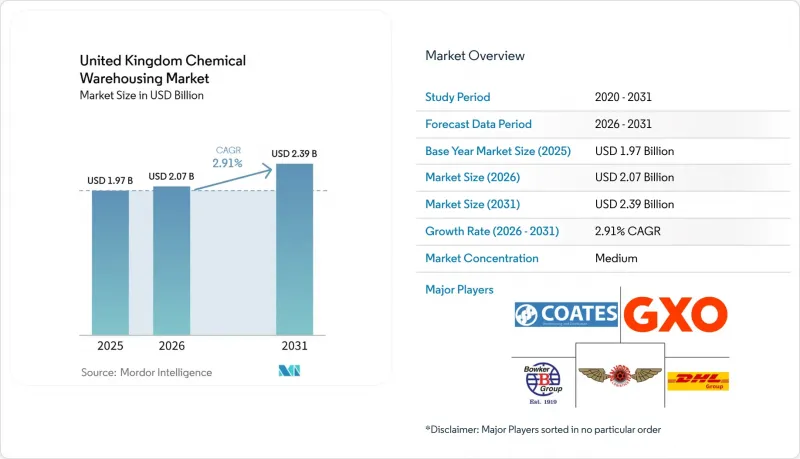
根據 Mordor Intelligence 預測,英國化學品倉庫市場規模將從 2025 年的 19.7 億美元成長到 2026 年的 20.7 億美元,到 2031 年將達到 23.9 億美元,預計 2026 年至 2031 年的複合年成長率為 2.91%。
本報告按倉庫類型(普通倉庫、特殊化學品倉庫、危險品倉庫等)、化學品類型(易燃液體、腐蝕性物質等)和終端用戶行業(基礎化學品製造、特種化學品製造、農藥等)進行細分。市場預測以以金額為準(十億美元)表示。
英國化學品倉庫市場趨勢與洞察
在製藥和生命科學製造領域的優勢
英國製藥業在2025年持續擴張,2月份較上季成長4.4%,12月前三個月較上季成長9.3%。這推動了對符合GDP標準且靠近生產和研發基地的低溫運輸倉儲空間的需求成長。根據英國政府的生命科學競爭力指標,英國在2024年吸引了更多外國直接投資和股權資本,從而增強了需要專業倉儲和配送解決方案的受監管目標產品的研發管線。生命科學產業計畫也概述了人工智慧賦能的醫療資訊服務,並計畫為此提供高達6億英鎊(8.0946億美元)的資金支持。此舉有望加速臨床開發,並擴大臨床實驗藥物的短期儲存流程。需要低溫處理和嚴格監管鏈管理的先進處方藥在英國的臨床試驗中取得了顯著進展,這將持續提高生物製藥供應鏈支援設施的規格要求。泰晤士河谷地區擴大生技藥品生產能力的計劃表明,對鄰近的無菌儲存和溫控物流有長期需求。所有這些因素共同支撐著英國化學品倉儲市場的穩定成長,因為生命科學產業正在擴展其生產、臨床營運和低溫運輸網路。
英國脫歐後的海關與保稅倉庫
根據英國稅務海關總署(英國 Revenue & Customs) 的報告,經授權的保稅倉庫總容量相當可觀,平均運轉率約為 87%,最高利用率可達 90%,這凸顯了英國對保稅設施在進口緩衝和延期繳納關稅方面的結構性依賴。與普通倉庫相比,保稅倉庫庫存中危險物品的比例明顯更高,這反映了風險隔離儲存和洩漏預防系統在保稅作業中的重要性。歐盟-英國貿易合作協議 (EU-UK Trade Cooperation Agreement) 和英國REACH 法規的持續實施,使得文件和原產地規則成為合規的核心,從而維持了對保稅儲存模式的需求,這種模式允許在貨物進入自由流通之前延期繳納關稅和增值稅(VAT)。英國的自由港計畫 (Freeport Program) 以簡化海關程序和延長未來 10 年的稅收優惠為特點,進一步強化了在指定區域內設立保稅倉庫的優勢,從而支持化學品的貿易流量。公私合作模式在港口基礎建設中發揮重要作用,有助於打造更清潔的船隊,同時泊位和鐵路運輸能力的提升也提高了危險品即時運輸的可預測性。因此,海關和保稅設施在英國脫歐後的化學品倉儲市場中仍扮演著重要的戰略角色。
倉庫空間嚴重短缺
受監管空間的結構性緊張狀況依然存在,海關批准的倉儲設施運轉率,可用空間有限,難以柔軟性應對新增化學品流入和季節性需求高峰。平均佔用率高達 87%,尖峰時段運轉率接近 90%,顯示危險品倉儲能力尤為有限。危險物品在海關倉庫的庫存佔比高於普通倉庫。此外,《常見危險物質管理法》(COMAH) 的監管也是一大阻礙因素,要求重點設施進行氣候風險評估並制定防洪規程,這可能會延誤倉儲能力的改造進度。雖然從風險管理的角度來看,合規負擔是合理的,但這進一步加劇了無需大規模維修即可容納特定類別危險品的高級設施的短缺。在英國化學品倉儲市場,這意味著位置決策必須在接近性港口和叢集與有限的可用土地和許可證供應之間取得平衡。短期影響包括改造成本增加和專用倉儲能力建設前置作業時間延長。
細分市場分析
到2025年,特種化學品倉庫將佔據最大佔有率,達到40.64%,因為資產所有者優先考慮符合危險物品處理標準的隔離、人工通風和先進的消防系統。對腐蝕性、易燃性和氧化性物質更嚴格的監管正在形成准入資本壁壘,維持英國化學品倉庫市場的服務溢價,並降低供應彈性。英格蘭的優先COMAH(關鍵危險設施)場所受到更嚴格的監管,包括氣候風險評估和防洪計劃,這意味著儲存設施的設計和位置與法規密切相關。這些法規提高了安全案例、緊急應變計畫和社區參與在日常營運管理中的作用。因此,英國化學品倉庫行業傾向於選擇靠近港口和工業集群的專用位置,以兼顧危險管理和多模態。
受生物製藥和先進療法在嚴格的GDP和GMP要求下進行臨床和商業化生產的推動,溫控設施的成長速度最快,達到5.78%。能夠為生物製藥和細胞療法提供2-8°C或更低冷藏保管的設施需要更高的規格標準,因此靠近製造地和機場的位置變得越來越重要。隨著2025年之前藥品產量的成長,這些設施對端到端可追溯性和頻繁品質審核的需求也進一步增加。預計到2031年,英國化學品倉儲市場規模將達到23.9億美元,複合年成長率為2.91%,營運商正在調整設施規模,將高規格單元集中在科技園區和國際門戶附近。這種配置既滿足了對受控環境日益成長的需求,也確保了常溫和低風險貨物的儲存能力。
其他好處:
- Excel格式的市場預測(ME)表
- 3個月的分析師支持
目錄
第1章:引言
- 研究假設和市場定義
- 調查範圍
第2章:調查方法
第3章執行摘要
第4章 市場狀況
- 市場概覽
- 市場促進因素
- 在製藥和生命科學製造領域的優勢
- 英國脫歐後的海關清關與保稅倉庫
- 特種化學品和先進材料的成長
- 港口基礎設施現代化
- 為實現淨零碳排放所做的努力
- 實施重大事故危害控制(COMAH)安全規則
- 市場限制因素
- 倉庫空間嚴重短缺
- 高昂的能源成本和租金
- 駕駛人危機
- 與英國脫歐相關的監管不確定性
- 價值供應鏈分析
- 監理情勢
- 技術展望
- 波特五力模型
- 地緣政治事件對市場的影響
- 循環經濟中的化學品回收
第5章 市場規模與成長預測
- 倉庫類型
- 普通倉庫
- 特用化學品倉庫
- 危險品(HAZMAT)倉庫
- 溫控化學品倉庫
- 依化學物質類型
- 易燃液體
- 腐蝕性物質
- 危險物質
- 氧化劑
- 其他
- 按最終用戶行業分類
- 基礎化學製造
- 特種化學品製造
- 製藥和生命科學
- 農業化學品
- 油漆、塗料、黏合劑
- 食品/飼料添加劑
- 石油天然氣/石油化工
- 其他
第6章 競爭情勢
- 市場集中度
- 策略趨勢
- 市佔率分析
- 公司簡介
- HW Coates
- Bowker Transport
- Den Hartogh Logistics
- GXO Logistics
- DHL Group
- Edge Worldwide
- Rhenus Logistics
- HOYER Group
- DSV
- CEVA Logistics
- Brenntag
- Bertschi
- Yusen Logistics
- Kuehne+Nagel
- Noatum Logistics
- Clarion Shipping Services LLC
- BDP International
- DACHSER
- Streamline Shipping Group Ltd.
- CH Robinson
第7章 市場機會與未來展望
According to Mordor Intelligence, the united kingdom chemical warehousing market size is expected to increase from USD 1.97 billion in 2025 to USD 2.07 billion in 2026 and reach USD 2.39 billion by 2031, growing at a CAGR of 2.91% over 2026-2031.
This report is Segmented by Warehouse Type (General Warehousing, Specialty Chemical Warehouse, Hazardous Materials (HAZMAT) Warehouses, and More), by Chemical Type (Flammable Liquids, Corrosives, and More), and by End-User Industry (Basic Chemicals Manufacturing, Specialty Chemicals Manufacturing, Agrochemicals, and More). The Market Forecasts are Provided in Terms of Value (USD Billion).
United Kingdom Chemical Warehousing Market Trends and Insights
Pharmaceutical and Life Sciences Manufacturing Strength
Pharmaceutical output in the United Kingdom expanded through 2025, with a 4.4% rise in February and a 9.3% three month on three-month pace by December, which is lifting storage needs for GDP-compliant and cold chain space close to manufacturing and research centers. Government life sciences competitiveness indicators show the United Kingdom attracted stronger foreign direct investment and equity finance into 2024, reinforcing the pipeline of regulated products that require specialized warehousing and distribution solutions. The Life Sciences Sector Plan also outlines an AI-ready health data service with up to GBP 600 million (USD 809.46 million) of support, a move that can accelerate clinical development and expand short-cycle storage flows for investigational products. Advanced therapy medicinal products, which require cryogenic handling and strict chain of custody controls, had a notable United Kingdom trial footprint in 2024 and will continue to push specification requirements for facilities that serve biopharma supply chains. Planned expansion of biologics manufacturing capacity in the Thames Valley region signals long-term demand for adjacent sterile storage and temperature-managed logistics. All together, these forces support steady expansion in the United Kingdom chemical warehousing market as life sciences scale manufacturing, clinical operations, and cold chain networks.
Post-Brexit Customs and Bonded Warehousing
HM Revenue & Customs reported large installed customs authorized capacity with utilization rates near 87% on average and 90% at peaks, highlighting the structural reliance on bonded facilities for import buffers and duty deferment. Hazardous goods comprised a materially higher share of customs warehouse inventory relative to general stores, which reflects the importance of risk-segregated storage and spill prevention systems in bonded operations. Ongoing implementation of the EU-UK Trade and Cooperation Agreement and UK REACH places documentation and origin rules at the core of compliance, sustaining demand for bonded storage models that defer duty and VAT until goods enter free circulation. The United Kingdom Freeports program, with simplified customs processes and extended tax relief windows through the next decade, strengthens the case for locating customs warehousing within designated zones that serve chemicals trade flows. Complementary public and private port investments in cleaner fleets and added berth and rail capacity improve predictability for just-in-time hazardous shipments. As a result, customs and bonded facilities remain a strategic lever in the United Kingdom chemical warehousing market in the post-Brexit context.
Severe Warehouse Space Shortage
Structural tightness persists for compliant space, and customs-authorized capacity has shown high utilization with limited free space, which constrains flexibility for new chemical flows and seasonal peaks. Median utilization at 87% and peak occupancy near 90% indicate limited headroom, especially for dangerous goods, where inventory shares are higher in customs warehouses than in general sites. COMAH oversight adds further constraints, as priority establishments require climate risk assessments and flood preparedness protocols that can extend timelines for capacity changes. The compliance burden is appropriate for risk management, but reinforces the scarcity of upper-tier sites that can accept certain hazard classes without extensive modification. For the United Kingdom chemical warehousing market, this means location decisions must balance proximity to ports and clusters with the limited availability of suitable lots and permits. The shorter effect is higher switching costs and longer commissioning lead times for specialized capacity.
Other drivers and restraints analyzed in the detailed report include:
- Specialty Chemicals and Advanced Materials Growth
- Port Infrastructure Modernization
- High Energy and Occupancy Costs
For complete list of drivers and restraints, kindly check the Table Of Contents.
Segment Analysis
Specialty chemical warehouses held the largest share of 40.64% in 2025 as asset owners prioritized segregation, engineered ventilation, and advanced fire suppression that align with hazardous substance handling standards. Enhanced controls for corrosive, flammable, and oxidizing substances create capital barriers that sustain service premiums and reduce supply elasticity in the United Kingdom chemical warehousing market. Priority COMAH sites in England operate under intensified oversight with climate risk assessments and flood planning, which keeps storage design and location choices tightly linked to regulation. These controls elevate the role of safety cases, emergency planning, and community liaison in day-to-day operational management. As a result, the United Kingdom chemical warehousing industry leans toward specialized footprints near ports and clusters that pair hazard control with multimodal access.
Temperature-controlled sites are the fastest growing of 5.78% as biopharma and advanced therapies expand clinical and commercial output with stringent GDP and GMP requirements. Facilities that support 2-8°C refrigerated storage or colder zones for biologics and cell-based therapies will command higher specification standards and closer siting to manufacturing and airports. Rising pharmaceutical production through 2025 strengthens the case for end-to-end traceability and frequent quality audits in these buildings. As the United Kingdom chemical warehousing market size advances to USD 2.39 billion by 2031 at a 2.91% CAGR, operators are calibrating footprints to concentrate higher spec units close to science parks and international gateways. This setup balances capacity for ambient and low-hazard goods while meeting rising demand for controlled environments.
List of Companies Covered in this Report:
- H.W. Coates
- Bowker Transport
- Den Hartogh Logistics
- GXO Logistics
- DHL Group
- Edge Worldwide
- Rhenus Logistics
- HOYER Group
- DSV
- CEVA Logistics
- Brenntag
- Bertschi
- Yusen Logistics
- Kuehne + Nagel
- Noatum Logistics
- Clarion Shipping Services L.L.C
- BDP International
- DACHSER
- Streamline Shipping Group Ltd.
- C.H Robinson
Additional Benefits:
- The market estimate (ME) sheet in Excel format
- 3 months of analyst support
TABLE OF CONTENTS
1 Introduction
- 1.1 Study Assumptions and Market Definition
- 1.2 Scope of the Study
2 Research Methodology
3 Executive Summary
4 Market Landscape
- 4.1 Market Overview
- 4.2 Market Drivers
- 4.2.1 Pharmaceutical and Life Sciences Manufacturing Strength
- 4.2.2 Post-Brexit Customs and Bonded Warehousing
- 4.2.3 Specialty Chemicals and Advanced Materials Growth
- 4.2.4 Port Infrastructure Modernization
- 4.2.5 Net Zero Carbon Commitments
- 4.2.6 COMAH Safety Regulation Enforcement
- 4.3 Market Restraints
- 4.3.1 Severe Warehouse Space Shortage
- 4.3.2 High Energy and Occupancy Costs
- 4.3.3 HGV Driver Shortage Crisis
- 4.3.4 Brexit-Related Regulatory Uncertainty
- 4.4 Value / Supply-Chain Analysis
- 4.5 Regulatory Landscape
- 4.6 Technological Outlook
- 4.7 Porter's Five Forces
- 4.7.1 Threat of New Entrants
- 4.7.2 Bargaining Power of Suppliers
- 4.7.3 Bargaining Power of Buyers
- 4.7.4 Threat of Substitutes
- 4.7.5 Competitive Rivalry
- 4.8 Impact of Geopolitical Events on the Market
- 4.9 Circular Economy Chemical Recycling
5 Market Size and Growth Forecasts (Value, USD Billion)
- 5.1 By Warehouse Type
- 5.1.1 General Warehousing
- 5.1.2 Specialty Chemical Warehouse
- 5.1.3 Hazardous Materials (HAZMAT) Warehouses
- 5.1.4 Temperature-Controlled Chemical Warehouses
- 5.2 By Chemical Type
- 5.2.1 Flammable Liquids
- 5.2.2 Corrosives
- 5.2.3 Toxic Substances
- 5.2.4 Oxidizers
- 5.2.5 Others
- 5.3 By End-user Industry
- 5.3.1 Basic Chemicals Manufacturing
- 5.3.2 Specialty Chemicals Manufacturing
- 5.3.3 Pharmaceuticals & Life Sciences
- 5.3.4 Agrochemicals
- 5.3.5 Paints, Coatings & Adhesives
- 5.3.6 Food & Feed Additives
- 5.3.7 Oil & Gas / Petrochemicals
- 5.3.8 Others
6 Competitive Landscape
- 6.1 Market Concentration
- 6.2 Strategic Moves
- 6.3 Market Share Analysis
- 6.4 Company Profiles (includes Global level Overview, Market level overview, Core Segments, Financials as available, Strategic Information, Products and Services, and Recent Developments)
- 6.4.1 H.W. Coates
- 6.4.2 Bowker Transport
- 6.4.3 Den Hartogh Logistics
- 6.4.4 GXO Logistics
- 6.4.5 DHL Group
- 6.4.6 Edge Worldwide
- 6.4.7 Rhenus Logistics
- 6.4.8 HOYER Group
- 6.4.9 DSV
- 6.4.10 CEVA Logistics
- 6.4.11 Brenntag
- 6.4.12 Bertschi
- 6.4.13 Yusen Logistics
- 6.4.14 Kuehne + Nagel
- 6.4.15 Noatum Logistics
- 6.4.16 Clarion Shipping Services L.L.C
- 6.4.17 BDP International
- 6.4.18 DACHSER
- 6.4.19 Streamline Shipping Group Ltd.
- 6.4.20 C.H Robinson
7 Market Opportunities and Future Outlook
- 7.1 White-space and Unmet-need Assessment

 歐洲化學品倉儲市場:市場佔有率分析、產業趨勢與統計、成長預測(2026-2031 年)北美化學品倉儲市場:市場佔有率分析、產業趨勢與統計及成長預測(2026-2031 年)德國化學品倉儲市場:市場佔有率分析、產業趨勢與統計、成長預測(2026-2031)日本化學品倉儲市場:市場佔有率分析、產業趨勢與統計及成長預測(2026-2031年)義大利化學品倉儲市場:市場佔有率分析、產業趨勢與統計及成長預測(2026-2031 年)印度化學品倉儲市場:市場佔有率分析、產業趨勢與統計及成長預測(2026-2031)中國化學品倉儲市場:市場佔有率分析、產業趨勢與統計及成長預測(2026-2031年)中東化學品倉儲市場:市場佔有率分析、產業趨勢與統計、成長預測(2026-2031年)法國化學品倉儲產業:市場佔有率分析、產業趨勢與統計、成長預測(2026-2031)非洲化學品倉儲市場:市場佔有率分析、產業趨勢與統計、成長預測(2026-2031年)