


 |
市場調查報告書
商品編碼
2155629
英國快速物流:市場佔有率分析、產業趨勢與統計及成長預測(2026-2031)United Kingdom Quick Commerce Logistics - Market Share Analysis, Industry Trends & Statistics, Growth Forecasts (2026 - 2031) |
||||||

※ 本網頁內容可能與最新版本有所差異。詳細情況請與我們聯繫。
據 Mordor Intelligence 稱,英國快速商業物流市場在 2025 年的價值為 15.2 億美元,預計到 2031 年將從 2026 年的 16.6 億美元成長到 24.9 億美元,在預測期(2026-2031 年)內的複合年成長率為 8.45%。
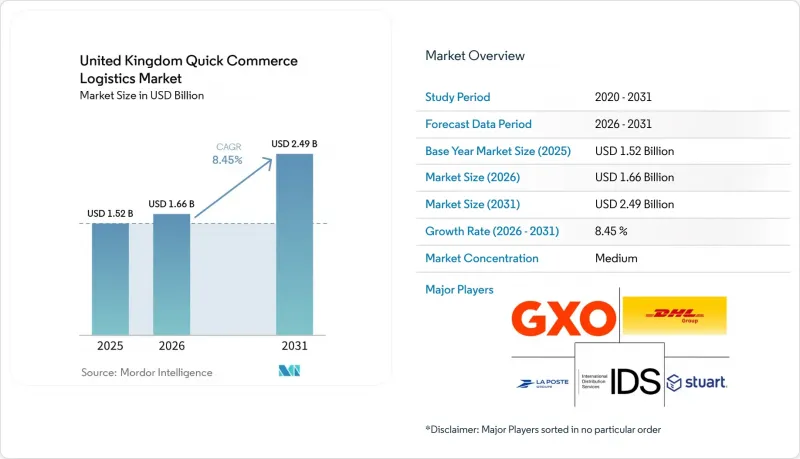
現有零售商不再將快速配送視為試驗性服務,而是將其發展成為一項永續的業務能力。本報告按服務類型(履約和暗店營運、最後一公里配送、逆向物流等)、履約模式(包括暗店模式、移動配送中心模式等)、配送模式(B2C、B2B)、城市等級(一線城市、二線城市、三線及以下城市)和地區(英格蘭、蘇格蘭、威爾斯、北愛爾蘭)進行細分。市場預測以美元計價。
英國快速商務物流市場的趨勢與洞察
10-30分鐘內送達的雜貨配送需求日益成長
消費者對一小時內送達雜貨的需求不僅體現在偏好調查中,也體現在實際購買行為上。數據顯示,英國消費者使用快速配送服務的比例從2024年11月的19%上升至2026年3月的22%。這一趨勢表明,消費者更多地出於特定需求而非一次性便利購買而定期使用雜貨配送服務。這也增加了都市區高峰期本地履約網路的處理量。英國快速配送物流市場正受益於規律性的雜貨訂單,這些訂單提高了配送路線和附近庫存的效率。
零售商將門市轉型為區域履約中心。
由於現有門市空間和庫存充足,大型連鎖超市正將其用作區域揀貨和包裝中心,從而減少了對專用設施的需求。預計到2026年,Tesco Whoosh將在1800家門市經營,服務超過70%的英國家庭。 Whoosh的銷售額年增51%,超過5.12億美元。零售商無需投資建造新的區域中心,即可利用門市員工揀貨並與末端配送合作夥伴合作。這降低了將快速配送服務擴展到大都會圈以外所需的資金。同時,這也為擁有成熟區域門市網路的現有零售商進入英國快速零售物流市場提供了一條切實可行的途徑。
需求稀少的地區配送成本高。
如果無法涵蓋人口密集的地區,在主要都會區以外進行快速配送仍面臨挑戰。配送路線密度低會導致單筆訂單配送成本更高,並限制了專用「暗店」模式的適用性。 《2025年就業權利法案》已於2026年2月、4月和8月分階段實施。該法案將保護勞工身分、法定病假工資、有薪年假和自動退休金登記列為提高平台配送人事費用最低工資的因素。與利潤率較低且依賴零工經濟的服務相比,擁有密集配送路線和成熟勞動力結構的企業更容易適應這項變化。在尖峰時段難以招募司機,以及因訂單金額較小而導致的低盈利,進一步加劇了英國低密度地區快速商業物流市場的營運挑戰。
細分市場分析
2025年,最後一公里配送服務佔英國快速商務物流市場規模的51.60%。這一環節代表了履約鏈的最後階段,這是一個對時間要求極高的環節,訂單必須在一小時內送達。由於訂單集中在倫敦、曼徹斯特和伯明翰,因此在同一區域內進行多次配送時,每次配送的成本可以降低。 2025年9月4日,英國競爭與市場管理局(CMA)無條件批准了Evri和DHL電子商務英國的合併。合併後的集團將擁有超過3萬名宅配和貨車駕駛人,以及1.2萬名員工和8,000輛車輛。如此規模將使其每年能夠處理超過10億小包裹,並新增1.5萬個非公路配送中心。
預計到2031年,逆向物流服務將成為成長最快的服務類別,複合年成長率將達到12.81%。這反映了英國線上商品26%的退貨率,以及時尚產業高達40%的退貨率。 2025年10月,DHL供應鏈推出了“退貨網路”,該網路包含11個專門用於處理多件商品退貨的設施。這項共用基礎設施旨在縮短多家零售客戶的檢驗和補貨時間。其餘服務活動包括履約和退貨商品的重新入庫。這有助於退貨處理在英國快速電商物流市場中發揮更大的作用。
2025年,零售門市履約在英國快速電商物流市場佔有率中佔34.99%(依履約模式細分)。利用現有門市空間可以避免建造專用設施所需的資本支出。此外,食品零售商通常已擁有區域庫存、門市員工以及與配送平台的合作關係。這些優點使得門市能夠方便地成為快速配送的樞紐。樂購(Tesco)涵蓋1800家門市的Whoosh網路就充分展現了這種模式的規模優勢。森寶利(Sainsbury's)報告稱,2025年透過Deliveroo、Uber Eats和Just Eat等平台實現的按需銷售額達到8.96億美元。接入多個平台可以提升現有門市營運的盈利。
基於微型倉配中心的履約模式是成長最快的,預計到2031年將以12.39%的複合年成長率成長。隨著「Amazon Now」在都市區的擴張,基於暗店的履約重新受到關注。這種模式利用專用的微型倉配設施,例如鐵路橋洞下和輕工業設施。混合營運模式結合了基於門市和專用設施的履約的特性。 Ocado計劃在2026年4月前在其所有六個面向客戶的履約中心部署「Swift Router」系統。該系統每小時可處理268件商品,較去年同期成長12%。它還能實現整籃訂單最快100分鐘的配送時限。因此,當一個地區的交易量很大且必要的投資合理時,自動化可以提高配送速度。
其他好處:
- Excel格式的市場預測(ME)表
- 3個月的分析師支持
目錄
第1章:引言
- 研究假設和市場定義
- 調查範圍
第2章:調查方法
第3章執行摘要
第4章 市場狀況
- 市場概況及Qcommerce在電子商務物流中的作用
- 傳統電子商務與快速物流
- 市場促進因素
- 10至30分鐘內送達的雜貨配送需求日益成長
- 零售商將門市轉型為區域履約中心。
- 平台主導的白牌快速商務合作關係正在擴大。
- 大城市小批量捕撈服務需求旺盛,城市微型捕撈服務正在擴張
- 亞馬遜和超級市場正在加強其高密度暗店網路。
- 透過零售媒體和忠誠度生態系統實現盈利,從而支持重複訂購
- 市場限制因素
- 客流量稀少的航線運作成本高昂。
- 城市履約中心的規劃挑戰
- 尖峰時段的騎士可用性和運力限制
- 多個訂單籃會對利潤率造成壓力。
- 法律規範
- 價值鍊和分銷管道的結構分析
- 技術創新前景
- 波特五力分析
- 準商務物流需求的演變
- 定價和成本結構分析
- 消費者行為與偏好分析
- 暗店和履約基礎設施的分析
- 永續交付解決方案和綠色物流舉措
- 地緣政治事件對供應鏈變化的影響
第5章 市場規模及成長預測(價值,2026-2031 年)
- 按服務類型
- 履約及暗店運營
- 最後一公里配送服務
- 逆向物流服務
- 加值物流服務
- 履約模式
- 利用暗店進行履約
- 利用微型倉配中心(MFC)進行履約
- 零售店內訂單履約
- 混合型履約模式
- 按型號提供
- B2C(企業對消費者)
- 企業對企業 (B2B) 交易
- 城市層級
- 一級
- 二級
- 三級及以下
- 按地區
- 英格蘭
- 蘇格蘭
- 威爾斯
- 北愛爾蘭
第6章 競爭情勢
- 市場集中度
- 關鍵策略趨勢
- 市佔率分析
- 公司簡介
- DHL Group(Including Evri)
- La Poste Group(Including DPD Group)
- GXO Logistics(Including Wincanton plc)
- International Distribution Service(Including Royal Mail)
- Stuart
- Beelivery
- InPost(Including Yodel and Menzies Distribution)
- CMA CGM Group(Including CEVA Logistics)
- Relay Technologies
- Gophr
- Addison Lee
- United Parcel Service of America, Inc.(UPS)
- FedEx
- Quiqup
- DX Express
- Ocado Group plc
- XPO, Inc.
- HIVED
- Whistl Group Limited
- Absolutely Couriers
- Speedy Freight
- Zedify
第7章 市場機會與未來展望
According to Mordor Intelligence, the United Kingdom quick commerce logistics market size was valued at USD 1.52 billion in 2025 and is estimated to grow from USD 1.66 billion in 2026 to reach USD 2.49 billion by 2031, at a CAGR of 8.45% during the forecast period (2026-2031).
Established retailers are making rapid delivery a continuing operating capability instead of treating it as a separate trial. This report is Segmented by Service Type (Fulfillment and Dark Store Operations, Last-Mile Delivery, Reverse Logistics, and More), by Fulfillment Model (Dark Store-Based, MFC-Based, and More), by Delivery Model (B2C, B2B), by City Tier (Tier 1, Tier 2, Tier 3 and Below), and by Geography (England, Scotland, Wales, Northern Ireland). The Market Forecasts are Provided in Terms of Value (USD).
United Kingdom Quick Commerce Logistics Market Trends and Insights
Rising Demand for 10 to 30 Minute Grocery Fulfillment
Demand for sub-hour grocery delivery is visible in shopping behavior rather than preference surveys alone. This showed that quick-commerce use rose from 19% of United Kingdom shoppers in November 2024 to 22% in March 2026. This pattern supports more regular use for grocery needs instead of isolated convenience purchases. It also increases the volume that local fulfillment networks process across busy urban periods. The United Kingdom quick commerce logistics market benefits when recurring grocery orders make delivery routes and nearby inventory more productive.
Retailer Conversion of Stores into Local Fulfillment Hubs
Large grocery chains are using stores as local pick-and-pack locations because existing space and inventory reduce the need for dedicated facilities. Tesco Whoosh operates from 1,800 stores in 2026 and reaches more than 70% of United Kingdom households. Whoosh sales rose 51% year-over-year and exceeded USD 512 million. Retailers can use store employees to pick orders and connect with last-mile partners instead of financing a new site for every neighborhood. This structure lowers the capital needed to extend rapid delivery beyond the largest cities. It also gives established retailers a practical route into the United Kingdom quick commerce logistics market, where they already have local store coverage.
High Cost to Serve in Sparse Demand Corridors
Rapid delivery outside major urban areas remains difficult when order density cannot support closely grouped stops. Lower route density raises the delivery cost for each order and limits the reach of dedicated dark-store models. The Employment Rights Act 2025 was implemented in phases in February, April, and August 2026. This identifies worker-status protections, statutory sick pay, paid annual leave, and pension auto-enrollment as factors that raise the labor-cost floor for platform delivery. Operators with dense routes and established workforce structures can manage this change more readily than thin-margin, gig-dependent services. Rider availability during peak periods and weak order economics from smaller baskets add to the operating challenge for the United Kingdom quick commerce logistics market in lower-density areas.
Other drivers and restraints analyzed in the detailed report include:
- Growth of Platform-Led White Label Quick Commerce Partnerships
- Amazon and Supermarket Reinforcement of Dense Dark Store Networks
- Planning Friction for Inner City Fulfillment Nodes
For complete list of drivers and restraints, kindly check the Table Of Contents.
Segment Analysis
Last-mile delivery services accounted for 51.60% of the United Kingdom quick commerce logistics market size in 2025. The segment is the final and time-sensitive link in every sub-hour fulfillment chain. Order concentration in London, Manchester, and Birmingham can lower the cost per drop when multiple deliveries occur within the same local area. The CMA cleared the Evri and DHL eCommerce United Kingdom merger without conditions on September 4, 2025. The combined group has more than 30,000 couriers and van drivers, 12,000 additional staff, and 8,000 vehicles. Its scale supports capacity for more than 1 billion parcels each year and adds 15,000 out-of-home delivery points.
Reverse logistics services have the fastest projected service-type growth at a 12.81% CAGR through 2031. This indicates online return rates of 26% across the United Kingdom and 40% for fashion. DHL Supply Chain launched its Return Network in October 2025 with 11 purpose-built facilities for multi-product returns. The shared infrastructure is designed to shorten inspection and restocking for multiple retail clients. Fulfillment and dark-store operations, plus value-added logistics, account for the remaining service activity. Value-added work includes refurbishment, recommerce, and restocking of returned goods. This supports a larger role for returns processing within the United Kingdom quick commerce logistics market.
Retail store-based fulfillment held 34.99% of the United Kingdom quick commerce logistics market share by fulfillment model in 2025. Existing store space avoids the capital requirement of a purpose-built facility. Grocery retailers also have local inventory, store teams, and relationships with delivery platforms. These features make stores a readily available base for rapid delivery. Tesco's 1,800-store Whoosh network demonstrates the scale that can be achieved with this approach. Sainsbury's reported USD 896 million in 2025 on-demand sales through Deliveroo, Uber Eats, and Just Eat. Multi-platform access can increase the return on established store operations.
Micro-fulfillment center-based fulfillment is the fastest-growing model, with a projected CAGR of 12.39% through 2031. Dark store-based fulfillment has regained relevance through Amazon Now's urban rollout. The model uses dedicated micro-fulfillment capacity, including sites under railway arches and in light-industrial units. Hybrid operations combine elements of store and dedicated-site fulfillment. Ocado deployed Swift Router across all 6 customer fulfillment centers by April 2026. The system processed 268 units each hour, 12% more than the previous year, and supported delivery windows as short as 100 minutes for a full-basket order. Automation can therefore strengthen dispatch speed where higher local volumes support the required investment.
Complete Report Scope:
- By Service Type
- Fulfillment and Dark Store Operations
- Last-Mile Delivery Services
- Reverse Logistics Services
- Value-Added Logistics Services
- By Fulfillment Model
- Dark Store-Based Fulfillment
- Micro-Fulfillment Center (MFC)-Based Fulfillment
- Retail Store-Based Fulfillment
- Hybrid Fulfillment Model
- By Delivery Model
- Business-to-Consumer (B2C)
- Business-to-Business (B2B)
- By City Tier
- Tier 1
- Tier 2
- Tier 3 and Below
- By Geography
- England
- Scotland
- Wales
- Northern Ireland
List of Companies Covered in this Report:
- DHL Group (Including Evri)
- La Poste Group (Including DPD Group)
- GXO Logistics (Including Wincanton plc)
- International Distribution Service (Including Royal Mail)
- Stuart
- Beelivery
- InPost (Including Yodel and Menzies Distribution)
- CMA CGM Group (Including CEVA Logistics)
- Relay Technologies
- Gophr
- Addison Lee
- United Parcel Service of America, Inc. (UPS)
- FedEx
- Quiqup
- DX Express
- Ocado Group plc
- XPO, Inc.
- HIVED
- Whistl Group Limited
- Absolutely Couriers
- Speedy Freight
- Zedify
Additional Benefits:
- The market estimate (ME) sheet in Excel format
- 3 months of analyst support
TABLE OF CONTENTS
1 Introduction
- 1.1 Study Assumptions and Market Definition
- 1.2 Scope of the Study
2 Research Methodology
3 Executive Summary
4 Market Landscape
- 4.1 Market Overview and Role of Q-Commerce in E-Commerce Logistics
- 4.2 Traditional E-commerce vs Quick Commerce Logistics
- 4.3 Market Drivers
- 4.3.1 Rising Demand for 10 to 30 Minute Grocery Fulfillment
- 4.3.2 Retailer Conversion of Stores Into Local Fulfillment Hubs
- 4.3.3 Growth of Platform-Led White Label Quick Commerce Partnerships
- 4.3.4 Expansion of Parcel-Rich Urban Micro Catchments in Tier 1 Cities
- 4.3.5 Amazon and Supermarket Reinforcement of Dense Dark Store Networks
- 4.3.6 Retail Media and Loyalty Ecosystem Monetisation Supporting Repeat Orders
- 4.4 Market Restraints
- 4.4.1 High Cost to Serve in Sparse Demand Corridors
- 4.4.2 Planning Friction for Inner City Fulfillment Nodes
- 4.4.3 Rider Availability and Peak Hour Capacity Constraints
- 4.4.4 Profitability Pressure from Multi-Order Basket Dilution
- 4.5 Regulatory Framework
- 4.6 Value Chain and Distribution Channel Architecture Analysis
- 4.7 Technology Innovations Outlook
- 4.8 Porter's Five Forces Analysis
- 4.8.1 Threat of New Entrants
- 4.8.2 Bargaining Power of Suppliers
- 4.8.3 Bargaining Power of Buyers
- 4.8.4 Threat of Substitutes
- 4.8.5 Rivalry Among Competitors
- 4.9 Evolution of Q-Commerce Logistics Requirements
- 4.10 Pricing and Cost Structure Analysis
- 4.11 Consumer Behavior and Preferences Analysis
- 4.12 Dark Store and Fulfillment Infrastructure Analysis
- 4.13 Sustainable Delivery Solutions and Green Logistics Initiatives
- 4.14 Impact of Geo-Political Events on Supply Chain Shifts
5 Market Size and Growth Forecasts (Value, 2026-2031)
- 5.1 By Service Type
- 5.1.1 Fulfillment and Dark Store Operations
- 5.1.2 Last-Mile Delivery Services
- 5.1.3 Reverse Logistics Services
- 5.1.4 Value-Added Logistics Services
- 5.2 By Fulfillment Model
- 5.2.1 Dark Store-Based Fulfillment
- 5.2.2 Micro-Fulfillment Center (MFC)-Based Fulfillment
- 5.2.3 Retail Store-Based Fulfillment
- 5.2.4 Hybrid Fulfillment Model
- 5.3 By Delivery Model
- 5.3.1 Business-to-Consumer (B2C)
- 5.3.2 Business-to-Business (B2B)
- 5.4 By City Tier
- 5.4.1 Tier 1
- 5.4.2 Tier 2
- 5.4.3 Tier 3 and Below
- 5.5 By Geography
- 5.5.1 England
- 5.5.2 Scotland
- 5.5.3 Wales
- 5.5.4 Northern Ireland
6 Competitive Landscape
- 6.1 Market Concentration
- 6.2 Key Strategic Moves
- 6.3 Market Share Analysis
- 6.4 Company Profiles (Includes Global Level Overview, Market Level Overview, Core Segments, Financials as Available, Strategic Information, Geographic/Network Coverage, Products & Services, and Recent Developments)
- 6.4.1 DHL Group (Including Evri)
- 6.4.2 La Poste Group (Including DPD Group)
- 6.4.3 GXO Logistics (Including Wincanton plc)
- 6.4.4 International Distribution Service (Including Royal Mail)
- 6.4.5 Stuart
- 6.4.6 Beelivery
- 6.4.7 InPost (Including Yodel and Menzies Distribution)
- 6.4.8 CMA CGM Group (Including CEVA Logistics)
- 6.4.9 Relay Technologies
- 6.4.10 Gophr
- 6.4.11 Addison Lee
- 6.4.12 United Parcel Service of America, Inc. (UPS)
- 6.4.13 FedEx
- 6.4.14 Quiqup
- 6.4.15 DX Express
- 6.4.16 Ocado Group plc
- 6.4.17 XPO, Inc.
- 6.4.18 HIVED
- 6.4.19 Whistl Group Limited
- 6.4.20 Absolutely Couriers
- 6.4.21 Speedy Freight
- 6.4.22 Zedify
7 Market Opportunities and Future Outlook
- 7.1 White-space and Unmet-Need Assessment

 全球末端物流技術市場預測(至2034年)-按解決方案類型、部署模式、交付方式、應用、最終用戶和地區分類的分析
 電子商務最終交付:市場佔有率分析、行業趨勢和統計數據、成長預測(2026-2031 年)新加坡最後一公里配送:市佔率分析、產業趨勢與統計及成長預測(2026-2031)印度D2C(直接面對消費者)物流:市場佔有率分析、行業趨勢和統計數據以及成長預測(2026-2031年)德國最後一公里配送:市場佔有率分析、產業趨勢與統計及成長預測(2026-2031 年)歐洲電子商務最後一公里配送:市場佔有率分析、產業趨勢與統計及成長預測(2026-2031 年)印度電子商務最後一公里配送:市場佔有率分析、產業趨勢與統計及成長預測(2026-2031)美國電子商務最後一公里配送:市場佔有率分析、產業趨勢與統計、成長預測(2026-2031)美國醫療小包裹最後一公里配送:市場佔有率分析、產業趨勢與統計及成長預測(2026-2031 年)英國醫療小包裹最後一公里配送:市場佔有率分析、產業趨勢與統計及成長預測(2026-2031 年)