


 |
市場調查報告書
商品編碼
2116363
印度D2C(直接面對消費者)物流:市場佔有率分析、行業趨勢和統計數據以及成長預測(2026-2031年)India Direct-to-Consumer Logistics - Market Share Analysis, Industry Trends & Statistics, Growth Forecasts (2026 - 2031) |
||||||

※ 本網頁內容可能與最新版本有所差異。詳細情況請與我們聯繫。
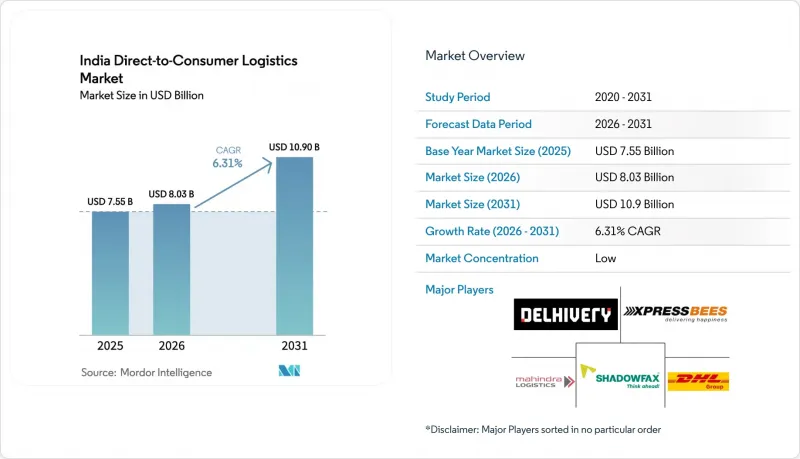
據 Mordor Intelligence 稱,2025 年印度 D2C(直接面對消費者)物流市場價值 75.5 億美元,預計將從 2026 年的 80.3 億美元成長到 2031 年的 109 億美元。
預測期(2026-2031 年)的複合年成長率預計為 6.31%。
本報告按服務類型(運輸、倉儲、附加價值服務)、最終用戶(時尚生活、消費性電子產品、快速消費品、家居用品、其他)、配送速度(當日達、隔日達、標準配送)和分銷管道(線上、線下)進行分類。市場預測以美元計價。
印度D2C(直接面對消費者)物流市場的趨勢與洞察
電子商務的蓬勃發展和數位基礎設施的快速成長
2024年電子商務支付量成長了23.8%,加速了小包裹湧入物流網路的速度。物流業者正透過自動化分類流程來應對這項挑戰,目前主要整合商已營運20個分類中心,每日處理小包裹量達150萬件。政府支持的ULIP(聯合陸地資訊平台)將海關、港口和公路資料庫整合到一個統一的介面中,減少了行政工作量並實現了即時追蹤。人工智慧的應用也迅速擴展;一個日常消費品(FMCG)托運人在實施預測性路線規劃工具後,人工干預減少了80%。這些進步共同作用,正在降低錯誤率,縮短運輸時間,並提升印度D2C(直接面對消費者)物流市場的客戶服務水準。
快速電商物流的興起,只需不到 10 分鐘履約。
僅用29個月時間,速購平台年銷售額就成長至12億美元,顯示消費者對衝動消費的快速配送需求強勁。儘管營運商擴大了其「暗店」(dark store)的營運規模,但同時也面臨日益成長的資金消耗。一家大型公司在2024會計年度投入了57.47億印度盧比(約6.72億美元),但僅創造了44.54億印度盧比(約5.2億美元)的收入,利潤率極低。人口密集的大都會圈地區貢獻了高達85%的訂單,而較小的城市僅貢獻了15-17%,每筆訂單的配送成本很高。由於市政規劃法規限制了「暗店」的密度,各公司正在重新審視其產品線,並利用人工智慧技術將揀貨流程縮短至15分鐘以內。儘管面臨這些挑戰,但由於未來規模經濟效益已被納入估值考量,投資者信心依然強勁。
大型電子商務公司和第三方物流公司之間的過度競爭
由於大型電商平台利用規模經濟優勢,將運費降至每小包裹包裹低於10印度盧比(約0.11美元),激進的降價策略正在擠壓整個履約行業的利潤空間。產業整合正在進行中,一項價值140.7億印度盧比(約1.645億美元)的收購要約便是明證,這表明產業正朝著透過提高密度來降低成本的方向發展。 QuickCommerce應用程式即使在提高費用後,其季度EBITDA虧損仍超過1億印度盧比(約合1,170萬美元),累計了單位盈利的極度困境。因此,小型宅配業者正將重點轉向高價值電子產品和醫療保健等細分領域,以維持獲利能力。競爭委員會正在監控合作關係,以防止形成壟斷性的配送路線,但由於短期供應過剩,現貨價格仍在持續波動。
細分市場分析
到2025年,運輸服務在印度D2C(直接面對消費者)物流市場中佔據47.35%的佔有率。快遞小包裹列車、電動車隊和自動化分類機的組合顯著縮短了前置作業時間,並鞏固了托運人的忠誠度。預計到2025年,印度D2C物流市場的運輸領域規模將達到35.8億美元,模組化車隊的擴張和動態路線規劃預計將帶來穩定成長。同時,儘管規模較小,但受逆向物流、安裝服務和即時視覺化儀錶板等綜合服務需求的推動,預計2026年至2031年間,附加價值服務將以4.82%的複合年成長率成長。
倉儲營運正向更靠近消費點的微型樞紐演進。這些微型樞紐通常以面積不到3000平方英尺的「暗倉」形式運營,訂單可在10分鐘內完成,而人工智慧驅動的庫存管理系統則能有效減少缺貨情況。對食品安全、溫度控制和資料隱私等相關法規的遵守,正推動企業對認證設施的投資。整合服務包將城際幹線運輸、市內配送和貨運代理服務融為一體,進一步模糊了印度D2C(直接面對消費者)物流市場中傳統的部門界線。
到2025年,時尚和生活方式產業將佔印度D2C(直接面對消費者)物流市場規模的31.45%,預計從2026年到2031年將以4.55%的複合年成長率成長,這主要得益於全通路策略的發展,帶動了季節性銷售高峰的增加。為了滿足衝動型消費的需求,快時尚平台正在試行兩小時內送達高階服飾的服務。各大品牌也不斷拓展銷售管道。例如,某女用貼身內衣品牌2024年28%的銷售額來自二、三線城市,主要得益於其特許經營及D2C平台。隨著消費者對退貨管理和尺寸更換服務的需求不斷成長,附加價值服務的推出也穩步推進。
消費性電子產品市場依然龐大,因此對高價商品採用保險和防篡改包裝至關重要。日常消費品(FMCG) 品類在快速零售通路中實現了三位數成長,這主要得益於冷藏物流中心和持續補貨演算法的普及應用。家居用品和室內裝飾用品則充分利用了耐用包裝技術和指定送貨上門系統的創新。各品類的合規要求持續多元化,印度標準局 (BIS) 的標準、強制性電池回收以及食品安全法規等都對操作手冊的製定產生了影響。
其他好處:
- Excel格式的市場預測(ME)表
- 3個月的分析師支持
目錄
第1章:引言
- 研究假設和市場定義
- 調查範圍
第2章:調查方法
第3章執行摘要
第4章 市場狀況
- 市場概覽
- 市場促進因素
- 電子商務的蓬勃發展和數位基礎設施的快速成長
- 10分鐘內快速送達的商業配送興起
- 透過全通路模式拓展至二、三線城市
- 國家物流政策與國家物流發展中心(ONDC)的引入
- 「Vande Barat」小包裹列車用於D2C快捷郵件配送
- 引進電動車和摩托車計程車將降低最後一公里出行成本和二氧化碳排放。
- 市場限制因素
- 大型電子商務企業和第三方物流公司之間的過度競爭
- 基礎設施瓶頸和供應鏈中斷
- 快速零售單位經濟效益所面臨的壓力/暗店的風險
- 零工經濟勞動力監管方面的不確定性
- 電子商務產業展望
- 價值供應鏈分析
- 監理情勢
- 技術展望
- 新冠疫情與地緣政治事件的影響
- 波特五力模型
第5章 市場規模與成長預測
- 按服務類型
- 運輸
- 倉庫/存儲
- 附加價值服務
- 最終用戶
- 時尚與生活風格
- 家用電子產品
- FMCG
- 家居與室內設計
- 其他
- 按配送速度
- 當日送達(24小時內)
- 隔日送達
- 標準
- 透過分銷管道
- 線上
- 離線
第6章 競爭情勢
- 市場集中度
- 策略趨勢
- 市佔率分析
- 公司簡介
- Delhivery
- DHL
- XpressBees
- Shadowfax
- Mahindra Logistics Ltd.
- Pickrr
- Shipyaari
- Shipway
- FedEx
- Gati Ltd(Subsidiary of Allcargo Logistics Ltd)
- Unicommerce
- Zippee
- Shiprocket
- EZ Logistics
- QuickShift
- Eshopbox
- NimbusPost
- Porter
- Emiza
- Loadshare Networks
第7章 市場機會與未來展望
According to Mordor Intelligence, the India direct-to-Consumer logistics market size was valued at USD 7.55 billion in 2025 and estimated to grow from USD 8.03 billion in 2026 to reach USD 10.9 billion by 2031, at a CAGR of 6.31% during the forecast period (2026-2031).
This report is Segmented by Service Type (Transportation, Warehousing and Storage, and Value-Added Services), End User (Fashion & Lifestyle, Consumer Electronics, FMCG, Home & Decor, and Others), Delivery Speed (Same-Day, Next-Day, and Standard), Distribution Channel (Online and Offline). The Market Forecasts are Provided in Terms of Value (USD).
India Direct-to-Consumer Logistics Market Trends and Insights
Surge in E-Commerce & Digital Infrastructure Boom
E-commerce payments grew 23.8% in 2024, accelerating volume inflows into parcel networks. Logistics operators responded by automating sortation; a major integrator now runs 20 such centers and handles 1.5 million parcels daily. Government-backed ULIP knits customs, port, and road databases into a single interface, trimming paperwork and enabling real-time track-and-trace. AI adoption spreads quickly: one FMCG shipper cut manual interventions by 80% after deploying predictive routing tools. Collectively, these advances lower error rates, shorten transit windows, and raise customer service benchmarks across the India direct-to-consumer logistics market.
Rise of 10-Minute Quick-Commerce Fulfillment
Quick-commerce platforms scaled annualized sales to USD 1.2 billion within 29 months, validating consumer appetite for impulse delivery. Operators expanded dark-store footprints but face mounting cash burn; a leading player spent INR 5,747 crore (USD 672 million) to earn INR 4,454 crore (USD 520 million) in FY 24, underscoring thin margins. Dense metro clusters deliver up to 85% of orders, whereas smaller cities add only 15-17% yet incur a higher cost per drop. Municipal zoning curbs dark-store density, prompting firms to refine merchandise assortments and leverage AI for sub-15-minute picking routines. Despite hurdles, investor confidence stays firm as valuations factor in eventual scale economies.
Hyper-Competitive Pricing from E-Tail Majors & 3PLs
Aggressive discounting compresses margins across fulfilment lanes as leading marketplaces leverage scale to negotiate sub-INR 10 per-parcel rates (USD 0.11 per parcel). Consolidation, highlighted by an INR 1,407 crore (USD 164.5 million) acquisition filing, signals the hunt for density-driven cost dilution. Quick-commerce apps post quarterly EBITDA losses exceeding INR 100 crore (USD 11.7 million) even after fee hikes, underscoring razor-thin unit economics. Smaller couriers, therefore, pivot toward niche verticals such as high-value electronics and healthcare to defend yields. The Competition Commission monitors tie-ups to avert monopolistic routing, yet near-term oversupply keeps spot rates volatile.
Other drivers and restraints analyzed in the detailed report include:
- Expansion into Tier-2/3 Cities via Omni-Channel Models
- National Logistics Policy & ONDC Enablement
- Quick-Commerce Unit-Economics Pressure/Dark-Store Risk
For complete list of drivers and restraints, kindly check the Table Of Contents.
Segment Analysis
Transportation services controlled 47.35% of the India direct-to-consumer logistics market share in 2025. Express parcel trains, EV fleets, and automated sorters combine to slash lead times, anchoring shipper loyalty. The India direct-to-consumer logistics market size for transportation stood at USD 3.58 billion in 2025 and is forecast to post steady gains through modular fleet expansion and dynamic routing. In parallel, value-added services, though smaller, are expected to post a 4.82% CAGR (2026-2031) on the back of high-touch needs such as reverse logistics, installation, and real-time visibility dashboards.
Warehouse and storage activities evolve toward micro-hubs near consumption centers. Dark-store nodes, many under 3,000 sq ft, facilitate 10-minute fulfilment, while AI-powered inventory systems reduce stock-outs. Regulatory compliance around food safety, temperature control, and data privacy drives investment in certified facilities. Integrated service bundles now blend intercity line-haul, intra-city distribution, and freight-forwarding, further blurring traditional silos in the India direct-to-consumer logistics market.
Fashion & lifestyle generated 31.45% of the India direct-to-consumer logistics market size in 2025, rising at a 4.55% CAGR (2026-2031) as omnichannel launches multiply seasonal drops. Quick-commerce platforms pilot premium apparel delivery within two hours, catering to impulse purchases. Brands broaden reach: one lingerie specialist derived 28% of 2024 sales from Tier-II/III towns via franchise roll-outs and D2C portals. Demand for returns management and size-exchange cycles reinforces value-added service uptake.
Consumer electronics remain sizeable due to high-value ticket sizes that justify insured, tamper-proof packaging. FMCG categories show triple-digit growth on quick-commerce rails, pushing for chilled chain nodes and continuous replenishment algorithms. Home & decor items leverage durable packaging innovations and room-of-choice delivery set-ups. Category compliance continues to diversify, with Bureau of Indian Standards codes, battery recycling mandates, and food safety rules shaping operating playbooks.
Complete Report Scope:
- By Service Type
- Transportation
- Warehousing and Storage
- Value-added Services
- By End User
- Fashion & Lifestyle
- Consumer Electronics
- FMCG
- Home & Decor
- Others
- By Delivery Speed
- Same-Day (Within 24 h)
- Next-Day
- Standard
- By Distribution Channel
- Online
- Offline
List of Companies Covered in this Report:
- Delhivery
- DHL
- XpressBees
- Shadowfax
- Mahindra Logistics Ltd.
- Pickrr
- Shipyaari
- Shipway
- FedEx
- Gati Ltd (Subsidiary of Allcargo Logistics Ltd)
- Unicommerce
- Zippee
- Shiprocket
- EZ Logistics
- QuickShift
- Eshopbox
- NimbusPost
- Porter
- Emiza
- Loadshare Networks
Additional Benefits:
- The market estimate (ME) sheet in Excel format
- 3 months of analyst support
TABLE OF CONTENTS
1 Introduction
- 1.1 Study Assumptions & Market Definition
- 1.2 Scope of the Study
2 Research Methodology
3 Executive Summary
4 Market Landscape
- 4.1 Market Overview
- 4.2 Market Drivers
- 4.2.1 Surge in e-commerce & digital infrastructure boom
- 4.2.2 Rise of 10-minute quick-commerce fulfillment
- 4.2.3 Expansion into Tier-2/3 cities via omni-channel models
- 4.2.4 National Logistics Policy & ONDC enablement
- 4.2.5 Vande Bharat parcel trains for express D2C shipping
- 4.2.6 EV/bike-taxi adoption lowering last-mile cost & CO2
- 4.3 Market Restraints
- 4.3.1 Hyper-competitive pricing from e-tail majors & 3PLs
- 4.3.2 Infrastructure bottlenecks & supply-chain disruption
- 4.3.3 Quick-commerce unit-economics pressure/dark-store risk
- 4.3.4 Regulatory uncertainty over gig-economy workforce
- 4.4 E-commerce Industry Outlook
- 4.5 Value / Supply-Chain Analysis
- 4.6 Regulatory Landscape
- 4.7 Technological Outlook
- 4.8 Impact of COVID-19 and Geo-Political Events
- 4.9 Porter's Five Forces
- 4.9.1 Bargaining Power of Suppliers
- 4.9.2 Bargaining Power of Buyers
- 4.9.3 Threat of New Entrants
- 4.9.4 Threat of Substitutes
- 4.9.5 Intensity of Competitive Rivalry
5 Market Size & Growth Forecasts
- 5.1 By Service Type
- 5.1.1 Transportation
- 5.1.2 Warehousing and Storage
- 5.1.3 Value-added Services
- 5.2 By End User
- 5.2.1 Fashion & Lifestyle
- 5.2.2 Consumer Electronics
- 5.2.3 FMCG
- 5.2.4 Home & Decor
- 5.2.5 Others
- 5.3 By Delivery Speed
- 5.3.1 Same-Day (Within 24 h)
- 5.3.2 Next-Day
- 5.3.3 Standard
- 5.4 By Distribution Channel
- 5.4.1 Online
- 5.4.2 Offline
6 Competitive Landscape
- 6.1 Market Concentration
- 6.2 Strategic Moves
- 6.3 Market Share Analysis
- 6.4 Company Profiles (includes Global level Overview, Market level overview, Core Segments, Financials as available, Strategic Information, Market Rank/Share for key companies, Products & Services, and Recent Developments)
- 6.4.1 Delhivery
- 6.4.2 DHL
- 6.4.3 XpressBees
- 6.4.4 Shadowfax
- 6.4.5 Mahindra Logistics Ltd.
- 6.4.6 Pickrr
- 6.4.7 Shipyaari
- 6.4.8 Shipway
- 6.4.9 FedEx
- 6.4.10 Gati Ltd (Subsidiary of Allcargo Logistics Ltd)
- 6.4.11 Unicommerce
- 6.4.12 Zippee
- 6.4.13 Shiprocket
- 6.4.14 EZ Logistics
- 6.4.15 QuickShift
- 6.4.16 Eshopbox
- 6.4.17 NimbusPost
- 6.4.18 Porter
- 6.4.19 Emiza
- 6.4.20 Loadshare Networks
7 Market Opportunities & Future Outlook
- 7.1 White-space & Unmet-need Assessment

 新加坡最後一公里配送:市佔率分析、產業趨勢與統計及成長預測(2026-2031)德國最後一公里配送:市場佔有率分析、產業趨勢與統計及成長預測(2026-2031 年)歐洲電子商務最後一公里配送:市場佔有率分析、產業趨勢與統計及成長預測(2026-2031 年)印度電子商務最後一公里配送:市場佔有率分析、產業趨勢與統計及成長預測(2026-2031)
 全球末端配送車輛市場預測(至2034年)-按車輛類型、動力系統、有效載荷能力、自動化程度、所有權、應用、最終用戶、銷售管道、分銷管道和地區分類的分析美國電子商務最後一公里配送:市場佔有率分析、產業趨勢與統計、成長預測(2026-2031)美國醫療小包裹最後一公里配送:市場佔有率分析、產業趨勢與統計及成長預測(2026-2031 年)英國醫療小包裹最後一公里配送:市場佔有率分析、產業趨勢與統計及成長預測(2026-2031 年)
 自主最後一公里配送市場-2026-2032年全球市場預測食品低溫運輸最後一公里配送市場:全球市場預測(2026-2032 年)