


 |
市場調查報告書
商品編碼
2119146
歐洲電子商務最後一公里配送:市場佔有率分析、產業趨勢與統計及成長預測(2026-2031 年)Europe E-Commerce Last-Mile Delivery - Market Share Analysis, Industry Trends & Statistics, Growth Forecasts (2026 - 2031) |
||||||

※ 本網頁內容可能與最新版本有所差異。詳細情況請與我們聯繫。
據 Mordor Intelligence 稱,2025 年歐洲電子商務最後一公里配送市場價值為 309.3 億美元,預計 2026 年將達到 335.7 億美元,到 2031 年將達到 496.5 億美元,2026 年至 2031 年的複合年成長率為 8.14%。
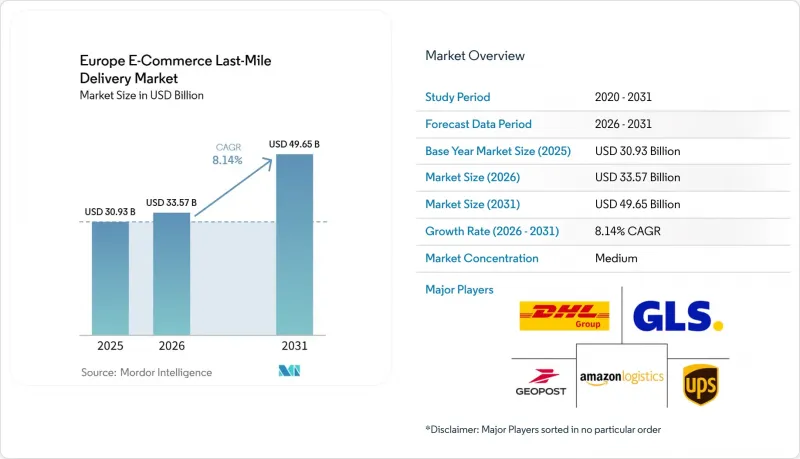
歐洲電商最後一公里配送市場正向融合宅配配送服務、包裹櫃、自提點和區域配送中心的網路模式轉型。本報告按配送類型(標準配送、當日達、次日達)、配送模式(B2C、B2B、C2C)、城市等級(一線城市、二線城市及其他)、產品類型(食品飲料、消費電子產品及其他)和國家/地區(英國、德國、法國、西班牙、義大利、比利時、荷蘭、北歐國家及其他)進行細分。市場預測以美元計價。
歐洲電子商務最後一公里配送市場的趨勢與洞察
不斷擴大的電子商務小包裹密度
小包裹密度的提高使得每條路線上的配送目的地數量增加,從而改善了歐洲電商最後一公里配送市場的經濟效益。零售商也越來越重視配送績效,因為配送失敗和延誤會影響顧客轉換率和再購率。歐洲首次配送成功率從2025年第一季的82.1%上升至第二季的86.4%。同期,準時送達率維持在98%以上。擁有密集網路的承運商可以利用這些營運效率的提升來提高服務可靠性,而無需相應增加人事費用。這項優勢也推動了大都會圈以外地區自提點和儲物櫃網路的投資。
擴大戶外配送和儲物櫃網路
在歐洲電子商務領域,便利的自提點取貨正成為最後一公里配送市場的核心要素,因為它能夠將包裹集中到易於取用的取貨點。預計到2025年,Geopost將在歐洲營運超過15萬個取貨點,其中包括5萬個儲物櫃,屆時便捷自提點的包裹量將成長31%。 InPost在2025年完成了14億小包裹的遞送,並新增了14200台自助小包裹取件機,使其歐洲自提櫃網路覆蓋範圍達到61196個。 GLS在24個月內將其取貨點網路從7萬個擴展到13萬個,並設定了2030年擁有3萬個自有儲物櫃的目標。 DPD德國和GLS於2026年3月推出了「inbox」共用網路,目標是在2027年底前建立2萬個共用點。共用網路既可以提高消費者的便利性,又可以減輕單一承運商的基礎設施負擔。
在最後一公里運輸環節,如何保障和留住勞工面臨挑戰
由於最後一公里配送服務依賴可靠的司機,因此,勞動力短缺仍然是歐洲電商最後一公里配送市場的阻礙因素。國際道路運輸聯盟(IRU)的報告顯示,到2025年,歐洲將有50.2萬個卡車駕駛人職位空缺,缺口高達13%。此外,預計到2030年將有66萬名司機退休。人手不足導致配送業者的招募、培訓和加班成本增加,也使得承運商難以在季節性高峰期提升服務能力。雖然儲物櫃、路線規劃工具和靈活的配送模式可以減少上門配送的數量,但並不能取代對訓練有素人員的需求。
細分市場分析
2025年,標準配送將佔歐洲電商最後一公里配送市場的56%。這反映出,即使有更快捷的配送方式,消費者仍優先考慮配送成本。標準配送為零售商提供了一種低成本的日常訂單解決方案,並允許承運商整合配送路線。此外,標準配送擴大與自提櫃和取貨點相結合,而非僅僅送貨上門。這種轉變可望提高首次送達成功率,並降低未送達商品所帶來的成本。次日達在價格和速度方面都介於標準配送和當日達之間。
預計到2031年,當日達服務將以11.59%的複合年成長率成長,成為歐洲電商最後一公里配送市場成長最快的配送方式。在距離較短、本地庫存充足的大都會圈,當日達服務最為可行。零售商通常使用這項服務來配送食品、日用品、時尚服飾和電子產品等緊急訂單。這種模式需要一定的區域履約能力才能達到高效率的配送水準。因此,當日達服務在人口密集的都市區以外可能仍將受到限制。企業可以透過提供付費的當日達服務選項,同時保持標準配送服務的廣泛覆蓋,來維持利潤率。
到2025年,B2C模式將佔歐洲電商最後一公里配送市場規模的47.96%。零售電商、生鮮履約和D2C(直接面對消費者)品牌仍將是該模式下小包裹量最大的領域。 Geopost報告稱,到2025年,歐洲五大主要市場的B2C包裹量將成長9%。 B2C配送需結合送貨上門、自提櫃和宅配門市服務以及退貨服務。零售商受益於配送公司在結帳時提供的可靠配送選項。因此,消費者配送仍是國內小包裹網路的核心業務量來源。
預計到2031年,C2C(消費者對消費者)領域將以14.26%的複合年成長率成長。二手商品平台和點對點(P2P)轉售管道的日益普及是推動該領域成長的主要因素。德國KEP在2026年進行的調查顯示,C2C是最具長期發展潛力的領域。這些小包裹體積相對較小,適合投遞到儲物櫃或自提點。這項特點與承運商正在建置的B2C配送網路相契合。 2025年,InPost收購了英國的Yodel和西班牙的Sending,在其儲物櫃網路的基礎上,進一步拓展了門到門配送能力。同時處理寄出和退回(逆向物流)服務的承運商能夠更有效地服務於轉售平台。
其他好處:
- Excel格式的市場預測(ME)表
- 3個月的分析師支持
目錄
第1章:引言
- 研究假設和市場定義
- 調查範圍
第2章:調查方法
第3章執行摘要
第4章 市場狀況
- 市場概況及最後一公里配送在電子商務物流的作用
- 電子商務消費趨勢
- 市場促進因素
- 透過電子商務擴大小包裹處理量
- 擴大商店取貨和儲物櫃網路
- 當日達/隔日達服務的滲透率
- 都市區送貨車輛的電氣化
- 對即時路線最佳化和可見性的期望
- 跨境市場履約的複雜性
- 市場限制因素
- 在最後一公里運輸環節,如何保障和留住勞工面臨挑戰
- 進入都市區的限制以及遵守低排放區規定的成本。
- 農村人口密度對零排放交付經濟的影響
- 包裝、退貨和逆向物流。
- 法律規範
- 價值鍊和分銷管道的結構分析
- 技術創新前景
- 波特五力分析
- 電子商務中最後一公里配送需求的演變
- 定價和成本結構分析
- 分析消費者行為與配送偏好
- 永續交付解決方案和綠色物流舉措
- 地緣政治事件對供應鏈變化的影響
第5章 市場規模及成長預測(價值,2026-2031 年)
- 按配送類型
- 標準配送
- 當日送達
- 隔日送達
- 按型號提供
- BtoC(Business-to-Consumer)
- 企業對企業 (B2B) 交易
- 個人對個人(C2C)交易
- 城市層級
- 一級
- 二級
- 三級及以下
- 依產品類型
- 食品/飲料
- 個人護理和居家護理
- 時尚與生活方式(配件、服裝、鞋履)
- 家具
- 家用電子電器和電器產品
- 其他產品
- 國家
- 英國
- 德國
- 法國
- 西班牙
- 義大利
- 比利時
- 荷蘭
- 北歐國家(丹麥、芬蘭、冰島、挪威、瑞典)
- 其他歐洲國家
第6章 競爭情勢
- 市場集中度
- 關鍵策略趨勢
- 市佔率分析
- 公司簡介
- DHL Group
- GLS Group
- Amazon Logistics
- United Parcel Service, Inc.
- FedEx
- InPost
- La Poste Group
- Correos Group
- PostNL
- Poste Italiane
- Geopost(DPDgroup Parent)
- Evri
- PostNord
- Bnode
- Bring
- Swiss Post Ltd.
- Cainiao
- Colis Prive
第7章 市場機會與未來展望
According to Mordor Intelligence, the Europe e-commerce last-mile delivery market was valued at USD 30.93 billion in 2025 and is expected to reach USD 33.57 billion in 2026 and USD 49.65 billion by 2031, registering a CAGR of 8.14% between 2026 and 2031.
The Europe e-commerce last-mile delivery market is moving toward networks that combine doorstep services with parcel lockers, pickup points, and local delivery hubs. This report is Segmented by Delivery Type (Standard, Same-Day, Next-Day), by Delivery Model (B2C, B2B, C2C), by City Tier (Tier 1, Tier 2, and More), by Product Type (Foods and Beverages, Consumer Electronics, Other Products), and by Country (United Kingdom, Germany, France, Spain, Italy, Belgium, Netherlands, Nordics, Rest of Europe). The Market Forecasts are Provided in Terms of Value (USD).
Europe E-Commerce Last-Mile Delivery Market Trends and Insights
E-Commerce Parcel Density Expansion
Parcel density is improving the economics of the Europe e-commerce last-mile delivery market because carriers can serve more addresses on each route. Retailers are also placing greater value on delivery performance because failed or delayed deliveries can affect customer conversion and repeat orders. First-attempt delivery success in Europe rose from 82.1% in the first quarter of 2025 to 86.4% in the second quarter. On-time delivery remained above 98% during the same period. Carriers with dense networks can use these operating gains to improve service reliability without incurring proportional labor costs. The same advantage is encouraging investment in pickup and locker coverage outside the largest cities.
Out-of-Home Pickup and Locker Network Expansion
Out-of-home delivery is becoming a central part of the Europe e-commerce last-mile delivery market because it consolidates deliveries at accessible collection points. Geopost operated more than 150,000 pickup points, including 50,000 lockers, across Europe in 2025, and its out-of-home volumes rose 31%. InPost delivered 1.4 billion parcels in 2025 and added 14,200 automated parcel machines, bringing its European network to 61,196 lockers. GLS expanded its network from 70,000 to 130,000 out-of-home points in 24 months and set a target of 30,000 owned lockers by 2030. DPD Germany and GLS launched the inbox shared network in March 2026, aiming to reach 20,000 shared points by the end of 2027. Shared networks can widen consumer access while lowering the infrastructure burden on each carrier.
Last-Mile Labor Availability and Driver Retention Pressure
Labor availability remains a restraint on the Europe e-commerce last-mile delivery market because final-mile service depends on reliable driver coverage. The IRU reported 502,000 unfilled truck driver positions across Europe in 2025, equal to a 13% shortage rate. It also stated that 660,000 drivers are expected to retire by 2030. Shortages can increase recruitment, training, and overtime costs for delivery operators. They also make it harder for carriers to add service capacity during seasonal peaks. Lockers, route-planning tools, and flexible delivery models can reduce the number of doorstep stops, but they do not eliminate the need for trained personnel.
Other drivers and restraints analyzed in the detailed report include:
- Same-Day and Next-Day Service Penetration
- Electrification of Urban Delivery Fleets
- Urban Access Constraints and Low-Emission Zone Compliance Costs
For complete list of drivers and restraints, kindly check the Table Of Contents.
Segment Analysis
Standard delivery held 56% of the Europe e-commerce last-mile delivery market share in 2025. Its position reflects continued consumer attention to delivery charges, even where faster options are available. Standard services give retailers a lower-cost option for routine orders and allow carriers to consolidate routes. They are also increasingly linked to lockers and pickup points rather than doorstep delivery. This change can improve first-attempt delivery performance and reduce missed delivery costs. Next-day delivery sits between standard and same-day services in both price and urgency.
Same-day delivery is forecast to grow at an 11.59% CAGR through 2031, making it the fastest-growing delivery type in the Europe e-commerce last-mile delivery market. It is most viable in large cities, where short travel distances and local stock support frequent dispatches. Retailers use it most often for urgent orders for food, household, fashion, and electronics. The model requires local fulfillment capacity before volume can reach an efficient level. As a result, same-day delivery is likely to remain selective outside dense urban areas. Operators can protect margins by offering it as a paid option while keeping standard delivery broadly available.
B2C accounted for 47.96% of the Europe e-commerce last-mile delivery market size in 2025. Retail e-commerce, grocery fulfillment, and direct-to-consumer brands continue to create the largest parcel flows in this model. Geopost reported 9% B2C volume growth in 2025 across its 5 major European markets. B2C delivery requires a mix of doorstep, locker, and parcel-shop services, as well as return services. Retailers benefit when carriers provide reliable delivery choices at checkout. This keeps consumer delivery the core volume base for national parcel networks.
C2C is forecast to grow at a 14.26% CAGR through 2031. Second-hand platforms and the wider use of peer-to-peer resale channels support the segment. Germany's 2026 KEP study identified C2C as the segment with the greatest longer-term potential. These parcels are often smaller and well-suited to locker or pickup-point delivery. That profile fits the networks carriers are building for B2C delivery. InPost's 2025 acquisitions of Yodel in the United Kingdom and Sending in Spain expanded its doorstep capabilities alongside its locker base. Carriers that handle both outbound and reverse flows can serve resale platforms more effectively.
Complete Report Scope:
- By Delivery Type
- Standard Delivery
- Same-Day Delivery
- Next-Day Delivery
- By Delivery Model
- Business-to-Consumer (B2C)
- Business-to-Business (B2B)
- Consumer-to-Consumer (C2C)
- By City Tier
- Tier 1
- Tier 2
- Tier 3 and Below
- By Product Type
- Foods and Beverages
- Personal and Household Care
- Fashion and Lifestyle (accessories, apparel, footwear)
- Furniture
- Consumer Electronics and Household Appliances
- Other Products
- By Country
- United Kingdom
- Germany
- France
- Spain
- Italy
- Belgium
- Netherlands
- NORDICS (Denmark, Finland, Iceland, Norway, and Sweden)
- Rest of Europe
List of Companies Covered in this Report:
- DHL Group
- GLS Group
- Amazon Logistics
- United Parcel Service, Inc.
- FedEx
- InPost
- La Poste Group
- Correos Group
- PostNL
- Poste Italiane
- Geopost (DPDgroup Parent)
- Evri
- PostNord
- Bnode
- Bring
- Swiss Post Ltd.
- Cainiao
- Colis Prive
Additional Benefits:
- The market estimate (ME) sheet in Excel format
- 3 months of analyst support
TABLE OF CONTENTS
1 Introduction
- 1.1 Study Assumptions and Market Definition
- 1.2 Scope of the Study
2 Research Methodology
3 Executive Summary
4 Market Landscape
- 4.1 Market Overview and Role of Last-Mile Delivery in E-Commerce Logistics
- 4.2 E-Commerce Spending Trends
- 4.3 Market Drivers
- 4.3.1 E-Commerce Parcel Density Expansion
- 4.3.2 Out-of-Home Pickup and Locker Network Expansion
- 4.3.3 Same-Day and Next-Day Service Penetration
- 4.3.4 Electrification of Urban Delivery Fleets
- 4.3.5 Real-Time Route Optimization and Visibility Expectations
- 4.3.6 Cross-Border Marketplace Fulfillment Complexity
- 4.4 Market Restraints
- 4.4.1 Last-Mile Labor Availability and Driver Retention Pressure
- 4.4.2 Urban Access Constraints and Low-Emission Zone Compliance Costs
- 4.4.3 Rural Density Penalties for Zero-Emission Delivery Economics
- 4.4.4 Packaging, Returns, and Reverse-Logistics Cost Inflation
- 4.5 Regulatory Framework
- 4.6 Value Chain and Distribution Channel Architecture Analysis
- 4.7 Technology Innovations Outlook
- 4.8 Porter's Five Forces Analysis
- 4.8.1 Threat of New Entrants
- 4.8.2 Bargaining Power of Suppliers
- 4.8.3 Bargaining Power of Buyers
- 4.8.4 Threat of Substitutes
- 4.8.5 Rivalry Among Competitors
- 4.9 Evolution of E-Commerce Last-Mile Delivery Requirements
- 4.10 Pricing and Cost Structure Analysis
- 4.11 Consumer Behavior and Delivery Preferences Analysis
- 4.12 Sustainable Delivery Solutions and Green Logistics Initiatives
- 4.13 Impact of Geo-Political Events on Supply Chain Shifts
5 Market Size and Growth Forecasts (Value, 2026-2031)
- 5.1 By Delivery Type
- 5.1.1 Standard Delivery
- 5.1.2 Same-Day Delivery
- 5.1.3 Next-Day Delivery
- 5.2 By Delivery Model
- 5.2.1 Business-to-Consumer (B2C)
- 5.2.2 Business-to-Business (B2B)
- 5.2.3 Consumer-to-Consumer (C2C)
- 5.3 By City Tier
- 5.3.1 Tier 1
- 5.3.2 Tier 2
- 5.3.3 Tier 3 and Below
- 5.4 By Product Type
- 5.4.1 Foods and Beverages
- 5.4.2 Personal and Household Care
- 5.4.3 Fashion and Lifestyle (accessories, apparel, footwear)
- 5.4.4 Furniture
- 5.4.5 Consumer Electronics and Household Appliances
- 5.4.6 Other Products
- 5.5 By Country
- 5.5.1 United Kingdom
- 5.5.2 Germany
- 5.5.3 France
- 5.5.4 Spain
- 5.5.5 Italy
- 5.5.6 Belgium
- 5.5.7 Netherlands
- 5.5.8 NORDICS (Denmark, Finland, Iceland, Norway, and Sweden)
- 5.5.9 Rest of Europe
6 Competitive Landscape
- 6.1 Market Concentration
- 6.2 Key Strategic Moves
- 6.3 Market Share Analysis
- 6.4 Company Profiles (includes Global level Overview, Market level overview, Core Segments, Financials as available, Strategic Information, Market Rank/Share for key companies, Products & Services, and Recent Developments)
- 6.4.1 DHL Group
- 6.4.2 GLS Group
- 6.4.3 Amazon Logistics
- 6.4.4 United Parcel Service, Inc.
- 6.4.5 FedEx
- 6.4.6 InPost
- 6.4.7 La Poste Group
- 6.4.8 Correos Group
- 6.4.9 PostNL
- 6.4.10 Poste Italiane
- 6.4.11 Geopost (DPDgroup Parent)
- 6.4.12 Evri
- 6.4.13 PostNord
- 6.4.14 Bnode
- 6.4.15 Bring
- 6.4.16 Swiss Post Ltd.
- 6.4.17 Cainiao
- 6.4.18 Colis Prive
7 Market Opportunities and Future Outlook
- 7.1 White-space and Unmet-Need Assessment

 新加坡最後一公里配送:市佔率分析、產業趨勢與統計及成長預測(2026-2031)印度D2C(直接面對消費者)物流:市場佔有率分析、行業趨勢和統計數據以及成長預測(2026-2031年)德國最後一公里配送:市場佔有率分析、產業趨勢與統計及成長預測(2026-2031 年)印度電子商務最後一公里配送:市場佔有率分析、產業趨勢與統計及成長預測(2026-2031)
 全球末端配送車輛市場預測(至2034年)-按車輛類型、動力系統、有效載荷能力、自動化程度、所有權、應用、最終用戶、銷售管道、分銷管道和地區分類的分析美國電子商務最後一公里配送:市場佔有率分析、產業趨勢與統計、成長預測(2026-2031)美國醫療小包裹最後一公里配送:市場佔有率分析、產業趨勢與統計及成長預測(2026-2031 年)英國醫療小包裹最後一公里配送:市場佔有率分析、產業趨勢與統計及成長預測(2026-2031 年)
 自主最後一公里配送市場-2026-2032年全球市場預測食品低溫運輸最後一公里配送市場:全球市場預測(2026-2032 年)