


 |
市場調查報告書
商品編碼
2119053
印度電子商務最後一公里配送:市場佔有率分析、產業趨勢與統計及成長預測(2026-2031)India E-Commerce Last-Mile Delivery - Market Share Analysis, Industry Trends & Statistics, Growth Forecasts (2026 - 2031) |
||||||

※ 本網頁內容可能與最新版本有所差異。詳細情況請與我們聯繫。
據 Mordor Intelligence 稱,2025 年印度電子商務最後一公里配送市場價值為 31.5 億美元,預計到 2031 年將達到 75.7 億美元,而 2026 年為 36.6 億美元,2026 年至 2031 年預測期內的複合年成長率為 15.63%。
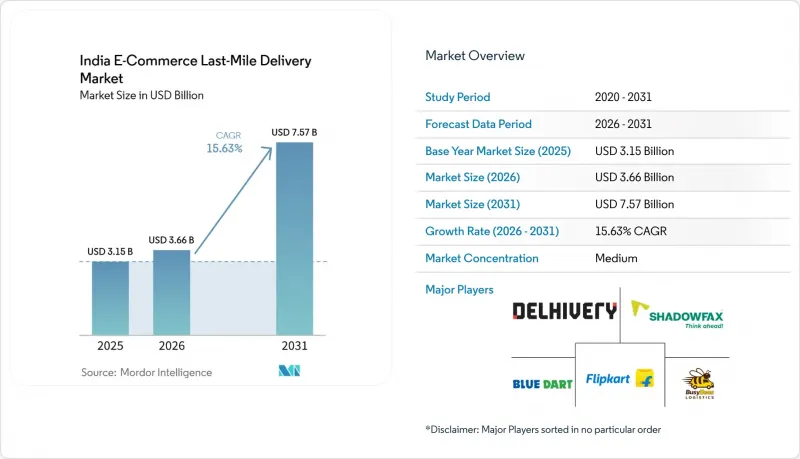
在主要大都會圈以外地區訂單密度不斷成長的推動下,印度的末端電商配送市場正在擴張。配送服務商正在擴大其在中小城市的配送範圍,提高配送速度,並打造更永續的配送路線經濟模式。本報告按配送類型(標準配送、當日達、隔日達)、配送模式(B2C、B2B、C2C)、城市等級(一線、二線、三線及以下)、產品類型(食品飲料、個人護理及家居用品、時尚生活用品、家具及其他)及地區(家具、中部、西部、東北部、南部)進行細分。市場預測以美元計價。
印度電子商務最後一公里配送市場的趨勢與洞察。
二、三線城市電子商務訂單密度快速成長
在印度的電商末端配送市場,大都會圈以外的需求已不再是次要因素,因為這些城市正在塑造小包裹量成長的下一階段。 2026會計年度,二線和三線城市貢獻了66%的新增D2C訂單,並貢獻了60%的GMV成長(與2025會計年度相比)。這表明,新訂單的創造擴大受到主要大都會圈區以外的消費者的驅動,而非成熟都市區。這正在改變配送業者的營運邏輯,因為當需求在眾多小規模的貿易區域而非少數人口密集的城市中心成長時,網路深度、路線規劃和區域配送的一致性變得更加重要。這也意味著目標消費者群體正變得更加分散,這有利於那些能夠在人口密度較低的路線出現擁擠之前,在這些區域建立服務可靠性的配送業者。因此,在印度的電商末端配送市場,擴大郵遞區號覆蓋範圍、在郊區配備配送人員以及規範小規模城市的末端配送流程,都展現出更大的價值。這一趨勢也表明,未來的競爭優勢不僅來自於保持在大都會圈路線上的地位,還來自於在新興需求叢集的早期階段就提高配送網路的密度。
大都會圈對配送速度的期望不斷提高
在印度的電商末端配送市場,快速商務的興起改變了許多都市區消費者對日常購物「可接受」標準的認知,導致大都會圈的配送速度期望值越來越高。 Flipkart Minutes計劃在2026年6月將微型倉配中心擴展至1000個,日處理訂單量達82萬份,併計劃到2026年底將這一數字提升至1500個。這顯示快速履約基礎設施正在快速發展。亞馬遜也宣布將「Amazon Now」服務擴展至印度300多個城市,自推出以來,該服務的訂單量每季加倍。這進一步重新定義了許多都市區場景下的預期配送時限。因此,平台營運的快遞服務正在樹立配送速度的新標桿,第三方承運商若想留住高頻購物的都市區客戶,就不能忽視這一趨勢。提高配送速度已不再僅依靠增加配送人員數量,還需要在路線密度、自動化分類和派送準確性方面進行更多投資。實際上,印度的電商最後一公里配送市場正在朝著一種新的模式轉變,在大都會圈,服務速度已成為一項基本的競爭優勢。
低密度郵遞區號區域的單次投遞成功率高。
印度電商的「最後一公里」配送市場仍面臨巨大的成本挑戰,尤其是在人口稀少的郵遞區號區域。這主要是由於配送路線眾多、目的地密度低以及難以預測配送成功率等原因所造成的。在許多路線上,標準配送可能是唯一可行的服務級別,因為如果單次配送無法涵蓋足夠多的目的地,加急配送的獲利能力就會受到影響。此外,在許多郊區和農村地區,由於實際配送條件惡劣,例如地址準確率低、目的地之間距離遠以及基礎設施不完善,數位化工具的優勢也受到限制。這解釋了為什麼儘管小包裹需求不斷成長,但將服務擴展到小規模的城市並不一定能帶來可觀的利潤。無法在這些路線上實現足夠配送密度的營運商往往會更加依賴分包商和合作夥伴網路,從而導致對配送數據的直接控制力下降,並影響未來的路線最佳化。因此,在印度的電子商務最後一公里配送市場,能夠同時擴大郵遞區號(PIN碼)覆蓋範圍、更有效地進行訂單叢集和嚴格控制成本的配送服務提供者將繼續具有優勢,而不是僅僅追求擴大配送範圍而不增加密度。
細分市場分析
至2025年,標準配送將佔印度電商末端配送市場的58.19%。這意味著,耗時數天的配送仍將佔據主導地位,消費者更重視價格和廣泛的地理覆蓋範圍,而非速度。這一細分意義重大,因為儘管快速配送方式正在影響消費者的期望和承運商的投資重點,但印度的電商末端配送市場仍依賴標準網路來實現規模化。 Flipkart Minutes計劃在2026年6月前部署1000個微型倉配中心,目前日處理訂單量已達82萬份,凸顯了為支持當日達和近乎即時送達而正在建設的高密度基礎設施。亞馬遜宣布Amazon Now正在擴展到300多個城市,自推出以來,訂單量每季加倍,顯示消費者對更快配送的需求正在迅速成長。
當日達是成長最快的細分市場,預計2026年至2031年複合年成長率將達到19.08%。這反映出快速履約模式正從以大都會圈主導提案迅速轉向更廣泛的營運標準。隔天達正逐漸成為一種實用的中階,因為它在速度和成本之間取得了平衡,並且非常適合那些需要比本地配送更嚴格控制的品類。電子產品和家用電器特別適合這種中階,因為它們通常需要更規範的配送時間,用於訂單確認、包裝和處理。隨著當日達網路的擴展,即使在超快速配送尚不經濟的地區,消費者的期望也在不斷提高,這可能會削弱僅提供標準配送服務的供應商的定價權。簡而言之,印度電商最後一公里配送市場不僅新增了一個更快的服務層級,消費者對配送承諾的價值判斷也正在重塑。
到2025年,B2C將佔印度電商末端配送市場佔有率的69.88%,證實了印度現有的小包裹配送網路仍將以電商平台和品牌對消費者(C2C)的配送模式為支撐。預計到2031年,C2C將以21.75%的複合年成長率成長,並有望成為成長最快的配送模式,因為轉售平台、社群電商和P2P交易的普及程度越來越高。這種構成表明,印度的電商末端配送業正在從傳統的零售配送擴展到更分散且以消費者為主導的訂單流。 B2B在該市場中所佔佔有率仍然較小,但受益於快速商務的成長,包括暗店補貨和有序庫存週轉。據Delhivery稱,在整合Ecom Express之後,第一季零擔貨運量年增15%,部分原因是快速商務業者對暗店補貨的需求增加。
由於小包裹價值通常較低、地址缺乏標準化,以及與典型的B2C流程相比,訂單行為難以預測,C2C模式的興起帶來了更具挑戰性的商業環境。此外,路線規劃和地址檢驗在這些配送中至關重要,因為即使是微小的錯誤也會迅速降低低價值小包裹的利潤率。從這個意義上講,印度的電商末端配送產業正在向數據主導營運轉型,因為傳統的以重量為準的定價和路線規劃在C2C主導的配送環境中已不再有效。到2031年,隨著C2C包裹量在國內小包裹運輸量中所佔佔有率的不斷擴大,那些能夠及早適應這一轉變的承運商有望從中受益。
其他好處:
- Excel格式的市場預測(ME)表
- 3個月的分析師支持
目錄
第1章:引言
- 市場分析與定義的前提條件
- 分析範圍
第2章 分析方法
第3章執行摘要
第4章 市場狀況
- 市場概覽:最後一公里配送在電子商務物流中的作用
- 電子商務消費趨勢
- 市場促進因素
- 二、三線城市電子商務訂單密度快速成長
- 在大都會圈的主要交通走廊,人們對更快的配送速度越來越有期望。
- 平台主導的專用配送網路日益佔據主導地位。
- 利用人工智慧技術進行分類和調度,最佳化小包裹運輸路線。
- 在都市區高頻、高密度配送中擴大電動汽車車隊的使用
- 對退貨處理和逆向物流透明度的需求日益成長。
- 市場限制因素
- 在人口稀少的郵遞區號區域,每次投遞的成功率很高,但成本卻很低。
- 促進要素和乘客流失、合規問題以及尖峰時段。
- 貨到付款、退貨和重新出貨給利潤率帶來壓力。
- 主要城市以外地區當日送達和超本地化服務的基礎設施碎片化。
- 法律規範
- 價值鍊和分銷管道的結構分析
- 技術創新前景
- 波特五力分析
- 電子商務最後一公里配送需求的演變
- 定價和成本結構分析
- 分析消費者行為與配送偏好
- 永續交付解決方案和綠色物流舉措
- 地緣政治事件對供應鏈變化的影響
第5章:市場規模與成長率預測(以金額為準,2026-2031 年)
- 按配送方式
- 標準配送
- 當日送達
- 隔日送達
- 交付模式
- B2C (Business-to-Consumer)
- B2B (Business-to-Business)
- C2C (Consumer-to-Consumer)
- 城市排名
- 一級
- 二級
- 三級及以下
- 依產品類型
- 食品/飲料
- 個人護理和家居用品
- 時尚與生活方式(配件、服裝、鞋類)
- 家具
- 家用電子電器/家用電器
- 其他產品
- 按地區
- 北方
- 中部
- 西
- 東
- 南部
第6章 競爭情勢
- 市場集中度
- 關鍵策略趨勢
- 市佔率分析
- 公司簡介
- Delhivery Limited
- TCI Express Limited
- Busybees Logistics Solutions Private Limited
- Shadowfax Technologies Private Limited
- Flipkart Online Services Private Limited
- Amazon, Inc.
- Blue Dart Express Limited
- DTDC Express Limited
- Allcargo Gati Limited
- India Post
- DHL Group
- FedEx
- LoadShare Networks Private Limited
- ElasticRun
- Porter
- Mahindra Logistics Limited
- Safexpress
- Aramex
- TVS Supply Chain Solutions Limited
- Borzo India Private Limited
第7章 市場機會與未來展望
According to Mordor Intelligence, the India e-commerce last-mile delivery market size was valued at USD 3.15 billion in 2025 and is estimated to grow from USD 3.66 billion in 2026 to reach USD 7.57 billion by 2031, at a CAGR of 15.63% during the forecast period 2026-2031.
The India e-commerce last-mile delivery market is expanding on the back of stronger order density beyond the largest metros, where carriers are adding coverage, improving delivery speed, and building more viable route economics in smaller cities. This report is Segmented by Delivery Type (Standard, Same-Day, Next-Day), by Delivery Model (B2C, B2B, C2C), City Tier (Tier 1, Tier 2, Tier 3 and Below), by Product Type (Foods and Beverages, Personal and Household Care, Fashion and Lifestyle, Furniture, and More), and by Region (North, Central, West, East, South). The Market Forecasts are Provided in Terms of Value (USD).
India E-Commerce Last-Mile Delivery Market Trends and Insights
Rapid Expansion of E-Commerce Order Density in Tier 2 and Tier 3 Cities
Demand outside the largest metros is no longer a secondary layer for the India e-commerce last-mile delivery market, because these cities are now shaping the next phase of parcel volume growth. Tier II and Tier III cities accounted for 66% of new D2C orders in FY 26 and contributed 60% of incremental GMV over FY 25, indicating that new order creation is increasingly led by non-metro consumers rather than by mature urban clusters. This changes the operating logic for carriers because network depth, route planning, and local delivery consistency matter more when demand is rising across many smaller catchments rather than in a few dense city cores. It also means the addressable shopper base is becoming more distributed, which favors carriers that can build service reliability in lower-density lanes before those lanes become crowded. The India e-commerce last-mile delivery market is therefore seeing greater value in pincode expansion, staffing for semi-urban deliveries, and standardizing last-mile processes across smaller cities. That pattern also suggests that future competitive gains will come from building density early in new demand clusters rather than only defending positions on metro routes.
Shift Toward Faster Delivery Expectations in Metro Corridors
Delivery expectations in the largest metros are tightening because quick commerce has changed what many urban shoppers now consider acceptable for everyday purchases in the India e-commerce last-mile delivery market. Flipkart Minutes had already scaled to 1,000 micro-fulfillment centers by June 2026, was processing 820,000 daily orders, and planned to reach 1,500 centers by the end of 2026, which shows the pace at which fast-fulfillment infrastructure is being added. Amazon also expanded Amazon Now to more than 300 Indian cities and stated that orders on the service had doubled every quarter since launch, which further reset the expected delivery window for many urban use cases. The result is that platform-controlled express operations are setting a delivery speed benchmark that third-party carriers cannot ignore if they want to retain higher-frequency urban accounts. This is forcing more investment into route density, automated sortation, and dispatch precision, because delivery speed can no longer be improved only by adding riders. In practical terms, the India e-commerce last-mile delivery market is moving toward a model where service speed is becoming a basic competitive requirement in large metro corridors.
High Cost per Successful Delivery in Low-Density Pin Codes
The India e-commerce last-mile delivery market still faces a hard cost challenge in lower-density pin codes because route spreads are wider, drop density is lower, and successful delivery is less predictable. Standard delivery can remain the only viable service level in many of these lanes because the economics of faster delivery deteriorate when routes cannot support enough stops per run. Carriers also face weaker address quality, longer inter-stop distances, and more uneven infrastructure in many semi-urban and rural corridors, which limits the benefit of digital tools when physical delivery conditions remain difficult. This is why service expansion into smaller cities does not automatically yield healthy margins, even as parcel demand rises. Operators that lack adequate density in these lanes often rely more on subcontracting and partnership networks, reducing direct control over delivery data and future route optimization. The India e-commerce last-mile delivery market will therefore continue to reward carriers that can combine pincode expansion with better order clustering and cost discipline, rather than pursuing reach without density.
Other drivers and restraints analyzed in the detailed report include:
- Rising Platform-Led Control Over Captive Delivery Networks
- Parcel Route Optimization Through AI-Enabled Sortation and Dispatching
- Margin Pressure from Cash on Delivery, Returns, and Reattempts
For complete list of drivers and restraints, kindly check the Table Of Contents.
Segment Analysis
Standard delivery held 58.19% of the India e-commerce last-mile delivery market share in 2025, which shows that multi-day fulfillment still dominates when affordability and broad geographic reach matter more than speed. This split is important because it shows that the India e-commerce last-mile delivery market still depends on standard networks for scale, even while fast-delivery formats are shaping shopper expectations and carrier investment priorities. Flipkart Minutes had reached 1,000 micro-fulfillment centers by June 2026 and was already processing 820,000 daily orders, underscoring how dense the infrastructure is being built to support same-day and near-instant fulfillment. Amazon stated that Amazon Now had expanded to more than 300 cities and that orders had doubled every quarter since launch, suggesting the rapid spread of rapid-delivery behavior.
Same-day delivery is the fastest-growing sub-segment, with a projected 19.08% CAGR from 2026 to 2031, reflecting how rapidly rapid-fulfillment models are moving from a metro-led proposition toward a broader operational benchmark. Next-Day Delivery is becoming a useful middle layer because it balances speed with cost and fits categories that need more control than hyperlocal fulfillment usually provides. Electronics and home appliances are especially suited to that middle tier because order verification, packaging, and handling often require more structured delivery windows. As same-day networks scale, they are also tightening customer expectations in places where ultra-fast delivery is not yet economically viable, which can weaken pricing power for standard-only operators. That means the India e-commerce last mile delivery market is not simply adding a faster service tier, but is also reshaping how every delivery promise is valued by both shoppers and merchants.
B2C accounted for 69.88% of the India e-commerce last-mile delivery market share in 2025, which confirms that organized parcel networks in India are still anchored by marketplace and brand-to-consumer shipment flows. C2C is projected to grow at a 21.75% CAGR through 2031, making it the fastest-expanding delivery model as resale platforms, social commerce, and peer-to-peer transactions gain wider acceptance. That mix shows how the Indian e-commerce last-mile delivery industry is broadening beyond conventional retail delivery into more fragmented and behavior-driven order flows. B2B remains smaller in this market, but it is benefiting from dark-store replenishment and organized inventory movement, linked to the growth of quick commerce. Delhivery reported that its part-truckload freight tonnage grew 15% year on year in the first quarter, after integrating Ecom Express, partly supported by dark-store restocking demand across quick-commerce operators.
The growth of C2C creates a more difficult operating environment because parcel values are often lower, addresses are less standardized, and order behavior can be less predictable than in regular B2C flows. These shipments also underscore the importance of route intelligence and address verification, since small errors can quickly erode margins on low-value parcels. In that sense, the India e-commerce last mile delivery industry is being pushed toward more data-led execution because traditional weight-based pricing and route planning are less effective in C2C-heavy traffic. Carriers that adapt to this shift early are likely to benefit as C2C volume becomes a more visible contributor to national parcel flows through 2031.
Complete Report Scope:
- By Delivery Type
- Standard Delivery
- Same-Day Delivery
- Next-Day Delivery
- By Delivery Model
- Business-to-Consumer (B2C)
- Business-to-Business (B2B)
- Consumer-to-Consumer (C2C)
- By City Tier
- Tier 1
- Tier 2
- Tier 3 and Below
- By Product Type
- Foods and Beverages
- Personal and Household Care
- Fashion and Lifestyle (Accessories, Apparel, Footwear)
- Furniture
- Consumer Electronics and Household Appliances
- Other Products
- By Region
- North
- Central
- West
- East
- South
List of Companies Covered in this Report:
- Delhivery Limited
- TCI Express Limited
- Busybees Logistics Solutions Private Limited
- Shadowfax Technologies Private Limited
- Flipkart Online Services Private Limited
- Amazon, Inc.
- Blue Dart Express Limited
- DTDC Express Limited
- Allcargo Gati Limited
- India Post
- DHL Group
- FedEx
- LoadShare Networks Private Limited
- ElasticRun
- Porter
- Mahindra Logistics Limited
- Safexpress
- Aramex
- TVS Supply Chain Solutions Limited
- Borzo India Private Limited
Additional Benefits:
- The market estimate (ME) sheet in Excel format
- 3 months of analyst support
TABLE OF CONTENTS
1 Introduction
- 1.1 Study Assumptions and Market Definition
- 1.2 Scope of the Study
2 Research Methodology
3 Executive Summary
4 Market Landscape
- 4.1 Market Overview and Role of Last-Mile Delivery in E-Commerce Logistics
- 4.2 E-Commerce Spending Trends
- 4.3 Market Drivers
- 4.3.1 Rapid Expansion of E-Commerce Order Density in Tier 2 and Tier 3 Cities
- 4.3.2 Shift Toward Faster Delivery Expectations in Metro Corridors
- 4.3.3 Rising Platform-Led Control Over Captive Delivery Networks
- 4.3.4 Parcel Route Optimization Through AI-Enabled Sortation and Dispatching
- 4.3.5 Growing Use of EV Fleets for High-Frequency Urban Drop Density
- 4.3.6 Increasing Demand for Returns Handling and Reverse Logistics Visibility
- 4.4 Market Restraints
- 4.4.1 High Cost per Successful Delivery in Low-Density Pin Codes
- 4.4.2 Driver and Rider Attrition, Compliance, and Peak-Hour Capacity Gaps
- 4.4.3 Margin Pressure from Cash on Delivery, Returns, and Reattempts
- 4.4.4 Fragmented Infrastructure for Same-Day and Hyperlocal Service Beyond Top Cities
- 4.5 Regulatory Framework
- 4.6 Value Chain and Distribution Channel Architecture Analysis
- 4.7 Technology Innovations Outlook
- 4.8 Porter's Five Forces Analysis
- 4.8.1 Threat of New Entrants
- 4.8.2 Bargaining Power of Suppliers
- 4.8.3 Bargaining Power of Buyers
- 4.8.4 Threat of Substitutes
- 4.8.5 Rivalry Among Competitors
- 4.9 Evolution of E-Commerce Last-Mile Delivery Requirements
- 4.10 Pricing and Cost Structure Analysis
- 4.11 Consumer Behavior and Delivery Preferences Analysis
- 4.12 Sustainable Delivery Solutions and Green Logistics Initiatives
- 4.13 Impact of Geo-Political Events on Supply Chain Shifts
5 Market Size and Growth Forecasts (Value, 2026-2031)
- 5.1 By Delivery Type
- 5.1.1 Standard Delivery
- 5.1.2 Same-Day Delivery
- 5.1.3 Next-Day Delivery
- 5.2 By Delivery Model
- 5.2.1 Business-to-Consumer (B2C)
- 5.2.2 Business-to-Business (B2B)
- 5.2.3 Consumer-to-Consumer (C2C)
- 5.3 By City Tier
- 5.3.1 Tier 1
- 5.3.2 Tier 2
- 5.3.3 Tier 3 and Below
- 5.4 By Product Type
- 5.4.1 Foods and Beverages
- 5.4.2 Personal and Household Care
- 5.4.3 Fashion and Lifestyle (Accessories, Apparel, Footwear)
- 5.4.4 Furniture
- 5.4.5 Consumer Electronics and Household Appliances
- 5.4.6 Other Products
- 5.5 By Region
- 5.5.1 North
- 5.5.2 Central
- 5.5.3 West
- 5.5.4 East
- 5.5.5 South
6 Competitive Landscape
- 6.1 Market Concentration
- 6.2 Key Strategic Moves
- 6.3 Market Share Analysis
- 6.4 Company Profiles (includes Global Level Overview, Market Level Overview, Core Segments, Financials as Available, Strategic Information, Market Rank/Share for Key Companies, Products & Services, and Recent Developments)
- 6.4.1 Delhivery Limited
- 6.4.2 TCI Express Limited
- 6.4.3 Busybees Logistics Solutions Private Limited
- 6.4.4 Shadowfax Technologies Private Limited
- 6.4.5 Flipkart Online Services Private Limited
- 6.4.6 Amazon, Inc.
- 6.4.7 Blue Dart Express Limited
- 6.4.8 DTDC Express Limited
- 6.4.9 Allcargo Gati Limited
- 6.4.10 India Post
- 6.4.11 DHL Group
- 6.4.12 FedEx
- 6.4.13 LoadShare Networks Private Limited
- 6.4.14 ElasticRun
- 6.4.15 Porter
- 6.4.16 Mahindra Logistics Limited
- 6.4.17 Safexpress
- 6.4.18 Aramex
- 6.4.19 TVS Supply Chain Solutions Limited
- 6.4.20 Borzo India Private Limited
7 Market Opportunities and Future Outlook
- 7.1 White-space and Unmet-Need Assessment

 新加坡最後一公里配送:市佔率分析、產業趨勢與統計及成長預測(2026-2031)印度D2C(直接面對消費者)物流:市場佔有率分析、行業趨勢和統計數據以及成長預測(2026-2031年)德國最後一公里配送:市場佔有率分析、產業趨勢與統計及成長預測(2026-2031 年)歐洲電子商務最後一公里配送:市場佔有率分析、產業趨勢與統計及成長預測(2026-2031 年)
 全球末端配送車輛市場預測(至2034年)-按車輛類型、動力系統、有效載荷能力、自動化程度、所有權、應用、最終用戶、銷售管道、分銷管道和地區分類的分析美國電子商務最後一公里配送:市場佔有率分析、產業趨勢與統計、成長預測(2026-2031)美國醫療小包裹最後一公里配送:市場佔有率分析、產業趨勢與統計及成長預測(2026-2031 年)英國醫療小包裹最後一公里配送:市場佔有率分析、產業趨勢與統計及成長預測(2026-2031 年)
 自主最後一公里配送市場-2026-2032年全球市場預測食品低溫運輸最後一公里配送市場:全球市場預測(2026-2032 年)