


 |
市場調查報告書
商品編碼
2118121
美國醫療小包裹最後一公里配送:市場佔有率分析、產業趨勢與統計及成長預測(2026-2031 年)United States Healthcare Parcel Last-mile Delivery - Market Share Analysis, Industry Trends & Statistics, Growth Forecasts (2026 - 2031) |
||||||

※ 本網頁內容可能與最新版本有所差異。詳細情況請與我們聯繫。
根據 Mordor Intelligence 估計,美國醫療小包裹最後一公里配送市場在 2025 年的價值為 146.3 億美元,到 2026 年成長到 158.3 億美元,到 2031 年成長到 230.9 億美元,在 2026 年至 2031 年的預測期內,複合年成長率為 7.84%。
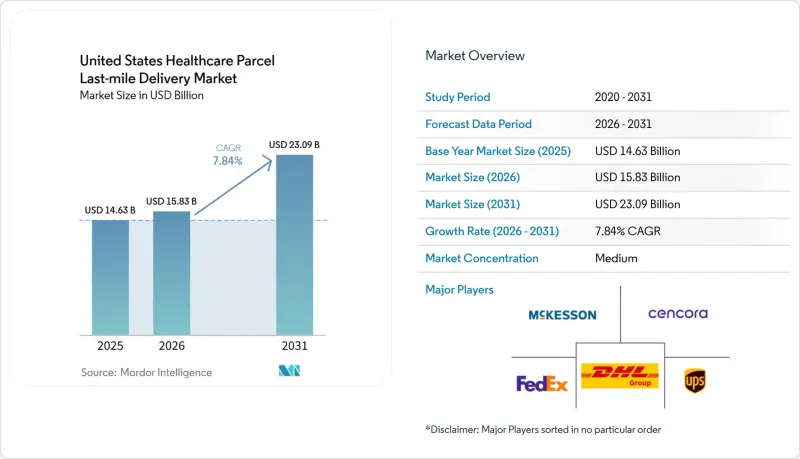
美國醫療保健小包裹「最後一公里」配送市場的成長主要受以下因素驅動:專業藥品需求的穩定成長、居家照護的擴展以及病患對更快更可靠的處方箋服務日益成長的需求。本報告按配送類型(標準配送、當日達、次日達)、溫度類型(溫控、非溫控)、產品類型(藥品、疫苗、其他)、配送模式(B2C、B2B)、最終用戶(線上藥局、實體藥局、診斷實驗室、其他)以及地區(東北部、東南部、西部、其他)進行細分。市場預測以美元計價。
美國醫療相關小包裹最後一公里配送市場的趨勢與見解。
擴大直接面向病患的專業藥局履約
在美國,直接送藥上門正在改變醫療小包裹的「最後一公里」配送市場。這是因為處方箋藥越來越直接送達患者家中,繞過了傳統的配送管道。這種轉變推動了對能夠處理敏感醫療資訊、確保送達確認並促進與醫療機構和藥房系統更順暢對接的小包裹配送路線的需求。此外,對能夠管理患者預約、處理配送失敗並最大限度減少服務中斷的網路的需求也在不斷成長。因此,與醫療系統和藥房工作流程高度整合的供應商,透過減少特殊藥物配送過程中關鍵的交接環節摩擦,正在獲得競爭優勢。
人們對處方箋藥當日/隔天送達的期望越來越高。
在美國,病患對醫療小包裹「最後一公里」配送服務的期望正逐漸接近更廣泛的電子商務服務標準,尤其是在處方箋補發和緊急治療需求方面。對於治療延誤可能影響患者護理的領域,例如癌症治療支持、注射藥物和其他必須快速送達的療法,當日達或次日達的需求最為迫切。此外,一些醫療用品無法承受數天的配送時間,因此需要更密集的區域配送網路。對於放射性藥物和特定患者專用藥物等時效性產品,服務挑戰更大,因為它們的臨床價值可能在數小時內降低。
關於受管制物質的 HIPAA、監管鍊和嚴格的合規負擔。
在美國醫療小包裹的最後一公里配送市場,合規性仍是一大限制因素。這是因為與普通小包裹承運商相比,醫療包裹承運商必須遵守更嚴格的法規來處理病患資料、儲存記錄和受管制藥品。這些要求透過合約、防篡改措施、追蹤日誌、儲存程序和交付驗證等環節增加了營運成本。此外,由於各州對受管制藥品的配送要求不盡相同,整個網路的運作條件也存在差異,使得全國範圍的管理更加困難。即使是流程中的一個小瑕疵,也可能使承運商面臨嚴重的法律和財務風險,這進一步提高了小規模承運商的進入門檻。
細分市場分析
到2025年,隔日達將占美國醫療小包裹「最後一公里」配送市場41.44%的佔有率,成為以金額為準最高的配送方式。這一主導地位反映了現有處方箋配藥基礎設施為零售藥局、專科藥局和醫院門診藥局提供服務。該領域非常適合常規處方箋續藥計劃,此類計劃對服務可靠性要求較高,但並非總是需要緊急臨床響應。此外,與時間緊迫的其他醫療配送服務相比,該領域還受益於成熟的配送路線密度高和營運負擔輕。
預計到2031年,當日達服務將以11.92%的複合年成長率成長,成為美國醫療小包裹「最後一公里」配送市場中成長最快的細分領域。放射性藥物的需求推動了對緊急腫瘤支持療法和居家醫療設備補充的需求,因為送達時間可能影響治療的連續性。對於非緊急產品,例如居家醫療耗材、非處方藥和診斷試劑盒補充,標準配送仍扮演重要角色。監管合規性也影響著這個細分市場,某些特定藥品和產品需要謹慎處理,這限制了能夠從法律和營運角度滿足當日達需求的配送公司數量。隨著時間的推移,這將形成一種兩極分化的市場結構,次日達仍將是配送量的主要驅動力,而當日達將成為一個高階細分市場,服務差異化和定價權都集中在這一領域。
2025年,非溫控運輸將占美國醫療小包裹最後一公里配送市場的52.86%,成為溫控運輸中佔比最大的部分。目前,常溫運輸佔據市場主導地位,因為其涵蓋了許多標準藥品、診斷試劑盒、居家醫療用品和常規醫療設備。因此,就規模化和網路利用率而言,這一細分市場佔據著至關重要的營運地位。這也反映出無需在最終交付時進行特殊溫度控制的醫療產品正被廣泛採用。
預計到2031年,需要溫控的貨運量將以8.70%的複合年成長率成長,這可能會縮小美國醫療包裹小包裹公里配送市場的佔有率。根據Cencora的分析,到2027年,全球上市的藥品中預計有一半需要冷鏈儲存,高於2013年至2017年間的37%。此外,由於細胞療法和基因療法可能需要超出傳統2°C至8°C範圍的低溫條件,對溫控的要求日益嚴格。這種轉變使得經過認證和檢驗的流程成為必需品,而不僅僅是可選項。對於那些希望在美國醫療小包裹最後一公里配送市場中扮演更重要角色的承運商而言,溫控也正成為一項策略要求。
其他好處
- Excel格式的市場預測(ME)表
- 3個月的分析師支持
目錄
第1章:引言
- 研究假設和市場定義
- 調查範圍
第2章:調查方法
第3章執行摘要
第4章 市場狀況
- 市場概況及最後一公里小包裹配送在醫療物流中的作用。
- 醫療費用趨勢
- 市場促進因素
- 擴大直接面向病患的專業藥局履約
- 人們對處方箋藥當日/隔天送達的期望越來越高。
- 居家照護和家庭醫院計畫的發展
- 生技藥品和疫苗的溫度控制要求
- 將配送編配軟體與藥局和電子病歷工作流程整合。
- 透過混合服務網路擴大對農村地區和低度開發地區的覆蓋範圍。
- 市場限制因素
- 關於受管制物質的 HIPAA、監管鍊和嚴格的合規負擔。
- 合格冷鏈包裝和再冰管理高成本。
- 促進要素短缺和因配送失敗而導致的重新配送成本
- 各州對宅配和醫療運輸模式的營運要求存在差異。
- 法律規範
- 價值鍊和分銷管道的結構分析
- 技術創新的前景
- 波特五力分析
- 醫療相關小包裹最後一公里配送要求的變化
- 地緣政治事件對供應鏈變化的影響
第5章 市場規模及成長預測(價值,2026-2031 年)
- 配送類型
- 標準配送
- 當日送達
- 隔日送達
- 按溫度類型
- 溫控型
- 無溫度控制
- 依產品類型
- 製藥
- 處方藥和特殊藥物
- 成藥
- 生物製藥(生物製劑和生物相似藥)
- 疫苗
- 臨床試驗用材料
- 細胞和基因治療
- 醫療器材
- 動物用藥品
- 血液、血漿和血液成分
- 診斷和測試產品
- 居家醫療用品
- 其他
- 製藥
- 按型號提供
- B2C
- B2B
- 最終用戶
- 醫院和診所
- 網路藥局和實體藥局
- 診斷實驗室
- 家庭醫療保健服務提供者
- 直接送達患者
- 其他
- 按地區
- 東北
- 東南部
- 中西部
- 西南
- 西
第6章 競爭情勢
- 市場集中度
- 關鍵策略趨勢
- 市佔率分析
- 公司簡介
- FedEx
- UPS
- DHL Group
- Cencora, Inc.
- McKesson Corporation
- Cardinal Health
- MedSpeed
- USPack
- Medical Couriers Inc.(MCI)
- Dropoff
- Life Couriers
- Priority Dispatch, Inc.
- MedZoomer
- Stat Experts, Inc.
- Lab Logistics
- OnWay
- Airspace
- Kuehne+Nagel(Including QuickSTAT)
- LifeScience Logistics
- National Courier Express
- ScriptDrop
- Courier Express
第7章 市場機會與未來展望
According to Mordor Intelligence, the United States healthcare parcel last-mile delivery market size was valued at USD 14.63 billion in 2025 and is estimated to grow from USD 15.83 billion in 2026 to USD 23.09 billion by 2031, at a CAGR of 7.84% during the forecast period 2026-2031.
Growth in the United States healthcare parcel last-mile delivery market is being supported by a steady shift toward specialty pharmaceuticals, more care delivered at home, and stronger patient demand for faster, more reliable prescription fulfillment. This report is Segmented by Delivery Type (Standard, Same-Day, Next-Day), by Temperature Type (Temperature Type, Non-Temperature), by Product Type (Pharmaceuticals, Vaccines, and More), by Delivery Model (B2C, B2B), by End User (E-Pharmacies, Diagnostic Labs, and More), and by Geography (Northeast, Southeast, West, and More). The Market Forecasts are Provided in Terms of Value (USD).
United States Healthcare Parcel Last-mile Delivery Market Trends and Insights
Expansion of Direct-to-Patient Specialty Pharmacy Fulfillment
Direct-to-patient fulfillment is changing the shipment profile of the United States healthcare parcel last-mile delivery market, as more prescriptions now move directly to patients' homes rather than through older channel steps. That shift raises demand for parcel routing that can support the handling of protected health information, delivery confirmation, and better integration with provider and pharmacy systems. It also creates a larger need for networks that can manage patient scheduling and failed delivery recovery with fewer service breaks. Operators with stronger links to health systems and pharmacy workflows are therefore gaining an advantage by reducing friction in handoffs that matter in specialty drug delivery.
Rising Same-Day and Next-Day Expectations for Prescription Refills
Patient expectations in the United States healthcare parcel last-mile delivery market are moving closer to broader e-commerce service standards, especially for refill and urgent therapy needs. Same-day and next-day demand is strongest where treatment delays can interrupt care, including oncology support, injectables, and other therapies that must reach the patient quickly. This also increases the need for denser local dispatch capacity, as some healthcare shipments cannot tolerate multi-day delivery windows. The service challenge is greater for time-sensitive products such as radiopharmaceuticals and certain patient-specific medications because their clinical value can decline within hours.
Tight HIPAA, Chain-of-Custody, and Controlled-Substance Compliance Burden
Compliance remains a major restraint in the United States healthcare parcel last-mile delivery market because operators must handle patient data, documented custody, and controlled substances under stricter rules than standard parcel providers. These requirements raise operating costs through agreements, tamper controls, tracking logs, retention practices, and delivery verification. The burden also becomes harder to manage at the national scale because controlled-substance courier requirements vary by state, creating uneven operating conditions across networks. A single weak process can expose an operator to severe legal and financial consequences, which increases the barrier to entry for smaller carriers.
Other drivers and restraints analyzed in the detailed report include:
- Growth in Home-Based Care and Hospital-at-Home Programs
- Temperature Integrity Requirements for Biologics and Vaccines
- High Cost of Qualified Cold-Chain Packaging and Re-Ice Management
For complete list of drivers and restraints, kindly check the Table Of Contents.
Segment Analysis
Next-day delivery accounted for 41.44% of the United States healthcare parcel last-mile delivery market share in 2025, making it the largest delivery type by value. Its leadership reflects the existing prescription fulfillment backbone that serves retail pharmacies, specialty pharmacies, and outpatient hospital dispensaries. This segment fits recurring refill programs where service reliability matters, but an urgent clinical response is not always required. It also benefits from established route density and a lower operating burden than most time-critical healthcare deliveries.
Same-day delivery is projected to expand at a 11.92% CAGR through 2031, making it the fastest-growing segment of the United States healthcare parcel last-mile delivery market. Radiopharmaceuticals are driving demand for urgent oncology support therapies and home health resupply, where timing can influence care continuity. Standard delivery still holds a role for non-urgent products such as home healthcare consumables, over-the-counter medications, and diagnostic kit replenishment. The segment is also shaped by compliance, as scheduled substances and sensitive products reduce the pool of couriers who can legally and operationally serve same-day demand. Over time, this creates a bifurcated structure where next-day remains the volume anchor, while same-day becomes the premium layer where service differentiation and pricing power concentrate.
Non-temperature-controlled shipments accounted for 52.86% of the United States healthcare parcel last-mile delivery market size in 2025, giving them the largest share among temperature types. Ambient deliveries account for the current volume because they include many standard pharmaceuticals, diagnostic kits, home healthcare supplies, and routine medical devices. This makes the segment operationally important for scale and network utilization. It also reflects the large installed base of healthcare products that do not require specialized thermal controls during the final handoff.
Temperature-controlled shipments are forecast to grow at a 8.70% CAGR through 2031, suggesting the share gap is likely to narrow in the United States healthcare parcel last-mile delivery market. Cencora indicated that half of all pharmaceutical products launched globally through 2027 will require cold-chain storage, compared with 37% for the 2013-2017 cohort. The need for temperature control is also becoming more demanding, as cell and gene therapies may require cryogenic conditions beyond the conventional 2 °C to 8 °C range. That shift turns certifications and validated processes into baseline requirements rather than optional advantages. It also makes temperature control a strategic requirement for carriers seeking a larger role in the United States healthcare parcel last-mile delivery market.
Complete Report Scope:
- By Delivery Type
- Standard Delivery
- Same-Day Delivery
- Next-Day Delivery
- By Temperature Type
- Temperature Controlled
- Non-Temperature Controlled
- By Product Type
- Pharmaceuticals
- Prescription and Specialty Drugs
- OTC Drugs
- Biopharmaceuticals (Biologics and Biosimilars)
- Vaccines
- Clinical Trial Materials
- Cell and Gene Therapies
- Medical Devices
- Veterinary Medicine
- Blood, Plasma and Blood Components
- Diagnostic and Laboratory Products
- Home Healthcare Supplies
- Others
- Pharmaceuticals
- By Delivery Model
- B2C
- B2B
- By End User
- Hospitals and Clinics
- E-Pharmacies and Pharmacies
- Diagnostic Laboratories
- Home Healthcare Providers
- Direct-to-Patient Deliveries
- Others
- By Region
- Northeast
- Southeast
- Midwest
- Southwest
- West
List of Companies Covered in this Report:
- FedEx
- UPS
- DHL Group
- Cencora, Inc.
- McKesson Corporation
- Cardinal Health
- MedSpeed
- USPack
- Medical Couriers Inc. (MCI)
- Dropoff
- Life Couriers
- Priority Dispatch, Inc.
- MedZoomer
- Stat Experts, Inc.
- Lab Logistics
- OnWay
- Airspace
- Kuehne+Nagel (Including QuickSTAT)
- LifeScience Logistics
- National Courier Express
- ScriptDrop
- Courier Express
Additional Benefits:
- The market estimate (ME) sheet in Excel format
- 3 months of analyst support
TABLE OF CONTENTS
1 Introduction
- 1.1 Study Assumptions and Market Definition
- 1.2 Scope of the Study
2 Research Methodology
3 Executive Summary
4 Market Landscape
- 4.1 Market Overview and Role of Parcel Last-Mile Delivery in Healthcare Logistics
- 4.2 Healthcare Spending Trends
- 4.3 Market Drivers
- 4.3.1 Expansion of Direct-to-Patient Specialty Pharmacy Fulfillment
- 4.3.2 Rising Same-Day and Next-Day Expectations for Prescription Refills
- 4.3.3 Growth in Home-Based Care and Hospital-at-Home Programs
- 4.3.4 Temperature Integrity Requirements for Biologics and Vaccines
- 4.3.5 Integration of Delivery Orchestration Software With Pharmacy and EMR Workflows
- 4.3.6 Expansion of Rural and Underserved Area Coverage Through Hybrid Carrier Networks
- 4.4 Market Restraints
- 4.4.1 Tight HIPAA, Chain-of-Custody, and Controlled-Substance Compliance Burden
- 4.4.2 High Cost of Qualified Cold-Chain Packaging and Re-Ice Management
- 4.4.3 Driver Shortages and Failed-Delivery Redelivery Costs
- 4.4.4 Fragmented State-Level Operating Requirements for Courier and Medical Transport Models
- 4.5 Regulatory Framework
- 4.6 Value Chain and Distribution Channel Architecture Analysis
- 4.7 Technology Innovations Outlook
- 4.8 Porter's Five Forces Analysis
- 4.8.1 Threat of New Entrants
- 4.8.2 Bargaining Power of Suppliers
- 4.8.3 Bargaining Power of Buyers
- 4.8.4 Threat of Substitutes
- 4.8.5 Rivalry Among Competitors
- 4.9 Evolution of Healthcare Parcel Last-Mile Delivery Requirements
- 4.10 Impact of Geo-Political Events on Supply Chain Shifts
5 Market Size and Growth Forecasts (Value, 2026-2031)
- 5.1 By Delivery Type
- 5.1.1 Standard Delivery
- 5.1.2 Same-Day Delivery
- 5.1.3 Next-Day Delivery
- 5.2 By Temperature Type
- 5.2.1 Temperature Controlled
- 5.2.2 Non-Temperature Controlled
- 5.3 By Product Type
- 5.3.1 Pharmaceuticals
- 5.3.1.1 Prescription and Specialty Drugs
- 5.3.1.2 OTC Drugs
- 5.3.2 Biopharmaceuticals (Biologics and Biosimilars)
- 5.3.3 Vaccines
- 5.3.4 Clinical Trial Materials
- 5.3.5 Cell and Gene Therapies
- 5.3.6 Medical Devices
- 5.3.7 Veterinary Medicine
- 5.3.8 Blood, Plasma and Blood Components
- 5.3.9 Diagnostic and Laboratory Products
- 5.3.10 Home Healthcare Supplies
- 5.3.11 Others
- 5.3.1 Pharmaceuticals
- 5.4 By Delivery Model
- 5.4.1 B2C
- 5.4.2 B2B
- 5.5 By End User
- 5.5.1 Hospitals and Clinics
- 5.5.2 E-Pharmacies and Pharmacies
- 5.5.3 Diagnostic Laboratories
- 5.5.4 Home Healthcare Providers
- 5.5.5 Direct-to-Patient Deliveries
- 5.5.6 Others
- 5.6 By Region
- 5.6.1 Northeast
- 5.6.2 Southeast
- 5.6.3 Midwest
- 5.6.4 Southwest
- 5.6.5 West
6 Competitive Landscape
- 6.1 Market Concentration
- 6.2 Key Strategic Moves
- 6.3 Market Share Analysis
- 6.4 Company Profiles (includes Global level Overview, Market level overview, Core Segments, Financials as available, Strategic Information, Market Rank/Share for key companies, Products & Services, and Recent Developments)
- 6.4.1 FedEx
- 6.4.2 UPS
- 6.4.3 DHL Group
- 6.4.4 Cencora, Inc.
- 6.4.5 McKesson Corporation
- 6.4.6 Cardinal Health
- 6.4.7 MedSpeed
- 6.4.8 USPack
- 6.4.9 Medical Couriers Inc. (MCI)
- 6.4.10 Dropoff
- 6.4.11 Life Couriers
- 6.4.12 Priority Dispatch, Inc.
- 6.4.13 MedZoomer
- 6.4.14 Stat Experts, Inc.
- 6.4.15 Lab Logistics
- 6.4.16 OnWay
- 6.4.17 Airspace
- 6.4.18 Kuehne+Nagel (Including QuickSTAT)
- 6.4.19 LifeScience Logistics
- 6.4.20 National Courier Express
- 6.4.21 ScriptDrop
- 6.4.22 Courier Express
7 Market Opportunities and Future Outlook
- 7.1 White-space and Unmet-Need Assessment

 新加坡最後一公里配送:市佔率分析、產業趨勢與統計及成長預測(2026-2031)印度D2C(直接面對消費者)物流:市場佔有率分析、行業趨勢和統計數據以及成長預測(2026-2031年)德國最後一公里配送:市場佔有率分析、產業趨勢與統計及成長預測(2026-2031 年)歐洲電子商務最後一公里配送:市場佔有率分析、產業趨勢與統計及成長預測(2026-2031 年)印度電子商務最後一公里配送:市場佔有率分析、產業趨勢與統計及成長預測(2026-2031)
 全球末端配送車輛市場預測(至2034年)-按車輛類型、動力系統、有效載荷能力、自動化程度、所有權、應用、最終用戶、銷售管道、分銷管道和地區分類的分析美國電子商務最後一公里配送:市場佔有率分析、產業趨勢與統計、成長預測(2026-2031)英國醫療小包裹最後一公里配送:市場佔有率分析、產業趨勢與統計及成長預測(2026-2031 年)
 自主最後一公里配送市場-2026-2032年全球市場預測食品低溫運輸最後一公里配送市場:全球市場預測(2026-2032 年)