


 |
市場調查報告書
商品編碼
2155310
電子商務最終交付:市場佔有率分析、行業趨勢和統計數據、成長預測(2026-2031 年)E-commerce Last-mile Delivery - Market Share Analysis, Industry Trends & Statistics, Growth Forecasts (2026 - 2031) |
||||||

※ 本網頁內容可能與最新版本有所差異。詳細情況請與我們聯繫。
根據 Mordor Intelligence 預測,全球電子商務最後一公里配送市場規模預計將在 2025 年達到 2,079.2 億美元,在 2026 年擴大到 2,316.1 億美元,並在 2031 年達到 3,876.9 億美元。
預計 2026 年至 2031 年的複合年成長率為 10.85%。
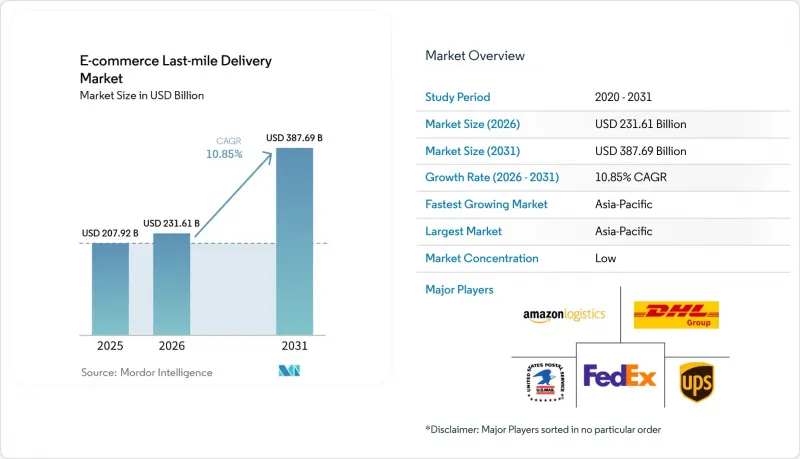
由於都市區小包裹密度不斷增加、當日達基礎設施快速發展以及配送網路廣泛採用路線最佳化工具,全球電子商務最後一公里配送市場正蓬勃發展。本報告按配送類型(標準配送、當日達、次日達)、配送模式(B2C、B2B、C2C)、城市等級(一線城市、二線城市、其他城市)、產品類型(食品飲料、個人護理、時尚生活、家具、其他產品)以及地區(北美、南美、亞太、歐洲、中東和非洲)進行細分。市場預測以美元計價。
全球電子商務最後一公里外送市場趨勢及洞察
城市走廊電子商務訂單密度成長
都市區訂單的日益集中正在降低全球電商最後一公里配送市場的單次配送成本。更密集的配送路線提高了車輛運轉率,並提升了配送範圍有限區域的路線規劃精準度。印度的快速電商平台到2026年初運營了約1900家「暗店」(dark stores),預計到年底這一數字將超過5000家。這些網路可在10-15分鐘內處理訂單,要求零售商採用高度在地化的履約能力,而非傳統的中心輻射式模式。亞馬遜於2026年5月推出的「亞馬遜供應鏈服務」(Amazon Supply Chain Services)表明,主要物流公司現在將自身的物流網路視為能夠同時服務外部品牌和自身零售業務的商業產品。在全球電商最後一公里配送市場,這種轉變正給那些仍依賴傳統成本結構且網路改造緩慢的物流公司帶來更大的壓力。
當日達/隔日達服務的滲透率
在全球電商末端配送市場,當日達和隔日達正從一項高階服務轉變為許多都市區的標準配備。這種轉變迫使承運商將庫存部署得更靠近終端用戶,並加強配送時段的管理。 2025年4月,Aramex與Shipsy簽署了一項主服務協議,旨在利用人工智慧驅動的路線最佳化、區域管理和時限管理工具來提升其當日達服務。最強勁的需求來自那些對配送速度要求高於成本的場景,尤其是在食品、退貨和訂閱服務等類別中。 Geopost的報告顯示,2025年,歐洲八個國家的溫控貨運量將成長11%,凸顯了快速配送對於生鮮產品和易碎品的重要性。在全球電商端配送市場,更快的配送速度不再只是服務升級,而是正在成為網路設計的基本原則。
都市區。
都市區交通管制使得在人口密集的城市地區實現電商「最後一公里」配送的盈利規模化變得困難。低排放氣體區、配送時間限制和車輛數量限制增加了配送路線的複雜性,降低了配送的柔軟性。 Springer Nature 2026 年發布的一項關於都市區「最後一公里」配送路線的研究表明,零排放區的實施可能會迫使營運商在電氣化帶來的成本節約完全實現之前,就將電動車車隊分配到受限路線上。這將給那些仍在多個轄區運作混合車隊的營運商帶來前期資本負擔。當充電設施、路肩空間和當地營運法規在不同城市之間存在差異時,這個問題會更加嚴重。儘管小包裹需求強勁,但這些摩擦正在限制全球電商「最後一公里」配送市場的服務柔軟性。
細分市場分析
到2025年,標準配送將佔全球電商末端配送市場佔有率的58.20%,這表明價格敏感型消費者和出貨量大的出貨方仍然優先考慮可預測且低成本的配送時間。標準配送的貨量為整體網路運轉率提供了密度基礎,全球電商末端配送市場仍依賴於此。當配送並非緊急、包裹量大且時間限制較為寬鬆時,標準服務扮演著尤為重要的角色。次日達服務持續佔據服務範圍的中間位置,受益於消費者對配送的既定預期以及配送網路向郊區的擴展。
預計到2031年,當日達服務將以14.30%的複合年成長率成長,而這一成長需要將庫存設置在距離終端客戶較近的位置。因此,承運商不僅需要增加長途運輸能力,還需要部署暗店、微型倉配中心和更智慧的調度系統。 2025年4月,Aramex透過部署Shipsy的AI驅動的管轄範圍和路線最佳化工具來應對這項挑戰,從而支持其當日達服務的擴展。 Geopost在歐洲的「家外取件」業務量在2025年成長了31%。這表明,小包裹商店和儲物櫃正在吸收部分原本需要成本高昂的上門配送的需求。這種需求緩解效應意義重大,因為當日達網路需要高運轉率才能維持盈利,而家外取件選項有助於在服務速度和降低配送成本之間取得平衡。
到2025年,B2C將佔全球電商端配送市場規模的66.56%,反映出零售商、時尚平台和經銷商在提升市場配送路線密度方面發揮核心作用。面向消費者的全球電商末端配送市場仍是大多數承運商運轉率模式的基礎。隨著品牌方透過小規模、分佈廣泛的小包裹履約來補充其業務,支援全通路和快速配送模式,B2B業務量也不斷成長。 Vinted、Poshmark和Shopee等平台正是這一趨勢的典型代表,它們產生了大量的小批量、週期性個人包裹。
預計到2031年,C2C模式將以16.97%的複合年成長率成長,使其成為全球電商最後一公里配送市場中成長最顯著的市場之一。這些小包裹通常重量輕、尺寸標準化,因此比人工配送模式更適合住宅和行動自提網路。因此,C2C模式在結構上非常適合儲物櫃和宅配箱系統,這些系統可以降低配送失敗率並提高配送效率。 B2B模式則較不為人所知,但其重要性日益凸顯,因為與傳統的大量補貨相比,分散式儲存點的補貨需要更頻繁、更嚴格的運輸。
區域分析
到2025年,亞太地區將佔據全球電商末端配送市場佔有率的38.41%,並將成為成長最快的地區,到2031年複合年成長率將達到11.93%。全球電商末端配送市場在亞太地區尤為活躍,規模和成長並非相互矛盾,而是相輔相成。中國主要物流業者正將其國內業務模式拓展至東南亞、歐洲和美洲,削弱了其以往緩慢且分散的配送體系所擁有的歷史優勢。菜鳥於2026年初開通了美國至墨西哥的貿易路線,在日本設立了物流技術辦公室,並在其廣東業務基地引進了ZeeBot倉儲機器人。澳洲郵政從 2026 年 7 月起,將其「按需當日送達服務」擴展至 68 個郵遞區號區域的 372 個新的郊區。這表明,亞太地區的區域策略不僅限於人口稠密的大都會圈,還涵蓋了需要靈活服務模式的廣大區域。
北美仍然是重要的商業中心,該地區的全球電子商務最後一公里配送市場正在經歷重組,既包括合作也包括直接競爭。美國郵政服務 (USPS) 作為共用的最後一公里基礎設施,在為尋求覆蓋全國範圍且避免重複建設低密度配送路線的私營快遞公司提供服務方面,正發揮著越來越重要的作用。 2026 年 5 月,DHL 電子商務與 USPS 簽署了一項價值超過 100 億美元的多年獨家協議,涵蓋超過 41,550 個郵遞區號區域和 1.7 億個配送中心的最後一公里配送服務。 2026 年 4 月,加拿大郵政開始籌備一項多年轉型計劃,其中包括計劃在 2026 年底或 2027 年初之前,將約 13.6 萬個地址的郵件配送方式從挨家挨戶配送過渡到共享郵箱。這些舉措表明,北美營運商正在透過混合模式平衡覆蓋範圍、成本和配送密度,而不是依賴單一所有權結構來覆蓋所有路線。
歐洲在全球電商最後一公里配送市場中呈現出最為複雜的多層次競爭格局,泛歐整合商、各國郵政服務機構以及來自中國的新興參與企業都在爭奪相同的小包裹需求。聯邦快遞(FedEx)於2026年2月與一個財團合作收購了InPost,旨在將住宅小包裹業務盈利與自提櫃基礎設施更緊密地聯繫起來。 GeoPost的網路在2025年涵蓋了超過15萬個小包裹商店和自提櫃,這表明「戶外配送」在該地區的商業模式中已高度融合。中東和南美地區的絕對數量仍然小規模。然而,這兩個地區對未來的成長至關重要,因為快速的都市區化和跨境需求可以為網路擴張提供支撐,前提是服務模式能夠適應當地的基礎設施。
其他好處:
- Excel格式的市場預測(ME)表
- 3個月的分析師支持
目錄
第1章:引言
- 研究假設和市場定義
- 調查範圍
第2章:調查方法
第3章執行摘要
第4章 市場狀況
- 市場概況及最後一公里配送在電子商務物流的作用
- 電子商務消費趨勢
- 市場促進因素
- 城市走廊電子商務訂單密度成長
- 當日達/隔日達服務的滲透率
- 跨境小包裹網路的擴展
- 零售商自有配送網路及公司車輛
- 配送協調軟體及路線最佳化部署現狀
- 微型倉配和暗店的接近性帶來的經濟影響
- 市場限制因素
- 都市區。
- 促進要素短缺和最後一公里運輸勞動強度高
- 出貨失敗、退貨和逆向物流成本
- 住宅電氣化與車輛停車場充電系統之間的差距。
- 法律規範
- 價值鍊和分銷管道的結構分析
- 技術創新前景
- 波特五力分析
- 電子商務中最後一公里配送需求的演變
- 定價和成本結構分析
- 分析消費者行為與配送偏好
- 永續交付解決方案和綠色物流舉措
- 地緣政治事件對供應鏈變化的影響
第5章 市場規模及成長預測(價值,2026-2031 年)
- 配送類型
- 標準配送
- 當日送達
- 隔日送達
- 按型號提供
- B2C(企業對消費者)
- 企業對企業 (B2B) 交易
- 個人對個人(C2C)交易
- 城市層級
- 一級
- 二級
- 三級及以下
- 依產品類型
- 食品/飲料
- 個人護理和居家護理
- 時尚與生活方式(配件、服裝、鞋類)
- 家具
- 家用電子電器和電器產品
- 其他產品
- 按地區/國家
- 北美洲
- 美國
- 加拿大
- 墨西哥
- 南美洲
- 巴西
- 秘魯
- 智利
- 阿根廷
- 其他南美國家
- 亞太地區
- 中國
- 日本
- 印度
- 韓國
- 澳洲
- 東南亞
- 其他亞太國家
- 歐洲
- 英國
- 德國
- 法國
- 西班牙
- 義大利
- 比荷盧經濟聯盟(比利時、荷蘭、盧森堡)
- 北歐國家(丹麥、芬蘭、冰島、挪威、瑞典)
- 其他歐洲國家
- 中東和非洲
- 阿拉伯聯合大公國
- 沙烏地阿拉伯
- 南非
- 奈及利亞
- 其他中東和非洲國家
- 北美洲
第6章 競爭情勢
- 市場集中度
- 關鍵策略趨勢
- 市佔率分析
- 公司簡介
- Amazon Logistics
- United Parcel Service(UPS)
- FedEx Corporation
- DHL Group
- United States Postal Service(USPS)
- Geopost(DPDgroup)
- GLS Group
- JD Logistics
- SF Express
- Cainiao Network
- Yamato Holdings
- J&T Express
- Delhivery
- Aramex
- Ninja Van
- Australia Post
- Canada Post
- Poste Italiane
- Sagawa Express
- Blue Dart Express
- InPost SA
- XpressBees
第7章 市場機會與未來展望
According to Mordor Intelligence, the global e-commerce last-mile delivery market was valued at USD 207.92 billion in 2025 and is expected to grow to USD 231.61 billion in 2026, reaching USD 387.69 billion by 2031, at a CAGR of 10.85% over 2026-2031.
The global e-commerce last-mile delivery market is gaining momentum from higher parcel density in urban corridors, faster same-day infrastructure rollout, and wider adoption of route optimization tools across carrier networks. This report is Segmented by Delivery Type (Standard, Same-Day, and Next-Day), by Delivery Model (B2C, B2B, and C2C), by City Tier (Tier 1, Tier 2, and More), by Product Type (Foods and Beverages, Personal Care, Fashion and Lifestyle, Furniture, and More), and by Geography (North America, South America, Asia-Pacific, Europe, and MEA). The Market Forecasts are Provided in Terms of Value (USD).
Global E-commerce Last-mile Delivery Market Trends and Insights
E-Commerce Order Density Growth in Urban Corridors
Rising order concentration in cities is lowering per-stop delivery cost in the global e-commerce last-mile delivery market. Dense routes improve vehicle utilization and make route planning more predictable across short delivery radii. India's quick-commerce platforms operated nearly 1,900 dark stores by early 2026, and the count was projected to exceed 5,000 by the end of the year. Those networks process orders within 10-15 minutes, which means retailers need hyper-local fulfillment capacity rather than a conventional hub-and-spoke model. Amazon's May 2026 launch of Amazon Supply Chain Services shows that large carriers now view logistics networks as commercial products that can serve both outside brands and captive retail volume. In the global e-commerce last-mile delivery market, this change is raising the pressure on carriers that still rely on legacy cost structures and slower network redesign.
Same-Day and Next-Day Service Penetration
Same-day and next-day delivery have moved from premium options to standard expectations in many urban markets within the global e-commerce last-mile delivery market. That shift is forcing carriers to move inventory closer to end users and tighten control over delivery time windows. Aramex signed a master services agreement with Shipsy in April 2025 to deploy AI-powered route optimization, territory management, and time-slot tools for its same-day service rollout. The strongest pull is coming from use cases where urgency matters more than shipping price, especially food, returns, and refill-driven categories. Geopost reported 11% growth in temperature-controlled activity across 8 European countries in 2025, which supports the role of fast delivery in perishable and sensitive shipments. In the global e-commerce last-mile delivery market, faster delivery is no longer only a service upgrade; it is becoming a network design rule.
Urban Curb Access Constraints and Delivery Slot Scarcity
Urban access rules are making it harder to scale e-commerce last-mile delivery profitably in dense city centers. Low-emission zones, restricted time windows, and vehicle limits raise route complexity and reduce delivery flexibility. A 2026 Springer Nature study on urban last-mile routing showed that Zero Emission Zone enforcement can force operators to dedicate electric vehicle fleets to restricted routes before the cost savings of electrification are fully realized. That creates a front-loaded capital burden for fleets that still operate mixed vehicle bases across several jurisdictions. The issue is more severe where charging access, curb space, and local operating rules change from one city to another. In the global e-commerce last-mile delivery market, these frictions are limiting service flexibility even when parcel demand remains strong.
Other drivers and restraints analyzed in the detailed report include:
- Cross-Border Parcel Network Expansion
- Micro-Fulfillment and Dark Store Proximity Economics
- Driver Shortage and High Last-Mile Labor Intensity
For complete list of drivers and restraints, kindly check the Table Of Contents.
Segment Analysis
Standard delivery accounted for 58.20% of the global e-commerce last-mile delivery market share in 2025, indicating that price-sensitive consumers and bulk-oriented shippers still value predictable, lower-cost service windows. The global e-commerce last-mile delivery market still depends on this base because standard volumes provide the density that supports broader network utilization. Standard service remains especially relevant when delivery urgency is low, and parcel baskets are larger or less time-sensitive. Next-day delivery continues to sit at the midpoint of the service spectrum, benefiting from normalized delivery expectations and expanding suburban fulfillment coverage.
Same-day delivery is projected to expand at a 14.30% CAGR through 2031, and that growth requires inventory to be placed within a short operating radius of the end customer. Carriers, therefore, need dark stores, micro-fulfillment nodes, and smarter dispatching rather than only more long-haul capacity. Aramex addressed this in April 2025 by deploying Shipsy's AI-powered territory and route optimization tools to support its same-day product rollout. Geopost's out-of-home volumes in Europe grew 31% in 2025, indicating that parcel shops and lockers are taking a share of the demand that would otherwise require costly doorstep service. That moderation effect matters because same-day networks need high utilization to remain profitable, and out-of-home options help balance service speed with delivery cost discipline.
B2C accounted for 66.56% of the global e-commerce last-mile delivery market size in 2025, reflecting the central role of retailers, fashion platforms, and electronics sellers in building route density across the market. The consumer side of the global e-commerce last-mile delivery market remains the foundational parcel flow on which most carrier utilization models are built. B2B volumes are also rising as brands replenish smaller and more distributed fulfillment nodes that support omnichannel and fast-delivery models. Platforms such as Vinted, Poshmark, and Shopee fit this pattern because they generate large volumes of small, repeat individual shipments.
C2C is projected to grow at a 16.97% CAGR through 2031, giving it one of the clearest expansion paths in the global e-commerce last-mile delivery market. These parcels are usually light, dimensionally standardized, and suited to residential or out-of-home collection networks rather than heavy-touch delivery models. That makes C2C structurally compatible with locker and parcel shop systems that lower failed delivery rates and increase stop efficiency. B2B, while less visible, is also becoming more important because replenishment to distributed storage locations requires more frequent, time-sensitive movement than traditional bulk restocking.
Complete Report Scope:
- By Delivery Type
- Standard Delivery
- Same-Day Delivery
- Next-Day Delivery
- By Delivery Model
- Business-to-Consumer (B2C)
- Business-to-Business (B2B)
- Consumer-to-Consumer (C2C)
- By City Tier
- Tier 1
- Tier 2
- Tier 3 and Below
- By Product Type
- Foods and Beverages
- Personal and Household Care
- Fashion and Lifestyle (Accessories, Apparel, Footwear)
- Furniture
- Consumer Electronics and Household Appliances
- Other Products
- By Region/Country
- North America
- United States
- Canada
- Mexico
- South America
- Brazil
- Peru
- Chile
- Argentina
- Rest of South America
- Asia-Pacific
- China
- Japan
- India
- South Korea
- Australia
- South East Asia
- Rest of Asia-Pacific
- Europe
- United Kingdom
- Germany
- France
- Spain
- Italy
- BENELUX (Belgium, Netherlands, and Luxembourg)
- NORDICS (Denmark, Finland, Iceland, Norway, and Sweden)
- Rest of Europe
- Middle East and Africa
- United Arab Emirates
- Saudi Arabia
- South Africa
- Nigeria
- Rest of the Middle East And Africa
- North America
Geography Analysis
Asia-Pacific accounted for 38.41% of the global e-commerce last-mile delivery market share in 2025 and is also the fastest-growing region, with a 11.93% CAGR through 2031. The global e-commerce last-mile delivery market is particularly dynamic in Asia-Pacific, where scale and growth reinforce each other rather than moving in opposite directions. China's leading logistics operators are extending their domestic operating models into Southeast Asia, Europe, and the Americas, thereby shrinking the historical advantage of slower, more fragmented delivery systems. Cainiao opened a United States-Mexico trade lane in early 2026 and set up a dedicated logistics technology office in Japan while deploying its ZeeBot warehouse robot in Guangdong operations. Australia Post expanded its On demand same-day service to 372 new suburbs across 68 postcodes from July 2026, demonstrating that regional strategy in Asia-Pacific also includes large geographies that need flexible service models rather than just dense metro playbooks.
North America remains a critical operating theater because the global e-commerce last-mile delivery market there is being reshaped through both collaboration and direct competition. The United States Postal Service is becoming increasingly central as shared final-mile infrastructure for private carriers seeking broad national coverage without duplicating every low-density route. DHL eCommerce signed an exclusive multi-year agreement worth more than USD 10 billion with USPS in May 2026, covering final-mile delivery to more than 41,550 ZIP Codes and 170 million delivery points. Canada Post began preliminary work on a multi-year transformation in April 2026, including plans to move approximately 136,000 addresses from door-to-door service to community mailboxes in late 2026 or early 2027. These moves show that North American players are balancing reach, cost, and delivery density through hybrid models rather than relying on a single ownership structure for every route.
Europe presents the most layered competitive landscape in the global e-commerce last-mile delivery market, as pan-European integrators, national postal systems, and Chinese entrants compete for the same parcel pools. FedEx's February 2026 move, in partnership with its consortium, to acquire InPost was designed to tie residential parcel economics more closely to locker infrastructure across Europe. Geopost's network passed 150,000 parcel shops and lockers in 2025, which shows how strongly out-of-home delivery is being built into the regional operating model. The Middle East and South America remain smaller in absolute terms. Still, both regions are important for future growth because fast urban adoption and cross-border demand can support network expansion when service models are adapted to local infrastructure realities.
- Amazon Logistics
- United Parcel Service (UPS)
- FedEx Corporation
- DHL Group
- United States Postal Service (USPS)
- Geopost (DPDgroup)
- GLS Group
- JD Logistics
- SF Express
- Cainiao Network
- Yamato Holdings
- J&T Express
- Delhivery
- Aramex
- Ninja Van
- Australia Post
- Canada Post
- Poste Italiane
- Sagawa Express
- Blue Dart Express
- InPost SA
- XpressBees
Additional Benefits:
- The market estimate (ME) sheet in Excel format
- 3 months of analyst support
TABLE OF CONTENTS
1 Introduction
- 1.1 Study Assumptions and Market Definition
- 1.2 Scope of the Study
2 Research Methodology
3 Executive Summary
4 Market Landscape
- 4.1 Market Overview and Role of Last-Mile Delivery in E-Commerce Logistics
- 4.2 E-Commerce Spending Trends
- 4.3 Market Drivers
- 4.3.1 E-Commerce Order Density Growth in Urban Corridors
- 4.3.2 Same-Day and Next-Day Service Penetration
- 4.3.3 Cross-Border Parcel Network Expansion
- 4.3.4 Retailer-Owned Delivery Networks and Private Fleets
- 4.3.5 Delivery-Orchestration Software and Route Optimization Adoption
- 4.3.6 Micro-Fulfillment and Dark Store Proximity Economics
- 4.4 Market Restraints
- 4.4.1 Urban Curb Access Constraints and Delivery Slot Scarcity
- 4.4.2 Driver Shortage and High Last-Mile Labor Intensity
- 4.4.3 Failed Delivery, Return, and Reverse Logistics Costs
- 4.4.4 Residential Electrification and Depot Charging Readiness Gaps
- 4.5 Regulatory Framework
- 4.6 Value Chain and Distribution Channel Architecture Analysis
- 4.7 Technology Innovations Outlook
- 4.8 Porter's Five Forces Analysis
- 4.8.1 Threat of New Entrants
- 4.8.2 Bargaining Power of Suppliers
- 4.8.3 Bargaining Power of Buyers
- 4.8.4 Threat of Substitutes
- 4.8.5 Rivalry Among Competitors
- 4.9 Evolution of E-Commerce Last-Mile Delivery Requirements
- 4.10 Pricing and Cost Structure Analysis
- 4.11 Consumer Behavior and Delivery Preferences Analysis
- 4.12 Sustainable Delivery Solutions and Green Logistics Initiatives
- 4.13 Impact of Geo-Political Events on Supply Chain Shifts
5 Market Size and Growth Forecasts (Value, 2026-2031)
- 5.1 By Delivery Type
- 5.1.1 Standard Delivery
- 5.1.2 Same-Day Delivery
- 5.1.3 Next-Day Delivery
- 5.2 By Delivery Model
- 5.2.1 Business-to-Consumer (B2C)
- 5.2.2 Business-to-Business (B2B)
- 5.2.3 Consumer-to-Consumer (C2C)
- 5.3 By City Tier
- 5.3.1 Tier 1
- 5.3.2 Tier 2
- 5.3.3 Tier 3 and Below
- 5.4 By Product Type
- 5.4.1 Foods and Beverages
- 5.4.2 Personal and Household Care
- 5.4.3 Fashion and Lifestyle (Accessories, Apparel, Footwear)
- 5.4.4 Furniture
- 5.4.5 Consumer Electronics and Household Appliances
- 5.4.6 Other Products
- 5.5 By Region/Country
- 5.5.1 North America
- 5.5.1.1 United States
- 5.5.1.2 Canada
- 5.5.1.3 Mexico
- 5.5.2 South America
- 5.5.2.1 Brazil
- 5.5.2.2 Peru
- 5.5.2.3 Chile
- 5.5.2.4 Argentina
- 5.5.2.5 Rest of South America
- 5.5.3 Asia-Pacific
- 5.5.3.1 China
- 5.5.3.2 Japan
- 5.5.3.3 India
- 5.5.3.4 South Korea
- 5.5.3.5 Australia
- 5.5.3.6 South East Asia
- 5.5.3.7 Rest of Asia-Pacific
- 5.5.4 Europe
- 5.5.4.1 United Kingdom
- 5.5.4.2 Germany
- 5.5.4.3 France
- 5.5.4.4 Spain
- 5.5.4.5 Italy
- 5.5.4.6 BENELUX (Belgium, Netherlands, and Luxembourg)
- 5.5.4.7 NORDICS (Denmark, Finland, Iceland, Norway, and Sweden)
- 5.5.4.8 Rest of Europe
- 5.5.5 Middle East and Africa
- 5.5.5.1 United Arab Emirates
- 5.5.5.2 Saudi Arabia
- 5.5.5.3 South Africa
- 5.5.5.4 Nigeria
- 5.5.5.5 Rest of the Middle East And Africa
- 5.5.1 North America
6 Competitive Landscape
- 6.1 Market Concentration
- 6.2 Key Strategic Moves
- 6.3 Market Share Analysis
- 6.4 Company Profiles (includes Global level Overview, Market level overview, Core Segments, Financials as available, Strategic Information, Geographic Presence, Products and Services, and Recent Developments)
- 6.4.1 Amazon Logistics
- 6.4.2 United Parcel Service (UPS)
- 6.4.3 FedEx Corporation
- 6.4.4 DHL Group
- 6.4.5 United States Postal Service (USPS)
- 6.4.6 Geopost (DPDgroup)
- 6.4.7 GLS Group
- 6.4.8 JD Logistics
- 6.4.9 SF Express
- 6.4.10 Cainiao Network
- 6.4.11 Yamato Holdings
- 6.4.12 J&T Express
- 6.4.13 Delhivery
- 6.4.14 Aramex
- 6.4.15 Ninja Van
- 6.4.16 Australia Post
- 6.4.17 Canada Post
- 6.4.18 Poste Italiane
- 6.4.19 Sagawa Express
- 6.4.20 Blue Dart Express
- 6.4.21 InPost SA
- 6.4.22 XpressBees
7 Market Opportunities and Future Outlook
- 7.1 White-space and Unmet-Need Assessment

 全球末端物流技術市場預測(至2034年)-按解決方案類型、部署模式、交付方式、應用、最終用戶和地區分類的分析
 英國快速物流:市場佔有率分析、產業趨勢與統計及成長預測(2026-2031)新加坡最後一公里配送:市佔率分析、產業趨勢與統計及成長預測(2026-2031)印度D2C(直接面對消費者)物流:市場佔有率分析、行業趨勢和統計數據以及成長預測(2026-2031年)德國最後一公里配送:市場佔有率分析、產業趨勢與統計及成長預測(2026-2031 年)歐洲電子商務最後一公里配送:市場佔有率分析、產業趨勢與統計及成長預測(2026-2031 年)印度電子商務最後一公里配送:市場佔有率分析、產業趨勢與統計及成長預測(2026-2031)美國電子商務最後一公里配送:市場佔有率分析、產業趨勢與統計、成長預測(2026-2031)美國醫療小包裹最後一公里配送:市場佔有率分析、產業趨勢與統計及成長預測(2026-2031 年)英國醫療小包裹最後一公里配送:市場佔有率分析、產業趨勢與統計及成長預測(2026-2031 年)